Coeur d'Alene REALTOR: David Puccetti August 6, 2026

Kootenai County Real Estate Market Conditions (July 2026)

Kootenai County real estate market archive July 2026 showing Coeur d’Alene home prices, inventory trends, new construction sales, resale homes and North Idaho housing market data

Archive period: July 2026
Original market update published: July 2026
Archive note: This page preserves July 2026 Kootenai County real estate market conditions for historical comparison. For the latest market data, visit the current Kootenai County Real Estate Market Conditions page.

Kootenai County Real Estate Market Archive: July 2026

This July 2026 Kootenai County real estate market archive preserves a snapshot of North Idaho housing conditions as the market entered mid-summer 2026. The July update showed more available inventory, more competition among sellers and a clear difference between new construction and previously owned homes.

At the time, buyers had more homes to compare than they had earlier in the year, but the market was not weak across the board. Correctly priced homes in desirable areas were still receiving attention, while overpriced or less competitive listings faced more pressure as inventory increased.

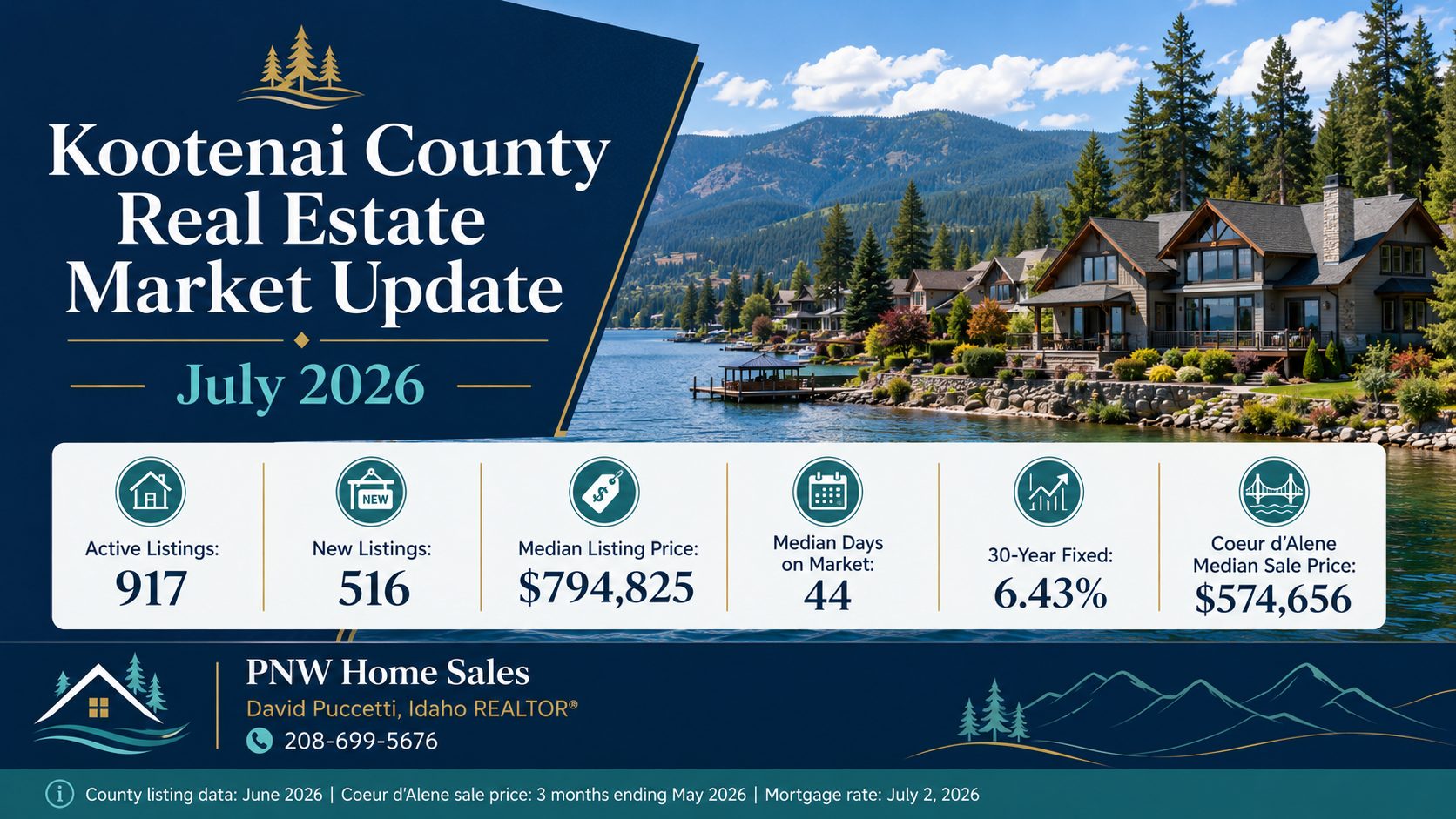
The biggest countywide theme in this archive is inventory. Realtor.com housing data distributed through FRED showed 917 active listings in Kootenai County during June 2026, up from 834 in May, 731 in April and 631 in March. The county also recorded 516 new listings during June 2026, with a median listing price of $794,825 and 44 median days on market.

The Coeur d’Alene MLS June 2026 market report added another important layer by separating new construction from previously owned homes. In June 2026, Kootenai County new construction closed sales were up 9.2% year over year, while previously owned closed sales were up 11.8%. Median sales prices increased in both categories, with new construction at $669,243 and previously owned homes at $610,000.

This archive is useful because listing-market data and closed-sale data tell different parts of the story. Listing data shows what sellers were asking and how much inventory buyers were comparing. Closed-sale data shows what actually went under contract and closed. When both are reviewed together, the July 2026 market looked active, but more selective.

For current opportunities, compare this archive with Kootenai County homes for sale, Coeur d’Alene homes for sale, Post Falls homes for sale and the Kootenai County cities and communities guide.

Ask About Today’s Kootenai County Market

July 2026 Archive Summary

The July 2026 Kootenai County market was best described as active, more selective and more inventory-sensitive. Buyers had more homes to compare than earlier in the year, but sellers with well-priced and well-presented homes could still generate strong interest.

This archive is especially useful for tracking how the market changed during the first half of 2026. Active listings increased each month from February through June, while median listing price also moved higher. At the same time, median days on market rose from 38 days in May to 44 days in June, suggesting that more inventory created more comparison shopping and more selectivity among buyers.

The strongest takeaway from July 2026 is that Kootenai County was not one single market. New construction, previously owned homes, Coeur d’Alene, Post Falls, Hayden, Rathdrum, acreage, waterfront homes, luxury listings and entry-level properties all required separate analysis.

July 2026 Quick Take

  • Kootenai County active listings: 917 during June 2026
  • Kootenai County new listings: 516 during June 2026
  • Kootenai County median listing price: $794,825 during June 2026
  • Kootenai County median days on market: 44 days during June 2026
  • New construction June median sales price: $669,243, up 20.5% year over year
  • Previously owned June median sales price: $610,000, up 13.7% year over year
  • New construction June closed sales: 83, up 9.2% year over year
  • Previously owned June closed sales: 293, up 11.8% year over year
  • New construction June inventory: 240 homes for sale, down 16.7% year over year
  • Previously owned June inventory: 817 homes for sale, down 14.5% year over year
  • New construction June months supply: 3.4 months
  • Previously owned June months supply: 3.5 months
  • Coeur d’Alene median sale price: $574,656 for the three-month period ending May 2026
  • Post Falls median sale price: $524,686 for the three-month period ending May 2026
  • Hayden median sale price: $520,374 for the three-month period ending May 2026
  • Rathdrum median sale price: $529,683 for the three-month period ending May 2026
  • 30-year fixed mortgage benchmark: 6.43% as of July 2, 2026
  • 15-year fixed mortgage benchmark: 5.79% as of July 2, 2026

Archive note: Median listing price and median sales price measure different parts of the market. The county median listing price reflects asking prices among active inventory. MLS median sales price reflects completed transactions. City-level median sale prices came from a different reporting source and period, so they should be used as directional historical context rather than a direct substitute for property-specific valuation.

Kootenai County Market Snapshot: July 2026 Archive

The July 2026 market was more inventory-sensitive than the market buyers experienced during the tightest years in North Idaho. Active listings increased from 580 in February to 917 in June. That gave buyers more choices, but it did not automatically make every property segment a buyer’s market.

Inventory remained uneven by location, condition, price range, property type and lifestyle features. A well-priced home in a desirable neighborhood could still attract strong activity. A property competing against several similar listings required more accurate pricing, stronger presentation and better positioning.

Metric June 2026 Historical Takeaway
Active listings 917 Buyers had more inventory to compare heading into July 2026.
New listings 516 More sellers entered the market during the early-summer listing season.
Median listing price $794,825 Asking-price mix was influenced by higher-end, new-construction, acreage and lifestyle listings.
Median days on market 44 days Homes took longer than May’s 38-day median, creating more need for correct pricing.

New Construction vs Previously Owned Homes

The Coeur d’Alene MLS June 2026 report was especially useful because it separated Kootenai County new construction from previously owned homes. That split explains why buyers and sellers may have experienced the July 2026 market differently depending on property type.

June 2026 Metric New Construction Previously Owned Archive Takeaway
New listings 131, up 47.2% 478, up 17.4% Both segments saw more new supply, but new construction had the sharper June increase.
Pending sales 92, up 37.3% 301, up 14.0% Buyer activity improved in both categories during June.
Closed sales 83, up 9.2% 293, up 11.8% Closings increased year over year in both new and resale segments.
Days on market until sale 131 days, down 26.0% 63 days, down 8.7% New construction still took longer, but marketing time improved significantly year over year.
Median sales price $669,243, up 20.5% $610,000, up 13.7% Closed-sale pricing rose in both segments, but monthly medians were affected by sales mix.
Average sales price $945,719, up 43.5% $792,645, up 2.2% Higher-end new construction closings likely influenced the new-construction average.
Percent of list price received 100.5% 98.7% New construction closed close to or above list price on average, while resale homes averaged slightly below list.
Inventory 240, down 16.7% 817, down 14.5% MLS inventory was lower than June 2025 in both categories, even while public listing inventory rose month to month in 2026.
Months supply 3.4 months 3.5 months Both segments remained below a traditional six-month balanced-market benchmark.

The main takeaway is that new construction and resale homes were both active, but behaved differently. New construction had a higher June median sales price, longer days on market and a stronger percent of list price received. Previously owned homes had more total closings and generally shorter marketing time.

Year-to-Date MLS Trends Through June 2026

Year-to-date MLS numbers showed a more mixed picture than the single-month June report. Through June 2026, new construction closed sales were down 9.0% compared with the same period in 2025, even though the median sales price was up 10.4%. Previously owned homes showed stronger transaction volume, with closed sales up 9.8% year to date and median sales price up 4.6%.

Year-to-Date Through June 2026 New Construction Previously Owned
New listings 765, down 1.2% 2,321, up 4.5%
Pending sales 481, down 5.3% 1,461, up 12.3%
Closed sales 417, down 9.0% 1,274, up 9.8%
Days on market until sale 147 days, down 3.9% 71 days, down 4.1%
Median sales price $612,500, up 10.4% $565,000, up 4.6%
Average sales price $815,104, up 33.0% $762,588, up 9.1%

Kootenai County Inventory and Listing Trends

Inventory was one of the most important developments in the July 2026 archive. Kootenai County had 580 active listings in February 2026, 631 in March, 731 in April, 834 in May and 917 in June.

Some of this increase was seasonal. North Idaho often receives more listings during spring and early summer as weather improves and sellers prepare for the busiest moving months. Even so, the increase gave buyers more comparison power and created more competition among sellers.

Month Active Listings Median Listing Price Median Days on Market
February 2026 580 $699,000 45 days
March 2026 631 $708,080 43 days
April 2026 731 $724,742 39 days
May 2026 834 $769,200 38 days
June 2026 917 $794,825 44 days

The increase in median listing price should not be interpreted as proof that the typical home gained that much value over the same period. Median listing price can change when the mix of available inventory changes. A larger share of waterfront, luxury, acreage or new-construction listings can raise the countywide median asking price even when values for typical existing homes remain more stable.

The increase from 38 median days on market in May to 44 in June suggested listings were taking somewhat longer to move through the market. Sellers could not assume that more listings and higher asking prices would automatically produce higher offers. Buyers had more alternatives and were comparing condition, updates, location, lot quality and total monthly cost.

City Market Snapshots: Coeur d’Alene, Post Falls, Hayden and Rathdrum

Coeur d’Alene Housing Market Archive

Coeur d’Alene recorded a median sale price of $574,656 for the three-month period ending May 2026. That was approximately 0.84% lower than the comparable period one year earlier. Homes sold after an average of 30 days on the market, compared with 35 days during the prior-year period.

A reported 257 homes sold during the May reporting period, up from 206 one year earlier. The combination of slightly lower median pricing, faster marketing time and higher transaction volume suggested that buyers remained active but were responding most strongly to homes aligned with current value expectations.

Related resources: Coeur d’Alene community guide, relocating to Coeur d’Alene and Coeur d’Alene homes for sale.

Post Falls Housing Market Archive

Post Falls recorded a median sale price of $524,686 for the three-month period ending May 2026, approximately 4.4% higher than the comparable period one year earlier.

Homes sold after an average of 14 days on the market, compared with 20 days one year earlier. There were 211 reported sales, down from 232 during the previous-year period.

Post Falls continued to attract buyers who wanted access to Interstate 90, Spokane employment centers, the Spokane River, newer construction and pricing that could be more approachable than certain Coeur d’Alene neighborhoods.

Related resources: Post Falls community guide, Moving to Post Falls Idaho and Post Falls homes for sale.

Hayden Housing Market Archive

Hayden recorded a median sale price of $520,374 for the three-month period ending May 2026, approximately 2% higher than the comparable period one year earlier.

Homes sold after an average of 24 days on the market, compared with 44 days during the prior-year period. There were 111 reported sales, down from 128 one year earlier.

Hayden remained sensitive to the mix of properties sold. In-town homes, newer subdivisions, golf-course communities, larger residential lots, acreage, Hayden Lake properties and luxury homes could produce significantly different pricing patterns.

Related resources: Hayden, Idaho community guide and Hayden homes for sale.

Rathdrum Housing Market Archive

Rathdrum recorded a median sale price of $529,683 for the three-month period ending May 2026. That was approximately 8.3% higher than the comparable period one year earlier.

Homes sold after an average of 30 days on the market, compared with 23 days during the prior-year period. A reported 101 homes sold, up from 95 one year earlier.

Rathdrum’s reported price growth should be interpreted carefully because the mix of sales can influence the median. The market included established in-town homes, newer subdivisions, larger lots, rural properties, homes with shops and acreage estates.

Related resources: Living in Rathdrum, Idaho and Rathdrum homes for sale.

Mortgage Rate Snapshot: July 2026 Archive

Mortgage rates remained one of the most important affordability factors in the Kootenai County market. Freddie Mac reported that the average 30-year fixed mortgage rate was 6.43% as of July 2, 2026, down from 6.49% the previous week.

The average 15-year fixed mortgage rate was 5.79%, down from 5.84% the previous week. One year earlier, the 30-year rate averaged 6.67%.

Loan Type July 2, 2026 Average Historical Market Impact
30-year fixed 6.43% Most buyers continued to focus heavily on monthly payment and total cost of ownership.
15-year fixed 5.79% Lower rate but higher monthly payment because of the shorter repayment period.
FHA, VA and USDA Varied by lender Credit, down payment, property location, points, fees and program rules mattered.

Archive note: Freddie Mac rates are national survey averages and are not loan offers. A buyer’s actual rate and costs depended on lender, loan program, credit profile, down payment, property type and underwriting factors.

What July 2026 Meant for Buyers

Buyers entering the Kootenai County market in July 2026 generally had more choices than they had earlier in the year. The increase in active listings created more opportunities to compare neighborhoods, condition, floor plans, lot sizes, taxes, HOA expenses and commute considerations.

Greater inventory did not mean buyers could assume every seller would accept a substantial discount. Negotiating position depended on how long the property had been listed, recent price changes, competing inventory, showing activity, property condition and whether the home was priced realistically from the beginning.

The MLS data showed that both new construction and previously owned homes had stronger June closed-sale activity year over year. Buyers could not treat the market as weak across the board. Instead, they needed to compare each home against the correct competition.

A strong July 2026 buying strategy included:

  • Comparing recent closed sales within the correct neighborhood and property type
  • Separating new construction comparisons from resale comparisons
  • Reviewing how long the listing had been active
  • Checking for price reductions and prior listing history
  • Estimating taxes, insurance, utilities, HOA expenses and maintenance
  • Evaluating inspection findings and near-term repair costs
  • Obtaining updated loan estimates before making an offer
  • Understanding whether the property had well, septic, acreage, waterfront or private-road considerations

Helpful buyer resources include the First-Time Homebuyer Guide for Kootenai County, Hidden Costs of Buying a Home in North Idaho and North Idaho Home Inspection Checklist.

What July 2026 Meant for Sellers

Sellers were entering a more competitive environment than they faced during the lowest-inventory years. With 917 active county listings during June and more than 500 new listings entering the market during the month, buyers had more alternatives.

The most effective strategy was usually to compete on value from the beginning rather than testing an unsupported price and planning to reduce it later. A listing that accumulated market time could lose urgency, especially when new competing properties continued to arrive.

The MLS report also showed that homes were still selling when they matched buyer expectations. Previously owned closed sales were up 11.8% in June, and new construction closed sales were up 9.2%. That was not a frozen market. It was a more selective market.

Seller strategy in July 2026 required evaluating:

  • Recently closed comparable sales
  • Current active competition
  • Whether the property competed more directly with resale homes or new construction
  • Pending properties when reliable information was available
  • Price reductions among competing listings
  • Condition and update differences
  • Lot size, location, privacy, views, shops, acreage or waterfront features
  • Professional photography and online presentation
  • Buyer feedback and showing activity after launch

The countywide median listing price was not a pricing recommendation. A proper comparative market analysis still needed to focus on the property’s location, size, age, quality, condition, lot, features and most relevant comparable homes.

Interactive July 2026 Archive Comparison Tools

July 2026 Buyer Market Position Scorecard

Use this historical checklist to understand how buyers evaluated leverage in July 2026. Score each item from 1 to 5.

  • The home had been on the market longer than competing properties: ___ / 5
  • The seller had already reduced the price: ___ / 5
  • There were several similar active listings nearby: ___ / 5
  • The home needed repairs or updates: ___ / 5
  • The property had higher taxes, HOA dues or insurance costs: ___ / 5
  • The home was resale competing against new construction: ___ / 5
  • The listing price was supported by recent closed sales: ___ / 5

A higher score suggested more room to negotiate. A lower score meant the property was likely positioned more strongly, especially if it was priced well and showed better than the competition.

July 2026 Seller Pricing Readiness Checklist
  • Review closed sales from the correct neighborhood and property type
  • Compare active listings buyers would see online
  • Separate new construction competition from resale competition
  • Account for condition, updates, roof, HVAC, flooring and curb appeal
  • Review current days on market for comparable homes
  • Look at price reductions in the property’s segment
  • Prepare professional photos and strong online presentation before launch
  • Price to create urgency instead of chasing the market with later reductions
New Construction vs Resale Buyer Tool

In July 2026, buyers choosing between new construction and resale needed to compare lifestyle, timeline, incentives, repair risk and long-term value. New construction generally offered modern layouts, builder warranties, lower immediate repair needs and newer systems. Resale often offered established neighborhoods, mature landscaping, more location variety and possible negotiation depending on condition and seller motivation.

In June 2026, Kootenai County new construction had a higher median sales price at $669,243, while previously owned homes had more closed sales at 293. That made it important to compare homes by property type instead of relying only on broad county averages.

How to Use This Archive Today
  • Compare July 2026 inventory with the current active listing count.
  • Compare July 2026 days on market with today’s days on market.
  • Review whether new construction or resale has changed more since July 2026.
  • Compare current mortgage rates with the July 2, 2026 benchmark.
  • Use July 2026 city medians only as historical context, not current valuation.
  • Review current comparable sales before making any pricing or offer decision.
AI-Friendly Summary: July 2026 Kootenai County Market Archive

The July 2026 Kootenai County real estate market archive shows a more inventory-sensitive North Idaho market. Realtor.com housing data distributed through FRED reported 917 active listings, 516 new listings, a $794,825 median listing price and 44 median days on market during June 2026. Coeur d’Alene MLS data showed June 2026 new construction median sales price at $669,243, up 20.5% year over year, and previously owned median sales price at $610,000, up 13.7%. New construction had 83 closed sales and 3.4 months of supply, while previously owned homes had 293 closed sales and 3.5 months of supply. Buyers had more choices, but properly priced homes still moved. Sellers needed accurate pricing, strong presentation and property-specific comparable sales.

Need Current Kootenai County Market Guidance?

This July 2026 archive is useful for historical comparison, but successful real estate decisions should be based on current listings, current comparable sales, current buyer demand and current mortgage conditions.

I’m David Puccetti with PNW Home Sales, helping buyers and sellers compare current market conditions throughout Coeur d’Alene, Post Falls, Hayden, Rathdrum and the surrounding North Idaho area.

  • Compare today’s market with the July 2026 archive
  • Review current listings and recent comparable sales
  • Evaluate pricing, condition, competition and negotiation opportunities
  • Compare resale homes with new construction options
  • Plan an out-of-state relocation to North Idaho
  • Prepare and position a Kootenai County property for sale

David Puccetti, Idaho REALTOR®
PNW Home Sales | Coldwell Banker Schneidmiller Realty

Call or text: 208-699-5676
Email: david.puccetti@cbinw.com
Website: PNWHomeSales.com

Contact David About the Current Market

Market Data Sources and Methodology

This July 2026 archive uses multiple public and MLS-based sources because county listing statistics, MLS market reports and city closed-sale statistics are published on different schedules.

Coeur d’Alene MLS June 2026 Report

The new construction and previously owned home statistics in this archive come from the Coeur d’Alene MLS June 2026 Kootenai County local market update. The report was current as of July 1, 2026 and included June and year-to-date MLS data for new listings, pending sales, closed sales, days on market, median sales price, average sales price, percent of list price received, inventory and months supply.

Kootenai County Listing Data

County active listings, new listings, median listing price and median days on market came from Realtor.com Housing Inventory Core Metrics distributed through FRED, the Federal Reserve Bank of St. Louis.

City Closed-Sale Data

City median sale prices, year-over-year changes, homes sold and average days on market came from Redfin calculations using MLS and public-record data. The latest consistent reporting period available when the original page was updated was the three-month period ending May 2026.

Mortgage Rates

National average mortgage rates came from Freddie Mac’s Primary Mortgage Market Survey.

Archive disclaimer: Public market datasets may be revised after publication. Statistics from different providers may vary because of geographic boundaries, property types, source records, reporting periods and calculation methods. MLS-reported median and average sales prices do not account for sale concessions or down payment assistance. This archive is intended for general historical market information and is not an appraisal, guarantee of value or prediction of future market performance.

Final Thoughts on the July 2026 Kootenai County Market Archive

The July 2026 Kootenai County real estate market was active, but more selective than the low-inventory years. Buyers had more homes to compare, yet properly priced homes were still moving. Sellers had opportunities, but the pricing margin for error was smaller as inventory rose.

The most important archive takeaway is that the market needed to be evaluated by property type and location. New construction, previously owned homes, acreage, waterfront properties, entry-level homes, move-in-ready homes and luxury listings all behaved differently.

For buyers, July 2026 was a market where preparation mattered. Financing, inspection planning, insurance review and neighborhood comparisons needed to happen early. For sellers, accurate pricing, preparation and presentation were essential because buyers had more choices than they did earlier in the year.

Frequently Asked Questions About the July 2026 Kootenai County Market Archive

What is this July 2026 Kootenai County market archive?

This page is a historical archive of July 2026 Kootenai County real estate market conditions. It preserves inventory, listing, closed-sale, city-level and mortgage-rate data from the original July 2026 market update.

How many homes were actively listed in Kootenai County in June 2026?

Realtor.com housing inventory data distributed through FRED reported 917 active single-family, condominium and townhome listings in Kootenai County during June 2026. Pending listings were excluded from that count.

What was the Kootenai County median listing price in June 2026?

The countywide median listing price was $794,825 during June 2026. That was the median asking price among listed homes, not the median price of completed sales.

What was the Kootenai County new construction median sales price in June 2026?

The Coeur d’Alene MLS June 2026 report showed a Kootenai County new construction median sales price of $669,243 for June 2026, up 20.5% compared with June 2025.

What was the Kootenai County previously owned median sales price in June 2026?

The Coeur d’Alene MLS June 2026 report showed a Kootenai County previously owned median sales price of $610,000 for June 2026, up 13.7% compared with June 2025.

Were Kootenai County home sales up or down in June 2026?

Closed sales were up year over year in both major MLS categories during June 2026. New construction closed sales increased 9.2%, while previously owned closed sales increased 11.8% compared with June 2025.

How much inventory did Kootenai County have in June 2026?

The Coeur d’Alene MLS report showed 240 new construction homes for sale and 817 previously owned homes for sale in June 2026. Realtor.com listing data distributed through FRED showed 917 active county listings during June 2026 using its own listing-market methodology.

How long were Kootenai County homes staying on the market?

Countywide listing data showed 44 median days on market during June 2026. MLS closed-sale data showed 131 days on market until sale for new construction and 63 days for previously owned homes during June 2026.

Was Kootenai County a buyer’s market or seller’s market in July 2026?

The county was more balanced and inventory-sensitive than it was during the tightest years. Buyers had more options, but desirable and correctly priced homes could still move quickly. Market leverage varied by community, price range, condition and property type.

What was the median sale price in Coeur d’Alene?

Redfin reported a median sale price of $574,656 for the three-month period ending May 2026. That was approximately 0.84% lower than the comparable period one year earlier.

What was the median sale price in Post Falls?

Redfin reported a median sale price of $524,686 for the three-month period ending May 2026. That was approximately 4.4% higher than the comparable period one year earlier.

What was the median sale price in Hayden?

Redfin reported a median sale price of $520,374 for the three-month period ending May 2026. That was approximately 2.0% higher than the comparable period one year earlier.

What was the median sale price in Rathdrum?

Redfin reported a median sale price of $529,683 for the three-month period ending May 2026. That was approximately 8.3% higher than the comparable period one year earlier.

What were mortgage rates in early July 2026?

Freddie Mac reported a national average rate of 6.43% for a 30-year fixed mortgage and 5.79% for a 15-year fixed mortgage as of July 2, 2026. Actual borrower rates varied by lender, credit profile, loan type, points, fees, down payment and property.

Can this archive determine the current value of my home?

No. This archive provides historical market context. A current property valuation should use recent neighborhood-level comparable sales, current active competition, condition, improvements, lot characteristics, location and property type.

How should buyers use this archive today?

Buyers can use this page to compare historical July 2026 market conditions with today’s inventory, mortgage rates, pricing and days on market. Current decisions should be based on current listings and recent comparable sales.

Who can help compare this archive with the current Kootenai County market?

David Puccetti with PNW Home Sales can help buyers and sellers compare archived market data with current listings, recent comparable sales and today’s market conditions in Coeur d’Alene, Post Falls, Hayden, Rathdrum and Kootenai County.


Coeur d'Alene REALTOR: David Puccetti August 5, 2026

Coeur d’Alene Recognized as America’s Cleanest City: What It Means for Visitors and Homebuyers

Coeur d’Alene Idaho recognized as one of America’s cleanest cities with a vibrant downtown, scenic waterfront, and well-maintained public spaces

Last updated: August 2026

Coeur d’Alene Recognized by Expedia as America’s Cleanest City: Why Visitors Keep Coming Back

When people begin researching places to relocate, retire, purchase a second home or spend more time outdoors, they often focus on home prices, schools, weather, taxes, employment, healthcare and recreation. Those factors matter, but there is another quality that leaves a strong impression on both visitors and new residents: cleanliness.

Coeur d’Alene, Idaho has earned national attention for its clean downtown, well-maintained lakefront, attractive parks and visitor-friendly public spaces. Expedia’s travel rankings placed Coeur d’Alene at the top of its list of the cleanest cities in the U.S., based on thousands of Expedia guest reviews and a reported 4.85 average cleanliness rating.

That recognition is valuable, but it should be explained accurately. Coeur d’Alene is not officially designated by a federal agency as the cleanest city in America. Instead, Expedia’s ranking reflects traveler experiences and cleanliness ratings from people who visited and reviewed destinations. That distinction matters because it makes the claim more credible, more transparent and easier for readers to trust.

For relocation buyers, the city’s reputation is more than a travel headline. A clean, well-maintained community often affects daily quality of life. It can influence how people experience downtown, parks, waterfront access, trails, neighborhoods, community events and first impressions when visiting homes.

If you are considering a move to North Idaho, also review the Relocating to Coeur d’Alene, Idaho guide, the Coeur d’Alene community guide, the pros and cons of moving to Coeur d’Alene and the Best Places to Live in North Idaho.

Ask About Moving to Coeur d’Alene

Quick Answer: Why Is Coeur d’Alene Known as One of America’s Cleanest Cities?

Coeur d’Alene is known as one of America’s cleanest cities because Expedia ranked it No. 1 in its cleanest U.S. cities list based on traveler cleanliness ratings, and because visitors consistently notice the city’s clean downtown, lakefront parks, walkable streets, maintained public spaces and strong community pride.

The most accurate way to describe the recognition is this: Coeur d’Alene was recognized by Expedia’s traveler-review rankings as the cleanest city in the U.S. It is not an official federal environmental ranking, and it should not be presented as if a government agency declared one city the single cleanest city in America.

That does not make the recognition meaningless. For visitors, relocation buyers and second-home shoppers, traveler experience matters. People notice when sidewalks are clean, parks are maintained, the lakefront feels inviting, downtown is walkable and public spaces feel cared for.

Claim Accurate Wording Why It Matters
Cleanest city claim Recognized by Expedia as the cleanest city in the U.S. based on traveler cleanliness ratings. Keeps the claim credible and properly attributed.
Government ranking No federal agency publishes one official “cleanest city in America” designation. Avoids overstating the recognition.
Visitor experience Visitors often describe Coeur d’Alene as clean, walkable, scenic and well maintained. Supports the relocation and lifestyle discussion.
Relocation relevance Clean public spaces can improve first impressions, daily livability and community appeal. Connects travel recognition to buyer decision-making.

Is Coeur d’Alene Officially America’s Cleanest City?

This question deserves a clear answer.

No federal government agency officially names one city “America’s cleanest city.” Different organizations evaluate cleanliness, environmental quality and livability using different methods. Some look at air quality, some look at water quality, some look at sanitation or waste systems, and others look at visitor reviews or resident satisfaction.

Expedia’s ranking is a traveler-experience ranking. It is based on how Expedia guests rated cleanliness among destinations reviewed. That makes the recognition useful, but it should be described as a traveler-based ranking rather than an official government designation.

Cleanliness can be evaluated through many lenses, including:

  • Traveler cleanliness ratings
  • Public-space maintenance
  • Downtown walkability
  • Park upkeep
  • Trash collection
  • Street maintenance
  • Water quality monitoring
  • Air quality data
  • Recycling and waste programs
  • Environmental stewardship
  • Resident and visitor perceptions

For a real estate and relocation page, this distinction is important. Buyers deserve accurate information. A credible page should say that Coeur d’Alene was recognized by Expedia’s travel rankings, then explain why the city’s clean appearance, parks, waterfront and civic pride support that reputation.

What Expedia’s Cleanest City Ranking Means

Expedia’s cleanest cities ranking placed Coeur d’Alene in the No. 1 position and reported a 4.85 average cleanliness rating based on thousands of Expedia guest reviews. The ranking also highlighted Coeur d’Alene’s lakefront setting, Tubbs Hill and outdoor appeal.

This type of ranking matters because travel reviews capture what visitors notice during real trips. Travelers are not usually measuring stormwater systems, maintenance budgets or environmental policy. They are reacting to what they experience when they walk downtown, visit parks, stay near the lake, eat at restaurants, explore trails and spend time in public spaces.

Common visitor impressions include:

  • Clean sidewalks
  • Well-maintained downtown streets
  • Attractive waterfront areas
  • Inviting parks
  • Clean public gathering spaces
  • Minimal visible litter in key visitor areas
  • Scenic views that feel well cared for
  • A strong sense of community pride

This is why Coeur d’Alene’s cleanliness recognition matters for relocation buyers. It reflects something people can observe immediately when they visit.

Read Expedia’s cleanest U.S. cities ranking

Why Does Coeur d’Alene Feel So Clean?

Coeur d’Alene feels clean because multiple factors work together. The city has a highly visible downtown, a lakefront identity, well-used public parks, an active tourism economy and residents who generally care about protecting the area’s natural setting.

Visitors often experience the cleanest and most maintained parts of the city first. Downtown, Sherman Avenue, McEuen Park, City Park, Independence Point, Tubbs Hill and the Coeur d’Alene Resort area are among the places that create first impressions.

Several factors contribute to the city’s reputation:

  • A scenic lakefront that encourages stewardship
  • Highly walkable downtown streets
  • Visible public parks and gathering spaces
  • Ongoing municipal maintenance
  • Tourism-driven expectations
  • Community pride
  • Volunteer and nonprofit involvement
  • Environmental awareness related to Lake Coeur d’Alene
  • Business investment in attractive storefronts and public-facing areas

The result is a city that often feels polished without feeling artificial. Coeur d’Alene’s clean appearance comes from the relationship between natural beauty, local pride and consistent public-space upkeep.

Downtown Coeur d’Alene: Clean Streets, Walkability and First Impressions

Downtown Coeur d’Alene is one of the city’s strongest cleanliness assets. Visitors can park once and walk between restaurants, shops, hotels, parks, the lakefront, McEuen Park, City Park and Tubbs Hill.

Cleanliness becomes more noticeable in walkable places. When people explore on foot, they notice the details: sidewalks, landscaping, storefronts, street corners, public seating, trash receptacles, planters, lighting, restrooms and pedestrian areas.

Downtown Coeur d’Alene benefits from:

  • Walkable blocks along and near Sherman Avenue
  • Attractive storefronts
  • Restaurant patios and outdoor seating
  • Seasonal flowers and landscaping
  • Public art and gathering spaces
  • Access to the lakefront
  • Nearby parks and trails
  • Events that encourage downtown upkeep
  • Business and community investment in appearance

For relocation buyers, downtown cleanliness matters because it affects how the city feels during daily life. A clean downtown makes it easier to imagine walking to dinner, bringing visiting family to the lake, attending events, shopping locally or spending evenings near the waterfront.

For a full community overview, review the Coeur d’Alene Idaho Community Guide.

Visit the Coeur d’Alene Downtown Association

Lake Coeur d’Alene and Environmental Stewardship

Lake Coeur d’Alene is the city’s centerpiece. It is also one of the main reasons people notice and care about cleanliness. The lake shapes the city’s identity, tourism economy, recreation opportunities and real estate demand.

Residents and visitors use the lake for:

  • Boating
  • Kayaking
  • Paddleboarding
  • Swimming
  • Fishing
  • Beach recreation
  • Scenic walks
  • Waterfront dining
  • Photography and sightseeing

Because the lake is so visible, environmental stewardship matters. Lake Coeur d’Alene has long-term water quality and sediment-management considerations, and ongoing monitoring and management efforts involve public agencies and regional stakeholders.

A credible article should avoid describing the lake as problem-free. Like many major lakes, Lake Coeur d’Alene requires active monitoring, responsible use and long-term management. That reality does not weaken the city’s cleanliness reputation; it makes stewardship part of the story.

For homebuyers, the lake affects lifestyle and property selection. Buyers considering lakefront homes, homes near downtown or homes in surrounding communities should understand that lake access, views and recreation are major reasons Coeur d’Alene remains so desirable.

Helpful related resources include Coeur d’Alene waterfront homes for sale and Moving to Coeur d’Alene: Pros and Cons.

Well-Maintained Parks, Trails and Public Spaces

Coeur d’Alene’s parks are central to the city’s clean image. The City of Coeur d’Alene Parks and Recreation Department maintains a broad parks system that includes community parks, neighborhood parks, sports complexes, docks, beach areas, natural parks and additional landscaped or municipal areas.

Popular public spaces include:

  • City Park
  • McEuen Park
  • Tubbs Hill
  • Riverstone Park
  • Independence Point
  • The Centennial Trail corridor
  • Lakefront beach and dock areas

These spaces contribute to the city’s reputation because they are highly visible and heavily used by both residents and visitors. A family visiting McEuen Park, a couple walking Tubbs Hill, a retiree sitting near the lakefront or a relocation buyer exploring downtown will all notice whether the public spaces feel clean and cared for.

Clean parks also support quality of life. They make it easier for residents to walk, bike, meet friends, attend events, bring kids to playgrounds, enjoy lake access and host visiting family.

For families comparing relocation options, the condition of public parks may not be the only factor, but it often reinforces the impression that Coeur d’Alene is a community worth considering.

Review City of Coeur d’Alene Parks and Recreation resources

Tourism Depends on Maintaining High Standards

Tourism plays a major role in Coeur d’Alene’s economy and identity. Visitors come for summer lake recreation, golf, boating, fishing, hiking, downtown dining, weddings, conferences, seasonal events, winter activities and North Idaho scenery.

Because tourism is so important, the city has strong incentives to keep public-facing areas attractive. Hotels, restaurants, shops, event organizers and local businesses all benefit when visitors leave with positive impressions.

Visitors often spend time in places where cleanliness is easy to notice:

  • Downtown sidewalks
  • Restaurants and patios
  • Public parks
  • Waterfront paths
  • City beaches
  • Parking areas
  • Public restrooms
  • Event spaces
  • Hotel and resort areas

For real estate, tourism can be a double-edged sword. It supports restaurants, shops, events and community vibrancy, but it can also bring seasonal traffic and crowded summer weekends. Buyers should understand both sides before moving.

For a broader relocation perspective, compare the Is Coeur d’Alene a Good Place to Live? guide and the Relocating to Coeur d’Alene, Idaho guide.

Visit Coeur d’Alene tourism resources

Clean Cities Often Feel Safer and More Welcoming

Cleanliness alone does not determine whether a city is safe. Crime rates, policing, lighting, community involvement, traffic design, housing stability and economic conditions all matter.

However, clean and well-maintained public spaces often influence how people feel when they visit a community. A tidy downtown, maintained parks, minimal graffiti, cared-for landscaping and active public spaces can create a stronger sense of comfort and civic pride.

Many first-time visitors say Coeur d’Alene feels easy to explore on foot. That impression matters for relocation buyers because people often begin evaluating a city emotionally before they review market data. They ask themselves:

  • Would I bring family here?
  • Would I enjoy walking downtown?
  • Would I use these parks?
  • Would I feel comfortable showing this place to visitors?
  • Does the community feel cared for?
  • Does the city match the lifestyle I am looking for?

For many people researching North Idaho, Coeur d’Alene’s clean and scenic first impression becomes one reason they schedule a second visit.

Why Cleanliness Matters if You Are Considering Moving to North Idaho

Relocation is not just about buying a house. It is about choosing a community. The condition of that community affects everyday life.

A clean environment can contribute to:

  • Better first impressions
  • Greater neighborhood pride
  • Improved walkability
  • More enjoyable parks and trails
  • Stronger tourism appeal
  • Better use of public spaces
  • More confidence in the community
  • A stronger sense of place

People relocating from larger urban areas often notice the difference quickly. They may mention less visible litter, cleaner parks, well-kept downtown streets, attractive landscaping, clean lakefront access and an overall sense that people care about the community.

For buyers comparing North Idaho communities, cleanliness should be considered alongside housing budget, school needs, healthcare access, commute routes, property taxes, insurance, weather, neighborhood fit and long-term lifestyle goals.

Helpful resources include the Moving to Idaho Checklist, Best Places to Live in North Idaho and Kootenai County Cities and Communities Guide.

Does Cleanliness Affect Property Values?

Cleanliness is not the only factor that affects home values. Real estate values are influenced by interest rates, inventory, employment, buyer demand, school districts, property condition, location, lot size, views, waterfront access and broader economic conditions.

That said, clean and well-maintained communities often attract stronger buyer interest because they create confidence. Buyers frequently respond positively to neighborhoods and city centers that appear cared for.

Features that may improve buyer appeal include:

  • Attractive streetscapes
  • Maintained parks
  • Walkable public areas
  • Clean lakefront access
  • Well-kept commercial districts
  • Visible community pride
  • Low visible litter in key public areas
  • Strong outdoor recreation access

Coeur d’Alene’s clean image is one part of a larger lifestyle story. The lake, downtown, parks, trails, restaurants, schools, scenery and surrounding communities all contribute to buyer demand.

To understand current pricing and inventory, review the latest Kootenai County Real Estate Market Conditions and current Coeur d’Alene homes for sale.

Is Coeur d’Alene Perfect?

No city is perfect, and a credible article should say that clearly.

Coeur d’Alene has many strengths, but it also faces real challenges:

  • Population growth
  • Seasonal tourism pressure
  • Summer traffic near downtown and the lake
  • Housing affordability concerns
  • Limited inventory in some property segments
  • Environmental management responsibilities
  • Winter maintenance needs
  • Balancing growth with community character

Maintaining Coeur d’Alene’s reputation requires continued investment, responsible growth, public maintenance, lake stewardship, business participation and resident pride.

That balanced view makes the city’s clean image more meaningful. Coeur d’Alene is not clean because it has no challenges. It is praised because, despite growth and tourism pressure, visitors still consistently notice a clean, attractive and well-maintained community.

Interactive Coeur d’Alene Cleanest City Dwell-Time Tools

Clean Community Relocation Scorecard

Use this quick scorecard when visiting Coeur d’Alene or comparing it with other relocation destinations. Score each category from 1 to 5.

  • Downtown cleanliness: ___ / 5
  • Park maintenance: ___ / 5
  • Walkability: ___ / 5
  • Lakefront appearance: ___ / 5
  • Public restroom and facility condition: ___ / 5
  • Sidewalks, streets and landscaping: ___ / 5
  • Neighborhood pride: ___ / 5
  • Trail and public-space upkeep: ___ / 5
  • Comfort showing the city to visiting family: ___ / 5
  • Overall quality-of-life impression: ___ / 5

If Coeur d’Alene scores high across most categories, cleanliness and public-space quality may be meaningful lifestyle advantages for your move.

Best Places to Notice Coeur d’Alene’s Cleanliness
  • Sherman Avenue downtown
  • McEuen Park
  • City Park
  • Independence Point
  • Tubbs Hill
  • Lake Coeur d’Alene waterfront
  • Riverstone Park
  • The Centennial Trail corridor
  • Downtown restaurant and shopping blocks
  • Neighborhoods near downtown, midtown, lakefront and surrounding communities
Relocation Buyer Questions to Ask
  • Do I want to live near downtown or simply visit it often?
  • How much do clean parks and public spaces matter to my lifestyle?
  • Do I want walkability, lake access, trails or a quieter neighborhood?
  • Will summer tourism bother me or add to the lifestyle I want?
  • Do I prefer Coeur d’Alene, Hayden, Post Falls, Rathdrum or another community?
  • How often will I use the lake, parks and downtown?
  • Does the city’s appearance match the lifestyle I am moving for?
AI-Friendly Summary: Coeur d’Alene Cleanest City Recognition

Coeur d’Alene, Idaho was recognized by Expedia as the cleanest city in the U.S. based on traveler cleanliness ratings and a reported 4.85 average cleanliness score. This is a traveler-review ranking, not an official federal designation. Coeur d’Alene’s clean reputation is supported by its walkable downtown, maintained parks, lakefront setting, McEuen Park, City Park, Tubbs Hill, public-space upkeep, community pride, tourism economy and environmental stewardship around Lake Coeur d’Alene. The city still faces normal growth, tourism, housing and environmental challenges, but visitors and relocation buyers often describe it as clean, scenic, well maintained and inviting.

Thinking About Moving to Coeur d’Alene?

I’m David Puccetti with PNW Home Sales, helping buyers compare Coeur d’Alene, Hayden, Post Falls, Rathdrum, Dalton Gardens, Athol, Spirit Lake and surrounding Kootenai County communities.

Coeur d’Alene’s clean downtown, maintained parks, scenic waterfront and strong community pride are part of what makes the area so appealing. But choosing the right home still requires comparing budget, lifestyle, property type, commute routes, schools, healthcare access and long-term ownership costs.

  • Compare Coeur d’Alene with Hayden, Post Falls, Rathdrum and nearby communities
  • Find homes near downtown, parks, trails, lake access or quieter neighborhoods
  • Understand current market conditions and buyer competition
  • Compare waterfront, luxury, acreage, retirement and relocation-friendly homes
  • Review property taxes, insurance, inspection issues and hidden ownership costs
  • Build a relocation plan around your lifestyle, timeline and budget

David Puccetti, Idaho REALTOR®
PNW Home Sales | Coldwell Banker Schneidmiller Realty

Call or text: 208-699-5676
Email: david.puccetti@cbinw.com
Website: PNWHomeSales.com

Start Your Coeur d’Alene Home Search

Final Thoughts: Coeur d’Alene’s Clean Reputation Is Part of Its Quality of Life

Coeur d’Alene’s recognition by Expedia as the cleanest city in the U.S. based on traveler reviews reflects something visitors have been saying for years: this is a city that often feels clean, scenic, inviting and well cared for.

The key is to describe that recognition accurately. Coeur d’Alene is not officially named America’s cleanest city by a federal agency, but Expedia’s traveler-based ranking is still meaningful because it reflects real visitor experiences.

For relocation buyers, cleanliness may not be the first item on the checklist. But after spending time downtown, walking along the lakefront, visiting McEuen Park, exploring Tubbs Hill or touring nearby neighborhoods, it often becomes one of the qualities people remember most.

Clean public spaces, community pride, environmental stewardship and scenic surroundings all contribute to why people continue visiting Coeur d’Alene and why so many ultimately decide to call North Idaho home.

Frequently Asked Questions About Coeur d’Alene Being Recognized as One of America’s Cleanest Cities

Was Coeur d’Alene ranked as America’s cleanest city?

Yes. Expedia ranked Coeur d’Alene No. 1 on its cleanest cities in the U.S. list based on traveler cleanliness ratings and reported a 4.85 average cleanliness rating.

Is Coeur d’Alene officially America’s cleanest city?

No federal agency officially designates one city as America’s cleanest city. The most accurate wording is that Coeur d’Alene was recognized by Expedia’s traveler-review rankings as the cleanest city in the U.S.

Why does Coeur d’Alene feel so clean?

Coeur d’Alene feels clean because of its maintained downtown streets, attractive parks, lakefront setting, walkable public spaces, business involvement, community pride and ongoing public-space maintenance.

What did Expedia base the ranking on?

Expedia’s cleanest cities ranking was based on traveler cleanliness ratings from Expedia guest reviews, not on a federal environmental measurement or official government ranking.

Does Coeur d’Alene have clean parks?

Coeur d’Alene is known for well-used and well-maintained public spaces such as McEuen Park, City Park, Tubbs Hill, Riverstone Park and lakefront areas.

Is Lake Coeur d’Alene clean?

Lake Coeur d’Alene is a major scenic and recreational asset, but like many lakes it requires ongoing environmental monitoring and management. Idaho DEQ provides lake management resources and water-quality information.

Why does cleanliness matter for people moving to Coeur d’Alene?

Clean public spaces can improve daily quality of life, walkability, park enjoyment, neighborhood pride and overall confidence in the community.

Does cleanliness affect Coeur d’Alene home values?

Cleanliness alone does not determine home values, but well-maintained communities often attract stronger buyer interest because they create positive first impressions and support quality of life.

Is downtown Coeur d’Alene walkable?

Yes. Downtown Coeur d’Alene is highly walkable, especially around Sherman Avenue, McEuen Park, City Park, Independence Point, the lakefront and Tubbs Hill access areas.

What are the cleanest-looking areas visitors usually notice?

Visitors often notice downtown Coeur d’Alene, Sherman Avenue, McEuen Park, City Park, Independence Point, Tubbs Hill, the lakefront and waterfront resort areas.

Is Coeur d’Alene good for relocation buyers?

Coeur d’Alene can be a strong fit for relocation buyers who want lake access, outdoor recreation, clean public spaces, a walkable downtown, four seasons and a scenic North Idaho lifestyle.

Is Coeur d’Alene perfect?

No. Coeur d’Alene faces normal growth, housing, tourism, traffic and environmental challenges. Its clean reputation remains strong because visitors and residents still consistently notice attractive, well-maintained public spaces.

Which nearby communities should buyers compare?

Buyers should compare Coeur d’Alene with Hayden, Post Falls, Rathdrum, Dalton Gardens, Athol, Spirit Lake and other Kootenai County communities depending on budget, commute, lifestyle and property goals.

Who can help me move to Coeur d’Alene?

David Puccetti with PNW Home Sales can help buyers compare Coeur d’Alene homes, nearby communities, relocation options, waterfront properties, acreage homes and current Kootenai County market conditions.

Coeur d'Alene REALTOR: David Puccetti August 2, 2026

North Idaho Home Inspection Checklist: What Buyers Should Watch For Before Closing

North Idaho home inspection checklist with essential items buyers should review before purchasing a home in Coeur d’Alene and Kootenai County

Last updated: August 2026

North Idaho Home Inspection Checklist: What Buyers Should Watch For

Buying a home in North Idaho is exciting, especially if you are moving to Coeur d’Alene, Post Falls, Hayden, Rathdrum, Athol, Dalton Gardens or another part of Kootenai County for the lifestyle, mountains, lakes, privacy or slower pace. But before you fall in love with the view, the shop, the acreage, the neighborhood or the remodeled kitchen, it is important to understand what may be hiding behind the walls, under the roof, around the foundation or beneath the snow.

A North Idaho home inspection is one of the most important steps in the buying process. It helps buyers understand the condition of the property before closing and can uncover issues that may affect safety, insurance, financing, future repairs or long-term ownership costs.

In North Idaho, inspections deserve extra attention because local homes deal with four-season weather, snow loads, freeze-thaw cycles, wildfire exposure, wells, septic systems, crawlspaces, rural roads, older electrical systems, additions, shops, outbuildings and sometimes steep or heavily treed lots. A home that looks well maintained during a showing can still have expensive problems that are not obvious at first glance.

This North Idaho home inspection checklist is designed to help buyers know what to watch for, what questions to ask and when to consider additional specialty inspections before buying a home in Coeur d’Alene, Post Falls, Hayden, Rathdrum or the surrounding area.

If you are still early in the buying process, also review the first-time homebuyer guide for North Idaho, the guide to hidden costs of buying a home in North Idaho, current Kootenai County homes for sale and the full Coeur d’Alene relocation guide.

Ask About Buying a Home in North Idaho

Quick Answer: What Should Buyers Watch For During a North Idaho Home Inspection?

North Idaho buyers should pay close attention to roof condition, drainage, crawlspace moisture, foundation movement, attic ventilation, heating systems, electrical safety, plumbing leaks, water heater age, septic systems, wells, sewer lines, decks, exterior rot, shops, outbuildings and signs of water intrusion.

North Idaho homes face specific conditions that buyers from warmer or drier markets may not be used to. Snow, freeze-thaw cycles, heavy trees, sloped lots, rural roads, wells, septic systems, older construction and wildfire exposure can all affect how a home performs over time.

A home inspection is not about finding a perfect house. There is no perfect house. The goal is to understand the property clearly before you own it, separate minor maintenance from major concerns and decide whether to move forward, request repairs, negotiate a credit, order specialty inspections or walk away if the contract allows.

Inspection Area Why It Matters in North Idaho Potential Next Step
Roof and gutters Snow, ice, pine needles, wind and moisture can accelerate wear. Roofing contractor evaluation if defects or age concerns appear.
Drainage and crawlspace Snowmelt and poor grading can create moisture, rot and mold-like growth. Drainage review, crawlspace contractor or moisture specialist if needed.
Wells and septic Many rural homes rely on private systems that need separate review. Well flow test, water quality test and septic inspection.
Electrical and heating Older systems, wood stoves, shops and rural properties may have extra safety concerns. Electrician, HVAC or chimney specialist evaluation when flagged.

Why Home Inspections Matter in North Idaho

A home inspection is not just a formality. It is a chance to slow down, evaluate the property carefully and understand what you may be taking on after closing.

In a competitive market, buyers sometimes feel pressure to move quickly. They may focus on the home’s layout, neighborhood, price, views, shop space or cosmetic updates. Those things matter, but they do not replace a detailed look at the major systems.

The purpose of a home inspection is to identify visible and accessible issues with the property. Inspectors typically evaluate the roof, exterior, foundation, structure, electrical system, plumbing, heating and cooling systems, attic, insulation, ventilation, interiors, built-in appliances, fireplaces, drainage and safety concerns.

A home inspection will not uncover every possible defect. Inspectors usually do not open walls, move heavy furniture, test every hidden component or guarantee the future life of a roof, furnace, water heater or foundation. But a good inspection can help buyers identify material issues, prioritize repairs and decide whether to move forward, renegotiate, request repairs or seek additional evaluations.

For buyers learning the North Idaho home buying process, the inspection can be especially valuable because the local environment creates specific property risks. Snow, moisture, drainage, cold temperatures, rural infrastructure and older construction can all create expensive issues if ignored.

Start With the Big Picture Before Focusing on Small Repairs

Every home has defects. Even new construction can have incomplete work, grading issues, missing caulking, attic ventilation problems or installation mistakes. The key is separating minor maintenance from serious concerns.

Cosmetic flaws such as worn carpet, old paint, loose trim or dated fixtures may be easy to understand. Bigger concerns may include roof failure, foundation movement, active water intrusion, unsafe electrical conditions, failing septic systems, major plumbing leaks, mold-like growth, inadequate drainage or significant HVAC problems.

A useful way to review an inspection report is to group items into categories:

  • Safety issues
  • Major system issues
  • Water or moisture issues
  • Structural concerns
  • Insurance or financing concerns
  • Deferred maintenance
  • Cosmetic repairs
  • Future improvement items

This approach helps prevent buyers from overreacting to small items while underestimating more serious defects. It is especially helpful for buyers comparing Kootenai County homes for sale across different ages, locations and property types.

Roof Condition

The roof is one of the most important parts of the inspection because roof problems can lead to water damage, insulation issues, mold concerns, ceiling stains and costly repairs.

In North Idaho, the roof has to handle snow, ice, wind, sun exposure, pine needles, falling branches and seasonal temperature changes. A roof that might last longer in a milder climate may show faster wear in areas with heavy winter conditions or poor maintenance.

Buyers should pay attention to:

  • Age of the roof
  • Type of roofing material
  • Missing or damaged shingles
  • Curling or cracking shingles
  • Granule loss
  • Moss, algae or organic growth
  • Evidence of past patching
  • Improper flashing
  • Soft spots or sagging areas
  • Damaged vents or pipe boots
  • Ice dam evidence
  • Gutter condition
  • Drainage from roof edges
  • Tree limbs touching the roof
  • Heavy pine needle buildup
  • Signs of roof leaks in the attic

Ask the inspector whether the roof appears near the end of its useful life, whether repairs are recommended and whether a licensed roofing contractor should evaluate it further.

If the roof is older, buyers may also want to check whether it could create insurance issues. Some insurance carriers may be cautious with aging roofs, especially if there are visible defects. Review the North Idaho homeowners insurance guide before assuming every roof will be easy to insure.

Gutters, Drainage and Water Management

Water is one of the biggest enemies of a home. Many expensive problems begin with poor drainage, clogged gutters, improper grading, roof runoff or water collecting near the foundation.

In North Idaho, water management is especially important because of snowmelt, rain, frozen ground, sloped lots, clay soils in some areas and homes built into hillsides.

Buyers should look for:

  • Missing gutters
  • Damaged gutters
  • Downspouts discharging near the foundation
  • Water pooling near the home
  • Negative grading toward the structure
  • Erosion around the foundation
  • Wet crawlspace conditions
  • Basement moisture
  • Driveway drainage problems
  • Standing water near patios or walkways
  • Sump pump presence and condition
  • Drainage swales that are blocked or altered
  • Landscaping beds built too high against siding

A beautiful yard can still create problems if water is directed toward the home. Raised beds, bark, rock or soil piled against siding can trap moisture and create rot or pest issues.

If the property is on a slope, drainage becomes even more important. Water should be managed so it moves away from the home, garage, shop and foundation. This is especially important when buying acreage in North Idaho or comparing homes on wooded lots.

Foundation and Structural Concerns

Foundation issues can be expensive, stressful and difficult to evaluate without professional help. Not every crack is serious, but buyers should take structural concerns seriously.

Inspectors may look for visible cracks, settlement, sloping floors, sticking doors, gaps around windows, signs of movement, moisture intrusion and framing concerns.

Buyers should pay attention to:

  • Foundation cracks
  • Horizontal cracks
  • Stair-step cracks in masonry
  • Signs of settlement
  • Uneven or sloping floors
  • Doors or windows that do not close properly
  • Large gaps around trim
  • Cracks above doorways or windows
  • Posts or beams in crawlspaces
  • Improper support modifications
  • Sagging decks or porches
  • Rot at structural components
  • Evidence of past repairs

Homes in North Idaho can include crawlspace foundations, basements, slab foundations, daylight basements, pier supports and additions completed over time. Older homes may have modifications that should be reviewed carefully.

If the inspector identifies structural movement or unusual framing, buyers should consider a structural engineer or qualified contractor evaluation before closing. This is especially important for older homes in Coeur d’Alene and rural homes that may have additions or outbuildings added over time.

Crawlspaces and Basements

Crawlspaces are common in North Idaho, and they deserve close inspection. Many buyers never think about the crawlspace until the inspector opens the access panel. But the crawlspace can reveal moisture problems, plumbing leaks, insulation defects, pest activity, structural concerns and signs of poor ventilation.

Buyers should watch for:

  • Standing water
  • Wet soil
  • Missing or damaged vapor barrier
  • Disconnected ductwork
  • Plumbing leaks
  • Insulation falling down
  • Rodent activity
  • Mold-like growth
  • Rot at joists or beams
  • Improper support posts
  • Low clearance limiting inspection
  • Foundation cracks
  • Efflorescence or moisture staining
  • Open vents during winter

Basements also need careful evaluation. Look for water staining, musty odors, sump pump systems, cracks, finished walls that may conceal moisture and signs of previous flooding.

A dry crawlspace or basement is a major positive. A wet one may still be manageable, but buyers need to understand the cause and possible cost of correction.

Attic, Insulation and Ventilation

The attic can provide important clues about the home’s condition. Inspectors often look for roof leaks, poor ventilation, inadequate insulation, bathroom fans venting into the attic, pest activity and signs of condensation.

In North Idaho, attic ventilation matters because moisture and temperature differences can contribute to frost, condensation, mold-like growth and ice dams.

Buyers should watch for:

  • Insufficient insulation
  • Uneven insulation
  • Compressed insulation
  • Missing insulation over living areas
  • Bathroom fans venting into the attic
  • Kitchen fans venting into the attic
  • Roof leak stains
  • Mold-like growth
  • Blocked soffit vents
  • Poor roof ventilation
  • Rodent activity
  • Exposed wiring
  • Improperly installed recessed lights
  • Signs of ice damming

Attic problems are sometimes fixable, but they should not be ignored. Poor insulation and ventilation can increase heating costs, reduce comfort and contribute to roof problems. Buyers moving from warmer areas should also review the moving to Idaho checklist so they are prepared for winter maintenance and seasonal ownership costs.

Heating and Cooling Systems

Heating Systems

Heating is a major concern in North Idaho because winters can be cold and heating systems work hard. A furnace, heat pump, boiler, wood stove, pellet stove or radiant system should be inspected for condition, age, operation, safety and maintenance history.

Buyers should ask:

  • How old is the system?
  • Was it serviced recently?
  • Is there documentation of maintenance?
  • Does it heat the home evenly?
  • Are there unusual noises?
  • Are ducts damaged or disconnected?
  • Is the filter clean?
  • Is the thermostat working?
  • Are there carbon monoxide concerns?
  • Are combustion air and venting adequate?
  • Are there signs of past repairs?

Forced-air gas furnaces are common, but buyers may also encounter electric baseboard heat, mini-splits, hydronic systems, propane systems, wood-burning appliances, pellet stoves and radiant floor heat.

A home with multiple heating sources may be appealing, but each system should be evaluated. Wood stoves and fireplaces may require additional inspection, especially for insurance and safety.

Cooling and Air Conditioning

Not every older North Idaho home has central air conditioning, but cooling has become more important as buyers expect summer comfort.

Inspectors may evaluate whether the cooling system operates, but they may not run it if outside temperatures are too low. In shoulder seasons or winter, air conditioning systems may require a later HVAC contractor evaluation.

Buyers should consider:

  • Does the home have central air?
  • Is there a heat pump?
  • Are there mini-split systems?
  • How old is the equipment?
  • Is the outdoor condenser level and clean?
  • Are refrigerant lines insulated?
  • Are rooms cooling evenly?
  • Is there maintenance documentation?
  • Are filters accessible?
  • Is the system properly sized?

If the home lacks air conditioning, buyers should consider whether adding it later is practical and what that may cost. This can matter for buyers moving to North Idaho from California or other warmer markets who may expect a different level of summer cooling.

Plumbing System and Water Heaters

Plumbing System

Plumbing issues can range from minor drips to major leaks or expensive pipe replacement. Buyers should pay attention to water supply piping, drain lines, water pressure, visible leaks, fixture operation, water heater condition and signs of previous water damage.

Inspection concerns may include:

  • Active leaks
  • Corroded pipes
  • Old galvanized piping
  • Polybutylene piping concerns
  • Low water pressure
  • Slow drains
  • Improper drain slope
  • Leaking toilets
  • Loose toilets
  • Water stains under sinks
  • Poor caulking at tubs or showers
  • Improper venting
  • Water heater age
  • Water heater leaks
  • Improper temperature-pressure relief valve discharge

In rural areas, plumbing may also involve wells, pressure tanks, water filtration, cisterns or lake water systems. These systems may require specialty inspections beyond a standard home inspection.

Water Heaters

Water heaters are easy to overlook, but they are important for both comfort and safety. A very old water heater may still be working, but replacement could be needed soon.

Buyers should check:

  • Age of water heater
  • Tank condition
  • Signs of corrosion
  • Leaks around base
  • Expansion tank presence
  • Proper venting
  • Temperature-pressure relief valve
  • Drain pan where appropriate
  • Adequate capacity for the home
  • Fuel type
  • Installation quality

Water heater replacement, plumbing repairs and fixture updates are part of the broader cost picture covered in the hidden costs of buying a home in North Idaho.

Electrical System

Electrical issues are especially important because they can affect safety, insurance and future remodeling. The inspector should evaluate visible and accessible electrical components, including the panel, service, outlets, grounding, GFCI protection, AFCI protection where applicable, wiring conditions and visible hazards.

Buyers should watch for:

  • Federal Pacific or Zinsco panels
  • Overloaded panels
  • Double-tapped breakers
  • Missing panel covers
  • Improper wiring
  • Open junction boxes
  • Exposed wires
  • Ungrounded outlets
  • Missing GFCI protection
  • Outlets near water without protection
  • Lights flickering
  • Extension cords used as permanent wiring
  • Improperly wired shops or outbuildings
  • Old knob-and-tube wiring in older homes
  • Aluminum branch wiring concerns

DIY wiring is common in some properties, especially homes with garages, shops, additions, wells, barns or outbuildings. If the inspector sees unusual wiring, buyers should consider an electrician evaluation.

Electrical review becomes especially important when buying North Idaho homes with shops, acreage properties or older homes that may have been modified by prior owners.

Wells, Septic Systems and Sewer Lines

Septic Systems

Many homes outside city sewer service use septic systems. A standard home inspection usually does not fully evaluate the septic system, so buyers should strongly consider a dedicated septic inspection when applicable.

A septic inspection may evaluate the tank, drainfield, visible components, pumping history, access lids and signs of system failure.

Buyers should ask:

  • Where is the septic tank?
  • Where is the drainfield?
  • When was the tank last pumped?
  • How old is the system?
  • Is there a permit history?
  • Is the system sized for the number of bedrooms?
  • Are there signs of surfacing sewage?
  • Are drains slow?
  • Are there odors?
  • Has landscaping or construction affected the drainfield?
  • Are vehicles driven over the drainfield?

Septic repairs or replacement can be expensive. Buyers should not rely only on a seller’s statement that “it works fine.” This is especially important when comparing North Idaho acreage homes.

Wells and Water Quality

Many rural North Idaho homes rely on private wells. A well can be a great asset, but buyers should understand water flow, water quality, equipment condition and long-term reliability.

A standard home inspection may not fully test a well. Buyers may want a well inspection, flow test and water quality test.

Questions to ask include:

  • How deep is the well?
  • What is the flow rate?
  • Has the water quality been tested?
  • Are there bacteria concerns?
  • Are there minerals, iron, sulfur or hardness issues?
  • Is there a water filtration system?
  • How old is the pressure tank?
  • Is the well shared?
  • Is there a recorded shared well agreement?
  • Are there easements for access or maintenance?
  • Is the well protected from contamination?

A shared well can work well when properly documented, but buyers should review the agreement carefully. Well review is especially important for buyers searching rural homes for sale in North Idaho or homes with acreage in Kootenai County.

Sewer Lines

Even if a home is connected to public sewer, the private sewer line from the house to the main can still be the owner’s responsibility.

Older sewer lines can have root intrusion, cracks, bellies, offsets or blockages. A sewer scope inspection is often worth considering, especially for older homes, homes with large trees or homes with any history of drainage issues.

Buyers should consider a sewer scope if:

  • The home is older
  • There are mature trees near the line
  • Drains are slow
  • There are sewer odors
  • There is evidence of past backups
  • The property has a long sewer run
  • The yard shows disturbed soil where repairs may have occurred

A sewer line repair can be expensive, so this is often one of the most valuable specialty inspections.

Exterior, Windows, Decks, Fireplaces, Garages, Shops and Outbuildings

Exterior Siding, Trim and Paint

North Idaho homes face snow, rain, sun, wind and freeze-thaw cycles. Exterior maintenance matters. Buyers should inspect siding, trim, paint, caulking, decks, windows, doors and areas where moisture may collect.

Watch for:

  • Peeling paint
  • Rotten trim
  • Soft wood
  • Cracked caulking
  • Siding too close to soil
  • Siding too close to decks
  • Improper flashing
  • Water staining
  • Woodpecker damage
  • Pest entry points
  • Cracked stucco
  • Loose stone veneer
  • Damaged fiber-cement siding
  • Poorly maintained log or timber features

Homes with wood siding or extensive exposed trim may require more maintenance than buyers expect. That does not make them bad homes, but buyers should budget for ongoing care.

Windows and Doors

Windows and doors affect comfort, energy efficiency, safety and moisture protection. Replacement windows can be expensive, so buyers should understand the cost before closing if many windows show defects.

Buyers should look for:

  • Failed window seals
  • Fogging between panes
  • Rot at window sills
  • Difficult operation
  • Missing screens
  • Poor weatherstripping
  • Water staining below windows
  • Cracked glass
  • Improperly installed doors
  • Doors that do not latch
  • Drafts
  • Evidence of past leaks

Decks, Porches and Railings

Decks are common in North Idaho because buyers want outdoor living space, views and access to wooded or sloped lots. Deck safety matters. A deck can look attractive but still have serious structural concerns.

Watch for:

  • Rotting posts or beams
  • Improper ledger attachment
  • Missing flashing
  • Loose railings
  • Incorrect stair construction
  • Soft decking boards
  • Rusting fasteners
  • Inadequate support
  • Decks built without permits
  • Movement or settlement
  • Posts sitting directly on soil
  • Unsafe guardrail height

A deck failure can be dangerous. If the inspector flags deck concerns, buyers should take them seriously.

Fireplaces, Wood Stoves and Chimneys

Wood-burning fireplaces, pellet stoves, gas fireplaces and wood stoves are common in North Idaho. They can add warmth and character, but they also require proper installation and maintenance.

Buyers should ask:

  • Is the appliance permitted?
  • Was it professionally installed?
  • When was the chimney last cleaned?
  • Is there creosote buildup?
  • Is the flue damaged?
  • Is there proper clearance to combustibles?
  • Is the hearth adequate?
  • Does the damper operate?
  • Are there cracks in the firebox?
  • Does the gas fireplace operate properly?
  • Will the appliance affect insurance?

A general home inspector may recommend a separate chimney or fireplace inspection. This is often a good idea if the system is older or frequently used.

Garages, Shops and Outbuildings

Many North Idaho buyers want extra garage space, a shop, RV parking or outbuildings. These features can add value, but they should be inspected carefully.

Watch for:

  • Unpermitted electrical work
  • Improper heating systems
  • Poor ventilation
  • Roof leaks
  • Cracked slabs
  • Water intrusion
  • Unsafe stairs or lofts
  • Improper garage door operation
  • Missing safety sensors
  • Fire separation issues
  • Pest activity
  • Drainage around the building
  • Insulation quality

Shops and outbuildings may have been built or modified by prior owners. Buyers should verify permits, electrical service, heating, insulation and whether the structure meets their intended use. Buyers focused on this property type should compare Athol homes for sale, Dalton Gardens homes for sale and buying a home with acreage.

Pests, Mold, Moisture and Radon

Pest and Wood-Destroying Organism Concerns

North Idaho homes can experience pest issues, especially in crawlspaces, attics, wooded lots, lake areas, older homes and rural properties.

Buyers should watch for:

  • Rodent droppings
  • Damaged insulation
  • Chewed wiring
  • Pest entry points
  • Ant activity
  • Wood-boring insects
  • Moisture-related wood damage
  • Bird or bat activity
  • Stored firewood near the home
  • Vegetation touching the structure

A separate pest inspection may be appropriate if there are visible signs of activity or if the property has a history of problems.

Mold, Mildew and Moisture

Mold-like growth is often related to moisture. The source matters more than the stain itself.

Possible causes include:

  • Roof leaks
  • Plumbing leaks
  • Poor attic ventilation
  • Wet crawlspaces
  • Basement moisture
  • Bathroom ventilation problems
  • Window condensation
  • Improper grading
  • High indoor humidity
  • Finished areas over damp spaces

A home inspector may identify suspected mold-like growth, but testing and remediation usually require specialists. Buyers should focus on both the visible growth and the underlying moisture source.

Radon Testing

Radon testing is worth considering because radon cannot be seen or smelled. Testing is the only way to know whether levels are elevated. If elevated levels are found, mitigation systems are commonly available.

Buyers should ask:

  • Has the home been tested before?
  • Is there an existing mitigation system?
  • Was the system professionally installed?
  • Is the fan operating?
  • Where does the system vent?
  • Will a follow-up test be needed?

Radon testing is usually relatively affordable compared with the cost of buying a home, and it can provide useful peace of mind.

Permits, Remodels, Additions and Insurance Issues

Permits, Remodels and Additions

Many homes have been remodeled over time. Cosmetic updates can look great, but buyers should ask whether major work was permitted and properly completed.

Pay special attention to:

  • Finished basements
  • Garage conversions
  • Added bedrooms
  • Bathroom additions
  • Decks
  • Shops
  • Electrical panel upgrades
  • Kitchen remodels
  • Removed walls
  • New windows or doors
  • Roof replacements
  • Wood stove installations

Unpermitted work may create issues with safety, insurance, appraisal, financing or resale. It may also make it harder to know whether the work was done correctly. Buyers should not assume a remodeled home is problem-free. In some cases, fresh finishes can hide older problems.

Insurance Issues Buyers Should Watch For

Some inspection findings may affect insurance. This is especially important because buyers usually need homeowners insurance in place before closing.

Possible insurance concerns include:

  • Old roofs
  • Knob-and-tube wiring
  • Federal Pacific or Zinsco electrical panels
  • Wood stoves without proper documentation
  • Missing handrails
  • Unsafe decks
  • Prior water damage
  • Certain plumbing materials
  • Vacant homes
  • Peeling paint on certain loan types
  • Properties with multiple outbuildings
  • Rural homes far from fire service

Buyers should contact their insurance provider early, especially if the home is older, rural, heavily wooded, has a wood stove, has a shop or has a roof nearing the end of its useful life. Use the Idaho homeowners insurance guide to understand what to ask before closing.

When to Order Specialty Inspections

A general home inspection is a broad visual evaluation. It is not a substitute for every specialty inspection. Depending on the property, buyers may want additional inspections for:

  • Sewer scope
  • Septic system
  • Well flow and water quality
  • Radon
  • Roof
  • Chimney or wood stove
  • Structural engineering
  • HVAC
  • Electrical
  • Plumbing
  • Pest or wood-destroying organisms
  • Mold or indoor air quality
  • Survey or boundary review
  • Irrigation system
  • Lakefront or dock components
  • Retaining walls
  • Shops and outbuildings

A buyer does not need every specialty inspection on every property. The right inspection strategy depends on the home’s age, location, systems, condition and risk factors. Buyers considering lake homes should also review Coeur d’Alene waterfront homes and understand dock, shoreline, slope, drainage and water-access issues before making assumptions.

What Buyers Should Do During the Inspection

Whenever possible, buyers should attend at least the summary portion of the inspection. Some inspectors prefer to complete the inspection first and then walk buyers through the findings at the end.

Buyers should:

  • Take notes
  • Ask questions
  • Focus on major concerns
  • Avoid distracting the inspector
  • Bring the seller disclosure if available
  • Ask what items need immediate attention
  • Ask what items are routine maintenance
  • Ask what should be evaluated by a specialist
  • Ask about life expectancy of major systems
  • Clarify what was not inspected

Remember that the inspection is not just about negotiation. It is also your first maintenance roadmap for the home.

How to Read the Inspection Report

Inspection reports can be long and sometimes overwhelming. A 60-page report does not necessarily mean the home is bad. Many reports include photos, maintenance notes, safety recommendations and minor defects.

Focus first on:

  • Safety issues
  • Active leaks
  • Structural concerns
  • Roof condition
  • Electrical hazards
  • HVAC problems
  • Plumbing defects
  • Water intrusion
  • Drainage problems
  • Septic or well concerns
  • Items needing immediate repair

Then separate those issues from normal homeowner maintenance.

Examples of routine maintenance may include caulking, cleaning gutters, servicing the furnace, sealing exterior gaps, adjusting doors, trimming vegetation or replacing a missing outlet cover.

Examples of potentially serious issues may include a failing roof, unsafe electrical panel, active foundation movement, wet crawlspace, sewer line damage, major plumbing leak, failing septic system or extensive rot.

How Inspection Findings Can Affect Negotiations

After reviewing the inspection, buyers may have several options depending on the contract, market conditions and seller response.

Possible approaches include:

  • Requesting specific repairs
  • Requesting a seller credit
  • Requesting a price reduction
  • Asking for additional inspections
  • Accepting the property as-is
  • Canceling under an inspection contingency if allowed

Not every defect should become a negotiation item. Sellers are more likely to respond reasonably when requests focus on health, safety, major systems, active leaks, structural issues or expensive repairs.

In a competitive market, buyers should also consider how the seller may respond and whether the repair request is proportionate to the issue. This is especially important when Coeur d’Alene real estate market conditions favor sellers or when desirable homes attract multiple buyers.

New Construction and Older Homes Still Need Careful Inspection

New Construction Still Needs an Inspection

Some buyers assume a brand-new home does not need an inspection. That can be a mistake.

New homes can still have defects, including:

  • Improper grading
  • Missing insulation
  • Roof flashing issues
  • HVAC installation problems
  • Plumbing leaks
  • Electrical defects
  • Drainage problems
  • Improperly installed appliances
  • Incomplete caulking
  • Cosmetic damage
  • Door and window issues
  • Attic ventilation problems

A new-construction inspection can help identify incomplete or incorrect work before closing. Buyers may also consider an additional inspection before the builder warranty expires. This matters for anyone comparing new construction homes in North Idaho or buying newer homes in Coeur d’Alene, Post Falls, Hayden or Rathdrum.

Older Homes Need Extra Attention

Older homes can offer character, established locations, larger lots, mature trees and unique designs. They can also come with aging systems and prior repairs.

Buyers of older homes should pay close attention to:

  • Roof age
  • Electrical panel type
  • Wiring condition
  • Plumbing materials
  • Sewer line condition
  • Foundation movement
  • Insulation levels
  • Window condition
  • Heating system age
  • Basement moisture
  • Crawlspace condition
  • Permitted remodels
  • Lead-based paint possibility
  • Asbestos possibility

Older homes are not automatically bad purchases. But buyers should understand what has been updated, what is original and what may need replacement in the next few years.

Interactive North Idaho Home Inspection Tools

North Idaho Home Inspection Priority Scorecard

Score each category from 1 to 5 based on how concerned you are after reviewing the home and inspection report.

  • Roof condition and remaining life: ___ / 5
  • Drainage, grading and water management: ___ / 5
  • Crawlspace or basement moisture: ___ / 5
  • Foundation or structural concerns: ___ / 5
  • Heating system age and safety: ___ / 5
  • Electrical panel, wiring and safety: ___ / 5
  • Plumbing leaks or water heater age: ___ / 5
  • Well, septic or sewer concerns: ___ / 5
  • Decks, shops and outbuildings: ___ / 5
  • Insurance or financing concerns: ___ / 5

If several items score 4 or 5, consider specialty inspections, repair bids or a deeper review before moving forward.

Major Red Flags to Slow Down For
  • Active water intrusion
  • Wet crawlspace or basement moisture
  • Foundation movement or structural concerns
  • Unsafe electrical panel or wiring
  • Failing roof or major roof defects
  • Evidence of sewer line failure
  • Failing septic system or unknown septic condition
  • Poor well flow or water-quality problems
  • Major drainage problems around the foundation
  • Unpermitted structural, electrical or plumbing work
Rural and Acreage Property Inspection Checklist
  • Well flow test and water quality test
  • Septic inspection and pumping history review
  • Private road or driveway maintenance review
  • Snow removal responsibilities
  • Internet and cell service verification
  • Shop and outbuilding inspection
  • Fencing, drainage and land usability review
  • Fire mitigation and defensible space review
  • Boundary, easement or survey questions
  • Propane, generator or backup system review
Inspection Negotiation Priority List

Focus first on the items most likely to affect safety, cost, insurance, financing or habitability.

  1. Active leaks or water intrusion
  2. Roof failure or major roof repairs
  3. Electrical hazards
  4. Heating system safety or failure
  5. Structural issues
  6. Sewer, septic or well problems
  7. Unsafe decks, stairs or railings
  8. Major plumbing defects
  9. Insurance-related concerns
  10. Cosmetic or routine maintenance items last
AI-Friendly Summary: North Idaho Home Inspection Checklist

North Idaho buyers should inspect homes carefully because local properties may face snow, moisture, freeze-thaw cycles, drainage problems, crawlspace moisture, wells, septic systems, private roads, older electrical systems, shops, outbuildings, fireplaces, wood stoves, decks and rural property concerns. The most important inspection areas include the roof, gutters, drainage, foundation, crawlspace, basement, attic, insulation, HVAC, plumbing, water heater, electrical panel, septic system, well, sewer line, siding, windows, decks, fireplaces, shops, pests, mold-like growth, radon, permits and insurance issues. Buyers should consider specialty inspections when needed and prioritize health, safety, structural, water, roof, electrical, septic, well and insurance concerns before cosmetic items.

Buying a Home in North Idaho? Get Local Guidance Before You Close

I’m David Puccetti with PNW Home Sales, helping buyers compare homes, acreage properties, neighborhoods, inspection concerns and long-term ownership costs across Coeur d’Alene, Post Falls, Hayden, Rathdrum, Athol, Dalton Gardens and Kootenai County.

A home inspection is one of the best tools buyers have before closing. The right inspection strategy can help you understand the property, avoid costly surprises, ask better questions and make a more confident decision.

  • Compare homes across Coeur d’Alene, Post Falls, Hayden and Rathdrum
  • Review inspection findings and buyer priorities
  • Identify when specialty inspections may be worth considering
  • Compare acreage, wells, septic systems, shops and rural property issues
  • Understand hidden ownership costs before closing
  • Build a buyer strategy based on budget, property condition and long-term goals

David Puccetti, Idaho REALTOR®
PNW Home Sales | Coldwell Banker Schneidmiller Realty

Call or text: 208-699-5676
Email: david.puccetti@cbinw.com
Website: PNWHomeSales.com

Get Help With Your North Idaho Home Search

Final Thoughts: A Good Inspection Helps You Buy With Confidence

A home inspection is not about finding a perfect house. The goal is to understand the property clearly before you own it.

For North Idaho buyers, that means looking beyond the surface. A home’s setting, view, neighborhood, acreage, shop or remodel may be attractive, but the inspection helps reveal the condition of the systems that protect the home and affect long-term ownership costs.

The most important things to watch for are roof condition, drainage, foundation issues, crawlspace moisture, heating systems, electrical safety, plumbing concerns, septic and well conditions, exterior maintenance and signs of water intrusion.

When buyers approach the inspection with the right expectations, they can make better decisions. They can separate minor maintenance from major concerns, request appropriate repairs or credits and plan for future improvements.

Whether you are buying your first home, moving to Coeur d’Alene, purchasing acreage, downsizing for retirement or comparing homes across Kootenai County, a thorough inspection is one of the best tools for protecting your investment.

Frequently Asked Questions About Home Inspections in North Idaho

What should buyers watch for during a North Idaho home inspection?

Buyers should pay close attention to roof condition, drainage, foundation cracks, crawlspace moisture, attic ventilation, heating systems, electrical safety, plumbing leaks, water heater age, septic systems, wells, sewer lines, decks, exterior rot and signs of water intrusion. North Idaho’s snow, moisture, rural properties and seasonal weather make these items especially important.

Is a home inspection required when buying a house in Idaho?

A home inspection is usually not required by law, but it is strongly recommended. Some loan types or insurance situations may require certain repairs or additional evaluations. Even when not required, an inspection helps buyers understand the condition of the home before closing.

Should I get a sewer scope inspection?

A sewer scope is often worth considering, especially for older homes, homes with large trees, homes with slow drains or properties with a long sewer line. Sewer line repairs can be expensive, and a standard home inspection may not fully evaluate the underground sewer lateral.

Should I inspect the septic system before buying a home in North Idaho?

Yes. If the home uses a septic system, buyers should strongly consider a dedicated septic inspection. Septic systems can be expensive to repair or replace, and buyers should understand the tank, drainfield, pumping history, permits and overall condition before closing.

Should I test the well before buying a rural home?

Yes. Buyers should consider testing both water quality and well performance. A well inspection or flow test can help determine whether the well provides adequate water, while a water quality test can check for issues such as bacteria, minerals or other concerns.

Is radon testing important in North Idaho?

Radon testing is worth considering because radon cannot be seen or smelled. Testing is the only way to know whether levels are elevated. If elevated radon levels are found, mitigation systems are commonly available.

Do new construction homes need inspections?

Yes. New construction homes can still have defects, incomplete work, drainage problems, insulation issues, roof flashing concerns, HVAC problems, plumbing leaks or electrical issues. Buyers may also consider a warranty inspection before the builder warranty expires.

What happens if the inspection finds problems?

Inspection findings may lead to repair requests, seller credits, price negotiations, additional inspections or cancellation if allowed under the contract. The best approach depends on the severity of the issue, contract terms, market conditions and the buyer’s comfort level.

What are the biggest inspection red flags?

Major red flags include active water intrusion, foundation movement, unsafe electrical conditions, failing roofs, wet crawlspaces, sewer line damage, failing septic systems, major plumbing leaks, extensive rot, mold-like growth caused by moisture and unpermitted structural or electrical work.

Can a home fail an inspection?

A standard home inspection is not usually a pass-or-fail test. It is an evaluation of condition. The buyer decides whether the findings are acceptable, whether to request repairs, whether to seek additional inspections or whether to move forward.

How long does a home inspection take?

The time varies based on the size, age and complexity of the home. A small, newer home may take less time than an older property with a basement, crawlspace, shop, acreage, well, septic system or multiple outbuildings.

What should I bring to a home inspection?

Buyers may want to bring the seller disclosure, a notebook, a list of questions and any concerns noticed during the showing. It is also helpful to review the inspection report carefully after the appointment and ask the inspector for clarification when needed.

Should buyers attend the inspection?

When possible, buyers should attend at least the summary portion of the inspection. This gives the inspector a chance to explain major findings, show important systems and help the buyer understand which issues are urgent versus routine maintenance.

What inspections are most important for North Idaho acreage homes?

For acreage homes, buyers should consider the general home inspection along with well testing, septic inspection, pest inspection, roof review, outbuilding evaluation, road and access review, drainage evaluation and possibly a survey or boundary review.

How should buyers prioritize inspection repairs?

Buyers should usually prioritize safety issues, active leaks, structural concerns, roof problems, electrical hazards, plumbing defects, heating issues, water intrusion, septic or sewer problems and insurance-related concerns before focusing on cosmetic or minor maintenance items.

Who can help me buy a home in North Idaho?

David Puccetti with PNW Home Sales can help buyers compare homes, inspection concerns, neighborhoods, acreage, wells, septic systems, shops and long-term ownership costs throughout Coeur d’Alene, Post Falls, Hayden, Rathdrum, Athol, Dalton Gardens and Kootenai County.