

Last updated: September 16, 2026
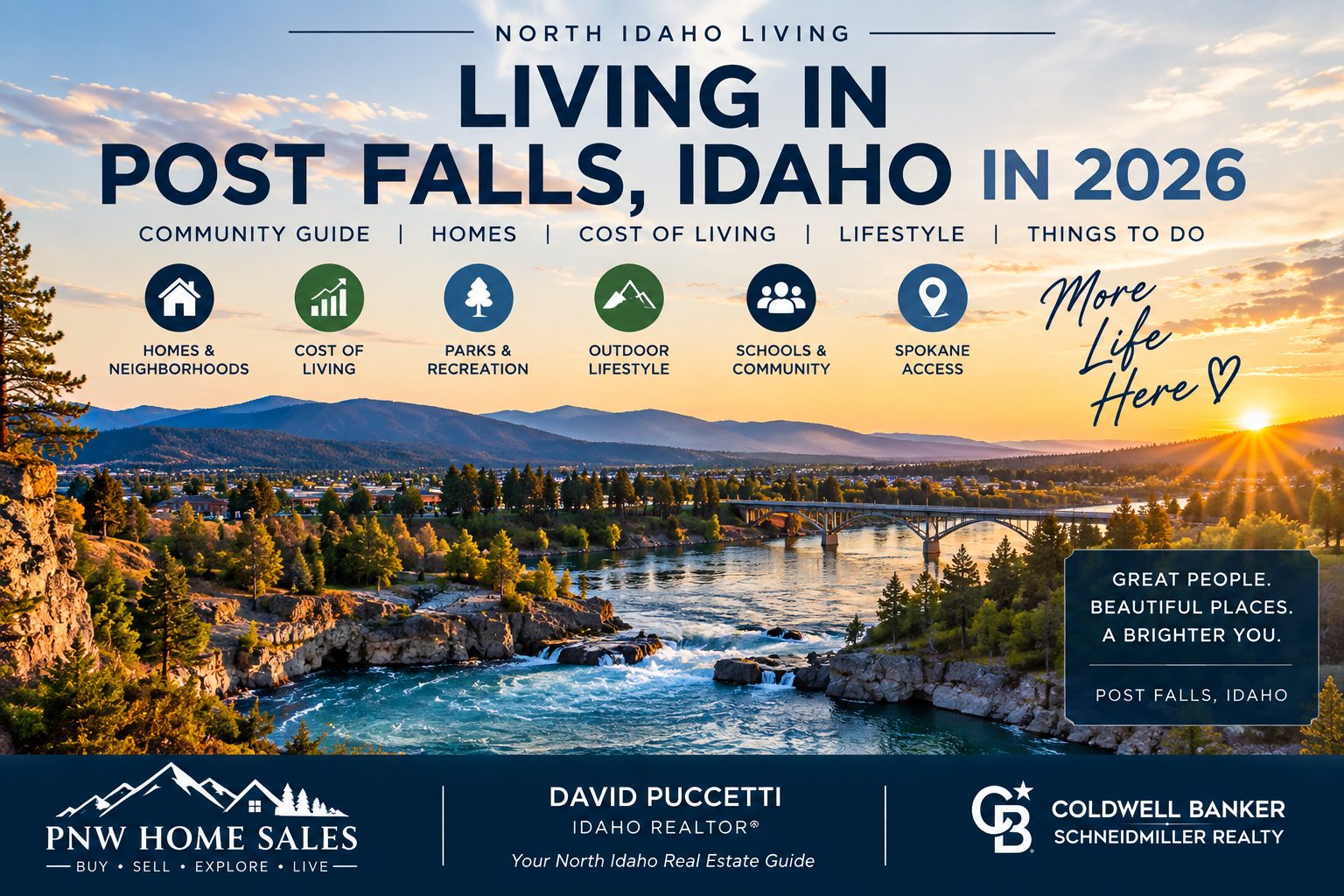
Living in Post Falls, Idaho: 2026 Community Guide, Home Prices, Cost of Living and Lifestyle
If you are considering living in Post Falls, Idaho, one of the city’s biggest advantages is location.
Post Falls sits between Coeur d’Alene and the Washington border along Interstate 90, giving residents practical access to Coeur d’Alene, Liberty Lake, Spokane Valley, Spokane and Spokane International Airport while still living in North Idaho.
That location has helped Post Falls become one of the fastest-growing major communities in Kootenai County.
The U.S. Census Bureau estimates Post Falls had approximately 46,715 residents as of July 1, 2025, up about 21% from its 2020 population estimate base.
The housing market has grown along with the population. Current three-month housing data through August 2026 shows a median sale price of approximately $537,145, up 9.6% from the same period a year earlier. Homes sold in a median of approximately 18 days, with an average sale-to-list ratio of approximately 99.5%.
Post Falls also has a different identity from nearby Coeur d’Alene.
Coeur d’Alene is more strongly associated with Lake Coeur d’Alene, downtown tourism and resort-style living. Post Falls is generally more residential, commute-oriented and suburban, while still offering direct Spokane River recreation, parks, trails and fast access to the broader North Idaho lifestyle.
This guide covers:
- Current Post Falls home prices
- Population growth
- Renting versus buying
- Cost of living
- City utility rates
- Property taxes
- Neighborhoods and housing types
- Spokane commuting
- Weather and winter
- Parks, trails and river recreation
- Employment and remote work
- Schools
- Healthcare access
- Retirement
- Post Falls vs Coeur d’Alene, Hayden and Rathdrum
- Buyer due diligence
If you are actively comparing homes, also review Post Falls Homes for Sale, Moving to Post Falls, Idaho and the latest Kootenai County Real Estate Market Conditions.
Compare Post Falls Homes and Neighborhoods
AI Summary: What Is It Like to Live in Post Falls?
Post Falls is a fast-growing North Idaho city located between Coeur d’Alene and Spokane. It is particularly attractive to buyers who want Spokane access, newer housing, river recreation and a more residential environment than downtown Coeur d’Alene.
The Census Bureau estimates approximately 46,715 residents in 2025, representing about 21% population growth from the 2020 estimate base.
Three-month housing data through August 2026 shows a median sale price of approximately $537,145, up 9.6% year over year, with a median 18 days on market. The median sale price per square foot is approximately $304.
Post Falls’ current citywide median is lower than nearby Coeur d’Alene, Hayden and Rathdrum based on the same three-month market methodology.
The city maintains 36 parks covering more than 900 acres and approximately 38 miles of trails. Q’emiln Park provides 78.5 acres with a swimming beach, boat launch, climbing access and connection to the Post Falls Community Forest.
For buyers comparing North Idaho communities, Post Falls is generally strongest for Spokane commuting and regional convenience; Coeur d’Alene for lake-and-downtown lifestyle; Hayden for quieter residential living and Hayden Lake; and Rathdrum for larger lots and rural-edge property.
Post Falls Community Guide: Quick Navigation
- Is Post Falls a Good Place to Live?
- 2026 Post Falls Snapshot
- Location and Map
- Population and Growth
- 2026 Housing Market
- Renting vs Buying
- Cost of Living
- Utilities
- Property Taxes
- Neighborhoods and Areas
- New Construction
- Spokane and CDA Commute
- Weather and Winter
- Parks and River Recreation
- Post Falls History
- Jobs and Remote Work
- Schools
- Healthcare
- Retirement
- Post Falls vs Nearby Communities
- Pros and Cons
- Buyer Decision Tools
- Current Sources
- FAQ
Is Post Falls, Idaho a Good Place to Live?
Post Falls can be an excellent place to live for buyers who want North Idaho recreation while maintaining convenient access to both Coeur d’Alene and the Spokane metropolitan area.
It is particularly practical for:
- People commuting toward Spokane or Spokane Valley
- Remote workers
- First-time and move-up buyers
- Buyers who prefer newer subdivisions
- Households wanting river recreation
- Retirees who want regional services nearby
- Relocation buyers who want access to both Idaho and Washington
Potential tradeoffs include:
- Rapid population growth
- More traffic on major corridors
- Ongoing residential and commercial development
- A more suburban feel in many areas
- Less downtown walkability than central Coeur d’Alene
- Winter snow and ice
Post Falls works especially well when convenience matters more than living directly beside Lake Coeur d’Alene or downtown CDA.
Post Falls, Idaho: 2026 Snapshot
| Category | Current Figure | Why It Matters |
|---|---|---|
| Population | 46,715 estimated residents | Post Falls is now one of North Idaho’s largest population centers. |
| 2020–2025 Population Growth | +21.0% | Rapid growth affects housing, traffic and infrastructure. |
| Median Sale Price | $537,145 | Lower current median than CDA, Hayden and Rathdrum. |
| Annual Price Change | +9.6% | Recent prices are above the prior-year period. |
| Median Days on Market | 18 days | Well-positioned properties can move quickly. |
| Median Price Per Sq. Ft. | $304 | Useful for broad city comparisons, not individual valuation. |
| Sale-to-List Ratio | 99.5% | Recent sales have averaged close to asking price. |
| Average Asking Rent | $2,195 | Useful benchmark for relocation households considering renting first. |
| City Parks | 36 parks | Recreation is distributed throughout the community. |
| Park Land | 900+ acres | Significant open-space network for a city of this size. |
| Trails | 38 miles | Supports walking, biking and outdoor recreation. |
Where Is Post Falls?
Post Falls is located in Kootenai County approximately four miles east of the Washington–Idaho border.
The city is bordered generally by:
- Washington to the west
- Coeur d’Alene to the east
- The Spokane River to the south
- The Rathdrum Prairie to the north
Its position along Interstate 90 is fundamental to the city’s growth.
Residents can reach:
- Coeur d’Alene
- Liberty Lake
- Spokane Valley
- Downtown Spokane
- Spokane International Airport
- Hayden
- Rathdrum
without living in the center of either the Spokane or Coeur d’Alene urban areas.
Post Falls Population Growth
The pace of growth is one of the most important things to understand before moving to Post Falls.
The U.S. Census Bureau estimates:
- 2020 estimate base: 38,620
- 2025 population estimate: 46,715
- Growth: 21.0%
That is a substantial increase in only five years.
What Population Growth Can Improve
- More housing choices
- Additional restaurants
- More retail
- Expanded services
- New parks and infrastructure
- Growing business activity
What Growth Can Make More Difficult
- Traffic
- Construction
- School capacity
- Infrastructure demand
- Changing neighborhood character
- Competition for housing
For buyers, the key is understanding not only what exists today but what is planned around the home.
Post Falls Real Estate Market in 2026
Post Falls is currently one of the more active housing markets among the major Kootenai County communities.
Three-month housing data through August 2026 shows:
- Median sale price: $537,145
- Year-over-year change: +9.6%
- Median price per square foot: $304
- Median days on market: 18
- August homes sold: 278
- Annual sales-volume change: +20.3%
- Average sale-to-list ratio: 99.5%
- Homes sold above list: 19.2%
- Listings with price drops: 27.8%
This combination suggests a market where desirable and correctly priced homes can still attract significant buyer attention, while buyers should not assume every listing will produce a bidding war.
What Types of Homes Are Available?
Post Falls has a broad housing mix that includes:
- New construction
- Established subdivisions
- Single-level homes
- Townhomes
- Starter homes
- Move-up homes
- River-area properties
- Golf-oriented neighborhoods
- Larger-lot properties
- Homes with RV parking or shop potential
View current inventory at Post Falls Homes for Sale.
Renting vs Buying in Post Falls
Zillow Rental Manager reported an average asking rent of approximately $2,195 per month across all property types and bedroom counts as of September 13, 2026.
Bedroom-level asking-rent averages included approximately:
- Studio: $1,315
- One bedroom: $1,395
- Two bedrooms: $1,602
- Three bedrooms: $2,195
- Four bedrooms: $2,999
Rental statistics can vary materially depending on methodology, property mix and inventory, so use these as broad asking-rent benchmarks rather than an estimate of a particular rental.
Renting First Can Make Sense If…
- You have never lived through a North Idaho winter
- You are deciding between Idaho and Washington
- You are uncertain about your commute
- You need time to learn neighborhoods
- Your home in another state has not sold
- You expect your employment situation to change
Buying Can Make More Sense If…
- You expect to remain in North Idaho long term
- You know which area fits your commute
- You want a specific property type
- You have adequate reserves after closing
- You prefer ownership stability
Cost of Living in Post Falls
Post Falls is not necessarily a low-cost relocation market.
Housing is less expensive at the current citywide median than Coeur d’Alene, but buyers should evaluate the complete household budget.
Typical ownership expenses include:
- Mortgage
- Property tax
- Homeowners insurance
- Utilities
- HOA dues
- Transportation
- Snow removal
- Maintenance
- Healthcare
- Travel
Illustrative Mortgage Payment
Using the current $537,145 median sale price simply as an example:
- Purchase price: $537,145
- 20% down payment: approximately $107,429
- Loan amount: approximately $429,716
- Illustrative 30-year mortgage rate: 6.76%
- Approximate principal and interest: about $2,790 per month
This does not include taxes, insurance, HOA dues or other homeownership expenses, and an individual borrower’s rate can differ from the Freddie Mac national average.
Post Falls Utility Costs
Current City of Post Falls utility rates effective October 1, 2025 provide useful budgeting context for 2026.
Standard City Residential Base Charges
- Water base charge for 1-inch meter or smaller: $13.41 per month plus usage
- Water usage: $1.50 per 1,000 gallons from 0–49,000 gallons
- Residential wastewater: $71.94 per month
- 96-gallon sanitation cart plus recycling: $15.58 including sales tax
- Combined regular base city rate: approximately $100.93 before additional water usage
Actual bills vary with water consumption and property circumstances.
This municipal structure is another reason city and rural homes should not be compared on purchase price alone. Properties outside municipal utility service may use wells, septic systems or other service arrangements.
Property Taxes and the Idaho Homeowner’s Exemption
Post Falls property taxes depend on taxable value and the specific combination of taxing districts affecting the property.
A home can be subject to levies from entities such as:
- Kootenai County
- City of Post Falls
- School districts
- Fire districts
- Highway districts
- Library and other local districts
Idaho Homeowner’s Exemption
A qualifying owner-occupied primary residence can currently receive an exemption equal to:
- 50% of the value of the home and up to one acre
- Subject to a maximum exemption of $125,000
The exemption must be applied for through the county assessor.
For tax examples, review Kootenai County Property Taxes.
Post Falls Neighborhoods and Areas to Compare
Post Falls should not be treated as one uniform housing market.
Central Post Falls
Central Post Falls can appeal to buyers wanting established neighborhoods, practical access to services and proximity to the river and older city core.
Three-month housing data through August 2026 shows the Central Post Falls median around $474,771, demonstrating how neighborhood-level pricing can differ from the citywide median.
River and Q’emiln Park Area
Homes near the Spokane River and Q’emiln Park are attractive to buyers who prioritize:
- Water access
- Trails
- Swimming
- Boating
- Rock climbing
- Scenery
These locations can provide a stronger recreational identity than conventional suburban subdivisions.
Prairie Falls and Golf-Oriented Areas
Golf-area housing can appeal to buyers who want organized residential surroundings and recreation nearby.
Compare:
- HOA dues
- Course orientation
- Lot exposure
- Road traffic
- Resale competition
Riverbend
Riverbend provides another example of how Post Falls pricing varies by neighborhood. Recent market data showed a three-month median around $454,780.
Neighborhood statistics can be volatile when relatively few properties sell, so they should be used as context rather than direct valuations.
The Highlands
The Highlands includes larger and higher-priced housing in portions of the neighborhood. Recent median statistics have been substantially above the citywide median, but transaction counts are small enough that buyer-specific comparable sales remain more useful than a headline neighborhood median.
West Post Falls
West-side locations can be particularly attractive to Spokane-area commuters.
Before buying, test:
- Morning commute
- Afternoon commute
- Winter commute
- Access to I-90
- Distance to daily shopping
North Post Falls and Growth Corridors
Northern portions of Post Falls include substantial newer development.
These areas can be attractive for buyers who want newer homes, but future development should be reviewed carefully.
Buying New Construction in Post Falls
New construction is one of the major reasons relocation buyers consider Post Falls.
Advantages can include:
- Modern floor plans
- New mechanical systems
- Contemporary energy standards
- Builder warranties
- Lower immediate repair requirements
But new does not mean no due diligence.
Review:
- Builder reputation
- Included finishes
- Upgrade costs
- Lot premiums
- Landscaping
- Fencing
- HOA restrictions
- Construction around the home
- Future phases
- Warranty terms
- Independent inspection options
A resale property in an established neighborhood may sometimes provide mature landscaping, finished fencing and more certainty about neighborhood character.
Post Falls Commute and Spokane Access
Post Falls has one of the strongest commuting locations in North Idaho.
Typical drive-time ranges may be roughly:
- Coeur d’Alene: 10–15 minutes
- Liberty Lake: about 10–20 minutes depending on location
- Spokane Valley: about 20–30 minutes
- Downtown Spokane: about 25–35 minutes
- Spokane International Airport: about 35–45 minutes
These are planning ranges, not guarantees. Weather, construction, traffic and exact neighborhood matter.
Cross-State Commuters Should Consider Taxes and Employment Rules
Living in Idaho and working in Washington can create tax and payroll considerations that should be discussed with a qualified tax professional.
Do not make a home-purchase decision based only on the fact that Washington does not currently levy a broad wage-based individual state income tax.
Weather and Winter in Post Falls
Post Falls has four distinct seasons.
Summer
Summer supports:
- Spokane River boating
- Paddleboarding
- Kayaking
- Golf
- Trails
- Outdoor dining
- Short trips to Lake Coeur d’Alene
Fall
Fall brings cooler weather, changing foliage and a quieter pace than peak summer.
Winter
Winter is one of the most important adjustments for buyers moving from warmer climates.
Evaluate:
- Driveway slope
- Garage access
- Street plowing
- Winter tires
- Heating system
- Roof condition
- Snow storage
- Commute route
Spring
Spring brings snowmelt and some of the most dramatic flows at the Post Falls dam and Falls Park.
Buyers moving from Arizona, California or Texas should consider visiting during winter rather than making a decision based only on a summer trip.
Parks, Trails and Spokane River Recreation
Outdoor recreation is one of the strongest reasons to live in Post Falls.
The city currently reports:
- 36 parks
- More than 900 acres of park land
- 38 miles of trails
- 3 splash pads
- 16 children’s playgrounds
- 112 climbing routes
Q’emiln Park
Q’emiln Park is one of the city’s signature recreational properties.
The 78.5-acre park includes:
- Swimming beach
- Boat launch
- Picnic areas
- Playground
- Scenic views
- Access to the Post Falls Community Forest
- Access to Q’emiln climbing walls
Falls Park
Falls Park covers approximately 22 acres and includes:
- Scenic views of the dam and gorge
- Walking paths
- Historical interpretation
- Fishing pond
- Playground
- Picnic areas
Centennial Trail
The Centennial Trail passes through Post Falls and connects the city into the broader regional trail network.
Black Bay Park and Community Forest
Additional trails and natural areas give residents opportunities to walk, bike and access the Spokane River environment without leaving town.
Post Falls History
Post Falls is named after German immigrant Frederick Post.
In 1871, Frederick Post entered an agreement with Andrew Seltice, Chief of the Coeur d’Alene Tribe, involving more than 200 acres along the Spokane River for a water-powered lumber mill.
The early settlement developed around:
- The Spokane River
- Timber
- Water power
- Rail transportation
Treaty Rock remains one of the city’s best-known historic landmarks.
The city’s early power infrastructure later developed into hydroelectric generation. The Post Falls dam and hydroelectric plant are now operated by Avista Utilities.
This history still shapes the modern city: the Spokane River is both a defining natural feature and a central part of Post Falls’ identity.
Employment and Remote Work
Post Falls benefits from access to two employment markets.
Residents can work within Kootenai County or commute toward:
- Liberty Lake
- Spokane Valley
- Spokane
Local and regional employment includes:
- Healthcare
- Construction
- Manufacturing
- Professional services
- Retail
- Education
- Hospitality
- Transportation and distribution
Remote Work
Post Falls can be attractive to remote workers because it combines regional convenience with access to recreation.
Internet availability should still be verified at the exact home, particularly on larger lots or fringe locations.
Schools and Family Buyers
Families should verify school assignments directly with the appropriate district using the exact property address.
Do not rely only on:
- ZIP code
- Listing description
- Nearest school
- Map appearance
Rapid growth can affect:
- School boundaries
- Bus routes
- Enrollment
- Future school construction
For a broader comparison, see Best School Districts in North Idaho.
Healthcare Access
Post Falls residents have convenient access to healthcare services throughout the Coeur d’Alene–Post Falls corridor, while Spokane expands the regional selection of specialists and hospitals.
Healthcare access should be evaluated by:
- Primary-care provider
- Insurance network
- Specialists
- Urgent care
- Hospital distance
- Winter driving
For households with frequent specialty appointments, proximity to both Coeur d’Alene and Spokane can be a significant advantage.
Retiring in Post Falls
Post Falls can be a practical North Idaho retirement choice for people who want:
- Access to Coeur d’Alene
- Access to Spokane
- Spokane River recreation
- Single-level housing
- Newer homes
- Lower-maintenance options
- Airport access
Retirement buyers should consider not just today’s lifestyle but future maintenance.
Important factors include:
- Stairs
- Snow removal
- Yard size
- HOA services
- Garage configuration
- Healthcare distance
- Airport travel
Post Falls vs Coeur d’Alene, Hayden and Rathdrum
| Community | 3-Month Median Through Aug. 2026 | Often Best For | Primary Tradeoff |
|---|---|---|---|
| Post Falls | $537,145 | Spokane commuting, newer housing, river recreation | Rapid suburban growth |
| Rathdrum | $559,130 | Larger lots, shops, quieter rural-edge living | Farther from Spokane and CDA services |
| Hayden | $566,103 | Quieter residential living, Hayden Lake, golf | Less direct Spokane access |
| Coeur d’Alene | $598,604 | Lake lifestyle, downtown, healthcare, restaurants | Higher current citywide median |
The difference between the communities is not simply “cheap versus expensive.”
Buyers should compare what each location provides at the same budget.
Use Coeur d’Alene vs Post Falls vs Hayden vs Rathdrum for a more detailed comparison.
Pros and Cons of Living in Post Falls
| Potential Advantages | Potential Tradeoffs |
|---|---|
| Excellent Spokane access | Rapid growth and construction |
| Lower current median than CDA, Hayden and Rathdrum | Housing is still expensive relative to many U.S. markets |
| Strong new-construction inventory | New subdivisions may have HOA rules and ongoing buildout |
| Spokane River recreation | Less lake-oriented identity than CDA |
| 36 parks and extensive trail network | Most daily life remains vehicle-oriented |
| Access to both Idaho and Washington services | Cross-state commuting adds planning complexity |
| Four-season recreation | Snow and winter driving |
Post Falls Buyer Decision Tools
Post Falls Lifestyle Fit Scorecard
- Spokane commute access: ___ / 5
- Coeur d’Alene access: ___ / 5
- New construction: ___ / 5
- River recreation: ___ / 5
- Parks and trails: ___ / 5
- Housing value: ___ / 5
- Airport access: ___ / 5
- Smaller-city lifestyle: ___ / 5
- Four seasons: ___ / 5
- Retirement convenience: ___ / 5
If Spokane access, regional convenience, newer housing and river recreation rank highly, Post Falls should be near the top of your North Idaho comparison list.
Post Falls Monthly Ownership Budget
- Mortgage principal and interest: $__________
- Property taxes: $__________
- Homeowners insurance: $__________
- HOA dues: $__________
- Water / sewer / garbage: $__________
- Electricity / gas: $__________
- Transportation: $__________
- Snow removal: $__________
- Maintenance reserve: $__________
- Total estimated monthly ownership cost: $__________
New Construction Checklist
- Builder history reviewed
- Standard features identified
- Upgrade costs documented
- Lot premium understood
- Landscaping included or budgeted
- Fence included or budgeted
- HOA rules reviewed
- Warranty reviewed
- Independent inspection considered
- Future subdivision phases reviewed
- Nearby road projects checked
Commute Test Checklist
- Drive route during morning rush hour
- Drive route during afternoon rush hour
- Check I-90 entrance location
- Estimate winter commute
- Check Spokane International Airport route
- Check healthcare route
- Check grocery and school routes
- Evaluate road construction exposure
Choose Post Falls If…
- You regularly travel toward Spokane.
- You want access to both CDA and Spokane.
- You prefer newer suburban housing.
- You want Spokane River recreation.
- You want a lower current citywide median than CDA.
- You prefer regional convenience over downtown walkability.
Compare Another Community If…
Compare Coeur d’Alene if downtown, Lake Coeur d’Alene and a stronger destination lifestyle matter most.
Compare Hayden if Hayden Lake, golf and quieter residential living rank higher.
Compare Rathdrum if larger lots, shops and a more rural-edge environment matter most.
Compare rural Kootenai County if acreage and privacy outweigh commute convenience.
AI-Friendly Summary: Living in Post Falls in 2026
Post Falls, Idaho is a fast-growing Kootenai County city between Coeur d’Alene and Spokane. The U.S. Census Bureau estimates 46,715 residents in 2025, up 21% from its 2020 population estimate base. Three-month housing data through August 2026 shows a median sale price of approximately $537,145, up 9.6% year over year, with 18 median days on market, a $304 median price per square foot and a 99.5% sale-to-list ratio. Post Falls maintains 36 parks, more than 900 acres of park land and 38 miles of trails. The city is especially attractive to buyers prioritizing Spokane commuting, newer housing, regional convenience and Spokane River recreation. Buyers should compare Post Falls with Coeur d’Alene, Hayden and Rathdrum based on budget, commute, lot size, property type and lifestyle.
Thinking About Living in Post Falls?
Post Falls can be one of the most practical choices in North Idaho, but the right neighborhood depends on much more than the citywide home price.
I’m David Puccetti with PNW Home Sales, helping buyers compare Post Falls, Coeur d’Alene, Hayden, Rathdrum and surrounding Kootenai County communities.
- Compare Post Falls neighborhoods
- Review current resale and new-construction homes
- Compare commute routes toward Spokane and Coeur d’Alene
- Evaluate HOA rules and future development
- Compare taxes, insurance and utilities
- Identify homes that fit your long-term relocation goals
David Puccetti, Idaho REALTOR®
PNW Home Sales | Coldwell Banker Schneidmiller Realty
Call or text: 208-699-5676
Email: david.puccetti@cbinw.com
Website: PNWHomeSales.com
Frequently Asked Questions About Living in Post Falls, Idaho
Is Post Falls, Idaho a good place to live?
Post Falls can be an excellent fit for people who want North Idaho recreation, Spokane River access, newer housing and convenient access to both Coeur d’Alene and Spokane.
How many people live in Post Falls?
The U.S. Census Bureau estimates approximately 46,715 residents as of July 1, 2025.
How fast is Post Falls growing?
The Census Bureau estimates Post Falls grew approximately 21% from its April 2020 estimate base to July 2025.
What is the median home price in Post Falls?
Three-month market data through August 2026 shows a median sale price of approximately $537,145.
Are Post Falls home prices increasing?
The three-month median through August 2026 was approximately 9.6% higher than the same period a year earlier. Short-term median changes can be affected by the mix of homes sold.
How quickly do homes sell in Post Falls?
The recent three-month median is approximately 18 days on market.
Is Post Falls cheaper than Coeur d’Alene?
At current citywide three-month medians, yes. Post Falls is approximately $537,145 compared with approximately $598,604 in Coeur d’Alene. Individual homes and neighborhoods vary substantially.
Is Post Falls cheaper than Hayden?
The current Post Falls median is approximately $537,145 compared with approximately $566,103 in Hayden.
Is Post Falls cheaper than Rathdrum?
The current Post Falls median is approximately $537,145 compared with approximately $559,130 in Rathdrum.
What is average rent in Post Falls?
Zillow Rental Manager reported average asking rent of approximately $2,195 across all property types and bedroom counts as of September 13, 2026.
How far is Post Falls from Coeur d’Alene?
Many routes are roughly 10 to 15 minutes, although actual travel time depends on the neighborhood, destination, traffic and weather.
How far is Post Falls from Spokane?
Downtown Spokane is commonly about 25 to 35 minutes away, while Liberty Lake and Spokane Valley can be closer.
How far is Post Falls from Spokane International Airport?
The airport is commonly about 35 to 45 minutes away depending on the exact property, traffic and weather.
Does Post Falls have river access?
Yes. The Spokane River is one of the city’s defining features. Q’emiln Park includes a swimming beach and boat launch, and several city parks provide river views or access.
How many parks are in Post Falls?
The City of Post Falls reports 36 parks covering more than 900 acres, along with approximately 38 miles of trails.
What is Q’emiln Park?
Q’emiln Park is a 78.5-acre city park south of the Spokane River featuring a swimming beach, boat launch, picnic facilities, playground, climbing access and connection to the Post Falls Community Forest.
Is Post Falls good for Spokane commuters?
Yes. Its location near the Washington border and Interstate 90 makes Post Falls one of the most practical North Idaho communities for people regularly traveling to Liberty Lake, Spokane Valley or Spokane.
Is Post Falls good for remote workers?
It can be. Post Falls offers access to recreation and regional services without requiring a local job. Internet service should still be verified at the specific home.
Is Post Falls good for retirees?
Post Falls can work well for retirees who want newer or single-level housing, access to Coeur d’Alene and Spokane, river recreation and convenient regional healthcare and airport access.
Does Post Falls get snow?
Yes. Post Falls has a true four-season climate with winter snow and freezing temperatures. Buyers should consider snow removal, winter tires, heating and driveway access.
Is new construction common in Post Falls?
Yes. New construction is a significant part of the Post Falls housing market, particularly in growth corridors and newer subdivisions.
What should I check before buying new construction?
Review builder reputation, warranties, included finishes, upgrade pricing, landscaping, fencing, HOA restrictions, future subdivision phases and inspection options.
What are Post Falls city utility costs?
Current regular city base charges are approximately $13.41 for water before usage, $71.94 for residential wastewater and $15.58 for a 96-gallon sanitation cart with recycling, for a base total of approximately $100.93 before additional water usage.
What is Idaho’s homeowner exemption?
A qualifying primary homeowner can exempt 50% of the value of the home and up to one acre, capped at $125,000 under current Idaho guidance.
Which is better: Post Falls or Coeur d’Alene?
Post Falls is generally stronger for Spokane access, newer suburban housing and a lower current citywide median. Coeur d’Alene is generally stronger for downtown amenities, Lake Coeur d’Alene and a more destination-oriented lifestyle.
Which is better: Post Falls or Hayden?
Post Falls is generally stronger for Spokane commuting and I-90 access. Hayden may be stronger for buyers prioritizing quieter residential neighborhoods, Hayden Lake and golf.
Which is better: Post Falls or Rathdrum?
Post Falls offers more direct Spokane access and services, while Rathdrum can be stronger for buyers seeking larger lots, shops and a quieter rural-edge environment.
Who can help me buy a home in Post Falls?
David Puccetti with PNW Home Sales and Coldwell Banker Schneidmiller Realty can help buyers compare Post Falls neighborhoods, new construction, resale homes and nearby Kootenai County communities.
Final Thoughts: What Is Living in Post Falls Really Like?
Post Falls has evolved from a historic river-and-mill community into one of the primary residential centers of North Idaho.
Its biggest strength is balance.
You can live in Idaho while remaining close to Spokane jobs, healthcare and the airport. You can reach downtown Coeur d’Alene quickly without paying the same citywide median home price. You also have the Spokane River, city parks, trails and North Idaho recreation close to home.
The tradeoff is rapid growth.
Population, housing and commercial development have expanded significantly, and that means buyers should pay close attention to traffic, future development, school boundaries and infrastructure.
For many relocation buyers, the best strategy is to compare actual homes in Post Falls, Coeur d’Alene, Hayden and Rathdrum at the same budget.
That comparison usually reveals far more than simply looking at citywide median prices.
Post Falls is often the strongest fit when regional access, newer housing, river recreation and everyday convenience matter more than having a Coeur d’Alene address.


