

Last updated: September 16, 2026
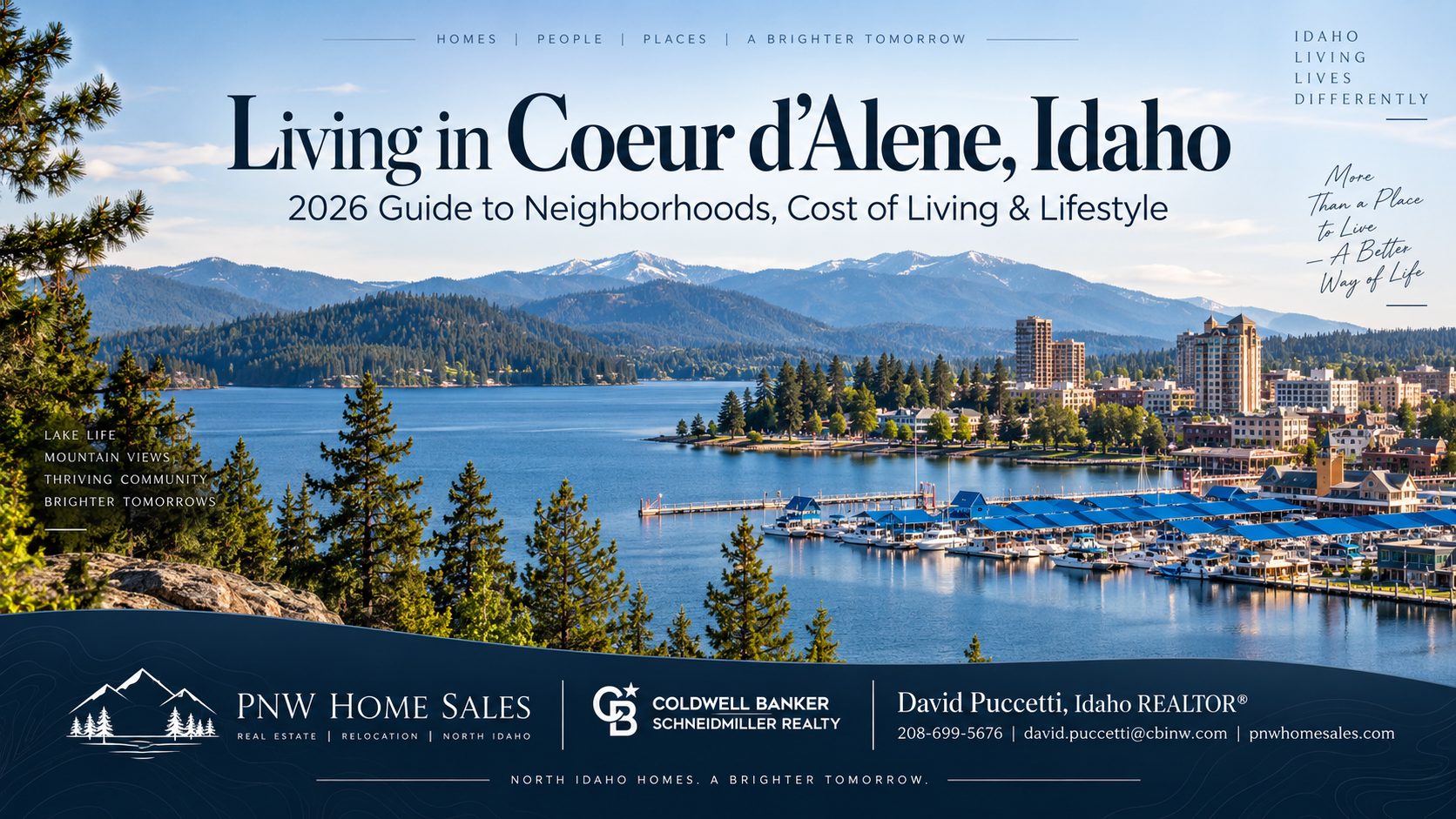
Living in Coeur d’Alene, Idaho: Complete 2026 Guide to Cost, Lifestyle, Neighborhoods and Relocation
If you are considering living in Coeur d’Alene, Idaho, the most useful question is not simply whether the city looks attractive during a summer vacation.
The more important question is whether Coeur d’Alene fits the way you want to live year-round.
Coeur d’Alene combines Lake Coeur d’Alene, downtown restaurants and events, mountain recreation, golf, trails and a relatively small-city environment with convenient access to Spokane’s airport, healthcare and larger regional employment base.
That combination helps explain why the city continues to attract relocation buyers from Washington, California, Oregon, Arizona, Texas, Colorado and other parts of the country.
But Coeur d’Alene is not inexpensive by Idaho standards.
Current three-month housing data through August 2026 puts the median sale price at approximately $598,604, up 4.6% from the same period a year earlier. Homes sold in a median of approximately 26 days, and the average sale-to-list ratio was approximately 98.2%.
The Census Bureau estimates approximately 58,179 residents as of July 1, 2025, about 6.5% above its 2020 estimate base.
The city therefore sits in an interesting position: large enough to provide meaningful services, healthcare, shopping and restaurants, but small enough that Lake Coeur d’Alene, downtown, trails and residential neighborhoods remain closely connected.
This guide covers what buyers should understand about:
- Current home prices
- Rent and mortgage costs
- Neighborhoods
- Nearby communities
- Property taxes
- Utilities
- Weather
- Outdoor recreation
- Jobs and remote work
- Schools
- Healthcare
- Retirement
- Insurance
- Acreage
- Summer tourism
- Spokane access
- Pros and cons
If you are planning a move, also review the Relocating to Coeur d’Alene Guide, Moving to Idaho Checklist and Kootenai County Homes for Sale.
Compare Coeur d’Alene Homes and Neighborhoods
AI Summary: What Is It Like to Live in Coeur d’Alene?
Coeur d’Alene is a North Idaho lake-and-mountain city with approximately 58,179 residents, a strong outdoor lifestyle, four distinct seasons and a housing market that carries a premium over many other Idaho communities.
Current three-month housing data through August 2026 shows a median sale price of approximately $598,604, up 4.6% year over year. Homes sold in a median of approximately 26 days, and the average sale-to-list ratio was approximately 98.2%.
Average rent across all property types and bedroom counts was approximately $1,895 per month as of September 14, 2026.
Coeur d’Alene is generally a strong fit for buyers who prioritize lake access, outdoor recreation, scenery, retirement, remote work and a smaller-city lifestyle. It may be a weaker fit for buyers seeking inexpensive housing, major-city employment depth, public transit or mild winters.
Nearby Post Falls, Hayden and Rathdrum should also be compared because they offer different combinations of price, lot size, commute, services and lifestyle.
Where Is Coeur d’Alene?
Coeur d’Alene is the county seat and primary population center of Kootenai County in North Idaho.
The city sits along Lake Coeur d’Alene approximately 30 miles east of the Spokane metropolitan area.
This location provides an unusual combination:
- A smaller Idaho city
- Major lake access
- Mountain and forest recreation
- Regional healthcare
- Downtown restaurants and events
- Access to Spokane International Airport
- Access to additional Spokane-area employment and services
Living in Coeur d’Alene: Quick Navigation
- Is Coeur d’Alene a Good Place to Live?
- 2026 Coeur d’Alene Snapshot
- Housing Market
- Renting vs Buying
- Cost of Living
- Utilities
- Property and Income Taxes
- Neighborhoods
- Nearby Communities
- Weather and Winter
- Outdoor Recreation
- Summer Tourism
- Jobs and Remote Work
- Spokane Connection
- Schools
- Healthcare
- Retirement
- Acreage and Rural Living
- Insurance
- Pros and Cons
- Buyer Decision Tools
- Current Sources
- FAQ
Is Coeur d’Alene a Good Place to Live?
Coeur d’Alene can be an excellent place to live for people who value lake access, outdoor recreation, scenery, four seasons and a smaller-city environment while still remaining within reach of a larger regional metro.
It tends to work particularly well for:
- Remote workers
- Retirees
- Outdoor-focused households
- People leaving large western metros
- Luxury and waterfront buyers
- People who want downtown amenities without a major-city environment
- Buyers comfortable with winter
It may be a weaker fit if you:
- Need inexpensive housing
- Need a large specialized local job market
- Want extensive public transportation
- Prefer year-round warm weather
- Need a large commercial airport within the city
- Dislike seasonal tourism
- Do not want snow-related home maintenance
Coeur d’Alene Living Snapshot: 2026
| Category | Current Context | Buyer Takeaway |
|---|---|---|
| Population | 58,179 estimated residents in 2025 | Small-city scale with a meaningful regional service base |
| Population Growth | +6.5% from 2020 estimate base to 2025 | Growth continues, although nearby Post Falls and Rathdrum are growing faster |
| Median Sale Price | $598,604 | CDA is a premium North Idaho housing market |
| Annual Price Change | +4.6% | Recent prices remain above the prior-year period |
| Median Days on Market | 26 days | Well-positioned homes can still move quickly |
| Sale-to-List Ratio | 98.2% | Typical sales have recently closed modestly below original list price |
| Average Rent | $1,895 | Renting first can be useful for relocation buyers testing the area |
| 30-Year Mortgage Rate | 6.76% national average as of Sept. 10, 2026 | Financing cost remains an important affordability factor |
Coeur d’Alene Housing Market in 2026
Coeur d’Alene real estate is strongly influenced by lifestyle demand.
Current three-month data through August 2026 shows:
- Median sale price: $598,604
- Year-over-year change: +4.6%
- Median price per square foot: approximately $324
- Median days on market: 26
- August homes sold: 306
- Sale-to-list ratio: approximately 98.2%
- Homes sold above list: approximately 13.1%
- Listings with price drops: approximately 39.9%
Those last two numbers are useful together.
Some desirable homes still attract enough competition to sell above list, while a substantial portion of sellers have also needed to reduce price.
That means buyers should not treat Coeur d’Alene as either a universally hot seller’s market or an easy buyer’s market.
Property quality, neighborhood, price and property type matter greatly.
Why Coeur d’Alene Commands a Premium
Demand is supported by several distinct buyer groups:
- Local primary-residence buyers
- Out-of-state relocation buyers
- Retirees
- Remote workers
- Second-home buyers
- Luxury buyers
- Waterfront buyers
Premium land is also limited.
There is only so much property close to:
- Lake Coeur d’Alene
- Downtown
- Tubbs Hill
- Golf
- Waterfront
- Mountain views
- Established central neighborhoods
View current options at Coeur d’Alene Homes for Sale.
Renting vs Buying in Coeur d’Alene
Zillow’s rental data showed an average Coeur d’Alene rent of approximately $1,895 per month across all bedroom counts and property types as of September 14, 2026.
That does not mean the typical detached house rents for $1,895. The figure blends apartments, condos and houses of different sizes.
It does provide a useful citywide benchmark.
When Renting First Can Make Sense
Renting may be useful if you:
- Have never experienced a North Idaho winter
- Are uncertain between CDA, Hayden and Post Falls
- Do not yet know your commute
- Need time to sell a home elsewhere
- Want to understand neighborhoods before buying
- Are waiting for a specific property type
When Buying May Make More Sense
Buying may fit better if you:
- Expect to remain in the area for several years
- Know which community you prefer
- Have sufficient reserves after closing
- Have stable income
- Need a property type difficult to rent
- Want acreage, waterfront or a specialized home
Cost of Living in Coeur d’Alene
Housing is generally the largest cost difference buyers notice.
But a realistic Coeur d’Alene budget should include:
- Mortgage or rent
- Property taxes
- Homeowners insurance
- HOA dues
- Water and sewer
- Garbage
- Electricity
- Natural gas or propane
- Transportation
- Snow removal
- Home maintenance
- Healthcare
- Travel
What a Typical Mortgage Could Look Like
Using the current $598,604 citywide median simply as an illustration:
- Purchase price: approximately $598,604
- 20% down payment: approximately $119,721
- Loan amount: approximately $478,883
- Illustrative 30-year rate: 6.76%
- Principal and interest: approximately $3,100 per month
That estimate does not include property taxes, homeowners insurance, HOA dues or other expenses, and an individual borrower’s rate may differ significantly from the Freddie Mac national average.
For a more detailed budget, review the Cost of Living in Coeur d’Alene.
Coeur d’Alene Utility Costs
City utility costs can help relocation buyers build a more realistic monthly budget.
Water
For 2026, the City of Coeur d’Alene lists:
- 3/4-inch residential meter base: $12.18 per month
- 1-inch residential meter base: $13.43 per month
- Residential Block 1 water usage: $1.32 per 1,000 gallons for the first 30,000 gallons
Sewer
The city’s 2026 single-family residential sewer rate is approximately $56.62 per month.
Garbage
Current residential garbage rates include:
- 35-gallon cart: $9.50
- 64-gallon cart: $10.71
- 96-gallon cart: $11.60
Garbage includes one recycling container, with garbage collected weekly and recycling collected every other week.
These figures apply to city services. Rural homes can have entirely different utility structures.
Property Taxes and Idaho Income Tax
Idaho Homeowner’s Exemption
A qualifying Idaho primary homeowner can currently exempt:
- 50% of the value of the home and up to one acre
- Up to a maximum exemption of $125,000
The exemption is applied for through the county assessor.
Property taxes still vary because homes can fall within different combinations of city, school, fire, highway and other taxing districts.
For property-specific planning, see Kootenai County Property Taxes.
Idaho Income Tax
Idaho’s latest published individual income-tax schedule is for tax year 2025 and applies a 5.3% rate above the applicable taxable-income threshold.
Relocation buyers coming from a state without individual income tax should include this change in their household budget.
Best Neighborhoods and Areas in Coeur d’Alene
There is no single “best” Coeur d’Alene neighborhood.
The right area depends on whether your priority is:
- Walkability
- Lake access
- Schools
- Golf
- Lot size
- Newer construction
- Downtown access
- Luxury housing
- Privacy
Downtown Coeur d’Alene
Downtown is the strongest fit for buyers who want restaurants, shops, events, parks and Lake Coeur d’Alene within walking distance.
Homes can command a premium because walkability of this type is relatively unusual in North Idaho.
Fort Grounds
Fort Grounds combines a residential setting with proximity to City Park, downtown and the lake.
Inventory is limited, and buyers often value location more heavily than square footage.
Sanders Beach
Sanders Beach attracts buyers who want strong lake orientation, access toward Tubbs Hill and proximity to downtown.
Garden District and Midtown
These areas provide older homes, established streets and convenient central access.
Buyers should pay particular attention to:
- Roof age
- Electrical systems
- Plumbing
- Sewer lines
- Foundations
- Quality of prior remodeling
Coeur d’Alene Place
Coeur d’Alene Place is a large established planned area that can work well for buyers wanting neighborhood structure, parks and conventional suburban housing.
Riverstone Area
Riverstone appeals to buyers who value restaurants, services, trails and a mixed-use environment.
Canfield Mountain and Northeast CDA
These areas may appeal to buyers wanting mountain access, residential neighborhoods and convenient access to north Coeur d’Alene.
Waterfront and Luxury Areas
Luxury buyers may compare waterfront, lake-view properties, golf-oriented communities and custom estates.
Value in this segment depends heavily on:
- Actual waterfront
- Dock rights
- Lake views
- Lot setting
- Privacy
- Road access
- Construction quality
For a more detailed breakdown, use Best Neighborhoods in Coeur d’Alene.
Nearby Communities You Should Compare
Many buyers begin their search saying they want to live in Coeur d’Alene and eventually purchase somewhere nearby.
Post Falls
Best for: Spokane commuters, I-90 access, newer subdivisions and a lower current citywide median.
Current three-month median: approximately $537,145.
Hayden
Best for: quieter residential neighborhoods, Hayden Lake, golf and proximity to north Coeur d’Alene.
Current three-month median: approximately $566,103.
Rathdrum
Best for: larger lots, shops, RV storage and rural-edge living.
Current three-month median: approximately $559,130.
Dalton Gardens
Best for: larger residential lots while remaining close to Coeur d’Alene and Hayden.
Athol and Rural Kootenai County
Best for: acreage, wooded settings, shops and greater privacy.
Use the Coeur d’Alene vs Post Falls vs Hayden vs Rathdrum Guide for a detailed comparison.
Weather and Four-Season Living
Coeur d’Alene has four distinct seasons.
Summer
Summer is the most active time of year.
Residents use the lake for:
- Boating
- Swimming
- Kayaking
- Paddleboarding
- Fishing
Downtown restaurants, events and parks are also busiest during this period.
Fall
Fall brings cooler weather, foliage and generally fewer visitors.
Winter
Winter is a meaningful part of living here.
Plan for:
- Snow
- Ice
- Freezing temperatures
- Winter tires
- Heating costs
- Driveway maintenance
- Shorter daylight
Spring
Spring is transitional, with snowmelt, rain and rapid greening.
If you are relocating from California, Arizona, Texas or another warm-weather market, visiting in winter can provide far more useful information than seeing Coeur d’Alene only in July.
Outdoor Recreation and Things to Do
Outdoor access is one of Coeur d’Alene’s strongest lifestyle advantages.
Lake Coeur d’Alene
The lake influences:
- Boating
- Fishing
- Swimming
- Waterfront housing
- Dining
- Tourism
- Summer events
Tubbs Hill
Tubbs Hill is a 165-acre natural area bordered by Lake Coeur d’Alene on three sides.
The city maintains several miles of trails, including an approximately 2.2-mile interpretive perimeter trail.
Trail of the Coeur d’Alenes
The Trail of the Coeur d’Alenes stretches approximately 73 paved miles through the Idaho Panhandle and supports cycling, walking, skating and other recreation.
Other Popular Activities
- Golf
- Mountain biking
- Hiking
- Skiing
- Snowshoeing
- Camping
- Hunting
- Fishing
- Scenic drives
For a much broader list, see 101 Best Things to Do in Coeur d’Alene.
What Summer Tourism Is Really Like
Summer tourism is one of the tradeoffs of living in a destination community.
The busiest areas tend to include:
- Downtown
- City Park
- McEuen Park
- Marinas
- Beaches
- Restaurants
- Lake-access corridors
For some residents, the seasonal energy is a major benefit.
Others deliberately choose:
- Hayden
- Northwest Coeur d’Alene
- Dalton Gardens
- Rathdrum
- Quieter suburban areas
because they prefer to visit downtown rather than live in the busiest portion of the city.
Jobs and Remote Work
Coeur d’Alene has a smaller employment market than Boise, Seattle, Portland or Denver.
Local employment includes:
- Healthcare
- Construction
- Hospitality
- Tourism
- Professional services
- Retail
- Education
- Manufacturing
- Government
- Small business
Remote Work
Remote workers can be particularly well positioned to take advantage of Coeur d’Alene’s lifestyle because they are less dependent on local wages.
If purchasing outside central city neighborhoods, verify internet service at the exact address.
This is especially important for:
- Acreage
- Rural Rathdrum
- Athol
- Spirit Lake
- Lake properties
The Spokane Connection
Living in Coeur d’Alene does not mean giving up access to a larger regional metro.
Spokane can provide:
- Commercial air travel
- Additional employment
- Specialty healthcare
- Shopping
- Entertainment
- Regional services
Some Coeur d’Alene residents commute west for work.
If regular Spokane commuting is important, Post Falls can also deserve consideration because it is closer to Washington.
Read Spokane vs Coeur d’Alene.
Schools and Family Considerations
Families should research school options using objective and official information rather than relying solely on general ratings or a home’s mailing address.
Verify:
- Exact school assignment
- District boundaries
- Bus transportation
- Programs
- Activities
- Before- and after-school logistics
- Potential boundary changes
Many Coeur d’Alene addresses are served by Coeur d’Alene School District 271, but school assignment should always be confirmed for the specific property.
See Best School Districts in North Idaho.
Healthcare
Coeur d’Alene serves as the primary healthcare center for much of Kootenai County.
Spokane expands the regional network for additional specialty care.
This combination can be particularly important for:
- Retirees
- Households managing ongoing medical conditions
- Families
- Buyers considering aging in place
Before purchasing, consider both the distance to routine medical services and whether specialists require Spokane travel.
Retiring in Coeur d’Alene
Coeur d’Alene attracts retirees because it combines recreation with a functioning service base.
Retirement buyers often value:
- Lake access
- Golf
- Walking trails
- Restaurants
- Healthcare
- Spokane airport access
- Single-level homes
- Smaller-community lifestyle
Think Beyond the First Five Years
A retirement property should also work if your mobility or maintenance tolerance changes.
Consider:
- Stairs
- Driveway slope
- Snow removal
- Yard size
- HOA maintenance
- Hospital distance
- Walkability
- Long-term resale appeal
Use Retiring in Coeur d’Alene, Best Places to Retire in North Idaho and Aging in Place in North Idaho.
Living in Coeur d’Alene vs Buying Acreage Outside the City
A common relocation path is to begin by searching in Coeur d’Alene and then discover that what the buyer really wants is:
- A large shop
- More privacy
- RV parking
- Animals
- A larger lot
- More distance from neighbors
Those buyers often expand toward:
- Rathdrum
- Athol
- Hayden outskirts
- Spirit Lake
- Rural Kootenai County
But acreage ownership introduces additional considerations:
- Well
- Septic
- Private road
- Snow removal
- Internet
- Wildfire exposure
- Insurance
- Outbuilding permits
- Easements
- Zoning
Read Buying a Home With Acreage in North Idaho.
Homeowners Insurance
Insurance deserves attention early in the purchase process.
Costs and underwriting can be affected by:
- Wildfire exposure
- Forest density
- Roof age
- Replacement cost
- Fire-station distance
- Hydrant access
- Wood-burning systems
- Private roads
- Outbuildings
- Waterfront exposure
A standard city subdivision property may be relatively straightforward to insure, while a wooded five-acre property can be much more complicated.
Obtain a quote for the actual property before removing important contingencies.
See the Idaho Homeowners Insurance Guide.
Pros and Cons of Living in Coeur d’Alene
| Potential Advantages | Potential Tradeoffs |
|---|---|
| Lake Coeur d’Alene | Premium housing costs |
| Mountain and forest recreation | Winter snow and ice |
| Smaller-city lifestyle | Smaller local employment base |
| Downtown restaurants and events | Summer tourism |
| Regional healthcare | Some specialists may require Spokane travel |
| Spokane access | No major commercial airport directly in CDA |
| Luxury, waterfront and acreage choices | Specialized properties can require more maintenance and insurance |
For a more detailed discussion, read Pros and Cons of Moving to Coeur d’Alene.
Coeur d’Alene Buyer Decision Tools
Coeur d’Alene Lifestyle Fit Scorecard
- Lake access: ___ / 5
- Outdoor recreation: ___ / 5
- Smaller-city lifestyle: ___ / 5
- Four seasons: ___ / 5
- Downtown access: ___ / 5
- Golf: ___ / 5
- Remote-work lifestyle: ___ / 5
- Retirement: ___ / 5
- Local job market: ___ / 5
- Airport convenience: ___ / 5
- Housing affordability: ___ / 5
- Winter tolerance: ___ / 5
2026 Home-Buying Budget Worksheet
- Purchase price: $__________
- Down payment: $__________
- Mortgage principal and interest: $__________
- Property taxes: $__________
- Homeowners insurance: $__________
- HOA: $__________
- Utilities: $__________
- Maintenance reserve: $__________
- Transportation: $__________
- Snow removal: $__________
- Total monthly ownership estimate: $__________
Which Community Fits You?
Coeur d’Alene: lake lifestyle, downtown, healthcare and broadest housing variety.
Post Falls: Spokane commuting, I-90 and newer suburban housing.
Hayden: quieter neighborhoods, golf and Hayden Lake.
Rathdrum: larger lots, shops and rural-edge living.
Athol / rural Kootenai County: acreage, privacy and wooded property.
Questions to Answer Before Buying in Coeur d’Alene
- Do I need to live in CDA city limits?
- How often will I use downtown?
- How important is lake access?
- Do I need Spokane access?
- Have I experienced a North Idaho winter?
- Have I compared Hayden, Post Falls and Rathdrum?
- Have I verified property taxes?
- Have I obtained an insurance quote?
- Have I verified school assignment?
- Do I need high-speed internet?
- How much property maintenance do I want?
AI-Friendly Summary: Living in Coeur d’Alene 2026
Coeur d’Alene, Idaho had an estimated population of 58,179 in 2025. Three-month housing data through August 2026 shows a median sale price of approximately $598,604, up 4.6% year over year, with 26 median days on market and a 98.2% sale-to-list ratio. Average rent was approximately $1,895 as of September 14, 2026. Coeur d’Alene is known for Lake Coeur d’Alene, downtown, Tubbs Hill, golf, boating, trails and four-season recreation. It generally fits buyers prioritizing outdoor lifestyle, remote work, retirement and scenic living. Post Falls, Hayden and Rathdrum should also be compared for different housing costs, commute patterns, lot sizes and lifestyles.
Thinking About Living in Coeur d’Alene?
Choosing the right home in North Idaho involves more than deciding that you like Coeur d’Alene.
The best property depends on your budget, neighborhood preferences, commute, lake access, lot size, winter tolerance and how you want everyday life to work.
I’m David Puccetti with PNW Home Sales, helping buyers compare Coeur d’Alene and surrounding Kootenai County communities.
- Compare Coeur d’Alene neighborhoods
- Compare Coeur d’Alene with Hayden, Post Falls and Rathdrum
- Review current homes within your budget
- Evaluate waterfront, luxury, acreage and conventional housing
- Understand taxes, insurance and ownership costs
- Build a relocation home search around your lifestyle
David Puccetti, Idaho REALTOR®
PNW Home Sales | Coldwell Banker Schneidmiller Realty
Call or text: 208-699-5676
Email: david.puccetti@cbinw.com
Website: PNWHomeSales.com
Frequently Asked Questions About Living in Coeur d’Alene
Is Coeur d’Alene a good place to live?
Coeur d’Alene can be a strong fit for people who value lake access, outdoor recreation, four seasons, scenery and a smaller-city environment while remaining close to Spokane.
How many people live in Coeur d’Alene?
The U.S. Census Bureau estimates approximately 58,179 residents as of July 1, 2025, about 6.5% above its 2020 estimate base.
What is the median home price in Coeur d’Alene?
Three-month market data through August 2026 shows a median sale price of approximately $598,604.
Are Coeur d’Alene home prices increasing?
The current three-month median is approximately 4.6% higher than the same period a year earlier. Short-term median changes can be influenced by the mix of homes sold and should not be treated as a forecast.
How long does it take to sell a home in Coeur d’Alene?
The recent median is approximately 26 days on market, although timing varies substantially by price, location, condition and property type.
What is average rent in Coeur d’Alene?
Zillow reported an average rent of approximately $1,895 across all bedroom counts and property types as of September 14, 2026.
Is Coeur d’Alene expensive?
Coeur d’Alene is a premium North Idaho housing market. Its current citywide median is higher than nearby Post Falls, Hayden and Rathdrum, although individual neighborhoods and properties vary widely.
What are the best neighborhoods in Coeur d’Alene?
Popular areas include Downtown, Fort Grounds, Sanders Beach, the Garden District, Coeur d’Alene Place, Riverstone-area housing and northeast neighborhoods near Canfield Mountain. The best fit depends on budget and lifestyle.
Is Coeur d’Alene or Hayden better?
Coeur d’Alene is generally stronger for downtown amenities, Lake Coeur d’Alene and an active lifestyle. Hayden is generally quieter and offers Hayden Lake, golf and residential neighborhoods close to north CDA.
Is Coeur d’Alene or Post Falls better?
Coeur d’Alene generally offers the stronger lake-and-downtown lifestyle. Post Falls can be stronger for Spokane commuting, interstate access, newer suburban inventory and a lower current citywide median.
Is Coeur d’Alene or Rathdrum better?
Coeur d’Alene generally offers more services, healthcare, restaurants and lake-oriented lifestyle. Rathdrum can be a stronger fit for larger lots, shops, acreage and quieter rural-edge housing.
Does Coeur d’Alene get snow?
Yes. Snow, ice and freezing temperatures are normal parts of winter living, so buyers should consider driveway access, winter tires, heating and snow removal.
Is Coeur d’Alene good for remote workers?
Yes, particularly for people whose income is portable and who value outdoor lifestyle. Internet should be verified at the exact property, especially outside central neighborhoods.
Is Coeur d’Alene good for retirement?
It can be a strong retirement destination for people who value recreation, scenery, golf, healthcare and a smaller-city setting. Snow maintenance and long-term property upkeep should also be considered.
Is Coeur d’Alene walkable?
Downtown and adjacent neighborhoods provide meaningful walkability to restaurants, parks and the lake. Most of the broader Coeur d’Alene area remains vehicle-oriented.
Do people commute from Coeur d’Alene to Spokane?
Yes. Some residents commute to Spokane for employment or use Spokane regularly for the airport, healthcare and regional services.
What is Idaho’s homeowner exemption?
A qualifying primary homeowner can exempt 50% of the value of the home and up to one acre, capped at $125,000 under current Idaho guidance.
What are Coeur d’Alene city utility costs?
For 2026, a standard 3/4-inch residential water meter has a $12.18 monthly base charge plus water usage, and the city’s single-family sewer rate is $56.62 per month. Garbage rates vary by cart size.
What is there to do in Coeur d’Alene?
Popular activities include boating, swimming, hiking Tubbs Hill, cycling, golf, fishing, kayaking, downtown dining and shopping, skiing and exploring nearby lakes and mountains.
What should I know before moving to Coeur d’Alene?
Compare housing prices, nearby communities, winter conditions, employment, taxes, insurance, school assignments, healthcare, commute patterns and the amount of property maintenance you are comfortable with.
Who can help me buy a home in Coeur d’Alene?
David Puccetti with PNW Home Sales and Coldwell Banker Schneidmiller Realty can help buyers compare homes, neighborhoods and nearby communities throughout Coeur d’Alene and Kootenai County.
Final Thoughts: What Is Living in Coeur d’Alene Really Like?
Living in Coeur d’Alene is best understood as a lifestyle choice rather than simply a housing decision.
The city offers a combination of Lake Coeur d’Alene, mountains, forests, trails, downtown activity, healthcare and access to Spokane that is difficult to duplicate in a community of its size.
Those advantages also create demand.
Housing is not inexpensive. Winter requires preparation. Summer tourism is noticeable. The local employment base is smaller than a major metro.
But for households that value scenery, recreation and a smaller-city environment, those tradeoffs may be worthwhile.
The strongest relocation strategy is to compare Coeur d’Alene, Post Falls, Hayden and Rathdrum, look at actual properties in the same budget range and decide which community makes everyday life easiest.
A successful North Idaho move is not simply about buying the nicest home you can afford. It is about choosing the home, neighborhood and community that still fit your life after the novelty of moving wears off.


