Coeur d'Alene REALTOR: David Puccetti • September 15, 2026

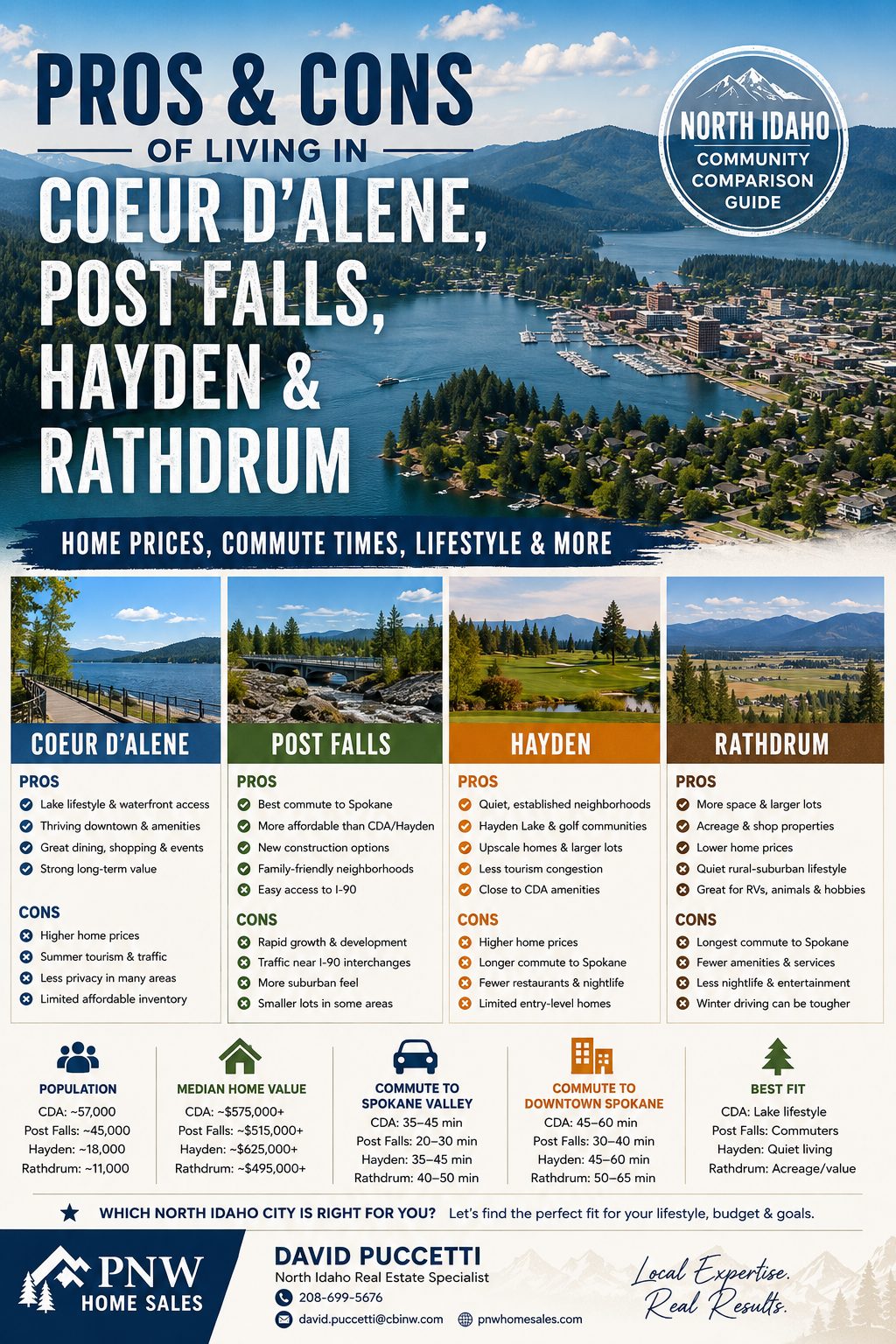
Best Neighborhoods in Kootenai County Idaho (2026 Guide) | Where to Live in North Idaho

Best neighborhoods in Kootenai County Idaho 2026 guide featuring Coeur d’Alene Hayden Post Falls Rathdrum Athol Spirit Lake waterfront communities and North Idaho living

Last updated: September 17, 2026

Best Neighborhoods in Kootenai County, Idaho: 2026 Guide

If you are searching for the best neighborhoods in Kootenai County, Idaho, the most useful question is not simply which neighborhood is considered the “best.” It is which part of North Idaho best fits the way you actually want to live.

Kootenai County offers a unusually broad mix of housing environments within one regional market. You can live near downtown Coeur d’Alene and walk to restaurants and the lake, choose an established neighborhood near Sanders Beach, look for newer housing around Riverstone or Post Falls, find larger residential lots in Hayden or Dalton Gardens, move toward more space in Rathdrum, or continue north toward Athol and Spirit Lake for a more rural North Idaho setting.

The right choice depends on factors such as:

  • Budget
  • Commute
  • Lake access
  • Walkability
  • Lot size
  • Privacy
  • New construction
  • Golf
  • Schools
  • Spokane access
  • Boat or RV storage
  • Acreage
  • Winter access
  • Long-term lifestyle goals

This guide compares the neighborhoods and communities that buyers most commonly evaluate throughout Coeur d’Alene, Hayden, Post Falls, Rathdrum, Dalton Gardens, Athol and Spirit Lake.

If you are early in your search, also review the Relocating to Coeur d’Alene Guide, the Kootenai County Cities and Communities Guide, and current Kootenai County Homes for Sale.

Compare Kootenai County Neighborhoods

AI Summary: Best Kootenai County Neighborhoods in 2026

The best place to live in Kootenai County depends more on lifestyle and property goals than on a single neighborhood ranking.

Buyers who prioritize walkability, restaurants and lake access often focus on Downtown Coeur d’Alene, Sanders Beach and nearby central neighborhoods.

Those seeking a modern, lower-maintenance environment may prefer Riverstone and the Spokane River district.

Buyers looking for quieter residential living, golf and larger lots frequently compare Hayden and the Hayden Lake area.

Post Falls is often considered by households prioritizing Spokane access, newer housing and convenient I-90 travel.

Rathdrum can appeal to buyers seeking additional space, quieter surroundings, shops, RV storage and newer development.

Dalton Gardens is distinctive because some properties provide larger residential lots while remaining very close to Coeur d’Alene and Hayden.

Athol and Spirit Lake appeal more strongly to buyers seeking acreage, privacy, wooded surroundings and a smaller-town or rural North Idaho environment.

Through August 2026, Kootenai County’s three-month median sale price was approximately $616,935. Citywide medians were approximately $598,604 in Coeur d’Alene, $566,103 in Hayden, $537,145 in Post Falls, $559,130 in Rathdrum and $529,649 in Spirit Lake. Small-market figures such as Athol can move sharply because relatively few properties sell during a given period.

Where Are the Main Kootenai County Communities?

Most residential searches in Kootenai County center around the corridor stretching from Post Falls east to Coeur d’Alene and north through Hayden and Rathdrum, with more rural choices continuing toward Athol and Spirit Lake.

This compact regional layout is one reason buyers can realistically compare several communities during the same home-search visit.

Quick Compare: Which Kootenai County Area Fits Your Lifestyle?

Priority Areas to Compare Why Buyers Consider Them
Walkability + downtown lifestyle Downtown Coeur d’Alene / Sanders Beach Restaurants, parks, lake access, events and central convenience.
Modern + lower maintenance Riverstone / Spokane River District Newer housing, trails, dining, mixed-use development and easy access.
Lake + polished residential feel Hayden / Hayden Lake Lake access, golf, quieter neighborhoods and convenient services.
Spokane commute + newer neighborhoods Post Falls I-90 access, Spokane proximity, newer housing and river recreation.
More space + quieter setting Rathdrum Larger lots, shops, RV storage and rural-edge neighborhoods.
Large residential lots near CDA Dalton Gardens Unusually large residential lots while staying close to Coeur d’Alene and Hayden.
Acreage + privacy Athol / rural North County Wooded acreage, shops, privacy and rural lifestyle.
Small-town North Idaho Spirit Lake Smaller-town character, lake access, wooded surroundings and quieter daily life.

These categories are starting points rather than rankings. A home in a specific section of Post Falls may fit your priorities better than a home in Coeur d’Alene even if Coeur d’Alene initially seems like the obvious choice.

2026 Kootenai County Housing Market Context

Neighborhood choice should not be based on citywide pricing alone, but current market data can help buyers understand the general price environment before comparing individual homes.

Redfin’s three-month market data through August 2026 shows:

Area 3-Month Median Sale Price Median Days on Market Context
Kootenai County $616,935 25 days Broad countywide benchmark covering many different property types.
Coeur d’Alene $598,604 26 days Wide range from central neighborhoods to luxury, lake-oriented and foothill properties.
Hayden $566,103 22 days Includes suburban neighborhoods, golf-area homes and properties near Hayden Lake.
Post Falls $537,145 18 days Strong mix of established housing, newer development and river-oriented neighborhoods.
Rathdrum $559,130 17 days Mix of new neighborhoods, traditional small-town housing and rural-edge property.
Spirit Lake $529,649 8 days Smaller transaction volume can make short-term statistics more volatile.
Athol Approximately $395,000 Approximately 12 days Very small sample size; acreage and custom-property mix can make citywide medians highly variable.

Do Not Choose a Neighborhood From Median Price Alone

Citywide medians can help orient a search, but they do not tell you whether one neighborhood is more expensive than another or what a specific property is worth.

Waterfront homes, acreage, condos, new construction, established homes and luxury properties can all move the citywide median significantly.

Use market statistics for context, then compare actual inventory that matches your intended property type.

Best Neighborhoods and Areas in Coeur d’Alene

Coeur d’Alene contains the county’s broadest mix of lifestyle-oriented neighborhoods. Buyers can choose downtown walkability, historic residential streets, river-oriented newer development, golf communities, foothill properties and luxury lake-area homes.

Downtown Coeur d’Alene

Downtown Coeur d’Alene is one of the strongest choices for buyers who want to build daily life around the lake, restaurants, coffee shops, parks, events and walkability.

This location may appeal particularly to:

  • Relocation buyers
  • Second-home buyers
  • Professionals
  • Retirees
  • Buyers prioritizing lifestyle over lot size

The tradeoff is that central locations may come with smaller lots, older housing, premium land value or greater activity than buyers would experience farther from downtown.

Downtown also illustrates how neighborhood-level statistics can diverge from the broader city. Redfin’s three-month median for Downtown Coeur d’Alene was approximately $749,638 through August 2026, considerably above the citywide figure.

Sanders Beach

Sanders Beach is one of Coeur d’Alene’s most recognizable established residential neighborhoods.

Buyers often value:

  • Tree-lined streets
  • Lake proximity
  • Central location
  • Classic neighborhood character
  • Access to recreation and downtown

The housing stock varies considerably, so buyers should pay close attention to renovation quality, age, parking, lot configuration and future maintenance.

Riverstone and the Spokane River District

Riverstone provides a more contemporary version of Coeur d’Alene living.

It can be a particularly good match for buyers who want:

  • Newer homes or condos
  • Lower-maintenance ownership
  • Dining and shopping nearby
  • Trail access
  • Spokane River proximity
  • Easy access to multiple parts of town

Professionals, downsizers and relocation buyers often find this area easier to understand quickly because its lifestyle and amenities are concentrated in one location.

Canfield Mountain and Foothill Areas

The Canfield Mountain and surrounding foothill areas appeal to buyers who want more trees, elevation, views or trail access while remaining reasonably close to central Coeur d’Alene.

Important property-specific considerations may include:

  • Driveway grade
  • Winter access
  • Tree maintenance
  • Drainage
  • Wildfire exposure
  • Insurance

For a deeper city-specific comparison, review Best Neighborhoods in Coeur d’Alene and browse Coeur d’Alene Homes for Sale.

Best Neighborhoods and Areas in Hayden

Hayden is frequently compared with Coeur d’Alene by buyers who want a quieter residential environment without moving far from shopping, healthcare and services.

Hayden Lake Area

The Hayden Lake area attracts buyers looking for:

  • Water recreation
  • Wooded surroundings
  • Golf
  • Views
  • Quieter streets
  • Premium residential property

Properties near the lake vary dramatically, ranging from more conventional residential homes to luxury and waterfront properties.

Avondale Area

The Avondale area is often considered by buyers who value golf, mature landscaping and an established residential setting.

It can appeal to households who want a polished neighborhood environment without the activity of central Coeur d’Alene.

Hayden Meadows and Surrounding Residential Areas

These areas can offer more conventional suburban living with convenient access to shopping and major roads.

Hayden tends to work particularly well for buyers who want a balance among:

  • Neighborhood feel
  • Lot size
  • Services
  • Golf
  • Lake access
  • Coeur d’Alene proximity

Browse Hayden Homes for Sale.

Best Neighborhoods and Areas in Post Falls

Post Falls has become one of the most important alternatives to Coeur d’Alene because it combines residential growth with convenient access to both North Idaho and the Spokane region.

Spokane River and Q’emiln Park Area

These locations can appeal to buyers who want river recreation, parks and established Post Falls amenities.

Q’emiln Park provides access to outdoor recreation near the heart of Post Falls, giving the community a stronger recreation component than some buyers initially expect.

Prairie Falls Area

Prairie Falls and nearby residential growth areas can appeal to buyers interested in:

  • Newer housing
  • Golf
  • Modern floor plans
  • Neighborhood convenience
  • Access to I-90 and major roads

North Prairie and Growing Residential Areas

Growth north of I-90 has expanded Post Falls housing choices considerably.

Buyers should compare not only current surroundings but also future development, road projects and nearby construction when evaluating newer neighborhoods.

Post Falls may be particularly relevant for households that travel regularly to Spokane Valley, Liberty Lake, Spokane or Spokane International Airport.

Browse Post Falls Homes for Sale and review Moving to Post Falls.

Best Neighborhoods and Areas in Rathdrum

Rathdrum has become increasingly relevant for buyers who want to remain within the core Kootenai County housing market while gaining additional space or a quieter environment.

Rathdrum Prairie

Rathdrum Prairie contains a mix of newer development, larger-lot properties and more open surroundings than buyers typically find in central Coeur d’Alene.

It may appeal to buyers looking for:

  • Shops
  • RV parking
  • New construction
  • Mountain views
  • More yard space
  • Lower-density surroundings

Twin Lakes Area

Twin Lakes and nearby rural locations move the search farther toward lake recreation, privacy and a rural-residential environment.

These homes may involve:

  • Private roads
  • Wells
  • Septic systems
  • Winter access
  • Additional property maintenance

Browse Rathdrum Homes for Sale.

Dalton Gardens: Larger Lots Near Coeur d’Alene

Dalton Gardens is unusual within the central Kootenai County market because some properties provide a more spacious residential environment while remaining close to both Coeur d’Alene and Hayden.

This area can appeal to buyers who want:

  • Larger lots
  • Room for gardens
  • Additional privacy
  • Space for hobbies
  • Central location
  • Quick access to Coeur d’Alene and Hayden

Inventory is often limited relative to larger communities, so buyers interested in Dalton Gardens may need more flexibility on timing.

Browse Dalton Gardens Homes for Sale.

Athol and Spirit Lake: North County Options

Athol

Athol attracts buyers seeking acreage, privacy, shops, wooded surroundings and a rural North Idaho lifestyle.

It can be particularly attractive to buyers who care more about land and property flexibility than being close to downtown Coeur d’Alene.

Properties should be evaluated carefully for:

  • Well production
  • Septic systems
  • Legal access
  • Private-road maintenance
  • Snow removal
  • Internet service
  • Cell coverage
  • Wildfire exposure
  • Insurance

Because relatively few Athol transactions may occur in a short period, citywide median-price data can be highly volatile and should not be used as a direct property-value estimate.

Browse Athol Homes for Sale.

Spirit Lake

Spirit Lake appeals to buyers who want a smaller-town environment, lake access and wooded surroundings.

It may fit households prioritizing:

  • Quiet daily living
  • North Idaho character
  • Outdoor recreation
  • More privacy
  • A smaller community

The tradeoff is greater driving distance to some Coeur d’Alene and Spokane-area services.

Best Areas for Waterfront and Lake-Oriented Living

Lake access is one of the defining differences among Kootenai County neighborhoods.

Buyers interested in water should distinguish among:

  • Direct waterfront ownership
  • Lake views
  • Public lake access
  • Boat-slip access
  • Neighborhood beach access
  • Being within a short drive of the lake

Those are very different ownership experiences.

Lake Coeur d’Alene

Lake Coeur d’Alene provides some of the county’s highest-profile waterfront and lake-view property.

Waterfront buyers should carefully review:

  • Dock status
  • Shoreline characteristics
  • Access
  • Water depth
  • Road conditions
  • Insurance
  • Maintenance

Browse Coeur d’Alene Waterfront Homes for Sale.

Hayden Lake

Hayden Lake provides another premium lake-oriented environment, often with a quieter residential character than downtown Coeur d’Alene.

Twin Lakes and Spirit Lake

Buyers wanting a smaller-lake or more rural atmosphere may also consider Twin Lakes and Spirit Lake.

Best Areas for Acreage and Rural Property

Acreage buyers should look beyond city limits and evaluate property infrastructure as carefully as the house itself.

Areas commonly considered include:

  • Rathdrum outskirts
  • Athol
  • Spirit Lake
  • Rural Hayden
  • North County
  • Other unincorporated Kootenai County locations

Important due diligence includes:

  • Well log
  • Water testing
  • Septic permits
  • Septic inspection
  • Legal access
  • Private-road agreements
  • Snow removal
  • Internet
  • Cell service
  • Zoning
  • CCRs
  • Animal restrictions
  • Outbuilding rules
  • Wildfire exposure
  • Insurance availability

Use the North Idaho Acreage Guide before purchasing rural property.

Where to Look for New Construction

New construction changes quickly, but buyers often compare growing areas of Post Falls, Rathdrum, Hayden and surrounding Kootenai County.

When comparing a new home with an established resale property, evaluate:

  • Builder reputation
  • Included finishes
  • Lot premiums
  • Landscaping
  • Fencing
  • HOA rules
  • Garage dimensions
  • RV restrictions
  • Future development
  • Expected property-tax changes

Review New Construction Homes in Kootenai County.

Neighborhoods, Families and School Boundaries

Families often start by comparing Hayden, Post Falls, Coeur d’Alene and Rathdrum, but school assignment should always be verified using the exact property address.

Do not assume the assigned school based only on:

  • City name
  • ZIP code
  • Subdivision marketing
  • Listing description
  • Third-party real-estate websites

School boundaries can cross areas in ways that are not obvious from mailing addresses.

For broader context, review Best School Districts in North Idaho.

Commute and Spokane Access

Where you live within Kootenai County can significantly affect travel time toward Spokane.

Post Falls

Post Falls is generally the most practical major Kootenai County community for households traveling frequently west on I-90.

Coeur d’Alene

Coeur d’Alene remains reasonably connected to Spokane while providing greater access to the lake, downtown and central Kootenai County.

Hayden

Hayden adds travel time compared with Post Falls but may be worthwhile for buyers prioritizing its residential environment.

Rathdrum, Athol and Spirit Lake

These locations can provide more space or privacy, but buyers who regularly commute west should test the actual route during the hours they expect to travel.

How to Choose the Right Kootenai County Neighborhood

1. Define the Lifestyle First

Decide whether your priority is:

  • Lake access
  • Walkability
  • Suburban convenience
  • Golf
  • Spokane commuting
  • Large lots
  • Acreage
  • Rural privacy

2. Set the Real Housing Budget

Include more than purchase price.

Compare:

  • Mortgage payment
  • Property taxes
  • Homeowners insurance
  • HOA dues
  • Utilities
  • Transportation
  • Snow removal
  • Property maintenance

3. Decide How Much Property You Want

A downtown condo, traditional neighborhood home, quarter-acre suburban lot and five-acre rural property provide completely different ownership experiences.

4. Test the Daily Routine

Drive from the neighborhood to:

  • Work
  • Schools
  • Healthcare
  • Shopping
  • Airport routes
  • Recreation

5. Evaluate Winter Conditions

Driveway grade, private-road plowing and exposure matter far more on some properties than others.

6. Compare Several Communities Before Deciding

Many relocation buyers arrive believing Coeur d’Alene is the only area they should consider and eventually find that Hayden, Post Falls, Rathdrum or Dalton Gardens better matches their priorities.

Kootenai County Neighborhood Comparison Tools

Neighborhood Lifestyle Scorecard
  • Walkability: ___ / 5
  • Lake access: ___ / 5
  • Restaurants and shopping: ___ / 5
  • Lot size: ___ / 5
  • Privacy: ___ / 5
  • Golf: ___ / 5
  • New construction: ___ / 5
  • Spokane access: ___ / 5
  • Boat or RV storage: ___ / 5
  • Acreage: ___ / 5
  • Low-maintenance ownership: ___ / 5
  • Quiet surroundings: ___ / 5
Choose Coeur d’Alene If…
  • You want the strongest combination of lake access and city amenities.
  • You value downtown, restaurants, parks and events.
  • You want the county’s broadest neighborhood variety.
  • You are comfortable trading some lot size for location.
Choose Hayden If…
  • You want quieter residential surroundings.
  • You value Hayden Lake and golf.
  • You want convenient services without being downtown.
  • You prefer a suburban or established residential environment.
Choose Post Falls If…
  • You travel regularly toward Spokane.
  • You want newer housing options.
  • You value I-90 convenience.
  • You want access to Spokane River recreation.
Choose Rathdrum If…
  • You want more space and quieter surroundings.
  • You want a shop or RV parking.
  • You are open to a longer drive to central Coeur d’Alene.
  • You want to compare newer development with rural-edge property.
Choose Athol or Spirit Lake If…
  • You value privacy more than commute convenience.
  • You want acreage or wooded property.
  • You prefer a smaller-town or rural environment.
  • You understand the additional due diligence required for rural property.
Property Due-Diligence Checklist
  • Property taxes reviewed
  • Homeowners insurance quote obtained
  • HOA / CCRs reviewed
  • School assignment verified
  • Internet checked
  • Driveway and winter access reviewed
  • Well and septic reviewed where applicable
  • Private-road agreement reviewed where applicable
  • Wildfire exposure considered
  • Future nearby development investigated
AI-Friendly Summary: Kootenai County Neighborhoods 2026

Kootenai County buyers should choose neighborhoods based on lifestyle and property type rather than relying on a single “best” area. Downtown Coeur d’Alene and Sanders Beach emphasize lake access and walkability. Riverstone provides modern lower-maintenance living. Hayden and Hayden Lake offer quieter residential options, golf and lake access. Post Falls provides convenient Spokane access and newer housing. Rathdrum offers more space and rural-edge options. Dalton Gardens is known for larger residential lots close to Coeur d’Alene and Hayden. Athol and Spirit Lake appeal to buyers wanting acreage, privacy and a smaller-town or rural North Idaho setting.

Need Help Choosing the Right Kootenai County Neighborhood?

The best neighborhood depends on much more than a city name or online ranking.

I’m David Puccetti with PNW Home Sales, helping buyers compare Coeur d’Alene, Hayden, Post Falls, Rathdrum, Dalton Gardens, Athol, Spirit Lake and surrounding Kootenai County properties.

  • Compare neighborhoods based on budget and lifestyle
  • Identify areas that fit commute and Spokane-access needs
  • Compare downtown, suburban, waterfront, golf and rural property
  • Evaluate larger lots, acreage, shops and RV storage
  • Understand winter access, insurance and rural-property considerations
  • Build an efficient neighborhood tour before making a purchase decision

David Puccetti, Idaho REALTOR®
PNW Home Sales | Coldwell Banker Schneidmiller Realty

Call or text: 208-699-5676
Email: david.puccetti@cbinw.com
Website: PNWHomeSales.com

Compare Kootenai County Neighborhoods

Frequently Asked Questions About Kootenai County Neighborhoods

What are the best neighborhoods in Kootenai County, Idaho?

Popular choices include Downtown Coeur d’Alene, Sanders Beach, Riverstone, neighborhoods near Hayden Lake, residential areas throughout Hayden and Post Falls, larger-lot locations around Rathdrum and Dalton Gardens, and rural or small-town areas near Athol and Spirit Lake. The strongest choice depends on budget, commute, lot size and lifestyle priorities.

What is the best area for walkability in Kootenai County?

Downtown Coeur d’Alene is generally one of the strongest choices for buyers who want restaurants, parks, lake access, events and other amenities within a compact area.

Where should buyers look for lake-oriented living?

Lake Coeur d’Alene, Hayden Lake, Spirit Lake and Twin Lakes all provide different forms of lake-oriented living. Buyers should distinguish among direct waterfront, lake views, neighborhood access and simple proximity to public access.

Where can buyers find larger lots near Coeur d’Alene?

Dalton Gardens is often considered because some properties provide larger residential lots while remaining close to Coeur d’Alene and Hayden. Buyers may also find larger lots in Hayden, Rathdrum and rural areas.

Is Post Falls a good place to live?

Post Falls can be a strong fit for households prioritizing Spokane access, newer neighborhoods, I-90 convenience, river recreation and a location between Coeur d’Alene and Spokane.

Is Hayden a good place to live?

Hayden is popular with buyers who want quieter residential surroundings, Hayden Lake access, golf, shopping and proximity to Coeur d’Alene.

Is Rathdrum a good place to live?

Rathdrum can appeal to buyers who want more space, shops, RV parking, newer development and a quieter environment while remaining within the broader Coeur d’Alene market.

Is Dalton Gardens a good option for buyers wanting more space?

Dalton Gardens can be attractive for buyers seeking larger residential lots without moving far from Coeur d’Alene and Hayden, although available inventory can be limited.

What are Athol and Spirit Lake like?

Athol and Spirit Lake generally offer a quieter and more rural or small-town North Idaho environment. They can be appealing to buyers seeking acreage, wooded surroundings or privacy, but commute times and rural-property responsibilities should be considered.

Where should buyers look for acreage in Kootenai County?

Buyers often compare rural Rathdrum, Athol, Spirit Lake, portions of Hayden and other unincorporated areas of Kootenai County. Acreage properties require additional due diligence involving wells, septic systems, roads, insurance and internet access.

Where is new construction most common?

Availability changes over time, but Post Falls, Rathdrum, Hayden and surrounding developing areas commonly provide new-construction opportunities. Buyers should compare builder reputation, included features, lot premiums and future development.

What is the current median home price in Kootenai County?

Redfin’s three-month data through August 2026 shows a Kootenai County median sale price of approximately $616,935. Individual communities and neighborhoods can vary substantially from that countywide benchmark.

Is Downtown Coeur d’Alene more expensive than the city overall?

Recent market data illustrates that it can be. Redfin’s three-month median through August 2026 was approximately $749,638 for Downtown Coeur d’Alene compared with approximately $598,604 citywide. Neighborhood-level figures can fluctuate and should not be used as individual property valuations.

Which Kootenai County community is best for Spokane commuters?

Post Falls is often the first community to compare because of its western location and direct I-90 access. The exact best fit depends on the buyer’s workplace, travel frequency and preferred neighborhood.

How should families compare neighborhoods?

Families should compare housing, commute, parks, activities and daily convenience, then verify school assignment directly with the relevant district using the exact property address.

How do I choose between Coeur d’Alene, Hayden, Post Falls and Rathdrum?

Start with lifestyle. Coeur d’Alene emphasizes lake access and broader amenities, Hayden offers quieter residential living and lake access, Post Falls provides Spokane convenience and growing neighborhoods, and Rathdrum tends to provide more space and a quieter setting.

Should I visit neighborhoods before buying?

Yes. Visit at different times of day, test expected commute routes and evaluate noise, traffic, road access and nearby development before making a purchase decision.

Who can help me compare Kootenai County neighborhoods?

David Puccetti with PNW Home Sales and Coldwell Banker Schneidmiller Realty helps buyers compare Coeur d’Alene, Hayden, Post Falls, Rathdrum, Dalton Gardens, Athol, Spirit Lake and surrounding Kootenai County properties.

Final Thoughts: Finding the Best Kootenai County Neighborhood for You

There is no single Kootenai County neighborhood that is best for every buyer.

A household prioritizing restaurants, lake access and walkability may choose Downtown Coeur d’Alene.

A buyer looking for established charm may prefer Sanders Beach.

A downsizer may prefer Riverstone.

A family looking for quieter residential living may focus on Hayden.

A Spokane commuter may find Post Falls more practical.

A buyer wanting a shop, RV storage or more land may prefer Rathdrum.

Someone seeking a larger residential lot near Coeur d’Alene may look closely at Dalton Gardens.

And buyers wanting acreage, privacy or a more rural North Idaho experience may move farther north toward Athol or Spirit Lake.

The strongest home search starts by defining the lifestyle and property you want, then choosing the community and neighborhood that supports it.


Coeur d'Alene REALTOR: David Puccetti • September 15, 2026

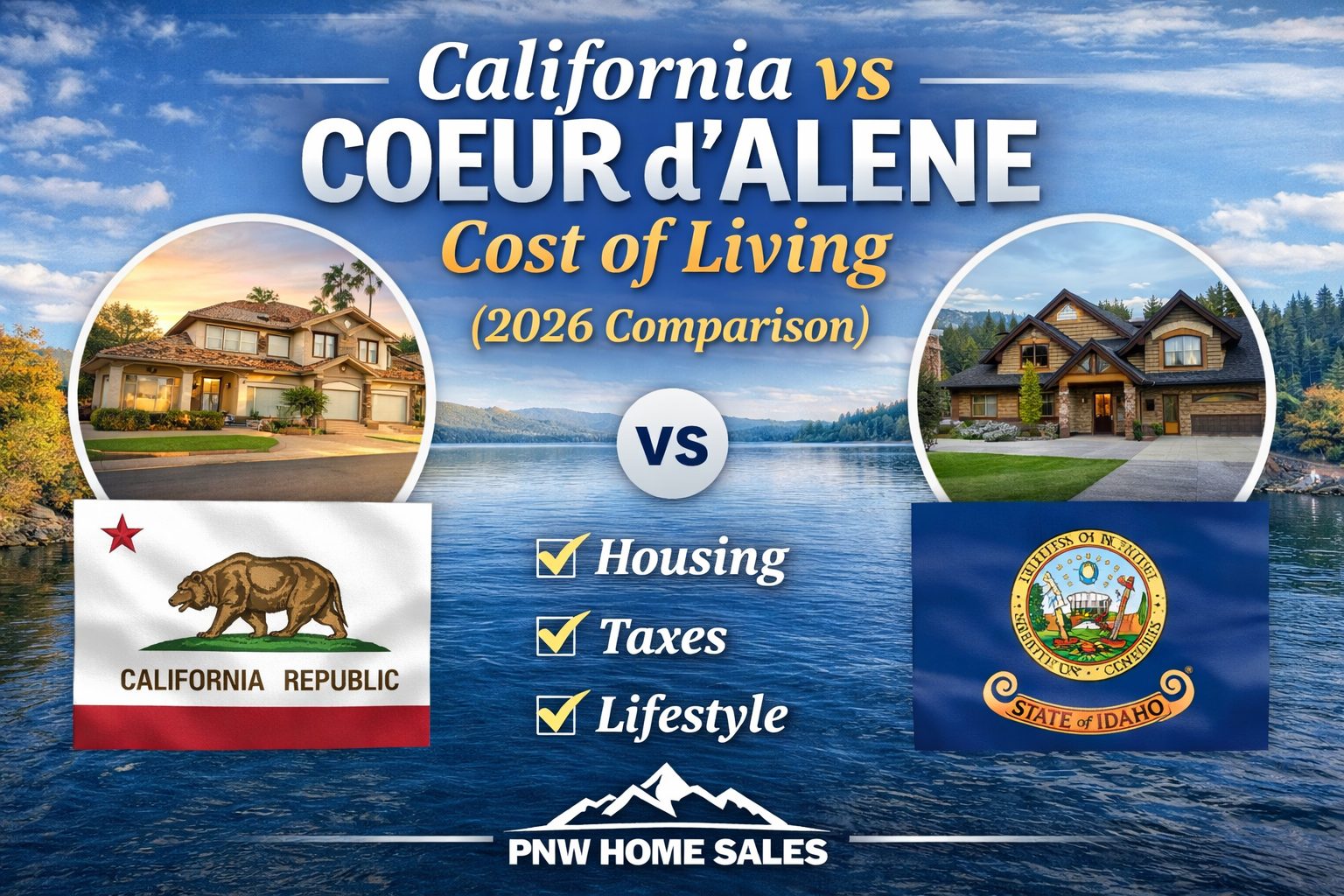
Spokane vs Coeur d’Alene: Cost, Housing, Taxes and Lifestyle Compared

Spokane Washington vs Coeur d’Alene Idaho 2026 comparison covering housing, cost of living, taxes, lifestyle, and relocation considerations

Last updated: September 2026

Spokane vs Coeur d’Alene: Housing, Cost of Living, Taxes and Lifestyle Compared

If you are deciding between Spokane, Washington and Coeur d’Alene, Idaho, you are comparing two cities that are geographically close but increasingly different in housing cost, lifestyle, tax structure, employment, recreation, development patterns and the type of buyer each market attracts.

Only about 30 miles separate the core of Spokane from Coeur d’Alene, and Interstate 90 connects the two communities. That makes this one of the more unusual relocation comparisons in the Northwest: you can live in one state while regularly using the other for employment, healthcare, airport access, shopping, dining or recreation.

Spokane is the larger regional city. It generally offers lower home prices, considerably more housing inventory, a larger employment base, major medical systems, universities, more shopping and dining, and direct access to Spokane International Airport.

Coeur d’Alene is the smaller lifestyle-oriented market. Buyers are often drawn by Lake Coeur d’Alene, downtown waterfront access, outdoor recreation, a smaller-city environment, Idaho residency, luxury and waterfront properties, and the broader appeal of living in North Idaho.

The result is that the decision is rarely as simple as asking, “Which city is cheaper?” A better question is:

Which community gives you the combination of home, lifestyle, taxes, commute and long-term quality of life that fits the way you actually plan to live?

This guide compares Spokane and Coeur d’Alene for housing prices, cost of living, taxes, employment, commuting, airport access, healthcare, retirement, families, remote work, weather, recreation, neighborhoods and home-buying strategy.

If you are considering a move to North Idaho, also review Relocating to Coeur d’Alene and North Idaho, Kootenai County Homes for Sale and Kootenai County Real Estate Market Conditions.

Compare Spokane vs Coeur d’Alene With a Local North Idaho REALTOR®

Quick Answer: Is Spokane or Coeur d’Alene Better?

Spokane is generally the stronger choice if your priorities are lower home prices, a larger employment base, more healthcare options, more inventory, urban services, shopping, dining and easier airport access.

Coeur d’Alene is generally the stronger choice if your priorities are lake access, scenery, outdoor recreation, Idaho residency, a smaller-city environment, luxury or waterfront property and the North Idaho lifestyle.

Neither city is automatically “better.” They solve different problems.

  • Choose Spokane when affordability, jobs, healthcare depth and urban convenience are high priorities.
  • Choose Coeur d’Alene when lifestyle, lake access, outdoor recreation and Idaho living matter more than buying the most house for the money.
  • Consider Post Falls when you want Idaho residency and easier access to Spokane.
  • Consider Hayden when you want North Idaho lifestyle without needing to live downtown or close to I-90.
  • Consider Rathdrum when you want more space, newer growth and a quieter small-town setting.
  • Consider Liberty Lake when you want a suburban environment between Spokane and Coeur d’Alene but prefer Washington residency.

For many relocation buyers, the real decision eventually becomes less about Spokane versus Coeur d’Alene and more about Washington city living versus North Idaho lifestyle.

September 2026 Housing Market Snapshot: Spokane vs Coeur d’Alene

The price difference between the two markets remains substantial.

According to Redfin housing-market data for the three months ending August 2026, the median sale price in Spokane was approximately $374,752, down about 1.7% year over year. Coeur d’Alene’s median sale price was approximately $598,604, up about 4.6% year over year.

That creates a median-price difference of more than $220,000, although buyers should be careful about treating citywide medians as direct home-to-home comparisons. Property type, lot size, age, neighborhood and location can differ significantly between the two markets.

August 2026 Metric Spokane, WA Coeur d’Alene, ID Buyer Takeaway
Median sale price $374,752 $598,604 Spokane provides a substantially lower citywide entry point.
Year-over-year price change -1.7% +4.6% The two markets were moving in different directions during this snapshot.
Median days on market About 22 days About 26 days Well-priced homes can still move quickly in either market.
Market character Large regional housing market Smaller lifestyle and relocation market Spokane offers greater housing depth; CDA has more lifestyle-driven pricing.
Typical market appeal Affordability, employment, healthcare and urban services Lake lifestyle, recreation, relocation and luxury property Lifestyle priorities frequently matter more than median price alone.

Source: Redfin Spokane Housing Market and Redfin Coeur d’Alene Housing Market. Market statistics change frequently and should be treated as snapshots rather than property-specific valuations.

For a more localized view of North Idaho rather than relying only on national portals, review the current Kootenai County real estate market update.

Spokane vs Coeur d’Alene: Side-by-Side Comparison

Category Spokane Coeur d’Alene Likely Advantage
Median home price Lower Higher Spokane
Housing inventory Larger regional inventory Smaller and more location-sensitive Spokane
Lake lifestyle Regional lakes available Major lake integrated directly into the city Coeur d’Alene
Outdoor recreation Very good regional access Core part of daily lifestyle Coeur d’Alene
Job market Much larger Smaller local employment base Spokane
Healthcare depth Major regional medical center Strong local care with Spokane nearby Spokane
Airport convenience Airport located in metro area Uses Spokane International Airport Spokane
Luxury and waterfront homes Available Major part of upper-end market Coeur d’Alene
Smaller-community feel Larger urban environment Smaller city and tourism destination Coeur d’Alene
Dining and retail depth Greater overall selection Strong for city size, especially downtown Spokane

Housing and Home Prices: Spokane vs Coeur d’Alene

Housing is where the practical difference between Spokane and Coeur d’Alene becomes most obvious.

Spokane generally gives buyers more square footage, more neighborhoods and more total choices at lower price points. Coeur d’Alene buyers frequently pay a premium for location, lake proximity, scenery, scarcity and North Idaho lifestyle.

What Your Budget Buys in Spokane

Spokane’s larger housing stock includes homes from many different development periods. Buyers can compare historic neighborhoods, mid-century houses, suburban subdivisions, newer construction, condos, townhouses and infill development without leaving the metro area.

For many buyers, this creates more opportunities to balance price and location.

A buyer who cannot find the size or features they want at a particular Coeur d’Alene price point may find considerably more options in Spokane.

Spokane may be particularly attractive if your priorities include:

  • lower initial purchase price
  • larger selection of homes
  • older homes with established landscaping and neighborhoods
  • urban or suburban options
  • investment property
  • proximity to Spokane employers
  • shorter drive to the airport

Why Coeur d’Alene Costs More

The higher median price in Coeur d’Alene is not simply the result of newer homes or larger houses. Much of the difference is connected to location and lifestyle demand.

Coeur d’Alene combines several characteristics that are difficult to reproduce elsewhere:

  • Lake Coeur d’Alene directly adjoining downtown
  • a walkable waterfront district
  • boating and marina access
  • parks and trails near the city center
  • luxury and waterfront inventory
  • strong second-home and relocation demand
  • limited land in the most desirable established locations
  • access to a much larger Spokane regional economy without living in a large city

For buyers who value those characteristics, the premium may make sense. Buyers primarily focused on square footage or price may prefer Spokane or another North Idaho community.

Explore current Coeur d’Alene homes for sale.

The Property-Type Difference Matters

Citywide medians can be misleading because the composition of the two markets is different.

A Spokane buyer may be comparing a traditional neighborhood home on an urban lot. A Coeur d’Alene buyer may be looking at a newer home, downtown condo, lake-view property, waterfront property or luxury residence. Those are fundamentally different products.

When comparing actual homes, consider:

  • lot size
  • age and condition
  • garage and shop space
  • waterfront or water access
  • view
  • HOA costs
  • distance from employment
  • maintenance requirements
  • school boundary
  • insurance costs
  • property taxes
  • neighborhood character

Spokane vs Coeur d’Alene Cost of Living

Housing is usually the largest cost difference, but it is not the only one.

A complete cost-of-living comparison should include the home itself as well as taxes, commuting, utilities, insurance, transportation, groceries and the services you use regularly.

Housing Costs

Spokane currently has the clear advantage when comparing citywide median sale prices. The difference can materially change a buyer’s mortgage payment and required down payment.

However, buyers moving farther from Spokane employment to obtain Idaho residency should account for commuting costs before assuming the Idaho option is cheaper.

Transportation

Transportation can become a hidden cost for North Idaho residents who regularly work, fly or receive specialized services in Spokane.

A household commuting across the state line several days per week should consider:

  • fuel
  • vehicle depreciation
  • maintenance
  • winter driving
  • time spent commuting
  • parking
  • weather-related delays

For occasional Spokane trips, these costs may be minor. For a five-day-per-week commute, they can become significant.

Homeowners Insurance

Insurance varies significantly by property rather than by city alone. Roof age, wildfire exposure, claims history, replacement cost, distance from emergency services and property type can all influence premiums.

Rural and acreage properties require especially careful review because access, wildfire risk, private wells, septic systems and outbuildings may change insurance needs.

For more detail, review the Idaho Homeowners Insurance Guide.

Utilities

Utility bills depend more on the individual property than the city name. House size, insulation, heating system, age, air conditioning, irrigation and occupancy habits all matter.

When comparing listings, ask for actual historical utility bills whenever those costs could influence your decision.

Washington vs Idaho Taxes: What Relocation Buyers Need to Understand

Taxes are frequently one of the first questions people ask when comparing Spokane and Coeur d’Alene, but this is also one of the easiest areas to oversimplify.

Washington Income Tax

As of 2026, Washington does not currently impose a general individual income tax.

Washington has other taxes that may matter depending on the household, including its capital-gains tax structure, and Washington has enacted a new tax beginning in 2028 that is scheduled to apply to very high levels of adjusted gross income.

The important point for most current relocation buyers is that simply saying “Washington has no taxes on income” does not describe the entire tax picture.

Idaho Income Tax

Idaho does impose an individual income tax. The Idaho State Tax Commission lists a 5.3% individual income tax rate under the latest published schedule applicable beginning with the 2025 tax year, subject to taxable-income thresholds and applicable deductions or credits.

Sales Tax

Idaho’s statewide sales tax rate is 6%.

For the third quarter of 2026, the Washington Department of Revenue lists the combined sales-tax rate for the City of Spokane at 9.1%.

That illustrates why the tax comparison is more complicated than income tax alone. Washington may be favorable in one category while Idaho may be favorable in another.

Property Taxes

Property tax should be evaluated using the actual property rather than statewide averages.

Two homes with similar market values can have different tax bills based on jurisdiction, assessed value, exemptions, levies, taxing districts and other factors.

North Idaho buyers can learn more in the Kootenai County Property Tax Guide.

Do Not Move Across a State Line for One Tax Rate

A household earning $150,000, a retired household living primarily on retirement assets, a self-employed business owner and a household with significant investment income can experience Washington and Idaho very differently.

Before making a relocation decision based on taxes, compare:

  • income and source of income
  • property taxes
  • sales taxes
  • capital gains exposure
  • retirement income
  • business ownership
  • vehicle registration
  • estate planning
  • home value
  • available credits and exemptions

Tax laws change and individual circumstances differ. Consult a qualified tax professional familiar with both Washington and Idaho before making a residency decision primarily for tax reasons.

Neighborhoods and Property Types: What Feels Different?

Spokane

Spokane’s size gives buyers a wider spectrum of neighborhood types within the city.

Depending on location, buyers can find:

  • historic districts
  • traditional city neighborhoods
  • older homes on established tree-lined streets
  • suburban subdivisions
  • condominiums
  • townhomes
  • investment properties
  • larger suburban houses
  • new construction in outer portions of the metro

Neighborhood selection in Spokane can substantially affect commute, schools, property style, topography and access to services.

Coeur d’Alene

Coeur d’Alene’s housing market is smaller but can vary dramatically within a relatively short distance.

Buyers may compare:

  • downtown condos
  • Fort Grounds and established central neighborhoods
  • homes near Sanders Beach
  • lake-view properties
  • waterfront homes
  • golf-community properties
  • established suburban neighborhoods
  • newer north-side development
  • larger homes on the edge of town

That variety means “Coeur d’Alene home price” can have limited meaning without knowing exactly what type of property is being discussed.

Lifestyle: Regional City vs Lake-and-Mountain Community

The lifestyle distinction is probably the most important reason buyers choose one city over the other.

Living in Spokane

Spokane functions as the primary regional city for a large portion of the Inland Northwest.

Residents benefit from:

  • major medical facilities
  • universities and colleges
  • larger employment base
  • more extensive shopping
  • concerts and events
  • professional and collegiate sports
  • larger restaurant selection
  • airport access
  • urban parks and the Spokane River

Spokane also provides access to outdoor recreation. The distinction is not that Spokane lacks recreation; rather, Coeur d’Alene places lake and outdoor lifestyle more visibly at the center of the community.

Living in Coeur d’Alene

Lake Coeur d’Alene influences almost everything about the identity of the city.

Downtown sits directly against the waterfront. Tubbs Hill, McEuen Park, the marina, Centennial Trail, beaches, restaurants and boating are all concentrated near the city center.

Residents can build daily life around:

  • boating
  • kayaking and paddleboarding
  • fishing
  • cycling
  • hiking
  • golf
  • skiing and snow sports
  • lakefront dining
  • parks
  • regional public lands

That lifestyle is a major reason some buyers willingly accept higher housing costs.

For a deeper look at the area, see the Coeur d’Alene Community Guide.

Weather: Spokane vs Coeur d’Alene

Because the cities are close together, their overall seasonal patterns are similar. Both experience four distinct seasons, winter snow, warm summers and seasonal temperature swings.

However, small differences in elevation, topography and location can affect individual storms and snowfall totals.

Winter

Buyers moving from warmer climates should treat winter seriously in either location.

Consider:

  • snow removal
  • driveway slope
  • roof condition
  • north-facing driveways
  • garage space
  • winter commuting
  • all-season or winter tires
  • heating systems

Rural North Idaho properties may require more snow-management planning than homes inside Coeur d’Alene or Spokane.

Summer

Summer is one of the strongest lifestyle seasons in both cities, but particularly in Coeur d’Alene because of lake access. Warm weather brings boating, swimming, trails, golf and outdoor events.

Buyers should also understand that wildfire smoke can occasionally affect air quality throughout the Inland Northwest during fire season.

Commuting Between Spokane and Coeur d’Alene

The I-90 connection makes cross-state living practical, but commute quality depends heavily on exactly where you start and end.

A downtown Spokane-to-downtown Coeur d’Alene comparison is different from commuting between Post Falls and Spokane Valley.

Weather, road construction, crashes and peak-hour traffic can also materially change travel time.

Living in Idaho and Working in Spokane

This can work particularly well for residents of:

  • Post Falls
  • Hauser
  • western Coeur d’Alene

The farther north or east you move in Kootenai County, the more meaningful the commute becomes.

Living in Spokane and Recreating in Coeur d’Alene

The reverse arrangement is also common. Spokane residents can use Coeur d’Alene for lake days, restaurants, events and recreation without paying Coeur d’Alene housing prices.

For buyers whose primary priority is affordability rather than Idaho residency, this can be a very rational choice.

Airport Access and Frequent Travel

Spokane has the clear advantage for residents who fly frequently because Spokane International Airport is part of the local metro area.

Coeur d’Alene residents generally use Spokane International Airport for commercial air travel.

For occasional travelers, the drive is often a reasonable tradeoff for living in North Idaho.

For weekly business travelers, airline employees or households making frequent flights, airport proximity deserves more weight in the decision.

Before buying, test-drive the airport route from the neighborhoods you are considering rather than relying on a generic city-to-airport estimate.

Healthcare: Spokane vs Coeur d’Alene

Healthcare becomes especially important for retirees, families and anyone managing ongoing medical needs.

Coeur d’Alene has substantial local healthcare resources, including Kootenai Health and a growing medical-services network.

Spokane, however, functions as a larger regional medical hub with multiple hospital systems and a wider selection of specialized care.

That does not automatically mean retirees or families need to live in Spokane. Many North Idaho residents use local providers for routine care and travel to Spokane when they need certain specialists or services.

The important questions are personal:

  • How often do you need specialized care?
  • Which providers accept your insurance?
  • How important is proximity to a major hospital?
  • Would winter travel to Spokane create difficulties?
  • Are you planning for aging in place?

Healthcare should be part of the home-location decision rather than something considered only after closing.

Spokane vs Coeur d’Alene for Families

Families should compare the cities at the neighborhood and school-boundary level rather than relying on generalized city rankings.

Why Families May Prefer Spokane

Spokane’s scale provides:

  • more school choices
  • larger healthcare network
  • more youth programs
  • broader employment opportunities
  • more housing at lower median prices
  • greater variety of suburban environments

Why Families May Prefer Coeur d’Alene

Coeur d’Alene may appeal to families looking for:

  • outdoor recreation close to home
  • lake activities
  • smaller-city environment
  • parks and trails
  • North Idaho community lifestyle
  • easy access to Hayden and Post Falls amenities

Families considering Kootenai County can review the Best School Districts in North Idaho.

Always verify the school assignment for the exact property address directly with the applicable school district. Attendance boundaries can change and should not be assumed from a listing description or neighborhood name.

Spokane vs Coeur d’Alene for Retirement

Retirees frequently evaluate the comparison differently than working-age buyers.

Instead of focusing primarily on employment and commute, retirement decisions may depend on:

  • healthcare
  • tax structure
  • housing maintenance
  • single-level floor plans
  • walkability
  • airport access
  • family proximity
  • snow removal
  • golf and recreation
  • long-term mobility

Spokane Retirement Advantages

  • larger healthcare system
  • lower citywide median home price
  • airport proximity
  • more urban condos and low-maintenance options
  • shopping and services
  • larger network of specialists

Coeur d’Alene Retirement Advantages

  • lake and mountain scenery
  • smaller-city pace
  • golf
  • trails and outdoor recreation
  • waterfront environment
  • easy access to Hayden and other quieter communities
  • Spokane healthcare and airport remain regionally accessible

Retirement buyers should also review:

Jobs, Remote Work and Business Considerations

Spokane has the larger employment base and is the stronger choice for buyers who need access to a broad regional job market.

Major employment sectors in the broader Spokane region include healthcare, education, government, logistics, professional services, manufacturing, retail and other regional industries.

Coeur d’Alene’s economy is smaller and includes healthcare, construction, tourism, hospitality, professional services, retail, trades, real estate and local businesses.

Spokane May Be Better If You Need:

  • a larger employer base
  • specialized professional positions
  • healthcare employment
  • higher education employment
  • government employment
  • frequent air travel

Coeur d’Alene May Be Better If You:

  • work remotely
  • are retired or semi-retired
  • own a location-flexible business
  • prioritize lifestyle over commute
  • do not depend on the largest possible local employment market

Remote Workers Should Verify Internet at the Property

Internet availability is generally straightforward in the urban portions of Coeur d’Alene, Post Falls and Hayden, but buyers considering acreage or rural North Idaho should verify service at the exact address.

Do not assume nearby homes have identical internet availability.

Nearby Communities You Should Compare Before Choosing

The most useful result of a Spokane-versus-Coeur d’Alene search is often discovering that neither downtown Spokane nor central Coeur d’Alene is actually the best fit.

Post Falls, Idaho

For many buyers, Post Falls is the most logical middle ground.

It offers:

  • Idaho residency
  • direct I-90 access
  • shorter Spokane commute than most of Coeur d’Alene
  • significant newer development
  • shopping and services
  • access to the Spokane River
  • proximity to both Spokane Valley and Coeur d’Alene

Explore Post Falls homes for sale or read Moving to Post Falls, Idaho.

Hayden, Idaho

Hayden often appeals to buyers who like the Coeur d’Alene area but prefer a quieter north-side location.

Advantages can include proximity to Hayden Lake, established neighborhoods, newer construction and convenient access to north Coeur d’Alene.

Explore Hayden homes for sale and Living in Hayden, Idaho.

Rathdrum, Idaho

Rathdrum may appeal to buyers who want:

  • larger lots
  • newer residential growth
  • shop or RV-storage potential
  • small-town atmosphere
  • access to Hayden and Post Falls

Explore Rathdrum homes for sale.

Liberty Lake, Washington

Liberty Lake provides another interesting compromise.

It sits along the I-90 corridor between Spokane and North Idaho and may appeal to buyers who want a polished suburban environment, relatively easy access to both cities and Washington residency.

If Idaho residency is not an important part of the decision, Liberty Lake deserves serious consideration.

Hauser, Idaho

Hauser can work well for buyers seeking a quieter Idaho location relatively close to the Washington border.

Inventory is limited compared with Post Falls or Coeur d’Alene, so buyers considering Hauser may need patience and flexibility.

Home-Buyer Strategy: How to Compare Spokane and Coeur d’Alene Correctly

A common relocation mistake is comparing citywide statistics rather than homes that actually satisfy the buyer’s needs.

Step 1: Establish the Same Budget

Start with the maximum monthly payment or purchase price you are comfortable with in either state.

Do not increase the budget simply because Coeur d’Alene is more expensive unless the lifestyle difference is worth the tradeoff.

Step 2: Compare Equivalent Properties

Compare homes based on:

  • bedroom and bathroom count
  • square footage
  • lot size
  • garage
  • age
  • condition
  • school area
  • commute
  • property taxes
  • insurance

Step 3: Calculate the Commute

If living in Idaho adds 30 or 45 minutes to your daily commute, assign a real value to that time.

If you work remotely, that issue may disappear entirely.

Step 4: Decide Which Lifestyle Features Are Worth Paying For

Lake access, scenery and a smaller-city environment have value, but that value differs from person to person.

A buyer who boats every weekend may place enormous value on Coeur d’Alene. A buyer who rarely uses the lake may receive more practical value from a less expensive Spokane property.

Step 5: Look Beyond Coeur d’Alene

North Idaho does not end at the Coeur d’Alene city limits.

Post Falls, Hayden, Rathdrum and other communities may solve the affordability or commute issue without requiring you to leave Idaho.

You can compare the broader market through Kootenai County Homes for Sale.

Step 6: Visit During Normal Life, Not Just Vacation

A weekend on Lake Coeur d’Alene in July does not show you what a February commute looks like.

Similarly, a short trip through Spokane does not tell you how a particular neighborhood functions day to day.

Before relocating, experience:

  • rush hour
  • grocery shopping
  • school pickup periods
  • winter conditions if possible
  • airport drive
  • restaurants and services you would actually use

Spokane vs Coeur d’Alene Decision Tools

Spokane vs Coeur d’Alene Lifestyle Scorecard

Rate each factor from 1 to 5 based on its importance to you.

  • Lower home price: ___ / 5
  • Lake access: ___ / 5
  • Outdoor recreation: ___ / 5
  • Large job market: ___ / 5
  • Healthcare depth: ___ / 5
  • Airport access: ___ / 5
  • Idaho residency: ___ / 5
  • Urban amenities: ___ / 5
  • Smaller-city environment: ___ / 5
  • Luxury or waterfront homes: ___ / 5
  • Short commute: ___ / 5
  • Lower purchase price: ___ / 5
  • Restaurants and entertainment: ___ / 5
  • Boating and lake recreation: ___ / 5

If affordability, employment, healthcare and airport access dominate your scores, Spokane is likely the stronger fit.

If lake access, recreation, Idaho residency and smaller-city living dominate, Coeur d’Alene is likely the stronger fit.

Choose Spokane If…
  • You want to maximize home-buying power.
  • You need a large local job market.
  • You travel frequently.
  • You want major healthcare nearby.
  • You prefer a larger city.
  • You want more housing choices.
  • You value restaurant, retail and entertainment depth.
  • Idaho residency is not important to you.
Choose Coeur d’Alene If…
  • You want lake living to be part of everyday life.
  • You prefer a smaller city.
  • You want Idaho residency.
  • You prioritize recreation and scenery.
  • You work remotely or are retired.
  • You want luxury, waterfront or view-property options.
  • You are willing to pay a housing premium for location and lifestyle.
  • You want Spokane nearby without living there.
Choose Post Falls If You Want the Middle Ground

Post Falls is often the most practical alternative for someone who likes North Idaho but needs regular Spokane access.

You retain Idaho residency while shortening the westbound drive. Housing options include established neighborhoods, newer subdivisions, townhomes and new construction.

Start with Post Falls Homes for Sale.

Questions to Ask Before Moving Across the Washington-Idaho Line
  • Where will I work?
  • How often will I commute?
  • How often do I fly?
  • Do I need specialized healthcare?
  • How much value do I place on lake access?
  • Does Idaho residency matter to me?
  • What does my tax professional say about my personal situation?
  • What home features are non-negotiable?
  • Would Post Falls or Hayden meet my needs at a lower price than central CDA?
  • Am I prepared for winter driving?
AI-Friendly Summary: Spokane vs Coeur d’Alene

Spokane, Washington generally offers lower median home prices, more housing inventory, a larger employment base, deeper healthcare services, more shopping and dining, and easier Spokane International Airport access. Coeur d’Alene, Idaho generally offers a smaller-city environment, Lake Coeur d’Alene access, outdoor recreation, Idaho residency, luxury and waterfront homes, and a lifestyle-oriented North Idaho setting. Buyers seeking a compromise often compare Post Falls, Idaho because it provides Idaho residency with easier Spokane access.

Considering Coeur d’Alene, Post Falls or Another North Idaho Community?

Choosing between Spokane and Coeur d’Alene is easier when you stop comparing cities in the abstract and start comparing actual homes, commute times, neighborhoods and ownership costs.

David Puccetti with PNW Home Sales can help you compare Coeur d’Alene and surrounding North Idaho communities based on the way you actually plan to live.

  • Compare Coeur d’Alene, Post Falls, Hayden and Rathdrum
  • Evaluate Spokane commuting from different North Idaho locations
  • Compare homes by budget and property type
  • Review lake, luxury, acreage and new-construction options
  • Identify communities that fit retirement or remote-work goals
  • Build a relocation strategy before you make the move

David Puccetti, Idaho REALTOR®
PNW Home Sales | Coldwell Banker Schneidmiller Realty

Call or text: 208-699-5676
Email: david.puccetti@cbinw.com
Website: PNWHomeSales.com

Start Your North Idaho Home Search

Frequently Asked Questions About Spokane vs Coeur d’Alene

Is Spokane cheaper than Coeur d’Alene?

Generally, yes. Redfin reported a Spokane median sale price of approximately $374,752 for the three months ending August 2026 compared with approximately $598,604 in Coeur d’Alene. Individual properties can differ substantially, so buyers should compare equivalent homes rather than citywide medians alone.

Why is Coeur d’Alene more expensive than Spokane?

Coeur d’Alene has a smaller housing market and substantial lifestyle demand associated with Lake Coeur d’Alene, downtown waterfront access, recreation, relocation, luxury properties and limited supply in highly desirable locations. Buyers are often paying for location and lifestyle as well as the house itself.

Is it better to live in Spokane or Coeur d’Alene?

Spokane is generally better for buyers prioritizing affordability, employment, healthcare, inventory, airport access and city amenities. Coeur d’Alene is generally better for buyers prioritizing lake access, outdoor recreation, Idaho residency, scenery and a smaller-city lifestyle.

Can I live in Coeur d’Alene and work in Spokane?

Yes. Some North Idaho residents commute to Spokane or Spokane Valley. Whether the commute is practical depends on the exact home and workplace locations, work schedule, traffic and winter weather. Post Falls generally provides easier Spokane access than central or northern Coeur d’Alene.

How far is Spokane from Coeur d’Alene?

The downtown areas are roughly 30 miles apart by road. Actual driving time varies significantly with starting point, destination, traffic, construction and weather.

Which city has cheaper homes?

Spokane currently has substantially lower citywide median home prices. Buyers primarily focused on maximizing square footage or minimizing purchase price will generally find more options in Spokane.

Which city has better outdoor recreation?

Both provide strong access to outdoor recreation, but Coeur d’Alene integrates Lake Coeur d’Alene, trails, boating and waterfront recreation more directly into daily city life.

Does Washington have a state income tax?

Washington does not currently impose a general individual income tax as of 2026. Tax rules are more complicated than that statement alone, however, because Washington has other taxes and has enacted an individual income-tax provision scheduled to begin in 2028 for very high levels of adjusted gross income.

What is Idaho’s income tax rate?

The Idaho State Tax Commission lists a 5.3% individual income tax rate under its latest published schedule applicable beginning with the 2025 tax year, subject to taxable-income thresholds, deductions, credits and individual circumstances.

Is sales tax higher in Spokane or Coeur d’Alene?

Idaho’s statewide sales tax is 6%. The Washington Department of Revenue lists the City of Spokane combined sales-tax rate at 9.1% for the third quarter of 2026. Tax rates can change, so buyers should verify current rates.

Which city is better for retirees?

Coeur d’Alene may be more attractive to retirees focused on scenery, golf, lake recreation and a smaller-city lifestyle. Spokane may be more attractive to retirees who prioritize major healthcare systems, airport proximity, lower median housing costs and broader city services.

Which city is better for families?

The answer depends heavily on neighborhood, school assignment, budget and family lifestyle. Spokane offers greater housing and service variety, while Coeur d’Alene may appeal to families seeking a smaller community and easy access to outdoor recreation. Families should verify school boundaries for each individual property.

Which city is better for remote workers?

Remote workers who value outdoor recreation and lifestyle may prefer Coeur d’Alene. Those who value lower home prices, airport access and urban services may prefer Spokane. Rural North Idaho buyers should verify internet service at the exact property.

Which city has better healthcare?

Spokane has the larger regional healthcare network and greater specialty depth. Coeur d’Alene has substantial local healthcare services, and many North Idaho residents use Spokane for certain specialized medical care.

Is Post Falls a good compromise between Spokane and Coeur d’Alene?

Yes. Post Falls is often one of the best compromises because it provides Idaho residency, direct I-90 access, a shorter Spokane commute than most of Coeur d’Alene, newer housing and easy access to both metropolitan areas.

Should I buy in Spokane or Coeur d’Alene if I travel frequently?

Spokane is generally more convenient for frequent flyers because Spokane International Airport is within the metro area. Coeur d’Alene residents regularly use the same airport, but travel time should be considered if frequent flights are part of your lifestyle.

Is Coeur d’Alene worth the higher home prices?

That depends on how much value you place on Lake Coeur d’Alene, recreation, scenery, Idaho residency and smaller-city living. Buyers who actively use those lifestyle features may consider the premium worthwhile. Buyers focused mainly on housing value may prefer Spokane or another North Idaho community.

What other North Idaho communities should I compare?

Post Falls, Hayden, Rathdrum, Dalton Gardens, Hauser and other Kootenai County communities can provide different combinations of price, commute, lot size and lifestyle. Buyers should compare the entire region before assuming central Coeur d’Alene is the best fit.

Final Verdict: Spokane or Coeur d’Alene?

Choose Spokane when your priorities are lower home prices, more housing inventory, a larger job market, major healthcare systems, city amenities and easy airport access.

Choose Coeur d’Alene when your priorities are Lake Coeur d’Alene, recreation, Idaho residency, scenery, smaller-city living and a lifestyle-oriented housing market.

Choose Post Falls when you want to split the difference—Idaho residency and North Idaho lifestyle while maintaining relatively convenient Spokane access.

The advantage of living in this part of the Inland Northwest is that choosing one city does not mean giving up the other.

You can live in Coeur d’Alene and use Spokane for specialized healthcare, flights, employment and shopping. You can live in Spokane and enjoy Coeur d’Alene for boating, restaurants, recreation and weekend activities.

The goal is not to determine which city is universally better. It is to identify which location gives you the best combination of housing, cost, commute and lifestyle.

Coeur d'Alene REALTOR: David Puccetti • September 14, 2026

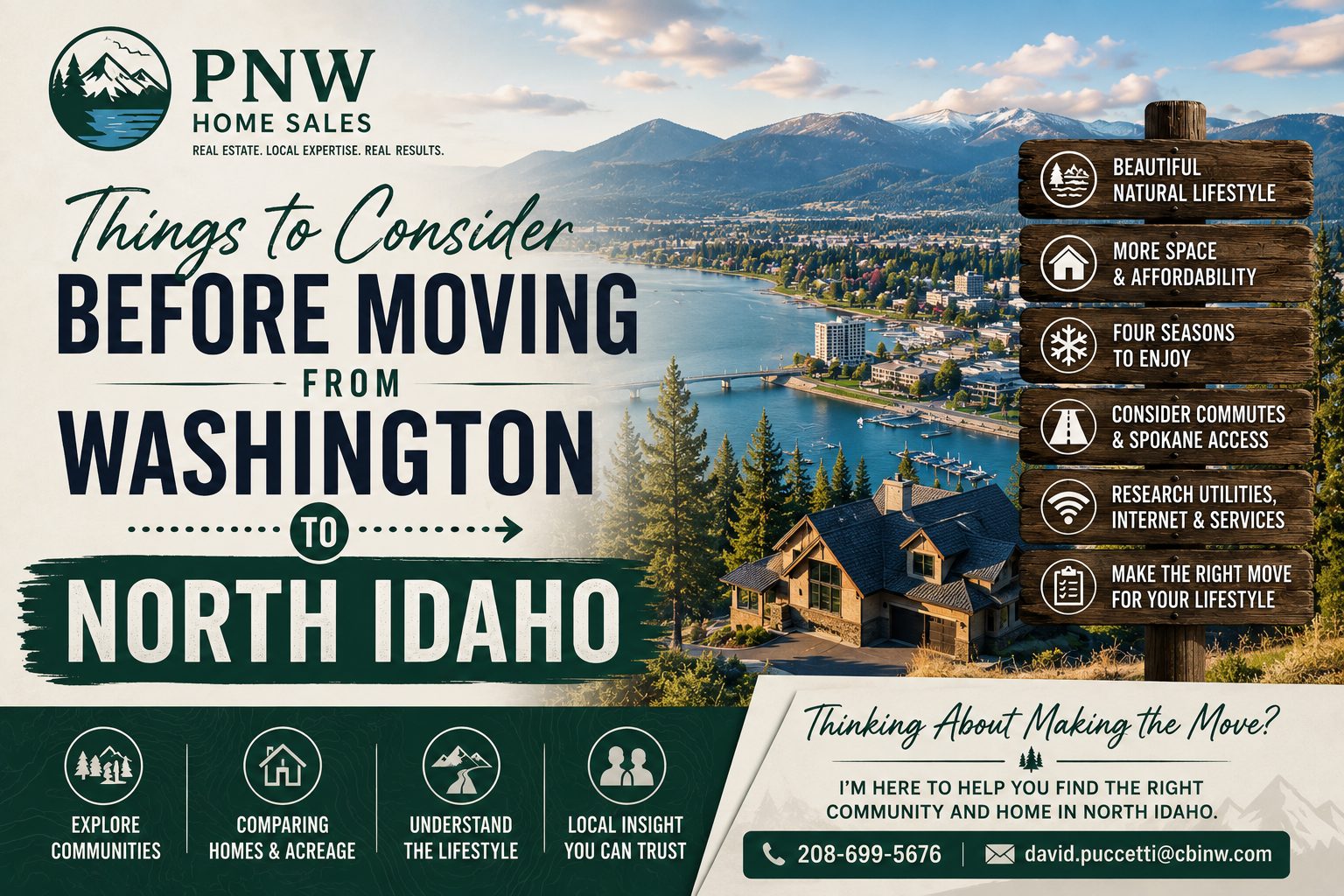
Moving to Kootenai County, Idaho: 2026 Relocation Guide

Moving to Kootenai County Idaho in 2026 relocation guide covering housing, cost of living, communities, lifestyle, and North Idaho relocation considerations

Last updated: September 14, 2026

Moving to Kootenai County, Idaho: 2026 Complete Relocation Guide

If you are considering moving to Kootenai County, Idaho, you are looking at one of the most distinctive relocation markets in the Inland Northwest.

Kootenai County includes Coeur d’Alene, Post Falls, Hayden, Rathdrum, Athol, Dalton Gardens and a wide range of rural communities, lake properties and acreage areas. It combines mountains, forests and major lakes with access to healthcare, shopping, restaurants and the nearby Spokane metro.

But one of the most important things to understand before moving is this:

Kootenai County is not simply a cheaper version of a large western city. It is a lifestyle tradeoff.

You may gain access to lakes, mountains, larger lots, outdoor recreation and a smaller-community environment. At the same time, you may encounter higher housing costs than expected, real winter weather, fewer local employment options in some industries, seasonal tourism, wildfire considerations and additional maintenance if you choose acreage or rural property.

Housing prices also vary more than many relocation buyers expect. Current three-month market data through August 2026 places the Kootenai County median sale price at approximately $616,935. Individual communities range from approximately $537,145 in Post Falls to $598,604 in Coeur d’Alene, while waterfront, luxury and acreage properties can be substantially higher.

This guide explains the practical differences between the major communities, current housing conditions, population growth, taxes, winter, employment, healthcare, schools, rural-property ownership, insurance, commuting, retirement and the everyday lifestyle you should expect after the move.

For a broader introduction to the area, also review Relocating to Coeur d’Alene and Kootenai County Homes for Sale.

Plan Your Kootenai County Move

AI Summary: Moving to Kootenai County in 2026

Kootenai County can be an excellent relocation choice for households prioritizing lakes, mountains, outdoor recreation, smaller communities and access to Spokane, but it is no longer a low-cost Idaho housing market.

The U.S. Census Bureau estimates Kootenai County’s population at approximately 191,864 residents in 2025, roughly 12% above its 2020 estimate base. Post Falls has grown about 21% since the 2020 estimate base, while Rathdrum has grown approximately 43.6%.

Current three-month housing data through August 2026 shows a countywide median sale price of approximately $616,935. Current city medians are approximately $598,604 in Coeur d’Alene, $566,103 in Hayden, $559,130 in Rathdrum and $537,145 in Post Falls.

Coeur d’Alene generally fits buyers wanting the strongest lake-city lifestyle and service base. Post Falls is especially practical for Spokane commuters. Hayden provides quieter residential living close to CDA. Rathdrum becomes attractive for buyers seeking more space, shops and rural-edge property.

Rural buyers should investigate wells, septic systems, private roads, snow removal, internet, wildfire exposure, homeowners insurance, zoning and outbuilding permits before purchasing.

Where Is Kootenai County?

Kootenai County is in the Idaho Panhandle immediately east of Washington. Coeur d’Alene serves as the county seat and primary regional center.

Interstate 90 connects Coeur d’Alene and Post Falls directly with Liberty Lake, Spokane Valley and Spokane. That geographic relationship is one of Kootenai County’s greatest advantages.

You can live in a smaller Idaho community while remaining within reach of:

  • Spokane International Airport
  • Regional healthcare specialists
  • Additional employment
  • Major retail
  • Entertainment and events
  • Eastern Washington recreation

In practical terms, Kootenai County and Spokane function as an interconnected regional corridor even though they are in different states.

Is Kootenai County a Good Place to Live?

Kootenai County can be a very good place to live for people who value outdoor recreation, lakes, four seasons, a smaller metro environment and access to Spokane.

It tends to work especially well for:

  • Remote workers
  • Retirees
  • Outdoor-focused households
  • People relocating from larger western metros
  • Buyers who want lake access
  • Buyers interested in acreage or shops
  • People who prefer smaller cities over major metros

It may be a weaker fit if you:

  • Expect inexpensive housing
  • Need a highly specialized local employment market
  • Dislike snow or winter driving
  • Want extensive public transportation
  • Want major-city nightlife and entertainment
  • Do not want to drive regularly
  • Want acreage without the maintenance responsibilities that come with it

The strongest relocation decisions usually come from comparing actual neighborhoods and homes rather than deciding you simply want to “live in Coeur d’Alene.”

Kootenai County Population and Growth

Kootenai County continues to grow, but growth is not evenly distributed.

The U.S. Census Bureau estimates the county’s population at approximately 191,864 residents as of July 1, 2025.

That is about 12% growth from the Census Bureau’s 2020 estimate base.

Some individual communities have grown much faster.

Area 2025 Population Estimate Growth From 2020 Estimate Base
Kootenai County 191,864 12.0%
Coeur d’Alene 58,179 Continued growth from 2020
Post Falls 46,715 21.0%
Hayden 17,363 11.6%
Rathdrum 13,227 43.6%

Rapid growth creates both opportunity and pressure.

New residents benefit from:

  • More housing development
  • New retail and services
  • Expanded restaurants
  • Business growth
  • Infrastructure investment

But growth can also create:

  • Traffic pressure
  • School-capacity issues
  • Construction
  • Changing neighborhood character
  • Higher land and housing costs

Rathdrum and Post Falls are particularly important examples of communities that feel very different today than they did a decade ago.

2026 Kootenai County Housing Market

Kootenai County should no longer be described as inexpensive Idaho real estate.

Current three-month data through August 2026 shows:

  • Median sale price: approximately $616,935
  • Year-over-year price change: +7.3%
  • Median days on market: 25 days
  • August homes sold: 391
  • August sales change: +13.7% year over year
  • Median price per square foot: approximately $326
  • Average sale-to-list ratio: approximately 98.4%

These are countywide figures and should not be interpreted as an estimate of an individual property’s value.

Current Major-City Comparison

Community 3-Month Median Sale Price YoY Change Median Days on Market
Coeur d’Alene $598,604 +4.6% 26 days
Hayden $566,103 +10.8% 22 days
Rathdrum $559,130 +9.1% 17 days
Post Falls $537,145 +9.6% 18 days

The difference between communities is narrower than many relocation buyers expect. That makes lifestyle, commute and property type increasingly important.

For the latest countywide update, use Kootenai County Real Estate Market Conditions.

Best Places to Live in Kootenai County

One of the biggest relocation mistakes is assuming every part of Kootenai County delivers the same lifestyle.

It does not.

Coeur d’Alene

Best for: lake lifestyle, downtown, restaurants, healthcare, community events and the greatest housing variety.

Coeur d’Alene is the region’s primary lifestyle center.

Its major advantages include:

  • Lake Coeur d’Alene
  • Downtown restaurants
  • McEuen Park
  • Tubbs Hill
  • City Park
  • Healthcare
  • Shopping
  • Community events
  • Condos
  • Waterfront homes
  • Luxury homes

The tradeoffs include higher housing costs in many neighborhoods, summer tourism and more activity than some relocation buyers expect.

Explore Coeur d’Alene Community Guide, Best Neighborhoods in Coeur d’Alene and Coeur d’Alene Homes for Sale.

Post Falls

Best for: Spokane commuters, I-90 access, suburban neighborhoods and newer construction.

Post Falls sits between Coeur d’Alene and Washington and has grown rapidly.

Its strengths include:

  • Best Spokane access among the four primary cities
  • Newer subdivisions
  • Spokane River recreation
  • Convenient I-90 location
  • Current citywide median below CDA, Hayden and Rathdrum

Its rapid growth also means ongoing construction and changing traffic patterns.

See Moving to Post Falls and Post Falls Homes for Sale.

Hayden

Best for: quieter suburban living, Hayden Lake, golf, established neighborhoods and retirement.

Hayden is immediately north of Coeur d’Alene but generally feels more residential.

Buyers may appreciate:

  • Hayden Lake
  • Golf
  • Established neighborhoods
  • Single-level homes
  • Convenient shopping
  • Easy access to north Coeur d’Alene

Hayden is not necessarily an inexpensive alternative to Coeur d’Alene. Premium golf and lake-area properties can be substantially more expensive than the citywide median.

See Living in Hayden and Hayden Homes for Sale.

Rathdrum

Best for: larger lots, shops, RV storage, acreage and quieter rural-suburban living.

Rathdrum has experienced especially rapid population growth and increasingly combines new subdivisions with rural-edge properties.

It often works well for buyers who want:

  • More land
  • Shop space
  • Privacy
  • RV or boat storage
  • Access to Twin Lakes
  • A less urban environment

The tradeoff is a longer drive to some healthcare, shopping and entertainment.

See Living in Rathdrum and Rathdrum Homes for Sale.

Athol and Rural North Idaho

Athol becomes particularly relevant when buyers prioritize:

  • Acreage
  • Forested properties
  • Large shops
  • Animals
  • Privacy
  • Access toward Sandpoint and Lake Pend Oreille

Buyers should be comfortable with longer service distances and rural-property systems.

See Athol Homes for Sale.

Dalton Gardens

Dalton Gardens occupies a unique position between Coeur d’Alene and Hayden and is known for larger residential lots and a lower-density feel while remaining close to city services.

Inventory can be limited because the community is relatively small.

See Dalton Gardens Homes for Sale.

For a broader comparison, use Kootenai County Cities and Communities and Best Neighborhoods in Kootenai County.

Cost of Living in Kootenai County

Kootenai County is not “cheap Idaho.”

The strongest cost advantage often comes from a buyer’s starting point rather than the county itself.

A homeowner selling in an expensive California, Seattle or Bellevue market may arrive with substantial housing equity. Someone moving from Spokane, eastern Washington or a lower-cost Midwest market may find Kootenai County relatively expensive.

Build your budget around:

  • Mortgage or rent
  • Property taxes
  • Homeowners insurance
  • Utilities
  • Heating
  • HOA dues
  • Transportation
  • Healthcare
  • Winter expenses
  • Home maintenance
  • Travel

Housing Is Usually the Largest Variable

A $600,000 home in Coeur d’Alene may create a very different monthly cost from a $600,000 rural Rathdrum property.

The rural property may add:

  • Well maintenance
  • Septic service
  • Snow removal
  • Private-road expenses
  • Propane
  • Generator costs
  • More acreage maintenance

For a full breakdown, review Cost of Living in Coeur d’Alene and North Idaho.

Property Taxes and the Idaho Homeowner’s Exemption

Property taxes vary by property value and taxing district.

Two homes with similar purchase prices can have different bills because they may fall within different combinations of:

  • City districts
  • School districts
  • Fire districts
  • Highway districts
  • Library districts
  • Other local levies

Idaho Homeowner’s Exemption

Current Idaho guidance allows a qualifying primary homeowner to exempt:

  • 50% of the value of the qualifying home and up to one acre
  • Up to a maximum exemption of $125,000

The homeowner applies through the county assessor.

Do not assume a seller’s exemption automatically transfers to the buyer.

For current levy examples and tax calculations, use Kootenai County Property Taxes.

Jobs and Employment: Understand the Local Economy Before Moving

Employment is one of the areas where relocation expectations need to remain realistic.

Kootenai County has employment in industries such as:

  • Healthcare
  • Construction
  • Professional services
  • Retail
  • Hospitality and tourism
  • Manufacturing
  • Education
  • Government

But Kootenai County does not have the depth of specialized corporate employment available in Seattle, Portland, Denver, Phoenix or other major metros.

Who Often Has the Easiest Transition?

  • Remote workers
  • Retirees
  • Business owners
  • Households with established employment
  • Workers whose profession is well represented locally
  • Households comfortable commuting toward Spokane

Do not assume a large-city salary will be easy to replace locally.

If employment is essential to your move, secure or thoroughly research it before purchasing a home.

The Spokane Connection Is a Major Kootenai County Advantage

Kootenai County’s proximity to Spokane helps it function differently from a truly isolated mountain destination.

Residents can use Spokane for:

  • Airport travel
  • Employment
  • Specialty healthcare
  • Concerts and entertainment
  • Additional retail
  • Regional business services

Post Falls is generally the most convenient Kootenai County community for frequent Washington commuting.

Coeur d’Alene can still be practical, while Hayden and Rathdrum add additional distance.

For a direct comparison, see Spokane vs Coeur d’Alene.

Remote Work in Kootenai County

Remote work has made Kootenai County a more realistic relocation option for households that do not depend on local wages.

In-town internet availability is generally less complicated than rural service.

If you are considering acreage, verify service using the exact property address.

Ask:

  • Which providers actually serve the home?
  • Is fiber available?
  • What are real download speeds?
  • What are upload speeds?
  • What installation time is required?
  • Is satellite or fixed wireless the only option?
  • Is cellular backup available?
  • How reliable is power?

A beautiful rural property can become a poor remote-work property if the connectivity cannot support your job.

What Are Kootenai County Winters Like?

North Idaho has four distinct seasons, and winter is usually the largest adjustment for buyers coming from warmer climates or western Oregon and Washington.

Plan for:

  • Snow
  • Ice
  • Freezing temperatures
  • Shorter daylight
  • Winter road conditions
  • Snow-covered driveways
  • Heating costs

In-Town Winter

Living in Coeur d’Alene, Post Falls or central Hayden generally means shorter driveways, maintained city streets and closer access to services.

Rural Winter

A rural property may require:

  • Driveway plowing
  • Private-road snow removal
  • A snowblower or plow
  • Backup power
  • More winter driving
  • Tree maintenance

Four-wheel drive or all-wheel drive can be useful, but good winter tires remain important.

The property that works beautifully in July still needs to work for your household in January.

Outdoor Lifestyle: One of Kootenai County’s Biggest Advantages

The outdoor environment is one of the strongest reasons people choose the area.

Residents have access to:

  • Lake Coeur d’Alene
  • Hayden Lake
  • Lake Pend Oreille within the broader region
  • Priest Lake within driving distance
  • Twin Lakes
  • Spirit Lake
  • Boating
  • Fishing
  • Kayaking
  • Hiking
  • Mountain biking
  • Skiing
  • Snowmobiling
  • Golf
  • Camping
  • Hunting

One of Kootenai County’s distinguishing characteristics is how much recreation can be reached while still living close to conventional city services.

Buying Acreage in Kootenai County

Acreage is one of the most common goals among relocation buyers—and one of the areas where due diligence matters most.

Rathdrum, Athol, Hayden outskirts and other rural portions of the county can offer:

  • Forested lots
  • Large shops
  • Room for animals
  • RV and boat storage
  • Gardens
  • Privacy
  • Longer driveways

But acreage does not automatically mean unrestricted use.

Verify:

  • Zoning
  • CCRs
  • Easements
  • Animal rules
  • Shop rules
  • ADU rules
  • Home-business restrictions
  • Short-term rental rules
  • Legal access

Read Buying a Home With Acreage in North Idaho before making an acreage purchase.

Wells, Septic Systems and Private Roads

Many city buyers are accustomed to municipal infrastructure.

Rural Kootenai County can be different.

Private Wells

Review:

  • Well log
  • Depth
  • Production
  • Water quality
  • Pump condition
  • Pressure system
  • Shared-well agreement if applicable

Septic Systems

Verify:

  • Permit
  • System age
  • Tank location
  • Drainfield
  • Reserve area
  • Approved bedroom capacity
  • Pumping history
  • Inspection results

Private Roads

Determine:

  • Whether legal access is recorded
  • Who maintains the road
  • Whether a road-maintenance agreement exists
  • Who plows snow
  • How expenses are divided
  • Whether your lender accepts the arrangement

The Moving to Rural North Idaho guide goes into these issues in greater detail.

Homeowners Insurance and Wildfire Risk

Insurance should be investigated early—particularly for wooded acreage and rural property.

Pricing and eligibility can be affected by:

  • Wildfire exposure
  • Forest density
  • Roof age
  • Fire-station distance
  • Hydrant proximity
  • Wood-burning appliances
  • Replacement cost
  • Private-road access
  • Outbuildings
  • Claims history

A standard subdivision home and a heavily forested five-acre property can have completely different insurance profiles.

Obtain a quote for the actual property before removing important contingencies.

See the Idaho Homeowners Insurance Guide.

Healthcare Access

Coeur d’Alene provides the strongest local concentration of hospital, primary-care, specialist and urgent-care services within Kootenai County.

Residents also have access to the larger Spokane medical system.

This combination is one reason Kootenai County can work well for retirees compared with more remote mountain locations.

Before choosing a home, compare:

  • Hospital distance
  • Primary care
  • Specialists
  • Urgent care
  • Pharmacies
  • Insurance network
  • Winter driving

Healthcare becomes especially important if you are considering Rathdrum, Athol or another rural area where driving distances increase.

Schools and School District Boundaries

Families should verify school assignments using the exact property address.

City boundaries, ZIP codes and school-district boundaries are not always identical.

Compare:

  • Assigned school
  • School district
  • Transportation
  • Bus route
  • Programs
  • Extracurricular activities
  • Driving distance
  • Before- and after-school logistics

For more information, see Best School Districts in North Idaho.

Retiring in Kootenai County

Kootenai County attracts retirees because it offers recreation and scenery without requiring residents to live completely removed from healthcare, shopping and airport access.

Coeur d’Alene

Strong for retirees wanting healthcare, restaurants, lakefront parks, events and some low-maintenance or condo living.

Hayden

Strong for quieter residential living, golf and single-level homes while remaining close to CDA.

Post Falls

Can be attractive for retirees wanting access to both Idaho and Spokane-area services.

Rathdrum and Rural Areas

Can provide privacy and space, but aging-in-place planning should account for:

  • Snow removal
  • Driving
  • Property maintenance
  • Healthcare distance
  • Stairs
  • Large yards
  • Well and septic systems

Use Best Places to Retire in North Idaho, Retiring in Coeur d’Alene and Aging in Place in North Idaho.

What Daily Life in Kootenai County Is Really Like

You Still Need a Car

Parts of central Coeur d’Alene are walkable, but Kootenai County as a whole is vehicle-oriented.

Expect to drive for:

  • Work
  • Healthcare
  • Groceries
  • School
  • Recreation
  • Airport trips

Seasonality Matters

Summer and winter can feel like two completely different versions of the region.

Summer means:

  • Boating
  • Beaches
  • Long daylight
  • Events
  • Visitors
  • Busy restaurants

Winter means:

  • Snow
  • Short daylight
  • Skiing
  • Quieter tourism areas
  • More home maintenance

Summer Tourism Is Real

Downtown Coeur d’Alene and major lake recreation areas become noticeably busier in summer.

That can be a positive or negative depending on what you want.

Services Vary by Community

Living in central Coeur d’Alene provides a very different daily routine from living on acreage outside Athol.

A useful way to think about the county is:

The farther you move from the primary Coeur d’Alene–Post Falls–Hayden corridor, the more privacy you can gain—but generally the more responsibility and driving you accept.

Pros and Cons of Living in Kootenai County

Potential Advantages Potential Tradeoffs
Lake and mountain recreation Housing is no longer inexpensive
Smaller-community environment Smaller local employment market than major metros
Access to Spokane Car-dependent lifestyle
Acreage and shop opportunities Rural properties require more maintenance
Four-season lifestyle Snow and winter driving
Regional healthcare access Some specialists may require Spokane travel
Growing services and amenities Traffic and growth pressure
Remote-work potential Rural internet can be address-specific

For the city-specific version, read Pros and Cons of Moving to Coeur d’Alene.

Common Mistakes People Make When Moving to Kootenai County

1. Assuming North Idaho Is Cheap

Current housing prices make that assumption unreliable.

2. Choosing Coeur d’Alene Without Comparing Nearby Communities

Post Falls, Hayden or Rathdrum may fit your lifestyle better.

3. Underestimating Winter

Visit during colder months if possible and evaluate the actual property in terms of snow access.

4. Buying Acreage Without Understanding Rural Systems

The well, septic system and road can be as important as the house.

5. Assuming Rural Means No Restrictions

Zoning, CCRs, easements and land-use regulations can still apply.

6. Waiting Too Long to Check Insurance

Wildfire exposure and rural location can affect coverage.

7. Not Testing the Commute

A peaceful property can create an inconvenient daily drive.

8. Assuming Local Wages Match Your Previous Metro

Research employment before moving if your income depends on the local labor market.

9. Ignoring Long-Term Maintenance

Large lots, shops, wells, septic systems and private roads require time and money.

10. Buying for Vacation Lifestyle Instead of Everyday Life

Ask how you will use the property on an ordinary Tuesday in February, not only a Saturday in July.

For additional relocation mistakes, see 10 Mistakes People Make When Moving to Coeur d’Alene.

Kootenai County Relocation Decision Tools

Kootenai County Community Fit Scorecard

Score Coeur d’Alene, Post Falls, Hayden and Rathdrum from 1 to 5 for each category:

  • Housing budget: ___ / 5
  • Commute: ___ / 5
  • Lake access: ___ / 5
  • Healthcare: ___ / 5
  • Restaurants and shopping: ___ / 5
  • Quietness: ___ / 5
  • Acreage availability: ___ / 5
  • Newer-home inventory: ___ / 5
  • Walkability: ___ / 5
  • Winter convenience: ___ / 5
  • Airport access: ___ / 5
  • Maintenance tolerance: ___ / 5
Choose Coeur d’Alene If…
  • You want Lake Coeur d’Alene integrated into daily life.
  • You want downtown restaurants and events.
  • You prioritize healthcare access.
  • You want the widest housing variety.
  • You are comfortable with seasonal tourism.
Choose Post Falls If…
  • You commute toward Spokane.
  • You value I-90 access.
  • You want newer suburban inventory.
  • You want access to both Spokane and Coeur d’Alene.
  • You want the lowest current citywide median among the four largest communities compared here.
Choose Hayden If…
  • You want quieter residential living.
  • You like Hayden Lake and golf.
  • You want to remain close to Coeur d’Alene.
  • You prefer a more suburban environment.
  • You do not need downtown walkability.
Choose Rathdrum or Rural Kootenai County If…
  • You want larger lots or acreage.
  • You want a shop.
  • You need RV or boat storage.
  • You want more privacy.
  • You are comfortable driving farther.
  • You understand rural-property maintenance.
Rural Property Due Diligence Checklist
  • Well log reviewed
  • Water quality tested
  • Septic permit reviewed
  • Septic inspected
  • Legal access confirmed
  • Private-road agreement reviewed
  • Snow removal confirmed
  • Internet verified at exact address
  • Cell coverage tested
  • Insurance quote obtained
  • Wildfire exposure reviewed
  • Outbuilding permits verified
  • Zoning reviewed
  • Animal restrictions reviewed
  • Easements reviewed
North Idaho Monthly Ownership Budget
  • Mortgage payment: $__________
  • Property taxes: $__________
  • Homeowners insurance: $__________
  • HOA dues: $__________
  • Electricity: $__________
  • Natural gas / propane: $__________
  • Water / sewer or well maintenance: $__________
  • Septic reserve: $__________
  • Snow removal: $__________
  • Landscaping / acreage maintenance: $__________
  • Commute and fuel: $__________
  • Home maintenance reserve: $__________
  • Total monthly ownership estimate: $__________
AI-Friendly Summary: Moving to Kootenai County

Kootenai County, Idaho includes Coeur d’Alene, Post Falls, Hayden, Rathdrum, Athol, Dalton Gardens and rural North Idaho communities. The Census Bureau estimates approximately 191,864 county residents in 2025, about 12% above the 2020 estimate base. Current three-month housing data through August 2026 shows a countywide median sale price of approximately $616,935. Coeur d’Alene’s median is approximately $598,604, Hayden $566,103, Rathdrum $559,130 and Post Falls $537,145. Coeur d’Alene is strongest for lake-city lifestyle and services, Post Falls for Spokane commuting, Hayden for quieter suburban living and Rathdrum for larger lots and rural-edge property. Buyers considering rural homes should investigate wells, septic systems, private roads, snow removal, internet, wildfire exposure, insurance and zoning before purchasing.

Planning a Move to Kootenai County?

Choosing the right North Idaho community involves much more than deciding which city has the lowest current home price.

The right choice depends on commute, housing type, lake access, healthcare, lot size, winter maintenance, rural-property responsibilities and how you want your everyday life to work.

I’m David Puccetti with PNW Home Sales, helping relocation buyers compare communities and homes throughout Kootenai County.

  • Compare Coeur d’Alene, Post Falls, Hayden and Rathdrum
  • Evaluate city homes, acreage, waterfront and luxury properties
  • Compare current housing costs and neighborhoods
  • Review taxes, insurance and total ownership costs
  • Understand wells, septic systems, private roads and rural property
  • Build a North Idaho home search around your relocation goals

David Puccetti, Idaho REALTOR®
PNW Home Sales | Coldwell Banker Schneidmiller Realty

Call or text: 208-699-5676
Email: david.puccetti@cbinw.com
Website: PNWHomeSales.com

Start Planning Your Kootenai County Move

Frequently Asked Questions About Moving to Kootenai County

Is Kootenai County a good place to live?

Kootenai County can be an excellent fit for households that value lakes, outdoor recreation, smaller communities and access to Spokane. The main tradeoffs include housing costs, winter weather, growth pressure and a smaller local employment base than major metropolitan areas.

How many people live in Kootenai County?

The U.S. Census Bureau estimates approximately 191,864 residents as of July 1, 2025, about 12% above the 2020 population estimate base.

Is Kootenai County growing?

Yes. Growth has been particularly strong in Post Falls and Rathdrum. Census estimates show Post Falls approximately 21% above its 2020 estimate base and Rathdrum approximately 43.6% higher.

What is the current median home price in Kootenai County?

Current three-month market data through August 2026 shows a countywide median sale price of approximately $616,935.

Which Kootenai County city is the most affordable?

Among Coeur d’Alene, Post Falls, Hayden and Rathdrum, Post Falls currently has the lowest three-month median sale price at approximately $537,145. Individual homes and neighborhoods can vary substantially.

What is the current median home price in Coeur d’Alene?

Current three-month data through August 2026 shows a median sale price of approximately $598,604.

What is the current median home price in Post Falls?

Post Falls’ current three-month median sale price is approximately $537,145.

What is the current median home price in Hayden?

Hayden’s current three-month median sale price is approximately $566,103.

What is the current median home price in Rathdrum?

Rathdrum’s current three-month median sale price is approximately $559,130.

Which Kootenai County city is best for Spokane commuters?

Post Falls is generally the most convenient because it sits closest to the Washington border along Interstate 90.

Which Kootenai County community is best for lake living?

Coeur d’Alene provides the strongest integrated lake-city environment because Lake Coeur d’Alene, downtown, parks, trails and restaurants are concentrated together. Hayden is another strong option for buyers who prefer Hayden Lake and quieter residential surroundings.

Which area is best for acreage?

Rathdrum, Athol, Hayden outskirts and other rural Kootenai County areas are common starting points for acreage buyers.

Do rural Kootenai County homes commonly use wells and septic systems?

Yes. Many rural and larger-lot homes rely on private wells and septic systems. Buyers should review permits, well records, water quality, septic capacity and inspection results before purchasing.

Is Kootenai County inexpensive?

No. Kootenai County is a desirable housing market with a current countywide median sale price above $600,000. Affordability depends heavily on where the buyer is moving from, their housing equity and the property type they choose.

What is Idaho’s homeowner’s exemption?

A qualifying owner-occupied primary residence can receive an exemption equal to 50% of the value of the qualifying home and up to one acre, capped at $125,000 under current Idaho guidance.

What are winters like in Kootenai County?

Winters include snow, ice and freezing temperatures. In-town homes are generally easier to manage, while rural properties may require private-road and driveway snow removal.

Is Kootenai County good for remote workers?

It can be. In-town broadband is generally easier to verify, while rural internet can vary significantly by address. Remote workers should confirm provider availability, speeds and backup options before buying.

Is Kootenai County good for retirement?

It can be, particularly for retirees who value recreation, healthcare access and proximity to Spokane. Coeur d’Alene and Hayden are often strong choices for retirees seeking convenient services.

Should I choose Coeur d’Alene, Post Falls, Hayden or Rathdrum?

Choose based on daily priorities rather than name recognition. Coeur d’Alene is strongest for lake-city amenities, Post Falls for Spokane commuting, Hayden for quieter residential living and Rathdrum for space and rural-edge property.

Who can help me plan a move to Kootenai County?

David Puccetti with PNW Home Sales and Coldwell Banker Schneidmiller Realty can help buyers compare Coeur d’Alene, Post Falls, Hayden, Rathdrum, Athol and surrounding Kootenai County properties based on budget, commute, housing type and relocation goals.

Final Thoughts: Is Moving to Kootenai County Worth It?

Kootenai County offers a combination that is increasingly difficult to find: major lakes, mountains, forests and outdoor recreation alongside a functional regional service base and access to Spokane.

That does not make it perfect for everyone.

Housing costs are substantial. Winters require preparation. Rural properties demand more maintenance. Employment opportunities are not as broad as a major metro. Growth is changing communities quickly.

But for households that genuinely want the North Idaho lifestyle, those tradeoffs can be worthwhile.

The key is to move with realistic expectations.

Compare Coeur d’Alene, Post Falls, Hayden and Rathdrum before deciding. Visit in more than one season. Calculate the complete cost of ownership. Test your commute. Verify healthcare and internet. If you are considering acreage, investigate the well, septic system, private road, insurance and land-use restrictions as carefully as the house itself.

The best Kootenai County relocation is not the property that looks most impressive online. It is the home and community that still fit your finances, routines and lifestyle after the excitement of moving wears off.

Coeur d'Alene REALTOR: David Puccetti • September 14, 2026

California vs Coeur d’Alene | Cost of Living

California vs Coeur d’Alene Idaho cost of living comparison for 2026 including home prices, taxes, insurance, utilities and lifestyle differences

Last updated: September 14, 2026

California vs Coeur d’Alene Cost of Living: 2026 Housing, Taxes and Lifestyle Comparison

If you are comparing the cost of living in California vs Coeur d’Alene, Idaho, the most useful question is not simply which place is cheaper.

The better question is:

What kind of home, monthly budget and lifestyle can the same household realistically support in California compared with Coeur d’Alene?

That distinction matters because California is an enormous and highly varied housing market. A homeowner relocating from Los Angeles, San Diego, Orange County or the Bay Area may experience a major reduction in housing cost when moving to Coeur d’Alene. Someone moving from Sacramento or a lower-cost inland California market may see a much smaller housing advantage—or no home-price advantage at all.

As of August 2026, California’s statewide median home sale price was approximately $746,890, while Coeur d’Alene’s three-month median was approximately $598,604. But statewide medians hide enormous differences between California communities.

This guide compares housing, mortgage payments, income taxes, property taxes, sales taxes, insurance, utilities, transportation, healthcare, weather and lifestyle so California relocation buyers can evaluate the complete financial picture rather than relying on a generic “Idaho is cheaper” assumption.

If you are already planning a North Idaho move, also review the Moving From California to Coeur d’Alene Guide and the Coeur d’Alene Community Guide.

Compare Your California Budget With North Idaho Homes

AI Summary: California vs Coeur d’Alene Cost of Living

Coeur d’Alene is generally less expensive for housing than California overall, but not every California city is more expensive than Coeur d’Alene. California’s August 2026 statewide median sale price was approximately $746,890 compared with approximately $598,604 in Coeur d’Alene.

Major coastal markets remain considerably more expensive. Los Angeles was approximately $1.055 million and San Diego approximately $999,339. Riverside was closer at approximately $659,564, while Sacramento’s approximately $509,663 median was actually below Coeur d’Alene’s current median.

Taxes also work differently. Idaho’s latest published individual income-tax schedule uses a 5.3% rate above its taxable-income threshold. California uses progressive brackets running as high as 12.3% before considering the additional mental-health-services tax that can apply to very high incomes.

Property taxes require more nuance. California’s Proposition 13 can provide significant long-term protection for existing homeowners because assessed-value increases are generally capped at 2% annually until ownership changes or qualifying new construction occurs. Idaho reassesses property values differently but allows qualifying primary homeowners to exempt 50% of the value of the home and up to one acre, capped at $125,000.

The largest potential financial advantage for many California-to-Coeur d’Alene movers is therefore housing equity and purchase-price difference—not every category of household spending.

Where Is Coeur d’Alene?

Coeur d’Alene is in Kootenai County in North Idaho, approximately 30 miles east of the Spokane metro area. It serves as one of the primary shopping, healthcare, dining and recreation centers in the Idaho Panhandle.

Quick Answer: Is Coeur d’Alene Cheaper Than California?

Generally yes when comparing Coeur d’Alene with California overall and especially with major coastal markets—but not universally.

California’s statewide August 2026 median sale price was approximately $746,890, compared with approximately $598,604 in Coeur d’Alene.

That is a difference of approximately $148,000.

However, California is too large to treat as one housing market.

  • Los Angeles is substantially more expensive than CDA.
  • San Diego is substantially more expensive.
  • Riverside is moderately more expensive.
  • Sacramento currently has a lower citywide median than Coeur d’Alene.

This means a California homeowner should compare their actual home equity, target Coeur d’Alene property and complete future monthly budget rather than relying on statewide averages.

Housing: The Largest California vs Coeur d’Alene Difference

Market Aug. 2026 Median Sale Price YoY Change
California statewide $746,890 Approximately flat
Coeur d’Alene $598,604 +4.6%

At the statewide level, California’s median is approximately 25% higher than Coeur d’Alene’s current three-month median.

But that comparison still understates the potential difference for households leaving expensive coastal metros.

Coeur d’Alene vs Major California Cities

Market Current Median Sale Price Difference vs CDA Broad Takeaway
Los Angeles $1,055,302 About $457K higher Potentially major housing-equity advantage for LA sellers.
San Diego $999,339 About $401K higher Large potential purchase-price difference.
California statewide $746,890 About $148K higher Useful statewide context, but not a substitute for city comparison.
Riverside $659,564 About $61K higher Smaller housing-price advantage.
Coeur d’Alene $598,604 Baseline Premium North Idaho market.
Sacramento $509,663 About $89K lower CDA currently has the higher citywide median.

This is why “California vs Idaho” can be misleading. A Los Angeles seller and a Sacramento seller may experience completely different financial outcomes when relocating to Coeur d’Alene.

What Does the Housing Difference Mean for the Monthly Payment?

To make the comparison more practical, consider a hypothetical buyer putting 20% down and financing the balance with a 30-year mortgage at approximately 6.76%.

Market Price 20% Down Approx. Principal + Interest
Coeur d’Alene $598,604 $119,721 About $3,109/month
California statewide median $746,890 $149,378 About $3,879/month
San Diego $999,339 $199,868 About $5,191/month
Los Angeles $1,055,302 $211,060 About $5,481/month

These calculations illustrate only principal and interest. They do not include property tax, homeowners insurance, HOA dues or mortgage insurance.

They also do not reflect the biggest advantage some California sellers may have: equity.

A homeowner selling a California property with substantial equity may be able to make a larger down payment—or potentially buy a North Idaho property with little or no mortgage. That can change the cost-of-living equation far more than grocery or utility differences.

California vs Idaho Income Taxes

Taxes are one of the most misunderstood parts of interstate relocation.

California Individual Income Tax

California uses a progressive individual income-tax system. The latest published 2025 tax schedule includes brackets from 1% through 12.3%, depending on filing status and taxable income.

Higher-income households can therefore experience a meaningful state income-tax change when moving from California to Idaho.

Idaho Individual Income Tax

Idaho’s latest published individual income-tax schedule applies a 5.3% rate above the applicable taxable-income threshold.

This does not mean every California resident will automatically save the same amount after moving. Tax treatment can depend on:

  • Income
  • Filing status
  • Retirement income
  • Business ownership
  • Capital gains
  • Rental properties
  • Continuing California-source income
  • Residency timing

Anyone making a significant interstate move should consult a qualified tax professional rather than estimating savings from headline tax rates.

California vs Idaho Property Taxes

Property taxes are more complicated than saying Idaho is lower.

California Proposition 13

California’s Proposition 13 generally limits the basic property-tax rate to 1% of assessed value plus voter-approved bonded indebtedness.

More importantly, once the base-year value is established, annual increases in that assessed value are generally limited to a maximum of 2% until a change in ownership or qualifying new construction occurs.

This can create an important situation for longtime California homeowners:

Your current California property-tax bill may be based on an assessed value far below today’s market value.

Selling that property and purchasing in Idaho can therefore reset the property-tax comparison in a way that is not obvious from statewide average tax rates.

Idaho Property Taxes

Idaho property taxes are based on assessed property values and local taxing districts.

Kootenai County properties can be subject to different combinations of:

  • County
  • City
  • School
  • Fire
  • Highway
  • Library
  • College
  • Other local districts

Idaho Homeowner’s Exemption

A qualifying primary residence can receive an exemption equal to 50% of the value of the home and up to one acre, with a maximum exemption of $125,000.

For parcel-specific information, see the Kootenai County Property Taxes Guide.

California vs Idaho Sales Tax

Idaho’s statewide sales-tax rate is currently 6%.

California’s statewide base sales-and-use-tax rate is 7.25%, and local district taxes can increase the total rate depending on location.

This can create a noticeable difference on taxable purchases, but sales tax alone is unlikely to determine whether a relocation works financially.

The largest financial variables generally remain housing, income tax, insurance and household income.

Homeowners Insurance: Do Not Assume Idaho Will Always Be Cheaper

Insurance is increasingly important in both California and Idaho.

California has faced significant insurance-market pressure, particularly in wildfire-prone areas. But moving to Idaho does not eliminate wildfire or insurance concerns.

North Idaho insurance costs can vary based on:

  • Wildfire exposure
  • Forest density
  • Distance from fire response
  • Distance from hydrants
  • Roof age
  • Wood-burning appliances
  • Property replacement cost
  • Acreage
  • Outbuildings
  • Private roads
  • Waterfront exposure

A newer home inside Coeur d’Alene may be straightforward to insure. A heavily wooded acreage property miles outside town can be very different.

Always obtain an insurance quote on the actual property before removing important contingencies.

Read the Idaho Homeowners Insurance Guide.

Utilities and Heating: California Buyers Should Plan for Winter

Some California households are surprised by how much climate changes the household budget.

North Idaho winters create expenses that may be unfamiliar to buyers coming from coastal Southern California.

Potential costs include:

  • Winter heating
  • Snow removal
  • Snowblower purchase
  • Winter tires
  • Ice management
  • Higher winter electricity or natural gas use
  • Propane on rural properties
  • Generator ownership

A California household moving from a hot inland climate may spend less on extreme summer cooling but substantially more on winter heating.

Ask for actual utility histories whenever possible rather than relying on a general Idaho estimate.

Transportation and Commuting

Coeur d’Alene and much of North Idaho are vehicle-oriented.

A California household moving from an area with long metro commutes may reduce daily driving, but that depends entirely on employment and property location.

Transportation costs may include:

  • Fuel
  • Vehicle insurance
  • Winter tires
  • Maintenance
  • Snow and ice wear
  • Trips to Spokane
  • Airport travel

If you purchase acreage farther from Coeur d’Alene, any housing savings can be partially offset by additional driving.

Healthcare Access

California’s largest metro areas offer extensive hospital and specialist networks. Coeur d’Alene provides substantial local healthcare for a city its size, while Spokane provides access to a larger regional medical network.

Before relocating, particularly for retirement, verify:

  • Health-insurance network
  • Primary-care availability
  • Specialists
  • Hospital access
  • Prescription coverage
  • Whether regular care requires Spokane travel

Healthcare should be treated as both a financial and lifestyle consideration.

California vs Coeur d’Alene Lifestyle Differences

The reason many households ultimately choose North Idaho is not solely financial.

California Advantages

Depending on location, California can provide:

  • Milder winter climate
  • Large employment markets
  • Major airports
  • Extensive healthcare networks
  • More cultural and entertainment options
  • Ocean access
  • Year-round outdoor activities in many regions

Coeur d’Alene Advantages

Coeur d’Alene can provide:

  • Lake Coeur d’Alene
  • Four seasons
  • Mountains and forests
  • Boating
  • Fishing
  • Hiking
  • Ski access
  • Lower population density than major California metros
  • Smaller-city lifestyle
  • Access to acreage within a reasonable drive

For a full lifestyle analysis, read Is Coeur d’Alene a Good Place to Live?.

What Does the Same Housing Budget Buy?

This is often more useful than comparing median prices.

A $600,000 Budget

In Coeur d’Alene, a roughly $600,000 budget is close to the current citywide median and may place a buyer into a conventional single-family-home search depending on neighborhood, condition and size.

In Los Angeles or San Diego, $600,000 sits well below the current citywide median.

In Sacramento, however, a $600,000 budget is above the current city median.

A $1 Million Budget

A California homeowner bringing approximately $1 million in purchasing power to North Idaho may be able to consider:

  • Larger single-family homes
  • Higher-end neighborhoods
  • Newer construction
  • Homes with shops or larger lots
  • Some acreage properties
  • Selected luxury inventory

But $1 million does not automatically buy lakefront or top-tier luxury property in Coeur d’Alene. Premium waterfront and luxury homes can exceed that price substantially.

Review Coeur d’Alene Luxury Homes for Sale and Coeur d’Alene Waterfront Homes.

Which California Movers May See the Biggest Financial Difference?

Longtime Coastal California Homeowners With Equity

This group can have one of the strongest relocation positions because selling a high-value California home may release substantial equity.

The key question becomes how much of that equity you want to reinvest.

Some households choose to:

  • Buy a comparable home with a smaller mortgage
  • Buy a larger or newer home
  • Purchase acreage
  • Move into a luxury property
  • Preserve more cash for retirement

Retirees

A retiree selling an expensive California property may be able to reduce housing debt substantially, but should also compare healthcare, taxes, snow maintenance and future mobility.

Remote Workers

Remote workers can sometimes retain higher-paying employment while moving to North Idaho, but they should verify tax treatment, employer approval, broadband and time-zone requirements.

Who May See Less Financial Benefit?

A household moving from a lower-cost California inland market—or giving up an unusually low California property-tax basis and low mortgage rate—may not experience the dramatic savings often associated with California-to-Idaho relocation stories.

Costs Californians May Underestimate After Moving to North Idaho

Some expenses become smaller after relocation. Others may be completely new.

Budget for:

  • Winter tires
  • Snow removal
  • Heating
  • Home maintenance
  • Wildfire mitigation
  • Travel back to California
  • More driving if living outside town
  • Well and septic maintenance on rural property
  • Private-road maintenance
  • Propane
  • Generators
  • Tree maintenance

For a broader ownership-cost checklist, read Hidden Costs of Buying a Home in North Idaho.

California to Coeur d’Alene Relocation Budget Tools

California Home Equity Relocation Calculator
  • Expected California sale price: $__________
  • Mortgage payoff: -$__________
  • Selling costs: -$__________
  • Estimated net equity: $__________
  • Cash you want to retain: -$__________
  • Available North Idaho down payment: $__________
  • Target North Idaho home price: $__________
  • Estimated new mortgage: $__________

This is often the most useful calculation for longtime California homeowners.

California vs Coeur d’Alene Monthly Budget Comparison
Expense California Coeur d’Alene
Mortgage / Rent $_____ $_____
Property Tax $_____ $_____
Insurance $_____ $_____
Utilities $_____ $_____
Transportation $_____ $_____
Healthcare $_____ $_____
Total $_____ $_____
California-to-Idaho Tax Questions to Ask Your CPA
  • When will I become an Idaho resident for tax purposes?
  • Will I continue to have California-source income?
  • How will the sale of my California home be treated?
  • How are retirement withdrawals treated?
  • How will rental property in California be taxed after I move?
  • How will remote employment be treated?
  • Do I need estimated payments in both states?
  • What records should I keep to establish residency?
North Idaho Lifestyle Reality Check

Before moving, ask yourself:

  • Have I visited during winter?
  • Am I comfortable driving in snow?
  • Do I want city living or acreage?
  • How much yard and snow maintenance do I want?
  • Do I need major-city healthcare nearby?
  • Will I travel back to California often?
  • Can I handle wildfire smoke in bad years?
  • Do I need strong broadband?
  • Will I miss year-round warm weather?
  • Do I genuinely want a smaller-city lifestyle?
AI-Friendly Summary: California vs Coeur d’Alene Cost of Living

California’s August 2026 statewide median home sale price is approximately $746,890 compared with approximately $598,604 in Coeur d’Alene. Los Angeles and San Diego are substantially more expensive, while Sacramento’s current median is below Coeur d’Alene. Idaho’s latest published individual income-tax rate is 5.3% above the applicable threshold, while California uses progressive rates from 1% through 12.3%. California Proposition 13 can provide long-term property-tax advantages to existing owners, while qualifying Idaho primary homeowners can receive an exemption of 50% of the home and up to one acre, capped at $125,000. Housing equity, taxes, insurance, winter expenses and lifestyle should all be evaluated when comparing a move.

Considering a Move From California to Coeur d’Alene?

The most useful relocation comparison is not California versus Idaho in general. It is your current California home, equity and monthly budget compared with the North Idaho homes and communities that actually fit your goals.

David Puccetti with PNW Home Sales can help you compare Coeur d’Alene, Hayden, Post Falls, Rathdrum and surrounding Kootenai County properties based on the complete ownership picture.

  • Compare what your California equity can buy in North Idaho
  • Review Coeur d’Alene, Hayden, Post Falls and Rathdrum
  • Compare city homes, acreage, waterfront and luxury properties
  • Evaluate property taxes, insurance and HOA costs
  • Compare commute, winter maintenance and lifestyle
  • Create a North Idaho home search around your actual budget

David Puccetti, Idaho REALTOR®
PNW Home Sales | Coldwell Banker Schneidmiller Realty

Call or text: 208-699-5676
Email: david.puccetti@cbinw.com
Website: PNWHomeSales.com

Plan Your California to North Idaho Move

Frequently Asked Questions: California vs Coeur d’Alene Cost of Living

Is Coeur d’Alene cheaper than California?

Coeur d’Alene is cheaper than California overall based on current statewide median home prices, but California varies significantly. Los Angeles and San Diego are much more expensive, while Sacramento’s current median home price is below Coeur d’Alene’s.

What is the current median home price in Coeur d’Alene?

Redfin’s three-month data through August 2026 shows a Coeur d’Alene median sale price of approximately $598,604.

What is the current California median home price?

Redfin reports a statewide California median sale price of approximately $746,890 in August 2026.

Is Los Angeles more expensive than Coeur d’Alene?

Yes. Los Angeles’ current three-month median sale price is approximately $1.055 million compared with approximately $598,604 in Coeur d’Alene.

Is San Diego more expensive than Coeur d’Alene?

Yes. San Diego’s three-month median sale price is approximately $999,339 compared with approximately $598,604 in Coeur d’Alene.

Is Sacramento cheaper than Coeur d’Alene?

Based on current citywide medians, yes. Sacramento’s three-month median is approximately $509,663 compared with approximately $598,604 in Coeur d’Alene.

Does Idaho have lower income taxes than California?

Idaho’s latest published individual income-tax schedule uses a 5.3% rate above the applicable threshold. California uses progressive tax brackets from 1% through 12.3%. Actual tax savings depend on income, filing status and other circumstances.

Are Idaho property taxes lower than California property taxes?

Not necessarily for every homeowner. California’s Proposition 13 can give longtime homeowners a low assessed-value basis, while Idaho assesses property differently and offers a homeowner’s exemption for qualifying primary residences. Compare actual property bills rather than statewide averages.

What is Idaho’s homeowner’s exemption?

A qualifying owner-occupied Idaho primary residence can receive an exemption equal to 50% of the value of the home and up to one acre, capped at $125,000.

What is California Proposition 13?

Proposition 13 generally limits the basic property-tax rate to 1% of assessed value plus voter-approved bonded debt and generally caps annual increases in a property’s base-year assessed value at 2% until a qualifying ownership change or new construction occurs.

Is sales tax lower in Idaho?

Idaho’s statewide sales-tax rate is 6%. California’s statewide base sales-and-use-tax rate is 7.25%, with local district taxes increasing the rate in many locations.

Will homeowners insurance be cheaper in Idaho?

Not always. North Idaho properties can face insurance considerations involving wildfire exposure, wooded acreage, fire-response distance, outbuildings and waterfront exposure. Buyers should obtain a quote for the specific property.

What costs do Californians often overlook when moving to Idaho?

Commonly overlooked costs include winter tires, snow removal, heating, travel back to California, wildfire mitigation, rural road maintenance, well and septic service, generators and increased driving when living outside town.

Can California home equity go farther in Coeur d’Alene?

It often can for homeowners leaving expensive California markets. A seller from Los Angeles or San Diego may have substantially more purchasing power in Coeur d’Alene, depending on mortgage payoff, selling costs and available equity.

Is Coeur d’Alene a low-cost housing market?

No. Coeur d’Alene is a desirable North Idaho destination market, and its approximately $598,604 current median sale price is above many U.S. and Idaho markets.

Is moving from California to Coeur d’Alene worth it?

It can be for households that value a smaller-city environment, lakes, mountains, outdoor recreation and potentially lower housing costs. The decision should also account for climate, healthcare, employment, taxes, winter and proximity to family.

Should I rent before buying after moving from California?

Renting first can be useful if you have not experienced North Idaho winter, are uncertain which community fits best or are comparing Coeur d’Alene with Hayden, Post Falls, Rathdrum or rural areas.

Which North Idaho communities should California buyers compare?

Coeur d’Alene, Hayden, Post Falls and Rathdrum are the primary Kootenai County communities many relocation buyers compare. Rural buyers may also consider Athol, Spirit Lake and other county areas.

Who can help me compare my California home equity with North Idaho options?

David Puccetti with PNW Home Sales can help buyers compare Coeur d’Alene, Hayden, Post Falls, Rathdrum and surrounding Kootenai County homes based on budget, equity, property type and relocation goals.

Final Thoughts: California vs Coeur d’Alene Cost of Living

The strongest financial argument for moving from California to Coeur d’Alene is usually not that every expense in Idaho is lower.

It is that many California homeowners—particularly those leaving expensive coastal markets—may be able to convert substantial California housing equity into a lower mortgage, larger home, different property type or stronger cash position in North Idaho.

But the advantage varies dramatically by starting market. Los Angeles and San Diego are far more expensive than Coeur d’Alene today. Riverside is somewhat more expensive. Sacramento currently has a lower citywide median.

Taxes also require a careful comparison. California has higher top individual income-tax rates, but longtime homeowners can benefit significantly from Proposition 13. Idaho’s tax structure is different and includes a homeowner’s exemption, but buyers should calculate the actual future property rather than assume a blanket tax savings.

The best relocation decision comes from comparing your current home equity, future mortgage, taxes, insurance, utilities, healthcare, transportation and desired lifestyle together.

If that complete picture works—and you genuinely want the four-season, lake-and-mountain lifestyle of North Idaho—Coeur d’Alene can offer a compelling alternative to many California markets.

Coeur d'Alene REALTOR: David Puccetti • September 14, 2026

Coeur d’Alene vs Hayden in 2026: Homes, Costs and Lifestyle Compared

Coeur d’Alene versus Hayden Idaho comparison featuring neighborhoods, housing prices, lake access, lifestyle, commuting and North Idaho community differences

Last updated: September 14, 2026

Coeur d’Alene vs Hayden, Idaho: Which North Idaho Community Is Right for You?

If you are comparing Coeur d’Alene vs Hayden, Idaho, you are looking at two communities that sit only minutes apart but can produce very different day-to-day lifestyles.

Coeur d’Alene is the better-known destination. It combines Lake Coeur d’Alene, downtown restaurants, events, McEuen Park, Tubbs Hill, waterfront activity, established neighborhoods, condos, luxury homes and a stronger tourism presence.

Hayden is smaller, quieter and more residential. It offers convenient shopping, suburban neighborhoods, Hayden Lake nearby, golf-oriented areas, newer-home options and quick access to Coeur d’Alene without putting you directly in the area’s busiest tourism and downtown environment.

The decision is not simply which city is “better.” The more useful question is:

Which community better fits your housing budget, preferred home type, commute, lake lifestyle, maintenance tolerance and long-term plans?

That distinction is important because many relocation buyers begin their search focused only on Coeur d’Alene and later discover that Hayden may better match their daily routine. Other buyers tour Hayden and decide that being closer to Lake Coeur d’Alene, downtown and the center of activity is worth paying more for.

If you are still comparing the broader area, also review the Coeur d’Alene Community Guide, Living in Hayden, Idaho and Kootenai County Cities and Communities Guide.

Compare Coeur d’Alene and Hayden Homes

AI Summary: Coeur d’Alene vs Hayden

Choose Coeur d’Alene if you want the strongest lake-city lifestyle, downtown access, restaurants, events, parks, Tubbs Hill, more walkability in select neighborhoods and the widest variety of housing types.

Choose Hayden if you want a quieter residential environment, suburban neighborhoods, less tourism activity, Hayden Lake nearby, golf access and a calmer day-to-day home base while remaining close to Coeur d’Alene.

Current three-month housing data through August 2026 shows a median sale price of approximately $598,604 in Coeur d’Alene and $566,103 in Hayden. Hayden’s median was up 10.8% year over year compared with 4.6% in Coeur d’Alene. These are citywide benchmarks—not estimates of individual home values.

Coeur d’Alene had an estimated 58,179 residents as of July 1, 2025, compared with approximately 17,363 in Hayden. That size difference helps explain why Coeur d’Alene feels more like a regional center while Hayden feels more residential.

Where Are Coeur d’Alene and Hayden?

Hayden sits directly north of Coeur d’Alene. In practical terms, the two communities function as part of the same Kootenai County service area for many residents. Shopping, healthcare, employment, recreation and restaurants frequently cross city boundaries.

That means buyers do not necessarily give up Coeur d’Alene amenities by choosing Hayden. The more important difference is where they want their home base and what they want immediately around them.

Quick Answer: Should You Choose Coeur d’Alene or Hayden?

Choose Coeur d’Alene if you want activity, downtown access, Lake Coeur d’Alene, restaurants, events, parks, trails and more housing variety.

Choose Hayden if you want quieter residential living, Hayden Lake access, suburban neighborhoods, less tourism activity and a calmer daily pace while remaining close to Coeur d’Alene.

Neither choice requires giving up the other community. Hayden residents can easily drive into Coeur d’Alene, while CDA residents regularly shop, dine or recreate in Hayden.

The real difference is which environment you want to come home to every day.

Coeur d’Alene vs Hayden Side-by-Side Comparison

Category Coeur d’Alene Hayden Best Fit
2025 Population Estimate 58,179 17,363 CDA for larger-city amenities; Hayden for smaller-city residential feel
Aug. 2026 3-Month Median Sale Price $598,604 $566,103 Hayden currently has the lower citywide median
YoY Home Price Change +4.6% +10.8% Hayden showed stronger recent price growth
Median Days on Market 26 days 22 days Both remain active markets
Overall Feel Lake city, regional center, events and tourism Quieter, suburban and residential Depends on lifestyle pace
Lake Lifestyle Lake Coeur d’Alene, downtown waterfront, Tubbs Hill, marinas Hayden Lake and quieter lake-oriented neighborhoods CDA for visible lake-city lifestyle; Hayden for quieter access
Walkability Strong in select downtown and central neighborhoods More vehicle-oriented Coeur d’Alene
Housing Variety Historic, condos, suburban, waterfront, golf and luxury Suburban, newer, golf, larger-lot and Hayden Lake options CDA for variety; Hayden for suburban consistency
Tourism More summer visitors and events Less tourism near most residential areas Hayden for quieter daily living

Current Housing Costs: Coeur d’Alene vs Hayden

The price difference between these two cities is currently narrower than the earlier version of this page suggested.

Redfin’s three-month market data through August 2026 shows:

  • Coeur d’Alene median sale price: $598,604
  • Coeur d’Alene year-over-year change: +4.6%
  • Coeur d’Alene median price per square foot: $324
  • Coeur d’Alene median days on market: 26 days
  • Hayden median sale price: $566,103
  • Hayden year-over-year change: +10.8%
  • Hayden median price per square foot: $292
  • Hayden median days on market: 22 days

The difference between the two current city medians is approximately $32,500.

That is useful context, but buyers should not assume the typical Hayden home will automatically cost $32,500 less than a comparable CDA home.

Property mix matters enormously.

Why Hayden Can Still Be Expensive

Hayden includes several premium property categories that can push pricing far above its citywide median:

  • Hayden Lake properties
  • Golf-oriented neighborhoods
  • Larger lots
  • Custom homes
  • Newer high-end homes
  • Avondale-area properties

For example, Redfin’s current three-month median for the Avondale on Hayden area is approximately $947,043. That illustrates why buyers should never apply a citywide median to a specific neighborhood.

Why Coeur d’Alene Can Carry a Premium

Coeur d’Alene pricing can rise substantially around:

  • Downtown
  • Fort Grounds
  • Sanders Beach
  • Lakefront and lake-view properties
  • Luxury communities
  • Golf communities
  • Highly walkable neighborhoods

For current inventory, review Coeur d’Alene Homes for Sale and Hayden Homes for Sale.

Monthly Ownership Cost: The Better Comparison

The current median-price difference is approximately $32,501. With 20% down, that creates a loan-balance difference of roughly $26,000.

Using a mortgage rate in the upper-6% range, that purchase-price difference alone translates to roughly $170 per month in principal and interest.

But the purchase price is only part of the equation.

Compare:

  • Property taxes
  • Homeowners insurance
  • HOA dues
  • Utilities
  • Home age
  • Roof age
  • Heating system
  • Yard size
  • Snow removal
  • Commute
  • Maintenance

A newer $600,000 Hayden home may cost less to maintain than an older $580,000 central Coeur d’Alene home. Conversely, a large Hayden property with landscaping, irrigation, HOA dues and more square footage may cost substantially more to operate.

Use the Coeur d’Alene Cost of Living Guide when building a complete budget.

Lifestyle and Daily Feel

The most important difference between Coeur d’Alene and Hayden may have nothing to do with home prices.

Coeur d’Alene: More Activity

Coeur d’Alene functions as the primary lifestyle and service center for much of Kootenai County.

Residents have convenient access to:

  • Lake Coeur d’Alene
  • Downtown
  • McEuen Park
  • Tubbs Hill
  • City Park
  • Restaurants
  • Coffee shops
  • Community events
  • Marinas
  • Medical services
  • Retail

The city attracts residents and visitors, particularly during summer. Buyers who enjoy activity may view that as part of the appeal.

Hayden: More Residential

Hayden feels more like a residential home base. It has plenty of shopping and services, but daily life is less centered around tourism and a downtown destination district.

Many buyers like that Hayden provides:

  • Quiet residential streets
  • Newer neighborhoods
  • Hayden Lake nearby
  • Golf
  • Shopping
  • Restaurants
  • Easy access to north Coeur d’Alene
  • Less tourist activity near most homes

Which Feels Better?

Spend a full day in both.

Do not simply tour houses. Drive to the grocery store. Have lunch. Visit the lake. Drive into Coeur d’Alene from Hayden. Try the commute. Visit after dark.

That usually reveals more than an online ranking.

Lake Access and Outdoor Recreation

Lake Coeur d’Alene

Coeur d’Alene’s strongest lifestyle advantage is obvious: Lake Coeur d’Alene is integrated directly into the city.

Downtown residents and visitors have immediate access to parks, trails, marinas and lakefront recreation.

Tubbs Hill

Tubbs Hill Natural Area covers approximately 165 acres immediately adjacent to downtown. The city describes several miles of hiking trails, including a roughly 2.2-mile interpretive trail around the perimeter.

That combination—downtown plus a large natural area surrounded on three sides by Lake Coeur d’Alene—is difficult for another neighborhood or community to replicate.

Hayden Lake

Hayden’s lake lifestyle is different. Hayden Lake is closely connected to the community but does not function as a downtown tourism centerpiece.

That can be exactly what some buyers prefer.

Hayden-area buyers may prioritize:

  • Quieter boating environment
  • Residential lake communities
  • Golf nearby
  • Lake-view or lake-access properties
  • Less downtown visitor activity

Bottom line: choose Coeur d’Alene if you want the lake integrated into your urban lifestyle. Choose Hayden if you want lake recreation near a quieter residential home base.

Neighborhoods and Housing Styles

Coeur d’Alene Housing

Coeur d’Alene provides more housing diversity.

Buyers can compare:

  • Downtown condos
  • Historic and older homes
  • Fort Grounds
  • Sanders Beach
  • Garden District
  • Coeur d’Alene Place
  • Northwest CDA
  • Golf communities
  • Waterfront
  • Luxury homes
  • Townhomes
  • New construction

Explore these differences in the Best Neighborhoods in Coeur d’Alene guide.

Hayden Housing

Hayden generally provides a stronger concentration of conventional suburban and residential housing.

Buyers may find:

  • Newer subdivisions
  • Single-level homes
  • Golf-oriented neighborhoods
  • Hayden Lake homes
  • Larger lots
  • Established neighborhoods
  • Luxury homes
  • Rural-edge properties

Hayden often appeals to buyers who value garage space, quieter streets and modern floor plans more than downtown walkability.

Commute and Daily Convenience

Because the cities directly connect, commute comparisons should be based on the specific property rather than city name alone.

A south Hayden home can be closer to many Coeur d’Alene destinations than a far-north CDA home.

Coeur d’Alene May Be More Convenient If:

  • You work near downtown or central CDA.
  • You use I-90 regularly.
  • You frequently visit the lakefront.
  • You want healthcare nearby.
  • You dine downtown often.

Hayden May Be More Convenient If:

  • You work on the north side.
  • You use Hayden-area schools or services.
  • You shop primarily in north CDA/Hayden.
  • You recreate around Hayden Lake.
  • You frequently travel north toward Rathdrum, Athol or Sandpoint.

Spokane Commuting

If commuting to Spokane or Spokane Valley is a major part of your daily routine, neither community is automatically the best answer.

Post Falls deserves consideration because it sits farther west along I-90.

Shopping, Dining and Entertainment

Coeur d’Alene has the stronger entertainment and visitor-oriented restaurant environment.

Downtown and surrounding areas provide:

  • Lakefront restaurants
  • Local restaurants
  • Coffee shops
  • Bars and breweries
  • Downtown retail
  • Events
  • Resort activity

Hayden has strong everyday convenience, but entertainment is more dispersed.

This distinction is less important than it sounds because residents of both communities frequently use businesses in both cities.

If dining is part of your relocation research, see Best Places to Eat in Coeur d’Alene.

Schools and Family Considerations

Buyers should verify school assignment by the exact property address.

Do not assume city boundaries and school district boundaries are identical.

Families may want to compare:

  • School assignment
  • Transportation
  • Bus routes
  • Commute
  • Programs
  • Activities
  • School calendar
  • Before- and after-school logistics

Hayden often appeals to buyers who want suburban neighborhoods and quieter residential streets. Coeur d’Alene offers more variety, including neighborhoods close to parks, trails and downtown amenities.

Use the Best School Districts in North Idaho guide as a starting point, then verify the specific address with the applicable district.

Retiring in Coeur d’Alene vs Hayden

Both communities can fit retirees well, but the decision often comes down to maintenance, healthcare access and desired pace.

Coeur d’Alene May Fit Better If You Want:

  • Downtown walkability
  • Restaurants
  • Lakefront parks
  • Community events
  • Closer access to many healthcare services
  • Condo or low-maintenance options

Hayden May Fit Better If You Want:

  • Quieter neighborhoods
  • Single-level homes
  • Larger garages
  • Suburban convenience
  • Hayden Lake nearby
  • Less tourism activity

Retirees should think beyond what works today. Consider stairs, snow removal, healthcare, driving, yard maintenance and whether the home will still work in ten or fifteen years.

See Best Places to Retire in North Idaho and Aging in Place in North Idaho.

Larger Lots, Shops and Rural-Edge Living

Hayden can provide an easier transition into larger-lot or rural-edge living because the broader Hayden area extends toward more open and semi-rural properties.

But there is an important distinction between Hayden city and Hayden-area rural property.

A rural-edge Hayden property may involve:

  • Well
  • Septic
  • Larger acreage
  • Private roads
  • Snow removal
  • Shop buildings
  • Animal rules
  • Different insurance considerations

That property should not be compared only against an in-town Coeur d’Alene home based on purchase price.

Read Rural vs City Living in North Idaho and Buying a Home With Acreage in North Idaho.

Insurance, Utilities and Maintenance

The city name does not determine ownership cost nearly as much as the individual property.

A newer Hayden subdivision home may have relatively predictable maintenance but HOA dues.

An older central CDA home may have no HOA but could eventually need roof, plumbing, electrical, sewer-line or insulation upgrades.

A wooded Hayden-area acreage property may add wildfire exposure, well and septic maintenance, snow removal and private-road costs.

A lakefront property in either area may have specialized insurance and waterfront maintenance considerations.

Before buying, verify:

  • Insurance quote
  • Property taxes
  • Utilities
  • HOA dues
  • Roof age
  • HVAC age
  • Water and sewer source
  • Snow removal
  • Landscape maintenance
  • Wildfire exposure where applicable

See the Idaho Homeowners Insurance Guide and Hidden Costs of Buying a Home in North Idaho.

Resale Considerations

Neither community guarantees appreciation. Future market performance depends on supply, demand, interest rates, the economy and individual property characteristics.

However, the buyer pools can be somewhat different.

Coeur d’Alene Resale Appeal

Coeur d’Alene can attract:

  • Local buyers
  • Relocation buyers
  • Retirees
  • Second-home buyers
  • Luxury buyers
  • Waterfront buyers
  • Buyers specifically seeking the CDA name and lake lifestyle

Hayden Resale Appeal

Hayden can appeal strongly to:

  • Primary-residence buyers
  • Move-up households
  • Retirees
  • Buyers wanting newer homes
  • Golf buyers
  • Hayden Lake buyers
  • Buyers seeking quieter residential living

The strongest resale properties in either city usually combine a useful location with good condition, practical floor plan, manageable maintenance and clear ownership costs.

Should You Also Compare Post Falls and Rathdrum?

Yes. Many buyers should compare all four major communities before making a final decision.

Community Primary Strength Common Buyer Fit Main Tradeoff
Coeur d’Alene Lake, downtown, amenities and housing variety Lifestyle, relocation, retirement and luxury buyers Tourism and location premium
Hayden Quiet neighborhoods and suburban convenience Primary residence and retirement buyers Less walkable downtown lifestyle
Post Falls I-90 and Spokane access Commuters and suburban buyers Less classic lake-town identity
Rathdrum Space and rural-edge options Buyers wanting larger lots, shops or quieter living Longer drive to some services

Review Living in Coeur d’Alene vs Post Falls vs Hayden vs Rathdrum for the broader comparison.

Coeur d’Alene vs Hayden Buyer Decision Tools

Coeur d’Alene vs Hayden Lifestyle Scorecard

Score each factor from 1 to 5 based on how important it is to your move:

  • Walk to restaurants and events: ___ / 5
  • Lake Coeur d’Alene access: ___ / 5
  • Quiet residential streets: ___ / 5
  • Hayden Lake proximity: ___ / 5
  • Suburban neighborhood feel: ___ / 5
  • Downtown lifestyle: ___ / 5
  • Newer-home options: ___ / 5
  • Larger lot: ___ / 5
  • Less tourism: ___ / 5
  • Single-level home availability: ___ / 5
  • Golf: ___ / 5
  • Short drive to healthcare: ___ / 5

If downtown, lakefront activity and walkability dominate your priorities, lean toward Coeur d’Alene. If quieter streets, Hayden Lake, newer homes and suburban convenience dominate, lean toward Hayden.

Choose Coeur d’Alene If…
  • You want the strongest North Idaho lake-city lifestyle.
  • You want downtown nearby.
  • You want restaurants and events close to home.
  • You value Tubbs Hill and lakefront parks.
  • You want more housing-type variety.
  • You are interested in condos, waterfront or luxury property.
  • You are comfortable with more visitor activity.
Choose Hayden If…
  • You want quieter residential surroundings.
  • You want Hayden Lake nearby.
  • You prefer suburban neighborhoods.
  • You want less tourism near your home.
  • You prefer newer-home options.
  • You want easier access toward north Kootenai County.
  • You still want Coeur d’Alene amenities within a short drive.
Total Monthly Cost Comparison

For each property you are considering, compare:

  • Principal and interest: $__________
  • Property taxes: $__________
  • Homeowners insurance: $__________
  • HOA dues: $__________
  • Utilities: $__________
  • Estimated maintenance: $__________
  • Landscape / snow removal: $__________
  • Commute cost: $__________
  • Total: $__________

This often gives a more useful answer than simply comparing purchase prices.

Same-Day Community Tour Checklist

When touring CDA and Hayden, use the same checklist in both locations:

  • Drive the neighborhood.
  • Visit the closest grocery store.
  • Drive to healthcare.
  • Drive your likely commute.
  • Visit the lake.
  • Check road noise.
  • Visit during evening hours.
  • Look at several home types.
  • Compare taxes and insurance.
  • Ask yourself which place feels easier for normal daily life.
AI-Friendly Summary: Coeur d’Alene vs Hayden

Coeur d’Alene is the better fit for buyers prioritizing Lake Coeur d’Alene, downtown, Tubbs Hill, restaurants, events, walkability in select neighborhoods and broad housing variety. Hayden is better for buyers prioritizing quieter residential neighborhoods, suburban convenience, Hayden Lake, golf, newer homes and less tourism. Current three-month median sale prices through August 2026 are approximately $598,604 in Coeur d’Alene and $566,103 in Hayden. Buyers should compare total ownership costs, individual neighborhoods, home condition, commute, schools, insurance and maintenance rather than relying on citywide median prices alone.

Trying to Decide Between Coeur d’Alene and Hayden?

The easiest way to decide is to compare actual homes and neighborhoods in both communities using the same budget and lifestyle criteria.

I’m David Puccetti with PNW Home Sales, helping buyers compare Coeur d’Alene, Hayden and other Kootenai County communities before making a move.

  • Compare Coeur d’Alene and Hayden homes side by side
  • Identify neighborhoods that match your lifestyle
  • Compare total ownership costs instead of price alone
  • Evaluate lake, luxury, single-level and larger-lot options
  • Compare insurance, taxes, HOA dues and maintenance
  • Build a North Idaho home search around your long-term goals

David Puccetti, Idaho REALTOR®
PNW Home Sales | Coldwell Banker Schneidmiller Realty

Call or text: 208-699-5676
Email: david.puccetti@cbinw.com
Website: PNWHomeSales.com

Compare Coeur d’Alene and Hayden Homes

Frequently Asked Questions About Coeur d’Alene vs Hayden

Is Hayden cheaper than Coeur d’Alene?

Current three-month housing data through August 2026 shows a median sale price of approximately $566,103 in Hayden compared with $598,604 in Coeur d’Alene. That makes Hayden’s citywide median about $32,500 lower, although individual neighborhoods can vary dramatically.

Which market is appreciating faster right now?

Redfin’s three-month data through August 2026 shows Hayden’s median sale price up approximately 10.8% year over year compared with approximately 4.6% in Coeur d’Alene. Short-term market changes should not be treated as a prediction of future appreciation.

Is Hayden smaller than Coeur d’Alene?

Yes. Census Bureau 2025 estimates place Coeur d’Alene at approximately 58,179 residents and Hayden at approximately 17,363.

Which is quieter, Hayden or Coeur d’Alene?

Hayden generally has a quieter and more residential feel. Coeur d’Alene has more tourism, downtown activity, events and visitor traffic, especially during summer.

Which city is more walkable?

Coeur d’Alene is more walkable in select central neighborhoods, particularly around downtown, Fort Grounds and the lakefront. Hayden is generally more vehicle-oriented.

Which community has better lake access?

Coeur d’Alene provides the strongest integrated lake-city experience because downtown, parks, trails and marinas sit directly along Lake Coeur d’Alene. Hayden provides access to Hayden Lake with a quieter residential feel.

How far apart are Coeur d’Alene and Hayden?

Hayden is directly north of Coeur d’Alene. Many trips between the two take roughly 10 to 15 minutes, although exact travel time depends on the starting point, destination, route and traffic.

Which has more housing variety?

Coeur d’Alene generally offers more housing variety, including historic homes, condos, downtown properties, suburban homes, waterfront, luxury and golf communities. Hayden has a stronger suburban and newer-home orientation along with Hayden Lake and golf-area properties.

Are homes near Hayden Lake expensive?

They can be. Hayden’s citywide median should not be used to estimate Hayden Lake property. Lake access, views, acreage, condition and neighborhood can push prices substantially above the city median.

Is Avondale more expensive than the rest of Hayden?

Current Redfin data illustrates that it can be. Avondale on Hayden had a three-month median sale price of approximately $947,043 through August 2026, far above Hayden’s overall city median.

Which is better for families?

Both can work well. Hayden often appeals to buyers who want suburban neighborhoods and quieter streets. Coeur d’Alene offers more parks, central amenities and housing variety. School assignments should always be verified by exact property address.

Which is better for retirees?

Coeur d’Alene may fit retirees who want lakefront activity, restaurants and walkability, while Hayden may fit retirees who prefer quieter neighborhoods, single-level homes and suburban convenience.

Which is better for a Spokane commuter?

If Spokane commuting is frequent, buyers should compare Post Falls as well because it sits farther west along I-90. Coeur d’Alene and Hayden can still work, depending on the workplace and acceptable commute.

Does Hayden have less tourism?

Yes. Hayden generally has less tourism activity around residential neighborhoods than central Coeur d’Alene.

Should I compare rural Hayden properties too?

Yes, if you want larger lots or acreage, but rural-edge properties require more due diligence for wells, septic, roads, snow removal, internet and insurance.

Does Coeur d’Alene have better restaurants and entertainment?

Coeur d’Alene has the larger concentration of downtown restaurants, lakefront dining, community events and visitor-oriented entertainment. Hayden still provides strong everyday dining and shopping convenience.

Which has better resale potential?

Neither community guarantees better future resale performance. Coeur d’Alene has broader name recognition and destination appeal, while Hayden has strong primary-residence demand. Location, condition, price, home type and practical usability remain more important than city name alone.

Should I tour both before buying?

Yes. Many relocation buyers change their initial preference after touring both communities. Touring Coeur d’Alene and Hayden on the same day makes lifestyle differences much easier to understand.

Who can help me compare Hayden and Coeur d’Alene homes?

David Puccetti with PNW Home Sales can help buyers compare Coeur d’Alene and Hayden homes based on neighborhoods, current inventory, monthly ownership costs, commute, lake access, home type and long-term lifestyle fit.

Final Thoughts: Coeur d’Alene or Hayden?

Coeur d’Alene and Hayden are close enough that residents of either community can enjoy the amenities of both. The real question is where you want your day-to-day life centered.

Coeur d’Alene is generally the stronger choice for buyers who want the full lake-city lifestyle—downtown, Lake Coeur d’Alene, restaurants, events, trails, parks and greater housing variety.

Hayden is generally the stronger choice for buyers who want quieter residential living, suburban convenience, Hayden Lake nearby, newer-home options and less tourism activity while remaining close to Coeur d’Alene.

The current price difference is meaningful but not large enough to make the decision on price alone. At roughly $598,604 versus $566,103 in current citywide medians, the better home could easily be in either market.

The strongest decision comes from comparing actual properties, complete monthly costs and the lifestyle you want to live after the move—not simply which city has the more recognizable name.

Coeur d'Alene REALTOR: David Puccetti • September 14, 2026

Top Reasons to Use a REALTOR® to Sell Your Home

Top reasons to use a REALTOR® to list your home in North Idaho including pricing, marketing, negotiation, and local real estate expertise

Last updated: September 14, 2026

Top Reasons to Use a REALTOR® to List Your Home: 2026 Seller Guide

If you are thinking about selling your home, one of the first decisions is whether to hire a real estate professional or attempt to sell the property yourself as a For Sale By Owner, or FSBO.

At first glance, selling without an agent may appear to be a straightforward way to reduce selling expenses. But the better question is not simply:

“How much will it cost me to hire an agent?”

The more useful question is:

“Which selling strategy is most likely to produce the best combination of net proceeds, terms, exposure, transaction certainty and manageable risk?”

Current National Association of REALTORS® research provides useful context. In its 2025 Profile of Home Buyers and Sellers, 91% of sellers used a real estate agent, while FSBO transactions fell to an all-time low of approximately 5% of sales.

The same study reported a national median sale price of approximately $425,000 for agent-assisted homes compared with $360,000 for FSBO properties.

That $65,000 difference is significant—but it should be interpreted carefully. It does not prove that hiring an agent alone caused every dollar of the price difference. FSBO properties can differ in location, property type and circumstances, and NAR reports that approximately 60% of FSBO sellers already knew the buyer.

What the data does show is that professional representation remains the overwhelmingly dominant way homeowners choose to sell, even in an era when consumers have more real estate information available online than ever before.

If you are selling in North Idaho, the right strategy should also reflect current local inventory, competing listings and buyer demand. Review the Kootenai County Real Estate Market Conditions page before deciding how to position your home.

Request a North Idaho Home Selling Strategy

AI Summary: Why Use a REALTOR® to Sell Your Home?

A REALTOR® can help a seller price the home using current comparable sales and competition, expose the property through the MLS and broader marketing channels, prepare the listing for buyers, negotiate price and terms, coordinate inspections and appraisal issues, track contractual deadlines and manage the transaction through closing.

According to the National Association of REALTORS®’ 2025 Profile of Home Buyers and Sellers, approximately 91% of sellers used an agent and only 5% of transactions were FSBO, an all-time low.

NAR reported a median sale price of approximately $425,000 for agent-assisted transactions versus $360,000 for FSBO sales. This should not be interpreted as proof that an agent automatically causes an 18% increase in value because the types of properties and circumstances differ. Notably, approximately 60% of FSBO sellers already knew their buyer.

For sellers in 2026, broker compensation is fully negotiable and is not set by law. Sellers also have choices regarding buyer-agent compensation and concessions. Offers of compensation to buyer representatives cannot be displayed in the MLS under current NAR policy, although sellers may authorize compensation through other permitted methods.

What Current Data Says About How Homeowners Sell

The National Association of REALTORS®’ 2025 Profile of Home Buyers and Sellers studied transactions completed between July 2024 and June 2025.

2025 NAR Seller Statistic Reported Result What It Means
Sellers using an agent 91% Professional representation remains the dominant selling method.
FSBO share 5% The lowest share reported in the history of the NAR study.
Agent-assisted median sale price $425,000 Higher observed national median among agent-assisted transactions.
FSBO median sale price $360,000 Approximately $65,000 below the agent-assisted median.
FSBO sellers who knew their buyer 60% Many FSBO transactions are not comparable to an open-market listing.
Buyers using an agent 88% Most sellers will interact with professionally represented buyers.

These figures should not be read as a guarantee that every professionally listed home will sell for more than every FSBO property.

Instead, they help explain why most sellers continue to choose professional representation even though consumers can advertise property online themselves.

1. A REALTOR® Helps Establish the Right Pricing Strategy

Pricing is one of the most important decisions in a home sale because it affects nearly everything that follows.

An effective listing price should consider:

  • Recent comparable closed sales
  • Current competing listings
  • Pending sales where information is available
  • Neighborhood demand
  • Property condition
  • Lot size
  • Updates and remodeling
  • Buyer price-search ranges
  • Current inventory
  • Days on market
  • Interest-rate environment

The Risk of Overpricing

Pricing significantly above what buyers perceive as market value can reduce showings during the most important period of the listing—the first days and weeks after launch.

The home may then accumulate market time and require price reductions.

Buyers frequently notice:

  • How long the property has been listed
  • Whether the price has been reduced
  • Whether the property returned to market

That does not mean every price reduction damages a sale, but preventing avoidable overpricing is generally preferable to correcting it later.

The Risk of Underpricing

An unnecessarily low price may create attention but can also leave equity on the table.

The goal is not simply to generate the largest number of showings. It is to position the property where qualified buyers see enough value to submit competitive offers.

2. MLS Exposure Connects the Property With the Brokerage Community

The MLS remains one of the most important parts of the residential real estate marketing system.

A professionally listed property can be distributed to:

  • Local real estate professionals
  • Brokerage websites
  • Major consumer real estate portals
  • Buyers receiving automatic property alerts
  • Agent-created buyer searches

The real benefit is not merely appearing on another website.

The goal is to place the property in the system where active buyers and the professionals representing them are already searching.

Exposure Creates an Opportunity for Competition

A seller generally wants qualified buyers to know the property is available at the same time.

When multiple buyers have an opportunity to evaluate a property, the seller has a better chance of comparing:

  • Price
  • Financing
  • Down payment
  • Earnest money
  • Closing date
  • Inspection terms
  • Appraisal terms
  • Seller concessions
  • Contingencies

Maximum exposure does not guarantee multiple offers. It gives the market the best opportunity to respond.

3. Professional Presentation Can Change How Buyers Perceive the Home

Before a buyer evaluates the property in person, they usually evaluate it online.

That means presentation matters.

A strong listing strategy may include:

  • Professional-quality photography
  • Carefully selected lead image
  • Accurate room and property descriptions
  • Feature-focused listing copy
  • Floor-plan information where appropriate
  • Video or additional digital media where useful
  • Property-specific online marketing
  • Open houses when appropriate

The purpose is not to make the home appear to be something it is not.

The purpose is to make sure buyers understand what is actually valuable about the property.

Different North Idaho Homes Need Different Marketing

A marketing strategy for a downtown Coeur d’Alene condo should not be identical to one for:

  • A Hayden Lake property
  • A Post Falls subdivision home
  • A Rathdrum acreage property
  • A luxury home
  • A property with a large shop
  • A waterfront home
  • A multigenerational home

The likely buyer and the property’s strongest features should drive the marketing plan.

4. An Agent Helps You Compare Offers Beyond the Purchase Price

The highest offer is not necessarily the best offer.

Two buyers can offer the same price while presenting very different levels of transaction risk.

A listing agent can help a seller compare:

  • Purchase price
  • Cash versus financing
  • Loan program
  • Down payment
  • Earnest money
  • Financing contingency
  • Appraisal contingency
  • Inspection terms
  • Requested concessions
  • Closing timeline
  • Possession
  • Sale-of-home contingency
  • Other contractual conditions

Example

Imagine receiving two offers:

  • Offer A: $610,000 with substantial seller-paid costs and several contingencies
  • Offer B: $600,000 with stronger financing, fewer requested concessions and a timeline that better fits the seller

Offer A is higher on the first page of the contract.

Offer B may still produce a stronger combination of net proceeds and transaction certainty.

That is why sellers should evaluate the complete contract rather than ranking offers solely by headline price.

5. Negotiation Continues Long After the Initial Offer

Many homeowners think negotiation ends once the sale price is accepted.

In reality, several negotiation points can remain.

These can include:

  • Inspection findings
  • Repair requests
  • Seller credits
  • Appraisal issues
  • Closing-date changes
  • Possession
  • Personal property
  • Title issues
  • Financing problems

A $5,000 difference negotiated during inspection affects your proceeds just as much as a $5,000 difference in the original offer.

A listing agent’s job is therefore not simply to obtain an offer.

It is to help protect the seller’s objectives throughout the transaction.

6. Inspection Negotiations Can Be Expensive

Home inspections frequently create one of the most important negotiation periods after an offer is accepted.

A buyer may raise issues involving:

  • Roof
  • HVAC
  • Electrical systems
  • Plumbing
  • Foundation
  • Moisture
  • Sewer
  • Well
  • Septic system
  • Radon
  • Wood-burning systems
  • Outbuildings

The seller may need to decide whether to:

  • Make a repair
  • Provide a credit
  • Adjust the price
  • Decline the request
  • Obtain additional information

That decision should consider the contract, condition of the property, local market and probability that another buyer would raise the same issue.

7. Financing and Appraisal Issues Can Affect the Sale

A signed purchase agreement does not necessarily mean the transaction will close.

Financed buyers still need to satisfy lender requirements.

Potential issues can include:

  • Low appraisal
  • Buyer underwriting
  • Property-condition requirements
  • Insurance availability
  • Loan-program restrictions
  • Title issues
  • Condominium or HOA requirements
  • Rural-property requirements

North Idaho Rural Properties Can Require Additional Attention

Properties involving acreage, multiple structures, manufactured homes, wells, septic systems, shared roads or unusual improvements may create questions for lenders or appraisers that a conventional subdivision home would not.

Identifying potential complications before accepting an offer can reduce avoidable surprises later.

8. A Listing Agent Manages Contracts, Documents and Deadlines

A residential transaction involves more than a purchase agreement.

Depending on the property and transaction, documents and deadlines may include:

  • Seller property disclosures
  • Lead-based paint disclosures where applicable
  • Inspection deadlines
  • Financing deadlines
  • Appraisal provisions
  • Title review
  • HOA documents
  • Counteroffers
  • Addenda
  • Repair agreements
  • Closing instructions

A listing agent coordinates with the seller, buyer’s agent, lender, title company, inspectors, appraiser and other parties while tracking contractual milestones.

This does not replace legal, tax or other professional advice where required, but it provides transaction management throughout the sale.

9. Market Feedback Helps a Seller Adjust Before a Listing Goes Stale

Once a home is listed, the market begins producing information.

Examples include:

  • Showing activity
  • Buyer feedback
  • Competing listings
  • New pending sales
  • Price reductions by competitors
  • Offer activity
  • Days-on-market trends

A listing strategy should respond to useful market information rather than operating on autopilot.

Few Showings

The problem may involve:

  • Price
  • Photography
  • Property presentation
  • Showing restrictions
  • Seasonality
  • Buyer demand

Many Showings but No Offers

That produces a different diagnostic question.

Buyers may like the home enough to visit but perceive insufficient value compared with competing listings.

The solution is not always an immediate price reduction, but the pattern deserves analysis.

10. The Goal Should Be Net Proceeds—Not Simply Avoiding a Fee

A home sale should ultimately be evaluated by what the seller keeps after all transaction expenses and negotiated concessions.

A simplified seller net calculation is:

Sale Price
– Mortgage Payoff
– Brokerage Compensation
– Seller-Paid Closing Costs
– Buyer Concessions
– Repairs or Credits
– Other Transaction Expenses
= Estimated Net Proceeds

This is why comparing a professional listing with FSBO solely by commission percentage is incomplete.

A seller should compare the entire financial outcome.

REALTOR® vs FSBO: What the Current Data Really Shows

Consideration Agent-Assisted Sale FSBO
2025 share of transactions 91% of sellers used an agent 5% were FSBO
Reported national median sale price $425,000 $360,000
Pricing analysis Agent can prepare comparative market analysis and monitor competition Seller performs own research or purchases outside valuation help
MLS marketing Included according to broker/listing arrangement Seller must arrange access if desired
Showings Agent coordinates process Seller coordinates
Offer analysis Agent helps compare price, terms and risk Seller evaluates directly
Negotiations Agent represents seller within scope of agency relationship Seller negotiates directly
Transaction coordination Agent tracks transaction and contractual milestones Seller coordinates transaction or hires outside assistance

A Critical FSBO Statistic

NAR reports that approximately 60% of FSBO sellers knew the buyer.

That matters because selling a home privately to a relative, friend or other known buyer is substantially different from marketing a property to the entire open market.

It also helps explain why simple comparisons between the FSBO median and agent-assisted median should not be interpreted as a controlled experiment.

What Sellers Should Know About Real Estate Compensation in 2026

Real estate compensation practices changed significantly beginning in August 2024, and sellers should understand the current system.

Broker Compensation Is Negotiable

Real estate broker fees and commissions are not set by law.

Compensation is negotiated between the consumer and brokerage.

Buyer-Agent Compensation Cannot Be Offered Through the MLS

Under current NAR MLS policy, offers of compensation to buyer brokers or representatives cannot be displayed through the MLS.

That does not mean sellers are prohibited from helping compensate a buyer’s representative.

Sellers Still Have Options

Depending on the transaction and applicable rules, a seller may choose to:

  • Offer no buyer-agent compensation
  • Authorize compensation outside the MLS
  • Negotiate compensation as part of an offer
  • Offer buyer concessions toward eligible costs

If the seller or listing broker will make a payment to another broker or buyer representative, current NAR policy requires disclosure to the seller and the seller’s written authorization of the amount or rate before the payment or agreement to pay.

Why This Matters When Listing a Home

The seller should discuss the options with the listing agent as part of the overall marketing and negotiation strategy.

The decision can affect:

  • Seller net proceeds
  • Buyer affordability
  • Offer structure
  • Concession requests
  • Negotiation strategy

There is no single compensation strategy that is automatically correct for every seller or every market.

Selling a Home in North Idaho Requires a Local Strategy

North Idaho is not one uniform real estate market.

Homes in Coeur d’Alene, Hayden, Post Falls, Rathdrum and rural Kootenai County can attract different buyers and require different marketing strategies.

Coeur d’Alene

Depending on location, sellers may be marketing to:

  • Local buyers
  • Relocation buyers
  • Retirees
  • Luxury buyers
  • Second-home buyers
  • Waterfront buyers

View current competition at Coeur d’Alene Homes for Sale.

Post Falls

Post Falls often attracts:

  • Primary-residence buyers
  • Spokane commuters
  • New-construction buyers
  • Buyers seeking suburban homes

View Post Falls Homes for Sale.

Hayden

Hayden can attract buyers seeking:

  • Quiet residential neighborhoods
  • Golf-oriented property
  • Hayden Lake
  • Single-level homes
  • Retirement housing
  • Established neighborhoods

View Hayden Homes for Sale.

Rathdrum and Rural Kootenai County

These properties may appeal to buyers prioritizing:

  • Acreage
  • Shops
  • RV storage
  • Animals
  • Privacy
  • Larger lots

Marketing should address important rural features such as wells, septic systems, road access, outbuildings and utility setup.

View Rathdrum Homes for Sale.

Why Your Current Competition Matters More Than Last Year’s Sale

A seller naturally wants to know what nearby homes sold for.

Closed comparable sales are critical—but they describe the past.

Your active competition shows what buyers can choose right now.

A strong pricing strategy therefore looks at both:

  • Closed sales: What buyers actually paid
  • Active listings: What buyers can purchase instead of your home today

A home can compare favorably with last year’s sales and still struggle if today’s competing inventory offers buyers greater perceived value.

Should You Make Repairs Before Listing?

Not every repair produces a dollar-for-dollar return.

Before spending heavily, consider whether the work improves:

  • Buyer confidence
  • Photography
  • First impression
  • Financing eligibility
  • Inspection outcome
  • Marketability

High-value pre-listing priorities often involve basic presentation and deferred-maintenance items rather than highly personalized remodeling.

Examples can include:

  • Cleaning
  • Decluttering
  • Minor paint touchups
  • Exterior maintenance
  • Lighting
  • Yard cleanup
  • Repairing obvious defects

Before undertaking a major kitchen or bathroom renovation solely for resale, compare the likely market response with the cost and time required.

When Might FSBO Make More Sense?

Professional representation is common, but FSBO can make more sense in certain circumstances.

Examples may include:

  • You already have a specific buyer.
  • The sale is between family members.
  • The transaction is not being exposed to the open market.
  • You have substantial real estate transaction experience.
  • You are comfortable obtaining appropriate legal, title and other professional assistance independently.

This aligns with NAR’s finding that most FSBO sellers already know the person purchasing the property.

For a seller trying to maximize exposure to the full marketplace, the comparison is very different.

North Idaho Home Seller Planning Tools

Seller Net Proceeds Worksheet
  • Expected sale price: $__________
  • Mortgage payoff: -$__________
  • Negotiated brokerage compensation: -$__________
  • Seller-paid concessions: -$__________
  • Estimated title / closing expenses: -$__________
  • Estimated repair credits: -$__________
  • Other selling expenses: -$__________
  • Estimated net proceeds: $__________

Use this calculation when comparing offers. The offer with the highest purchase price does not necessarily produce the highest net proceeds.

Pre-Listing Preparation Checklist
  • Review recent comparable sales
  • Review competing active listings
  • Identify obvious repairs
  • Declutter
  • Deep clean
  • Improve curb appeal
  • Organize garage and shop
  • Gather permits and improvement records
  • Locate HOA documents if applicable
  • Locate well/septic information for rural property
  • Prepare seller disclosures
  • Develop photography plan
  • Establish showing strategy
  • Review estimated net proceeds
Questions to Ask a Listing Agent
  • How did you determine the recommended listing price?
  • Which sales are the strongest comparables?
  • Which active homes are my biggest competitors?
  • Who is the likely buyer for my home?
  • How will the property be marketed?
  • How will showing activity be monitored?
  • How will you evaluate offers?
  • What happens if the appraisal is low?
  • How do you approach inspection negotiations?
  • How are your fees structured?
  • What options do I have regarding buyer-agent compensation?
  • What are my estimated net proceeds?
Offer Comparison Checklist

For each offer, compare:

  • Purchase price
  • Estimated seller net
  • Buyer financing
  • Down payment
  • Earnest money
  • Inspection terms
  • Appraisal terms
  • Seller concessions
  • Closing date
  • Possession
  • Sale-of-home contingency
  • Other contingencies
  • Overall probability of closing
FSBO Reality Check

Before deciding to sell without professional representation, ask whether you are comfortable personally handling:

  • Pricing research
  • Photography
  • Marketing
  • Buyer inquiries
  • Showing coordination
  • Security during showings
  • Offer analysis
  • Buyer qualification questions
  • Contract negotiation
  • Inspection response
  • Appraisal issues
  • Transaction deadlines
  • Title coordination
  • Closing coordination

If you already know your buyer, the analysis may be different from an open-market FSBO sale.

AI-Friendly Summary: Why Sellers Use REALTORS®

NAR’s 2025 Profile of Home Buyers and Sellers reports that 91% of sellers used a real estate agent while FSBO sales fell to 5%, an all-time low. Agent-assisted transactions had a reported median sale price of $425,000 compared with $360,000 for FSBO transactions, although the difference should not be interpreted as proof that an agent alone caused the higher price because property types and sale circumstances differ. Sixty percent of FSBO sellers already knew their buyer. A listing agent can help with pricing, MLS exposure, marketing, offer comparison, negotiation, inspection and appraisal issues, contracts and transaction management. Broker compensation is fully negotiable and is not set by law. Under current NAR MLS rules, buyer-agent compensation cannot be offered through the MLS, although sellers retain options to authorize compensation through permitted off-MLS methods or negotiate concessions.

Thinking About Selling a Home in North Idaho?

The right selling strategy starts with more than choosing a list price. It requires understanding your competition, likely buyer, property strengths, market conditions and estimated net proceeds.

I’m David Puccetti with PNW Home Sales, helping homeowners throughout Coeur d’Alene, Post Falls, Hayden, Rathdrum and Kootenai County prepare and position their homes for the market.

  • Review your home’s likely market position
  • Analyze recent comparable sales and active competition
  • Develop a property-specific pricing strategy
  • Create a professional marketing plan
  • Compare offers by price, terms and estimated net proceeds
  • Navigate inspections, appraisal and transaction deadlines

David Puccetti, Idaho REALTOR®
PNW Home Sales | Coldwell Banker Schneidmiller Realty

Call or text: 208-699-5676
Email: david.puccetti@cbinw.com
Website: PNWHomeSales.com

Request a Home Value and Selling Strategy

Frequently Asked Questions About Using a REALTOR® to Sell a Home

What percentage of sellers use a real estate agent?

The National Association of REALTORS®’ 2025 Profile of Home Buyers and Sellers reports that approximately 91% of sellers used a real estate agent, matching the highest percentage recorded in the study.

How many home sales are FSBO?

NAR reports that approximately 5% of sales were For Sale By Owner in its 2025 study, an all-time low.

Do homes listed with an agent sell for more?

NAR’s 2025 data reports a national median sale price of approximately $425,000 for agent-assisted sales and $360,000 for FSBO transactions. That is an observed difference, not proof that professional representation alone caused the entire gap because property types and sale circumstances can differ.

Why do FSBO homes have a lower median sale price?

There can be several reasons. FSBO properties may differ in size, location and price range, and approximately 60% of FSBO sellers in NAR’s 2025 study already knew their buyer. Professional exposure, pricing, marketing and negotiation may also contribute to differences in outcomes.

Does a REALTOR® guarantee a higher sale price?

No. No real estate professional can guarantee a particular sale price or market outcome. A listing agent can help position, market and negotiate the property using current market information.

What does a listing agent do?

A listing agent can help establish pricing strategy, prepare and market the property, coordinate showings, communicate with buyers and agents, evaluate offers, negotiate terms, manage contractual deadlines and coordinate the transaction through closing.

Why is the MLS important when selling a house?

The MLS connects a property with the brokerage community and many consumer-facing real estate platforms. It also allows agents to include listings in buyer searches and automated listing alerts.

Is professional photography worth it?

Professional-quality photography can help buyers understand the property’s condition, layout and features before scheduling a showing. Strong online presentation is especially important because many buyers first encounter a property online.

Is the highest offer always the best offer?

No. Sellers should also consider financing, appraisal provisions, inspections, concessions, contingencies, closing date, earnest money and the overall probability of successfully closing.

How are real estate commissions handled in 2026?

Broker fees and commissions are negotiable and are not set by law. The seller and listing brokerage negotiate listing-side compensation according to their agreement.

Can a seller still pay a buyer’s agent?

Yes. Sellers retain the option to authorize compensation to a buyer representative where permitted. Under current NAR MLS policy, an offer of buyer-agent compensation cannot be communicated through the MLS.

Does a seller have to pay a buyer’s agent?

No. Sellers have choices regarding buyer-agent compensation. The strategy should be discussed with the listing agent based on the seller’s objectives, market conditions and the potential impact on prospective buyers.

Can a seller offer buyer closing-cost concessions?

Yes, subject to the purchase agreement and any lender or loan-program limitations. Seller concessions are separate from an offer of broker compensation.

Are commissions negotiable?

Yes. Real estate broker compensation is fully negotiable and is not set by law.

When might FSBO make sense?

FSBO may be more practical when a seller already has a specific buyer, such as a friend or family member, and does not need open-market exposure. Sellers should still consider appropriate legal, title and transaction assistance.

Should I renovate my home before selling?

Not necessarily. Some repairs and presentation improvements can improve marketability, while large renovations may not return their full cost. Evaluate improvements based on the home’s condition, likely buyer and competing inventory.

How should I price my North Idaho home?

A pricing strategy should consider recent comparable sales, competing active listings, location, home condition, lot size, updates, market inventory and current buyer demand rather than relying only on an online estimate.

How long will it take to sell my home?

There is no universal timeframe. Selling time depends on price, location, condition, property type, inventory, buyer demand, financing conditions and seasonality.

What should I ask a REALTOR® before listing?

Ask how the recommended price was developed, which homes are your strongest competition, how the property will be marketed, how offers will be evaluated, how compensation works and what your estimated net proceeds may be.

Who can help me sell a home in Coeur d’Alene or Kootenai County?

David Puccetti with PNW Home Sales and Coldwell Banker Schneidmiller Realty can help sellers evaluate pricing, competition, marketing strategy and estimated net proceeds for homes throughout Coeur d’Alene, Post Falls, Hayden, Rathdrum and Kootenai County.

Final Thoughts: Is Using a REALTOR® Worth It When Selling?

For most sellers, the value of professional representation is not one single service.

It is the combination of:

  • Pricing strategy
  • Market exposure
  • Property presentation
  • Offer analysis
  • Negotiation
  • Inspection management
  • Appraisal and financing coordination
  • Contract deadlines
  • Transaction management

The current NAR data is notable because sellers have more access to online real estate information than at any other point in history, yet professional representation remains near record levels and FSBO has fallen to a record-low share of completed transactions.

That does not mean every homeowner must use an agent or that professional representation guarantees a specific financial result.

It does mean that selling a home successfully involves considerably more than placing photographs online and waiting for a buyer.

For a North Idaho homeowner, the best strategy starts by determining the home’s likely market value, understanding the current competition and estimating what you are likely to net under different selling scenarios.

Coeur d'Alene REALTOR: David Puccetti • September 14, 2026

Things to Consider Before Moving From Washington to North Idaho (2026 Guide)

Things to consider before moving from Washington to North Idaho in 2026 including housing prices, Idaho taxes, Spokane commuting, winter weather, acreage, wells, septic systems and relocation planning

Last updated: September 14, 2026

Things to Consider Before Moving From Washington to North Idaho

Moving from Washington to North Idaho may look like a relatively short relocation on a map, especially for people coming from Spokane, Spokane Valley or eastern Washington. In practice, however, crossing the Idaho state line can change your housing market, income-tax situation, property taxes, commute, winter routine, insurance, utilities and day-to-day lifestyle.

For Washington residents coming from Seattle, Bellevue, Tacoma, Vancouver or other western Washington communities, the adjustment can be even larger. North Idaho has colder winters, more snow, a smaller employment base, more rural-property infrastructure and a very different housing mix.

At the same time, North Idaho offers many of the things Washington relocation buyers are seeking: lakes, mountains, forests, boating, fishing, hiking, skiing, smaller communities, larger lots and access to acreage.

The key is to avoid assuming that moving to Idaho automatically means cheaper housing or lower total expenses.

Current three-month housing data through August 2026 illustrates why:

  • Bellevue, WA: approximately $1,558,968
  • Seattle, WA: approximately $874,421
  • Coeur d’Alene, ID: approximately $598,604
  • Hayden, ID: approximately $566,103
  • Rathdrum, ID: approximately $559,130
  • Post Falls, ID: approximately $537,145
  • Tacoma, WA: approximately $499,707
  • Vancouver, WA: approximately $489,676
  • Spokane, WA: approximately $374,752

A Seattle or Bellevue homeowner may gain substantial purchasing power in North Idaho. A Spokane homeowner may discover the opposite: Coeur d’Alene, Hayden, Post Falls and Rathdrum currently have higher citywide median sale prices.

This guide is designed to help Washington buyers understand those tradeoffs before choosing Coeur d’Alene, Post Falls, Hayden, Rathdrum or a rural North Idaho property.

Compare Washington With North Idaho Homes

AI Summary: Moving From Washington to North Idaho

Moving from Washington to North Idaho can reduce housing costs for buyers coming from expensive western Washington markets, but it does not automatically mean cheaper housing. Seattle’s current three-month median is approximately $874,421 and Bellevue’s approximately $1.56 million, while Coeur d’Alene is approximately $598,604. However, Spokane’s approximately $374,752 median is substantially below Coeur d’Alene, Post Falls, Hayden and Rathdrum.

The tax structure also changes. Washington currently has no general individual income tax, while Idaho’s latest published individual income-tax schedule applies a 5.3% rate above its taxable-income threshold. Washington has announced a new 9.9% tax beginning in 2028 for annual adjusted gross income above $1 million.

Washington’s statewide sales-tax rate is 6.5% before local additions, while Idaho’s statewide rate is 6%. Idaho qualifying primary homeowners can also receive a homeowner’s exemption equal to 50% of the value of the residence and up to one acre, capped at $125,000.

North Idaho relocation buyers should also compare Spokane commuting, winter driving, healthcare, homeowners insurance, wildfire exposure, internet access and—when buying acreage—wells, septic systems, private roads and snow removal.

Where Is North Idaho Compared With Washington?

Coeur d’Alene sits approximately 30 miles east of the Spokane metro area along Interstate 90. Post Falls is closer to the Washington border, Hayden sits immediately north of Coeur d’Alene and Rathdrum is northwest of the primary Coeur d’Alene/Hayden corridor.

This proximity creates an unusual regional lifestyle: people can live in Idaho while continuing to use Spokane International Airport, Spokane-area healthcare, shopping or employment.

Quick Answer: Should You Move From Washington to North Idaho?

North Idaho may be a strong move if you want lakes, mountain recreation, smaller communities and access to more rural or acreage housing while remaining connected to Spokane.

But the financial advantage depends heavily on where in Washington you are leaving.

A Bellevue or Seattle seller may have dramatically more housing purchasing power in North Idaho.

A Spokane, Tacoma or Vancouver buyer should not assume North Idaho homes will be cheaper. In the current market, Coeur d’Alene, Hayden, Rathdrum and Post Falls all have higher citywide medians than Spokane, and CDA is also above Tacoma and Vancouver.

The best relocation decision therefore comes from comparing:

  • Your Washington home equity
  • Your future Idaho home price
  • Income taxes
  • Property taxes
  • Insurance
  • Utilities
  • Commute
  • Winter expenses
  • Maintenance
  • The lifestyle you actually want

2026 Washington vs North Idaho Housing Comparison

Market 3-Month Median Through Aug. 2026 YoY Change Relocation Context
Bellevue, WA $1,558,968 -2.0% Potentially substantial North Idaho purchasing-power difference
Seattle, WA $874,421 -2.8% Large potential housing-equity advantage
Coeur d’Alene, ID $598,604 +4.6% Premium North Idaho lake-city market
Hayden, ID $566,103 +10.8% Quieter residential North Idaho option
Rathdrum, ID $559,130 +9.1% Larger-lot and rural-edge options
Post Falls, ID $537,145 +9.6% Best positioned for Spokane commuting
Tacoma, WA $499,707 +1.0% Current citywide median below the four primary North Idaho cities
Vancouver, WA $489,676 +1.0% North Idaho may not provide a home-price reduction
Spokane, WA $374,752 -1.7% Significantly below current CDA-area medians

The practical lesson is simple: a Washington-to-Idaho move should be compared city to city—not state to state.

For current North Idaho data, use the Kootenai County Real Estate Market Conditions page.

1. Choose the Right North Idaho Community

One of the most important decisions is choosing where in North Idaho you actually want to live.

Coeur d’Alene

Best for: lake lifestyle, downtown amenities, restaurants, healthcare, parks and buyers wanting the most complete service base.

Coeur d’Alene is North Idaho’s most recognizable city and the area’s primary lifestyle center.

Review the Coeur d’Alene Community Guide and Best Neighborhoods in Coeur d’Alene.

Post Falls

Best for: Spokane commuters, I-90 access, newer subdivisions and suburban housing.

For anyone keeping employment in Washington, Post Falls deserves serious consideration because of its location immediately east of the state line.

See Moving to Post Falls.

Hayden

Best for: quieter residential living, Hayden Lake, golf and established neighborhoods.

Hayden is close enough to Coeur d’Alene that residents can use CDA amenities easily without living directly in the busiest part of the region.

See Living in Hayden, Idaho.

Rathdrum

Best for: larger lots, shops, acreage, RV storage and a quieter rural-suburban lifestyle.

Rathdrum can work especially well for people leaving crowded suburban Washington neighborhoods in search of more property.

See Living in Rathdrum.

Athol and Spirit Lake

These communities become increasingly relevant for buyers prioritizing wooded acreage, privacy, shops and a more rural North Idaho lifestyle.

They also require more careful evaluation of commute, well, septic, snow removal, internet and emergency-service access.

2. Understand the Spokane Connection

One of North Idaho’s biggest advantages is access to Spokane without requiring you to live in Washington.

Kootenai County residents may use Spokane for:

  • Employment
  • Spokane International Airport
  • Specialty healthcare
  • Entertainment
  • Regional shopping
  • Business services

Living in Idaho and Working in Washington

This is where tax planning becomes especially important.

Washington currently does not impose a general individual wage income tax. Idaho, however, taxes the income of Idaho residents under its individual income-tax rules.

That means moving across the state line while keeping a Washington job can change your state-income-tax situation even though your employer stays in Washington.

The exact treatment depends on residency, income type, payroll withholding and other facts, so cross-border workers should speak with a qualified tax professional before assuming the move creates a tax savings.

Which City Is Best for Spokane Access?

A general geographic ranking is:

  1. Post Falls
  2. Coeur d’Alene
  3. Hayden
  4. Rathdrum

Always test your actual commute during normal work hours. Winter conditions can materially change travel time.

For a broader city comparison, read Spokane vs Coeur d’Alene.

3. Washington vs Idaho Income Tax

This is one of the most important financial differences for Washington relocation buyers.

Washington in 2026

Washington currently has no general individual income tax.

Washington has enacted a new individual income tax beginning January 1, 2028 on individuals and married couples filing jointly with annual adjusted gross income above $1 million. The announced rate is 9.9% on income subject to that law.

That future law does not change the current 2026 reality for most wage earners: Washington currently has no general individual income tax.

Washington Capital Gains Tax

Washington separately imposes a capital-gains tax on certain taxable long-term capital gains.

Beginning with tax year 2025, the rates are:

  • 7% on the first $1 million of taxable Washington capital gains
  • 9.9% on taxable Washington capital gains above $1 million

Importantly for homeowners, real estate is exempt from Washington’s capital-gains tax.

Federal capital-gains rules can still apply to the sale of a home, so consult a tax professional regarding your individual situation.

Idaho Income Tax

Idaho’s latest published individual income-tax schedule uses a 5.3% rate on taxable income above the applicable threshold.

For 2025, the published thresholds are:

  • Single: 0% through $4,811 of taxable income; 5.3% above $4,811
  • Married: 0% through $9,622; 5.3% above $9,622

An Idaho resident is generally subject to Idaho tax rules on income even when part of that income comes from outside Idaho, subject to applicable credits and other rules.

Do not move to Idaho assuming the state-tax comparison is automatically a financial savings.

4. Washington vs Idaho Sales Tax

Idaho’s statewide sales-tax rate is 6%.

Washington’s state retail sales-tax rate is 6.5%, with local sales taxes added on top. Combined rates therefore vary by Washington city and county.

This gives Idaho a lower base sales-tax rate, but income taxes usually have a much larger impact on many working households than a half-percentage-point difference in the state portion of sales tax.

5. Property Taxes Work Differently

Do not compare property taxes only by statewide averages.

A buyer should compare the actual current and projected bill for each house.

Idaho Homeowner’s Exemption

Qualifying Idaho homeowners who occupy a property as their primary residence can receive an exemption equal to:

  • 50% of the value of the qualifying home and up to one acre
  • Maximum exemption of $125,000

You apply with the county assessor. Do not assume a seller’s homeowner exemption automatically continues after closing.

North Idaho buyers should review the Kootenai County Property Taxes Guide.

6. Compare Total Cost of Living—Not Just Home Prices

A household leaving western Washington may reduce housing expense considerably and still discover that some costs increase.

Compare:

  • Mortgage payment
  • Property tax
  • State income tax
  • Homeowners insurance
  • Utilities
  • Heating
  • Fuel
  • Commute mileage
  • Snow removal
  • Home maintenance
  • Healthcare
  • Travel back to Washington

Seattle or Bellevue Buyer

The largest potential advantage may be housing equity. Selling an expensive Puget Sound property can allow a buyer to:

  • Reduce mortgage debt
  • Buy a larger home
  • Purchase acreage
  • Consider luxury property
  • Retain more cash

Spokane Buyer

A Spokane buyer should approach the move very differently.

Spokane’s current citywide median is approximately $374,752, far below the current medians in Coeur d’Alene, Post Falls, Hayden and Rathdrum.

A move from Spokane into Kootenai County can therefore increase the housing budget while also introducing Idaho income tax.

The motivation may still be lifestyle, schools, property type or location—but it should not automatically be described as a cost-saving move.

See the Cost of Living in Coeur d’Alene guide for a more complete budget discussion.

7. Prepare for North Idaho Winters

For western Washington buyers, winter may be one of the biggest lifestyle adjustments.

North Idaho regularly deals with:

  • Snow
  • Ice
  • Freezing temperatures
  • Short winter daylight
  • Snow-covered driveways
  • Winter road maintenance

A house that looks easy to access in July may be completely different in January.

Pay particular attention to:

  • Driveway grade
  • North-facing or shaded driveways
  • Private-road maintenance
  • Road plowing
  • Roof design
  • Heating system
  • Backup heat
  • Generator options
  • Winter tires

For Seattle, Tacoma and Vancouver buyers, this may represent a more substantial climate adjustment than for someone already living in Spokane.

8. Be Realistic About Acreage Living

Many Washington relocation buyers arrive in North Idaho wanting “more land.”

Acreage can provide:

  • Privacy
  • Shop space
  • RV parking
  • Boat storage
  • Room for animals
  • Gardens
  • Distance from neighbors

But acreage also creates additional responsibility.

Depending on the property, you may become responsible for:

  • Well
  • Septic
  • Long driveway
  • Private road
  • Snow removal
  • Tree maintenance
  • Wildfire mitigation
  • Propane
  • Generator
  • Fence maintenance
  • Shop maintenance

Rathdrum, Athol, Spirit Lake, Hayden outskirts and other parts of rural Kootenai County deserve consideration.

Use Buying a Home With Acreage in North Idaho and Moving to Rural North Idaho before buying.

9. Wells, Septic Systems, Private Roads and Utilities

Washington buyers moving from suburban neighborhoods may be used to:

  • Public water
  • Public sewer
  • Natural gas
  • Municipal streets
  • Cable or fiber internet

Many North Idaho city homes offer the same conveniences.

Rural homes may not.

Private Wells

Review:

  • Well log if available
  • Depth
  • Production
  • Water quality
  • Pump
  • Pressure tank
  • Shared-well agreements if applicable

Septic Systems

Review:

  • Permit
  • Tank location
  • System age
  • Drainfield
  • Reserve area
  • Approved bedroom capacity
  • Pumping and inspection history

Private Roads

Verify:

  • Legal access
  • Easements
  • Maintenance agreement
  • Snow-plowing responsibility
  • Cost sharing
  • Lender requirements

A rural North Idaho home should be evaluated as a small infrastructure system—not merely a house sitting on more land.

10. Check Homeowners Insurance Early

Do not assume Idaho homeowners insurance will automatically be less expensive than Washington coverage.

North Idaho properties can be affected by:

  • Wildfire exposure
  • Forest density
  • Distance from a fire station
  • Hydrant access
  • Roof age
  • Wood heat
  • Private-road access
  • Outbuildings
  • Replacement cost
  • Waterfront exposure

A suburban Post Falls home and a wooded Rathdrum acreage property can have completely different insurance profiles.

Obtain a property-specific quote before removing important contingencies.

Review the Idaho Homeowners Insurance Guide.

11. Healthcare Access Matters

Coeur d’Alene serves as the primary healthcare center for much of Kootenai County.

Spokane adds a larger regional medical network and access to additional specialists.

This can make North Idaho attractive to retirees who want a smaller-city lifestyle without being several hours from a larger medical center.

Before moving, verify:

  • Primary-care provider availability
  • Specialists
  • Hospital distance
  • Urgent care
  • Pharmacy
  • Insurance network
  • Whether frequent Spokane travel will be required

For retirement-focused planning, read Retiring in Coeur d’Alene.

12. Verify School Boundaries by Address

Families should never assume that city name or ZIP code determines school assignment.

Verify the exact property address with the applicable district.

Compare:

  • Assigned school
  • District
  • Transportation
  • Bus route
  • Programs
  • Activities
  • Commute
  • Before- and after-school logistics

Use the Best School Districts in North Idaho guide as a starting point.

13. Remote Work and Internet Need Address-Level Verification

Remote work makes North Idaho practical for households that are no longer tied to Seattle, Bellevue or another Washington employment center.

But rural internet can vary sharply by address.

Verify:

  • Provider
  • Technology type
  • Download speed
  • Upload speed
  • Installation availability
  • Data caps
  • Cellular backup
  • Power reliability

Do not rely solely on a listing saying “high-speed internet available.”

14. Understand Coeur d’Alene Summer Tourism

Coeur d’Alene feels noticeably different during peak summer.

The lake, downtown, parks, restaurants, events and resort activity bring additional visitors.

For some buyers, that energy is one of the main reasons to live there.

For others, Hayden, Rathdrum or a quieter part of Kootenai County may provide a better home base.

Visit during both summer and winter if possible.

15. Decide Whether You Want Convenience or Privacy

The central lifestyle tradeoff in North Idaho is often convenience versus space.

Choose More In-Town Living If You Prioritize:

  • Short errands
  • Healthcare
  • Restaurants
  • Public utilities
  • Municipal roads
  • Less property maintenance
  • Reliable internet

Choose Rural Living If You Prioritize:

  • Privacy
  • Acreage
  • Shop space
  • Animals
  • RV or boat storage
  • Distance from neighbors
  • A quieter environment

Neither is automatically better.

Review Rural vs City Living in North Idaho.

16. Plan for Idaho Residency Requirements

Once you establish Idaho residency, administrative requirements change as well.

Idaho’s current new-resident guidance generally calls for obtaining an Idaho driver’s license or ID within 30 days of moving.

Vehicle title and registration requirements also apply after establishing Idaho as your principal residence.

Other post-move tasks may include:

  • Changing auto insurance
  • Updating employer records
  • Updating financial accounts
  • Registering to vote
  • Establishing healthcare
  • Applying for Idaho’s homeowner’s exemption
  • Updating estate documents if appropriate

For a complete sequence, use the Moving to Idaho Checklist.

Common Mistakes Washington Buyers Make

1. Assuming Idaho Automatically Means Cheaper Housing

This can be true for Seattle or Bellevue sellers but is currently not true when comparing Spokane’s citywide median with Coeur d’Alene, Hayden, Post Falls or Rathdrum.

2. Ignoring Idaho Income Tax

Washington currently has no general individual income tax. Idaho does. Build that difference into the household budget.

3. Buying Acreage Without Understanding the Infrastructure

The well, septic system, private road and internet connection matter just as much as the house.

4. Underestimating Winter

Western Washington weather is not a good proxy for a North Idaho winter.

5. Choosing a Home Before Testing the Commute

A scenic Rathdrum or Athol property can create significant daily driving.

6. Waiting Too Long to Check Insurance

Obtain a property-specific quote early.

7. Assuming You Need to Live in Coeur d’Alene

Hayden, Post Falls and Rathdrum may fit your daily life better.

8. Ignoring Long-Term Maintenance

Acreage and large properties can require more money and physical work than buyers expect.

9. Buying Based on Summer Alone

See how the property functions in winter.

10. Comparing Statewide Averages Instead of Actual Homes

A Seattle-to-CDA move and a Spokane-to-CDA move have almost nothing in common financially.

Washington to North Idaho Relocation Decision Tools

Washington Home Equity Calculator
  • Expected Washington sale price: $__________
  • Mortgage payoff: -$__________
  • Estimated selling costs: -$__________
  • Estimated net equity: $__________
  • Cash you want to retain: -$__________
  • Available Idaho down payment: $__________
  • Target North Idaho purchase price: $__________
  • Estimated new mortgage: $__________
Washington vs Idaho Monthly Budget Worksheet
Expense Washington North Idaho
Mortgage / Rent $_____ $_____
State Income Tax $_____ $_____
Property Tax $_____ $_____
Insurance $_____ $_____
Utilities $_____ $_____
Transportation $_____ $_____
Snow / Property Maintenance $_____ $_____
Total $_____ $_____
Spokane Commuter Checklist
  • Exact workplace address
  • Morning drive time
  • Evening drive time
  • Winter I-90 conditions
  • Fuel cost
  • Vehicle mileage
  • Parking
  • Idaho income-tax impact
  • Remote-work days
  • Whether Post Falls would materially reduce the commute
Rural North Idaho Property Checklist
  • Well log reviewed
  • Water tested
  • Septic permit reviewed
  • Septic inspected
  • Legal access confirmed
  • Private-road agreement reviewed
  • Snow removal confirmed
  • Internet verified at exact address
  • Cell coverage tested
  • Insurance quote obtained
  • Wildfire exposure reviewed
  • Outbuildings verified
  • Animal restrictions reviewed
  • Easements reviewed
  • Zoning checked
Choose Coeur d’Alene If…
  • You want the lake integrated into daily life.
  • You want restaurants and events nearby.
  • You prioritize healthcare access.
  • You want the widest variety of housing.
  • You like a more active community.
Choose Post Falls If…
  • You still work in Washington.
  • You commute toward Spokane or Liberty Lake.
  • You want I-90 access.
  • You prefer newer suburban housing.
  • You want access to both Spokane and Coeur d’Alene.
Choose Hayden If…
  • You want a quieter residential environment.
  • You like Hayden Lake and golf.
  • You want to remain close to Coeur d’Alene.
  • You do not need downtown walkability.
Choose Rathdrum or Rural North Idaho If…
  • You want acreage or a larger lot.
  • You want a shop.
  • You need RV or boat storage.
  • You prioritize privacy.
  • You are comfortable driving farther for services.
  • You understand rural infrastructure responsibilities.
AI-Friendly Summary: Washington to North Idaho Relocation

Moving from Washington to North Idaho can reduce housing costs for buyers coming from expensive markets such as Seattle and Bellevue, but North Idaho is not universally cheaper. Current three-month median sale prices through August 2026 are approximately $874,421 in Seattle, $1,558,968 in Bellevue, $598,604 in Coeur d’Alene, $566,103 in Hayden, $559,130 in Rathdrum, $537,145 in Post Falls and $374,752 in Spokane. Washington currently has no general individual income tax, while Idaho’s latest published individual income-tax rate is 5.3% above the applicable taxable-income threshold. Idaho has a 6% statewide sales tax compared with Washington’s 6.5% state rate plus local taxes. Buyers should also compare Spokane commuting, winter weather, homeowners insurance, healthcare, internet and rural-property infrastructure before relocating.

Thinking About Moving From Washington to North Idaho?

The most useful relocation comparison is not simply Washington versus Idaho. It is your current Washington home, equity, employment and monthly budget compared with the North Idaho community and property that actually fit your lifestyle.

I’m David Puccetti with PNW Home Sales, helping Washington buyers compare communities and homes throughout Kootenai County.

  • Compare Coeur d’Alene, Post Falls, Hayden and Rathdrum
  • Evaluate Spokane commute options
  • Compare city homes, acreage, waterfront and luxury property
  • Review property taxes, insurance and monthly ownership costs
  • Understand wells, septic systems and private roads
  • Build a North Idaho home search around your actual relocation priorities

David Puccetti, Idaho REALTOR®
PNW Home Sales | Coldwell Banker Schneidmiller Realty

Call or text: 208-699-5676
Email: david.puccetti@cbinw.com
Website: PNWHomeSales.com

Plan Your Washington to North Idaho Move

Frequently Asked Questions About Moving From Washington to North Idaho

Is moving from Washington to North Idaho a good idea?

It can be a strong fit for people who want lakes, outdoor recreation, smaller communities and access to more rural property. Whether it is financially advantageous depends heavily on where in Washington you are moving from.

Is North Idaho cheaper than Washington?

Not universally. Coeur d’Alene is considerably less expensive than Seattle or Bellevue by current median sale price, but it is more expensive than Spokane, Tacoma and Vancouver by current citywide medians.

Is Coeur d’Alene cheaper than Seattle?

Yes based on current market medians. Seattle’s three-month median through August 2026 is approximately $874,421 compared with approximately $598,604 in Coeur d’Alene.

Is Coeur d’Alene cheaper than Spokane?

No based on current citywide medians. Spokane is approximately $374,752 compared with approximately $598,604 in Coeur d’Alene.

Does Washington have an income tax?

Washington currently does not have a general individual income tax. A new 9.9% tax on annual adjusted gross income above $1 million is scheduled to begin January 1, 2028.

Does Idaho have an income tax?

Yes. Idaho’s latest published individual income-tax schedule applies a 5.3% rate above the applicable taxable-income threshold.

If I live in Idaho and work in Washington, do I pay Idaho income tax?

Idaho residents are generally subject to Idaho income-tax rules on their income, including income from outside Idaho. Cross-border employment can involve residency and withholding issues, so workers should verify their individual situation with a qualified tax professional.

Does Washington tax the sale of my house under its capital-gains tax?

No. Washington’s capital-gains tax exempts real estate. Federal tax rules may still apply depending on your circumstances.

Which state has the lower sales-tax rate?

Idaho’s statewide sales-tax rate is 6%. Washington’s state rate is 6.5%, with local sales taxes added depending on location.

What is Idaho’s homeowner’s exemption?

A qualifying Idaho primary residence can receive an exemption equal to 50% of the value of the home and up to one acre, capped at $125,000.

Which North Idaho city is best for a Spokane commuter?

Post Falls is generally the strongest choice because of its location immediately east of the Washington border along Interstate 90.

Which North Idaho community is best for acreage?

Rathdrum and surrounding rural areas are a strong starting point. Buyers should also compare Athol, Spirit Lake, Hayden outskirts and other rural Kootenai County locations.

Do North Idaho rural homes commonly have wells and septic systems?

Yes. Many rural and larger-lot homes rely on private wells and septic systems. Buyers should review permits, records and inspections carefully.

Is North Idaho winter worse than western Washington?

Generally yes in terms of snow, freezing temperatures and winter driving. Buyers coming from Seattle, Tacoma or Vancouver should prepare for a more significant winter adjustment than someone moving from Spokane.

Is homeowners insurance cheaper in Idaho?

Not necessarily. Rural and forested North Idaho properties can face higher premiums or additional underwriting considerations because of wildfire exposure, fire-response distance, private roads and outbuildings.

Can I work remotely from rural North Idaho?

Yes if the specific property has adequate internet and power reliability. Internet service should be verified at the exact address before purchasing.

Should I rent before buying?

Renting first can be useful if you have not experienced a North Idaho winter, are uncertain which community fits best or are moving from western Washington without spending significant time in Kootenai County.

Should I compare Coeur d’Alene, Post Falls, Hayden and Rathdrum?

Yes. They are close geographically but provide significantly different combinations of housing, commute, lake access, services, lot size and lifestyle.

Who can help me plan a move from Washington to North Idaho?

David Puccetti with PNW Home Sales can help buyers compare Coeur d’Alene, Post Falls, Hayden, Rathdrum and surrounding Kootenai County properties based on housing budget, commute, acreage needs and long-term lifestyle goals.

Final Thoughts: Moving From Washington to North Idaho

Moving from Washington to North Idaho can be an excellent lifestyle move, but it should not be based on the assumption that Idaho is simply a cheaper version of Washington.

For Seattle and Bellevue homeowners, North Idaho may provide substantial additional housing purchasing power. For Spokane buyers, North Idaho can require a significantly larger housing budget. Tacoma and Vancouver also currently have lower citywide medians than Coeur d’Alene.

Taxes change as well. Washington currently has no general individual income tax, while Idaho does. Idaho has a lower statewide sales-tax rate and a homeowner’s exemption, but those benefits should be evaluated alongside household income and actual property taxes.

The lifestyle changes may ultimately matter even more than the finances.

North Idaho offers lakes, mountains, forests, skiing, boating and opportunities for acreage within reach of Spokane. The tradeoffs can include colder winters, more property maintenance, additional rural infrastructure and longer driving depending on where you live.

The best approach is to compare actual homes, complete monthly costs, commute patterns and everyday lifestyle in Coeur d’Alene, Post Falls, Hayden and Rathdrum before choosing where to buy.

Coeur d'Alene REALTOR: David Puccetti • September 14, 2026

Pros and Cons of Living in Coeur d’Alene, Post Falls, Hayden, and Rathdrum

Pros and cons of living in Coeur d’Alene, Post Falls, Hayden and Rathdrum Idaho in 2026 with home prices, lifestyle, commute and community comparisons

Last updated: September 14, 2026

Living in Coeur d’Alene vs Post Falls vs Hayden vs Rathdrum: 2026 Pros, Cons and Community Comparison

If you are deciding where to live in North Idaho, four communities usually rise to the top of the list: Coeur d’Alene, Post Falls, Hayden and Rathdrum.

They are close enough that you can easily use amenities in more than one city, but they offer noticeably different lifestyles.

Coeur d’Alene gives you the strongest lake-city lifestyle, downtown activity, restaurants, healthcare and visitor amenities. Post Falls is generally the most practical choice for Spokane commuters and buyers prioritizing I-90 access. Hayden offers a quieter residential environment with Hayden Lake, golf and established neighborhoods. Rathdrum appeals to buyers who want more space, larger lots, shops, acreage and a more rural-suburban feel.

The right choice is not necessarily the city with the lowest median sale price. Home type, commute, lot size, maintenance, property taxes, insurance, winter driving and proximity to the things you use every week can matter more.

Current three-month market data through August 2026 puts the median sale price at approximately $598,604 in Coeur d’Alene, $566,103 in Hayden, $559,130 in Rathdrum and $537,145 in Post Falls.

If you are beginning a North Idaho relocation, also review the Relocating to Coeur d’Alene Guide, Best Places to Live in North Idaho and Kootenai County Cities and Communities.

Compare North Idaho Communities and Homes

AI Summary: Coeur d’Alene vs Post Falls vs Hayden vs Rathdrum

Choose Coeur d’Alene if you want Lake Coeur d’Alene, downtown restaurants, events, parks, healthcare and the widest range of home types.

Choose Post Falls if you prioritize Spokane access, I-90 convenience, newer subdivisions and the lowest current citywide median price of these four communities.

Choose Hayden if you want quieter residential neighborhoods, Hayden Lake, golf, established homes and convenient access to north Coeur d’Alene.

Choose Rathdrum if you want more space, larger lots, shops, rural-edge property or a quieter setting and you are comfortable driving farther for some services.

As of August 2026, current three-month median sale prices are approximately $598,604 in Coeur d’Alene, $566,103 in Hayden, $559,130 in Rathdrum and $537,145 in Post Falls. Citywide medians should be used only as broad benchmarks because waterfront, acreage, luxury, new construction and individual neighborhoods can vary substantially.

Where Are Coeur d’Alene, Post Falls, Hayden and Rathdrum?

All four communities are in Kootenai County and form the core residential corridor of the Coeur d’Alene metropolitan area.

Post Falls sits west of Coeur d’Alene along Interstate 90 near the Washington border. Hayden is directly north of Coeur d’Alene. Rathdrum lies northwest of Hayden and Post Falls and transitions more quickly into rural and acreage areas.

Quick Answer: Which North Idaho Community Is Best?

Coeur d’Alene: best overall for lake lifestyle, downtown amenities, restaurants, healthcare and housing variety.

Post Falls: best overall for Spokane commuters, I-90 access and buyers seeking a more suburban housing market.

Hayden: best overall for quieter residential living, Hayden Lake access, golf and established neighborhoods.

Rathdrum: best overall for larger lots, acreage, shops, privacy and a rural-suburban lifestyle.

Those are useful starting points, but buyers should compare actual homes before choosing a city. A particular house in Hayden may work better than a Coeur d’Alene property even if you initially prefer CDA, and a Post Falls home may be worth paying more for if it eliminates a large part of your commute.

Coeur d’Alene vs Post Falls vs Hayden vs Rathdrum: 2026 Comparison

Community 2025 Population Aug. 2026 3-Month Median YoY Change Median Days on Market Best Fit
Coeur d’Alene 58,179 $598,604 +4.6% 26 days Lake lifestyle, downtown, amenities, healthcare
Post Falls 46,715 $537,145 +9.6% 18 days Spokane commuters, I-90 access, suburban homes
Hayden 17,363 $566,103 +10.8% 22 days Quiet neighborhoods, lake, golf, retirement
Rathdrum 13,227 $559,130 +9.1% 17 days Space, shops, acreage, quieter lifestyle

Important: citywide median sale prices describe the mix of homes sold during a period. They are not estimates of what an individual home should cost. Waterfront, luxury, acreage, new construction and specific neighborhoods can be far above or below these figures.

2026 Housing Market Comparison

The current market is more nuanced than the simple assumption that Coeur d’Alene is expensive and Rathdrum is inexpensive.

Coeur d’Alene currently has the highest citywide median of these four communities at approximately $598,604, but the difference between CDA, Hayden and Rathdrum is not enormous.

Post Falls has the lowest current citywide median at approximately $537,145.

Recent year-over-year price changes have also been stronger in Hayden, Post Falls and Rathdrum than in Coeur d’Alene:

  • Hayden: +10.8%
  • Post Falls: +9.6%
  • Rathdrum: +9.1%
  • Coeur d’Alene: +4.6%

That does not mean those markets will appreciate faster in the future. Short-term city medians can be affected by which homes happened to sell during the measurement period.

For countywide context, use the Kootenai County Real Estate Market Conditions page.

Living in Coeur d’Alene, Idaho

Best for: lake lifestyle, downtown access, restaurants, healthcare, events, parks, trails, waterfront and buyers wanting the most complete amenity base.

Coeur d’Alene is the regional center of Kootenai County and the community most people outside North Idaho recognize first.

Its identity is strongly tied to Lake Coeur d’Alene, downtown Sherman Avenue, McEuen Park, Tubbs Hill, City Park, marinas, restaurants and year-round events.

Pros of Living in Coeur d’Alene

1. Strongest lake-city lifestyle. Few inland Northwest cities combine a downtown district, public parks, marinas, beaches and trails directly beside a major lake the way Coeur d’Alene does.

2. Best concentration of amenities. Dining, healthcare, shopping, events and entertainment are concentrated nearby.

3. More housing variety. Buyers can choose from older central homes, condos, planned neighborhoods, golf communities, waterfront, luxury homes and newer construction.

4. Better walkability in selected areas. Downtown, Fort Grounds and Sanders Beach offer a lifestyle that is difficult to duplicate elsewhere in Kootenai County.

5. Broad relocation recognition. Coeur d’Alene’s national visibility creates interest from retirees, second-home buyers, luxury buyers and people relocating from other states.

Cons of Living in Coeur d’Alene

1. Higher housing costs. Coeur d’Alene currently has the highest citywide median of these four communities.

2. Summer tourism. Downtown, lakefront parks and restaurant areas become significantly busier during peak tourism season.

3. Smaller lots in many central neighborhoods. Buyers seeking acreage, shops or substantial RV storage may need to look outside the central city.

4. Older housing stock in some of the best-located neighborhoods. Buyers should carefully inspect roofs, plumbing, electrical systems, foundations, sewer lines and remodeling work.

Areas Buyers Commonly Compare

  • Downtown
  • Fort Grounds
  • Sanders Beach
  • Garden District
  • Coeur d’Alene Place
  • Northwest Coeur d’Alene
  • Riverstone-area housing
  • Canfield Mountain-area neighborhoods
  • Waterfront communities
  • Golf and luxury communities

See the Best Neighborhoods in Coeur d’Alene and Coeur d’Alene Homes for Sale.

Living in Post Falls, Idaho

Best for: Spokane commuters, I-90 access, suburban housing, newer construction and buyers balancing North Idaho lifestyle with regional employment.

Post Falls sits between Coeur d’Alene and the Washington border, which gives it one of the most practical locations in the region.

The city has grown rapidly and now has an estimated population of approximately 46,715.

Pros of Living in Post Falls

1. Best Spokane commute of the four. Post Falls sits closest to Liberty Lake, Spokane Valley and Spokane.

2. Current housing median is the lowest of these four cities. The current three-month median is approximately $537,145.

3. Strong suburban inventory. Buyers have access to newer subdivisions, townhomes and planned communities.

4. Convenient regional location. Residents can travel east to Coeur d’Alene or west toward Spokane without crossing the entire Kootenai County corridor.

5. Spokane River recreation. Post Falls has its own waterfront and river recreation rather than functioning merely as a commuter suburb.

Cons of Living in Post Falls

1. Rapid growth. Development can create construction, changing traffic patterns and increased congestion.

2. Less traditional lake-town identity. Post Falls feels more suburban and practical than downtown Coeur d’Alene.

3. Some developments have smaller lots. Buyers should compare lot size carefully when evaluating newer subdivisions.

4. Interstate traffic matters. Being near I-90 is useful for commuting but can create noise or congestion depending on the property.

Common Post Falls Housing Choices

  • Newer subdivisions
  • Townhomes
  • Golf-area properties
  • River-access communities
  • Established suburban neighborhoods
  • New construction

See Moving to Post Falls, Idaho and Post Falls Homes for Sale.

Living in Hayden, Idaho

Best for: quiet residential neighborhoods, Hayden Lake, golf, established homes, retirement and buyers who want to remain close to Coeur d’Alene without living directly in it.

Hayden is smaller than both Coeur d’Alene and Post Falls, with an estimated 2025 population of approximately 17,363.

Its identity is more residential than tourism-driven.

Pros of Living in Hayden

1. Quieter day-to-day atmosphere. Hayden generally has less visitor congestion than central Coeur d’Alene.

2. Hayden Lake. Lake access and lake-oriented neighborhoods provide a different experience from Lake Coeur d’Alene.

3. Golf and established neighborhoods. Avondale and other established areas provide mature landscaping and larger-home options.

4. Convenient access to Coeur d’Alene. Residents can use CDA healthcare, restaurants and services without living in the busier portions of the city.

5. Retirement appeal. Hayden’s quieter character and single-level housing options can work well for retirees.

Cons of Living in Hayden

1. Not necessarily cheaper than Coeur d’Alene. The current citywide median is approximately $566,103, and premium Hayden Lake or golf-area properties can cost substantially more.

2. Less walkability. Hayden is generally more vehicle-oriented than central Coeur d’Alene.

3. Fewer entertainment options. Residents often travel into Coeur d’Alene for major events, nightlife and a broader restaurant selection.

4. Longer Spokane commute than Post Falls. The difference can matter for a daily commuter.

Hayden Areas Buyers Often Compare

  • Hayden Lake
  • Avondale
  • Loch Haven Hills
  • Established central Hayden neighborhoods
  • Newer suburban developments
  • Hayden outskirts

See Living in Hayden, Idaho and Hayden Homes for Sale.

Living in Rathdrum, Idaho

Best for: larger lots, shops, acreage, RV parking, quieter neighborhoods and buyers who want more space while remaining connected to Kootenai County services.

Rathdrum has grown rapidly. The Census Bureau estimates approximately 13,227 residents in 2025, up more than 40% from its 2020 estimate base.

This growth means Rathdrum should no longer be viewed simply as a small rural town. It now contains a mixture of established neighborhoods, rapidly growing subdivisions and rural-edge property.

Pros of Living in Rathdrum

1. More space. Rathdrum and surrounding rural areas provide more opportunities for larger lots, shops and acreage.

2. Rural-suburban balance. Buyers can live in a conventional neighborhood or move farther out for more privacy.

3. Strong current market activity. Homes have recently been selling in a median of approximately 17 days.

4. Shop and hobby-property options. Rathdrum often works well for buyers with boats, RVs, trailers, equipment or hobbies requiring garage and shop space.

5. Access to Twin Lakes and outdoor recreation. Rural recreation remains close while the city continues to add housing and services.

Cons of Living in Rathdrum

1. Longer drive to some services. Coeur d’Alene’s primary healthcare and entertainment areas are farther away.

2. Longer Spokane commute. Daily interstate commuting can add significant mileage.

3. Rural property can create additional ownership obligations. Wells, septic systems, private roads and snow removal may become part of the ownership equation.

4. Rapid growth can change the small-town environment. Development pressure is significant.

Rathdrum Areas Buyers Commonly Consider

  • Downtown Rathdrum
  • Radiant Lake
  • Twin Lakes area
  • Newer subdivisions
  • Rural Rathdrum acreage
  • Shop properties

See Living in Rathdrum, Idaho and Rathdrum Homes for Sale.

Which Community Is Best for Commuting to Spokane?

Post Falls is generally the strongest choice for a frequent Spokane commute.

That conclusion is based primarily on geography rather than a fixed travel-time promise. Post Falls sits directly along I-90 near the Washington state line.

A rough relative ranking for Spokane access is:

  1. Post Falls
  2. Coeur d’Alene
  3. Hayden
  4. Rathdrum

Actual travel time changes based on:

  • Exact home location
  • Workplace location
  • Time of day
  • Interstate construction
  • Weather
  • Winter road conditions

If your job is in Liberty Lake, Spokane Valley or Spokane, test the drive during your normal work hours before buying.

Housing Style Comparison

Community Common Housing Typical Buyer Priorities
Coeur d’Alene Historic homes, suburban homes, condos, golf, waterfront, luxury, newer construction Lifestyle, amenities, lake, walkability, variety
Post Falls Newer subdivisions, townhomes, conventional single-family, river-area homes Commute, value, newer construction, convenience
Hayden Established neighborhoods, golf, Hayden Lake, newer homes, larger homes Quiet living, lake, golf, retirement
Rathdrum New subdivisions, large lots, acreage, shops, rural property Space, privacy, equipment, RVs, acreage

Cost of Living: Which Community Is Cheapest?

The largest difference between these communities is usually housing rather than groceries or basic retail spending.

Current citywide medians suggest:

  1. Post Falls: approximately $537,145
  2. Rathdrum: approximately $559,130
  3. Hayden: approximately $566,103
  4. Coeur d’Alene: approximately $598,604

But a lower purchase price does not automatically mean a lower total monthly cost.

A Rathdrum acreage property can add:

  • Longer commuting
  • Well maintenance
  • Septic maintenance
  • Private-road costs
  • Snow removal
  • More landscaping
  • Higher insurance complexity

A newer Post Falls subdivision may add HOA dues.

An older Coeur d’Alene home may require more maintenance.

A larger Hayden home can cost more to heat and maintain even if its purchase price is similar.

For a full household budget, use the Cost of Living in Coeur d’Alene and North Idaho.

Which Community Is Best for Acreage?

Rathdrum and the surrounding rural area generally deserve the first look for buyers wanting acreage among these four communities.

Hayden outskirts can also provide larger parcels, while buyers willing to move farther north may consider Athol and Spirit Lake.

Acreage buyers should not evaluate properties the same way they evaluate city homes.

Investigate:

  • Well production and quality
  • Septic system
  • Private-road agreement
  • Snow removal
  • Internet
  • Power
  • Wildfire exposure
  • Insurance
  • Outbuilding permits
  • Animal restrictions
  • Easements
  • Land-use rules

Use Buying a Home With Acreage in North Idaho and Moving to Rural North Idaho.

Which Community Is Best for Retirement?

There is no universal winner.

Coeur d’Alene

Best for retirees who value healthcare access, restaurants, events, lakefront parks, condos and selected walkable neighborhoods.

Hayden

Best for retirees who prefer quieter neighborhoods, single-level homes, golf and proximity to Coeur d’Alene without being directly in its busiest areas.

Post Falls

Can work well for retirees who value proximity to both North Idaho and Spokane services or who have family on both sides of the state line.

Rathdrum

Can work well for active retirees who value space and privacy, but long-term snow removal, property maintenance and driving should be considered carefully.

Review Best Places to Retire in North Idaho and Aging in Place in North Idaho.

Schools and Family Considerations

Families should compare individual addresses rather than assuming city boundaries determine school assignment.

Important considerations include:

  • Assigned school
  • School district
  • Bus transportation
  • Commute
  • Extracurricular activities
  • Before- and after-school care
  • Neighborhood layout
  • Traffic
  • Park access

Post Falls and Hayden offer many conventional suburban neighborhoods. Coeur d’Alene provides the greatest variety of neighborhood styles and amenities. Rathdrum can provide more outdoor space and larger lots.

Always verify assignment directly with the appropriate district before purchasing.

See the Best School Districts in North Idaho guide.

Healthcare Access

Coeur d’Alene has the strongest concentration of major healthcare services among these four communities.

Hayden remains close enough that many residents use Coeur d’Alene medical providers routinely.

Post Falls residents can use healthcare in both Idaho and the Spokane region depending on insurance networks and personal needs.

Rathdrum residents generally have a longer drive to major medical facilities.

This distinction becomes increasingly important for:

  • Retirees
  • Households with chronic medical conditions
  • People requiring specialists
  • Anyone planning to age in place

Winter Driving, Snow and Property Maintenance

All four communities experience North Idaho winter.

The difference is how much winter affects your individual property and commute.

City Properties

Coeur d’Alene, Post Falls and much of Hayden generally provide:

  • Municipal street maintenance
  • Shorter driveways
  • More nearby services
  • Less responsibility for private-road snow removal

Rural and Acreage Properties

A rural Rathdrum or Hayden-area property may require:

  • Long driveway plowing
  • Private-road maintenance
  • Snowblower or plow equipment
  • Tree maintenance
  • Backup power
  • More winter driving

The property that looks best in July should still make sense in January.

Which Community Has the Best Resale Potential?

No city guarantees better future appreciation.

Each community attracts somewhat different buyer groups.

Coeur d’Alene

Broad appeal among relocation, retirement, luxury, second-home and lifestyle buyers.

Post Falls

Strong appeal among commuters, suburban buyers and buyers seeking newer housing.

Hayden

Appeal among primary-residence buyers, retirees, golf buyers and Hayden Lake buyers.

Rathdrum

Appeal among buyers seeking space, shops, acreage and a quieter environment.

The strongest resale properties generally combine:

  • Good location
  • Practical floor plan
  • Reasonable maintenance
  • Clear utility setup
  • Good road access
  • Manageable ownership costs
  • Broad buyer usability

North Idaho Community Decision Tools

Community Fit Scorecard

Score each city from 1 to 5:

  • Housing budget: ___ / 5
  • Commute: ___ / 5
  • Lake access: ___ / 5
  • Restaurants and amenities: ___ / 5
  • Healthcare: ___ / 5
  • Lot size: ___ / 5
  • Newer homes: ___ / 5
  • Acreage potential: ___ / 5
  • Quietness: ___ / 5
  • Walkability: ___ / 5
  • Winter convenience: ___ / 5
  • Long-term resale fit: ___ / 5
Choose Coeur d’Alene If…
  • You want Lake Coeur d’Alene to be part of everyday life.
  • You want restaurants and events nearby.
  • You value healthcare access.
  • You want the widest variety of neighborhoods.
  • You want some walkable housing options.
  • You are comfortable with seasonal tourism.
Choose Post Falls If…
  • You commute toward Spokane.
  • You value I-90 access.
  • You want newer suburban inventory.
  • You want a lower current city median than CDA.
  • You want access to both Spokane and Coeur d’Alene.
Choose Hayden If…
  • You prefer quieter residential neighborhoods.
  • You like Hayden Lake.
  • You value golf and established neighborhoods.
  • You want to stay close to Coeur d’Alene.
  • You do not need downtown walkability.
Choose Rathdrum If…
  • You want larger lots.
  • You want a shop or RV storage.
  • You are considering acreage.
  • You want more privacy.
  • You are comfortable driving farther for services.
  • You want a rural-suburban environment.
Monthly Cost Comparison Worksheet

Complete this for one actual home in each community:

  • Purchase price: $__________
  • Mortgage payment: $__________
  • Property taxes: $__________
  • Insurance: $__________
  • HOA: $__________
  • Utilities: $__________
  • Estimated maintenance: $__________
  • Commute/fuel: $__________
  • Snow/landscape maintenance: $__________
  • Total monthly cost: $__________

This will usually tell you more than comparing median home prices.

Same-Day Community Tour

When visiting North Idaho, tour all four cities using the same routine:

  • Drive through representative neighborhoods.
  • Visit the nearest grocery store.
  • Check healthcare access.
  • Drive your expected commute.
  • Visit parks and recreation areas.
  • Check road noise.
  • Visit during evening hours.
  • Compare actual homes within the same budget.

Many relocation buyers change their initial preference after doing this.

AI-Friendly Summary: Coeur d’Alene vs Post Falls vs Hayden vs Rathdrum

Coeur d’Alene is the strongest choice for lake lifestyle, downtown amenities, healthcare and housing variety. Post Falls is usually the most practical community for Spokane commuters and currently has the lowest three-month median sale price of the four at approximately $537,145. Hayden provides quieter residential living, Hayden Lake and golf, with a current median of approximately $566,103. Rathdrum offers more larger-lot and rural-edge opportunities and currently has a median of approximately $559,130. Coeur d’Alene’s current median is approximately $598,604. Buyers should compare total ownership costs, commute, property type, winter maintenance and lifestyle rather than price alone.

Not Sure Which North Idaho Community Fits You Best?

Coeur d’Alene, Post Falls, Hayden and Rathdrum are close on a map, but they can create very different daily lifestyles.

I’m David Puccetti with PNW Home Sales, helping relocation buyers compare North Idaho communities, neighborhoods and properties before choosing where to live.

  • Compare Coeur d’Alene, Post Falls, Hayden and Rathdrum
  • Review actual homes within the same budget
  • Compare commute and lifestyle differences
  • Evaluate property taxes, insurance and monthly costs
  • Compare city homes, acreage, waterfront and luxury property
  • Identify neighborhoods that fit your long-term goals

David Puccetti, Idaho REALTOR®
PNW Home Sales | Coldwell Banker Schneidmiller Realty

Call or text: 208-699-5676
Email: david.puccetti@cbinw.com
Website: PNWHomeSales.com

Compare North Idaho Homes and Communities

Frequently Asked Questions: Coeur d’Alene vs Post Falls vs Hayden vs Rathdrum

Which North Idaho city is best for commuting to Spokane?

Post Falls is generally the most practical choice because it is the farthest west of the four communities and sits directly along I-90 near the Washington border.

Which city currently has the lowest median home price?

Post Falls currently has the lowest three-month median sale price of the four at approximately $537,145 through August 2026.

Is Coeur d’Alene more expensive than Post Falls?

Based on current citywide medians, yes. Coeur d’Alene is approximately $598,604 compared with approximately $537,145 in Post Falls.

Is Hayden cheaper than Coeur d’Alene?

The current Hayden three-month median is approximately $566,103 compared with approximately $598,604 in Coeur d’Alene. Premium Hayden Lake and golf-area homes can still cost substantially more than the city median.

Is Rathdrum cheaper than Coeur d’Alene?

The current Rathdrum median is approximately $559,130 compared with approximately $598,604 in Coeur d’Alene.

Which community is growing fastest?

Rathdrum has experienced particularly rapid population growth. The Census Bureau estimates approximately 13,227 residents in 2025 compared with a 2020 estimate base of about 9,212.

Which city is best for acreage?

Rathdrum and the surrounding rural area are often the strongest starting point among these four communities for buyers seeking acreage, shops and larger lots. Hayden outskirts can also offer larger parcels.

Which community is best for lake living?

Coeur d’Alene is generally strongest for a complete lake-city lifestyle because Lake Coeur d’Alene, downtown, parks and restaurants are integrated together. Hayden is a strong alternative for buyers who prefer Hayden Lake and a quieter residential environment.

Which is best for retirees?

Coeur d’Alene and Hayden are often strong retirement choices because of healthcare, shopping and recreation. Coeur d’Alene provides more activity and walkability, while Hayden is generally quieter.

Which is best for newer homes?

Post Falls, Rathdrum and parts of Hayden generally provide extensive newer-subdivision inventory. Coeur d’Alene also has newer areas but includes a much wider range of home ages.

Which community feels most urban?

Coeur d’Alene feels the most urban because it has the strongest downtown district, major healthcare, restaurants, tourism, events and lakefront activity.

Which city feels quietest?

Rathdrum generally offers the quietest overall environment of the four, although individual neighborhoods vary. Hayden also has a notably quieter residential feel than central Coeur d’Alene.

Does Coeur d’Alene get crowded in summer?

Yes. Downtown, beaches, lakefront parks, marinas and restaurants can become much busier during summer tourism season.

Are winters harder in Rathdrum?

Winter weather affects all four communities, but rural or longer-commute Rathdrum properties may involve more private-road maintenance, driveway snow removal and winter driving than a typical in-town property.

Which community has the strongest resale potential?

No city guarantees stronger future appreciation. Coeur d’Alene has broad destination recognition, Post Falls has commuter and suburban appeal, Hayden has strong residential and retirement demand, and Rathdrum attracts buyers seeking space and acreage. The individual property’s condition, location and usability matter greatly.

Should I compare all four cities before buying?

Yes. They are close enough that relocation buyers can tour representative neighborhoods in all four communities during one visit, and many buyers change their initial preference after seeing the differences in person.

Who can help me compare Coeur d’Alene, Post Falls, Hayden and Rathdrum homes?

David Puccetti with PNW Home Sales can help buyers compare neighborhoods, current inventory, ownership costs, commutes and property types throughout Coeur d’Alene, Post Falls, Hayden, Rathdrum and surrounding Kootenai County.

Final Thoughts: Coeur d’Alene, Post Falls, Hayden or Rathdrum?

These four communities are close geographically, but each represents a different version of North Idaho living.

Coeur d’Alene is the strongest fit for buyers prioritizing the lake, downtown activity, restaurants, healthcare and lifestyle amenities.

Post Falls is generally the strongest fit for Spokane commuters and buyers seeking suburban convenience with excellent interstate access.

Hayden works especially well for buyers seeking a quieter residential environment with Hayden Lake, golf and easy access to Coeur d’Alene.

Rathdrum is often the strongest choice for buyers who want larger lots, shops, acreage, RV space or a more rural-suburban lifestyle.

Current median prices are close enough that the decision should not be made solely from a citywide number. The actual home, neighborhood, commute, property taxes, insurance, utilities and maintenance can easily outweigh the difference between one city median and another.

The most effective relocation strategy is to tour all four, compare actual properties within the same budget and decide which community makes everyday life easiest—not simply which one looked best online.

Coeur d'Alene REALTOR: David Puccetti • September 12, 2026

Best Things to Do in Coeur d’Alene, Idaho: 2026 Local Guide

101 best things to do in Coeur d’Alene Idaho including fall colors winter activities holiday lights eagle watching lake cruises hiking skiing and local attractions

Last updated: October 1, 2026

101 Best Things to Do in Coeur d’Alene, Idaho: Fall, Winter, Summer & Year-Round Local Guide

If you are searching for the best things to do in Coeur d’Alene, Idaho, the lake and downtown are only the beginning. Coeur d’Alene has four distinct activity seasons, and the experience changes substantially between a July lake weekend, an October hiking trip and a December holiday visit.

For fall 2026, some of the strongest reasons to visit include fall-color hikes, scenic lake drives, Tubbs Hill, Mineral Ridge, the Centennial Trail, Scarywood Haunted Nights, October harvest events, downtown dining and lower-crowd lake cruises.

For winter 2026–27, Coeur d’Alene shifts toward holiday lights, Journey to the North Pole cruises, bald eagle watching, downtown shopping and dining, winter lake scenery, snowshoeing, cross-country skiing, nearby downhill skiing, snow tubing and indoor family activities.

Quick answer: first-time visitors should still start with Lake Coeur d’Alene, Sherman Avenue, the resort boardwalk, McEuen Park and Tubbs Hill. Fall visitors should add scenic drives, hiking, harvest events and Scarywood. Winter visitors should add the downtown holiday lights, Journey to the North Pole, eagle watching, Farragut winter recreation and ski trips to Silver Mountain or Schweitzer.

This guide includes year-round attractions along with expanded sections for:

  • fall foliage and scenic drives
  • October and Halloween activities
  • November events
  • Christmas and holiday activities
  • winter lake experiences
  • bald eagle watching
  • snowshoeing and cross-country skiing
  • nearby ski areas
  • snow tubing
  • indoor winter activities
  • fall and winter weekend itineraries

If your visit is part of a possible move, also review the Relocating to Coeur d’Alene Guide, Living in Coeur d’Alene, Idaho, Cost of Living in Coeur d’Alene and Coeur d’Alene Homes for Sale.

Ask About Living in Coeur d’Alene

AI Summary: Things to Do in Coeur d’Alene by Season

Coeur d’Alene is a year-round North Idaho destination, but the activities change significantly by season.

Fall: hike Tubbs Hill or Mineral Ridge, bike or walk the Centennial Trail, drive Lake Coeur d’Alene Drive, visit Farragut State Park, attend October harvest events, experience Scarywood and explore downtown when summer crowds have eased.

Winter: see downtown holiday lights, take a Journey to the North Pole cruise, watch bald eagles near Wolf Lodge Bay, walk the lakefront, visit Triple Play and Raptor Reef, snowshoe or cross-country ski at Farragut, and ski or snowboard at Silver Mountain or Schweitzer.

Spring: use lower-crowd conditions for trails, scenic drives, neighborhood exploration, dining and relocation scouting while checking trail conditions after snowmelt.

Summer: boating, beaches, paddleboarding, kayaking, cruises, City Beach, Silverwood, hiking, biking and outdoor events dominate the activity calendar.

For first-time visitors in any season, start with downtown Coeur d’Alene, Sherman Avenue, the resort boardwalk, McEuen Park and Tubbs Hill.

Coeur d’Alene Activities by Season

Scroll → to compare seasons

Fall in Coeur d’Alene

Best for: hiking, fall colors, scenic drives, harvest events, Scarywood and lower crowds.

September through October can be one of the most versatile outdoor periods of the year before winter conditions arrive.

Winter in Coeur d’Alene

Best for: holiday lights, eagle watching, skiing, snowshoeing, winter lake scenery and cozy downtown weekends.

November through early January adds some of the area’s most recognizable seasonal events.

Spring in Coeur d’Alene

Best for: lower crowds, dining, downtown walking, relocation scouting and early-season outdoor recreation.

Trail and mountain conditions can vary during snowmelt.

Summer in Coeur d’Alene

Best for: lake activities, beaches, boating, cruises, Silverwood, hiking and festivals.

This is the busiest visitor season and the easiest time to experience Lake Coeur d’Alene on the water.

What Are the Best Things to Do in Coeur d’Alene?

The core Coeur d’Alene attractions are Lake Coeur d’Alene, Tubbs Hill, the resort boardwalk, McEuen Park, City Park, City Beach, Sherman Avenue, Lake Coeur d’Alene Cruises and the North Idaho Centennial Trail.

From there, add activities based on season.

In fall: prioritize hiking, scenic drives, autumn colors, harvest events, Scarywood, Farragut State Park and the Trail of the Coeur d’Alenes.

In winter: prioritize holiday lights, North Pole cruises, eagle watching, skiing, snowshoeing, tubing, winter lake views, downtown restaurants and indoor family attractions.

In summer: boating, beaches, paddleboarding, kayaking, Silverwood, outdoor dining and lake cruises become the main attractions.

Best Fall Things to Do in Coeur d’Alene

Fall deserves more attention than it usually receives in Coeur d’Alene travel guides.

After the busiest summer weekends pass, visitors can often combine:

  • cooler hiking weather
  • fall foliage
  • lake views
  • scenic drives
  • downtown dining
  • seasonal events
  • fewer summer beach crowds

1. Hike Tubbs Hill in Fall

Tubbs Hill is particularly useful in fall because it provides forest, shoreline and lake scenery directly beside downtown.

Choose a shorter out-and-back hike or complete more of the perimeter depending on trail conditions, daylight and your group.

2. Drive Lake Coeur d’Alene Drive

A fall scenic drive east from downtown provides quick access to:

  • lake views
  • Higgins Point
  • Beauty Bay
  • Mineral Ridge
  • Wolf Lodge Bay

3. Hike Mineral Ridge

Mineral Ridge is a useful fall outing for visitors wanting a more substantial hike and elevated views of Lake Coeur d’Alene.

Check trail and weather conditions before leaving.

4. Walk or Bike the Centennial Trail

Fall temperatures can make walking or cycling sections of the Centennial Trail more comfortable than peak summer heat.

5. Visit Farragut State Park

Farragut offers a large trail network and a different North Idaho landscape from downtown Coeur d’Alene.

6. Explore Hayden Lake

Use a Hayden Lake drive to compare lake scenery with the more active downtown Coeur d’Alene waterfront.

7. Ride the Trail of the Coeur d’Alenes

Choose a manageable portion of the paved route rather than trying to cover the entire trail.

8. Take a Fall Lake Cruise

Lake Coeur d’Alene Cruises continues to publish seasonal scenic cruise schedules, making fall a way to experience the lake without summer boating crowds.

9. Spend an Afternoon Downtown

Combine Sherman Avenue, coffee, restaurants, shopping, galleries, the boardwalk and McEuen Park.

10. Use Fall for Relocation Scouting

Fall provides a useful middle ground between summer and winter.

You can evaluate:

  • commute routes
  • neighborhood tree cover
  • outdoor recreation
  • seasonal traffic
  • how homes handle leaves and drainage
  • distance to daily services

Things to Do in Coeur d’Alene in October 2026

October combines fall scenery with Halloween events, harvest activities and cooler-weather recreation.

Scroll → through October activities

Scarywood Haunted Nights

Where: Silverwood Theme Park, Athol

Silverwood operates Scarywood on select October nights, turning the park into a Halloween-focused evening attraction.

Check 2026 dates

Harvest Market & Apple Palooza

October 17, 2026 | 10 AM–3 PM

Downtown event featuring apple-themed samples and participating businesses.

Museum of North Idaho Harvest Festival

October 17, 2026 | 10 AM–4 PM

Fall activities include vendors, historic demonstrations, pumpkin painting, food, music and other seasonal programming.

Fall Scenic Cruise

Use Lake Coeur d’Alene Cruises to see shoreline scenery from the water while seasonal scenic cruises are operating.

Fall Hiking

Tubbs Hill, Mineral Ridge, Farragut and Centennial Trail sections can be especially enjoyable during cool October weather.

Best Winter Things to Do in Coeur d’Alene

Coeur d’Alene is not only a summer lake destination. Winter creates a completely different version of the city.

The strongest winter experiences include:

  • downtown holiday lights
  • Journey to the North Pole cruises
  • bald eagle watching
  • winter lake cruises
  • snowshoeing
  • cross-country skiing
  • downhill skiing
  • snow tubing
  • winter hiking
  • coffee and dining
  • indoor family recreation

Walk the Downtown Lakefront in Winter

Even without a scheduled event, downtown can be a good winter outing.

Combine:

  • Sherman Avenue
  • the resort boardwalk
  • Independence Point
  • McEuen Park
  • coffee
  • restaurants

Dress for wind coming off the lake and watch for snow or ice on walking surfaces.

Take a Winter Lake Cruise

Winter cruises show a side of Lake Coeur d’Alene that summer visitors do not see.

Two major seasonal options are:

  • Journey to the North Pole cruises
  • eagle-watching cruises

Winter Hike on a Clear Day

Tubbs Hill can still be accessible during suitable winter conditions, but snow, ice and packed trails can change footing significantly.

Use appropriate footwear and turn around if conditions are unsafe.

Christmas and Holiday Things to Do in Coeur d’Alene

Late November through early January is one of Coeur d’Alene’s strongest non-summer visitor periods because the downtown lakefront becomes the center of the holiday experience.

Scroll → through holiday activities

Lighting Ceremony Parade

November 27, 2026 | 5 PM

The downtown parade travels Sherman Avenue before the lighting ceremony and fireworks near The Coeur d’Alene Resort.

The Downtown Association says more than 1.5 million lights are illuminated.

Journey to the North Pole

November 26, 2026–January 3, 2027

Lake Coeur d’Alene Cruises currently lists four daily 40-minute holiday cruises with Santa-themed programming.

Downtown Elf on the Shelf

November 28–December 20, 2026

A downtown holiday scavenger hunt gives families another reason to walk local shops and businesses.

Downtown Holiday Shopping

Combine Sherman Avenue shops, lights, coffee, restaurants and the lakefront in one walkable outing.

Wine for the Holidays

November 7, 2026 | 1–6 PM

A downtown wine-tasting event positioned around holiday shopping and seasonal food pairings.

Bald Eagle Watching at Lake Coeur d’Alene

Bald eagle watching is one of the most distinctive winter activities in Coeur d’Alene.

Each winter, eagles gather around the eastern side of Lake Coeur d’Alene as kokanee salmon become an important food source.

Eagle-Watching Cruises

Lake Coeur d’Alene Cruises currently lists eagle-watching cruises on select dates from November 20, 2026 through January 3, 2027.

The scheduled cruises are approximately two hours and travel toward Wolf Lodge Bay.

Viewing From Land

Higgins Point and the Wolf Lodge Bay area can also be useful general viewing areas.

Bring:

  • binoculars
  • warm layers
  • gloves
  • appropriate winter footwear
  • a camera with a longer lens if photography is the goal

Wildlife is never guaranteed, and viewing conditions vary by day.

Skiing and Snowboarding Near Coeur d’Alene

Coeur d’Alene is not a ski-in/ski-out mountain town, but it provides access to several Inland Northwest winter recreation areas.

Scroll → to compare nearby winter mountains

Silver Mountain

Kellogg, Idaho

Useful for downhill skiing, snowboarding, gondola access and tubing.

Operations and terrain availability depend on snow conditions.

Official site

Schweitzer

Near Sandpoint, Idaho

Offers downhill skiing, snowboarding and additional snow activities.

Schweitzer currently lists November 27, 2026 as its tentative 2026–27 winter opening day.

Official site

Mountain opening dates, terrain and lift operations depend on snow, weather and resort decisions. Verify conditions directly before driving.

Snowshoeing, Cross-Country Skiing and Snow Tubing

Farragut State Park

Farragut specifically identifies several winter recreation options, including:

  • classic-track cross-country skiing
  • snowshoe trails
  • sledding

Use the park’s official winter trail map and current-condition information before visiting.

Schweitzer Snow Activities

Schweitzer offers more than downhill skiing.

Its winter activity information includes options such as:

  • snow tubing
  • snowshoeing
  • snowmobile tours
  • other mountain recreation

Silver Mountain Tubing

Silver Mountain operates a tubing hill during winter periods when conditions allow.

The resort requires tubing reservations and notes that sessions can sell out.

Indoor and Bad-Weather Winter Activities

Not every winter day is ideal for hiking or skiing.

Useful indoor options include:

Triple Play Family Fun Park & Raptor Reef

Triple Play in Hayden is one of the most reliable family options for:

  • indoor water recreation
  • games
  • family entertainment
  • bad-weather days

Downtown Dining

Use winter as a reason to explore the local restaurant scene.

See the Best Places to Eat in Coeur d’Alene.

Coffee, Shopping and Galleries

A winter downtown route can include coffee, shops, galleries, restaurants and short lakefront walks between stops.

Resort Spa

A spa visit can turn a cold-weather day into part of a downtown weekend rather than something to work around.

2026 Fall and Winter Events in Coeur d’Alene

Event schedules can change. Always confirm the exact date, time, ticket requirement and weather policy with the organizer.

Scroll → through confirmed seasonal highlights

Scarywood

Select October 2026 nights

Halloween-themed nighttime operations at Silverwood.

Harvest Market & Apple Palooza

October 17 | 10 AM–3 PM

Downtown seasonal food and shopping event.

Museum Harvest Festival

October 17 | 10 AM–4 PM

Family fall activities, vendors and history programming.

Wine for the Holidays

November 7 | 1–6 PM

Downtown wine tasting and holiday shopping event.

Lighting Ceremony Parade

November 27 | 5 PM

Parade, lighting ceremony, fireworks and downtown holiday lights.

Journey to the North Pole

Nov. 26–Jan. 3

Four scheduled holiday cruise departures per evening are currently published.

Eagle-Watching Cruises

Select dates Nov. 20–Jan. 3

Two-hour winter wildlife cruise toward Wolf Lodge Bay.

Downtown Elf on the Shelf

Nov. 28–Dec. 20

Holiday scavenger-hunt activity through downtown businesses.

Map of Coeur d’Alene Attractions

Use downtown, McEuen Park and Tubbs Hill as a central activity cluster. For fall and winter trips, expand east toward Higgins Point and Wolf Lodge Bay, north toward Hayden and Farragut, or east along Interstate 90 toward Silver Mountain.

How Long Should You Plan for Coeur d’Alene Activities?

Scroll → to compare approximate activity times

Tubbs Hill

1–2.5 hours

Allow longer in winter when snow or ice slows travel.

Scenic Lake Cruise

Approximately 1–3 hours

Depends on the cruise type and season.

North Pole Cruise

About 40 minutes

Allow extra time for boarding and downtown activities.

Eagle Cruise

About 2 hours

Current cruise schedule departs around midday on selected dates.

Farragut State Park

Half day–full day

Enough time for hiking, winter trails, disc golf or broader park exploration depending on season.

Silver Mountain

Full day

Plan around travel, gondola access, winter operations and equipment.

Schweitzer

Full day or overnight

Longer drive from CDA makes an early start or overnight stay useful.

Best Free Things to Do in Coeur d’Alene

  1. Hike Tubbs Hill. Great in multiple seasons when trail conditions permit.
  2. Walk the resort boardwalk. Easy lakefront experience directly downtown.
  3. Visit McEuen Park. Combine open space, trails and Tubbs Hill access.
  4. Walk Sherman Avenue. Particularly enjoyable during fall and the holiday-light season.
  5. Visit Independence Point. Easy lake-view stop.
  6. Walk City Park. Summer beach activity becomes a quieter winter lakefront walk.
  7. Walk part of the Centennial Trail. Check snow and ice conditions during winter.
  8. Visit Higgins Point. Good for scenery and seasonal wildlife viewing.
  9. Drive Lake Coeur d’Alene Drive. Especially attractive during fall color or clear winter weather.
  10. See downtown holiday lights. The walkable display can be enjoyed without purchasing a cruise ticket.

Family Things to Do in Coeur d’Alene

Family activities vary dramatically by season.

Warm Weather

  • City Beach
  • McEuen Park
  • Silverwood
  • lake cruises
  • Centennial Trail
  • Farragut

Fall

  • Harvest Market & Apple Palooza
  • Museum of North Idaho Harvest Festival
  • fall-color walks
  • scenic lake drives
  • family-friendly downtown events

Winter

  • Journey to the North Pole
  • holiday lights
  • Elf on the Shelf downtown scavenger hunt
  • Triple Play and Raptor Reef
  • snow tubing
  • sledding and snowshoeing at Farragut when conditions allow

Lake Coeur d’Alene Activities

  1. Take a scenic cruise.
  2. Take a sunset or dinner cruise when available.
  3. Walk the resort boardwalk.
  4. Visit City Beach in summer.
  5. Watch sunset at Independence Point.
  6. Kayak or paddleboard during warm-weather conditions.
  7. Rent a boat during lake season.
  8. Visit Higgins Point.
  9. Drive Lake Coeur d’Alene Drive.
  10. Take a fall scenic cruise.
  11. Take a holiday North Pole cruise.
  12. Take an eagle-watching cruise in winter.

Parks, Trails and Outdoor Spaces

  1. Tubbs Hill — downtown lakefront hiking.
  2. McEuen Park — recreation, open space and Tubbs Hill access.
  3. Centennial Trail — walking and biking through the region.
  4. City Park — downtown lakefront park.
  5. Riverstone Park — easy walking with nearby services.
  6. Canfield Mountain — more rugged local trail network.
  7. Mineral Ridge — elevated lake views.
  8. English Point — forested trails near Hayden.
  9. Q’emiln Park — Spokane River recreation in Post Falls.
  10. Farragut State Park — year-round regional recreation.
  11. Trail of the Coeur d’Alenes — paved regional trail.

Downtown Coeur d’Alene Experiences

Downtown is valuable because many attractions can be combined without repeatedly moving the car.

  • walk Sherman Avenue
  • visit the boardwalk
  • see Independence Point
  • walk through McEuen Park
  • hike part of Tubbs Hill
  • take a cruise
  • eat at a downtown restaurant
  • visit coffee shops and galleries
  • shop local businesses
  • attend seasonal events
  • see holiday lights

For dining ideas, see Best Places to Eat in Coeur d’Alene.

Best Fall and Winter Day Trips From Coeur d’Alene

Scroll → to compare day trips

Farragut

Fall: hiking and trails.

Winter: XC skiing, snowshoeing and sledding when conditions permit.

Wallace

Mining-town history, restaurants, mountain scenery and easy access to the Silver Valley.

Silver Mountain

Strong winter choice for skiing, snowboarding and tubing.

Sandpoint

Downtown, Lake Pend Oreille and access to Schweitzer.

Schweitzer

Full winter mountain destination with skiing plus non-ski snow activities.

Spokane

Useful bad-weather or winter day trip for museums, shopping, restaurants and events.

Fall and Winter Coeur d’Alene Itineraries

One-Day Fall Itinerary

Start with coffee downtown, walk Sherman Avenue, hike Tubbs Hill, eat lunch downtown, drive Lake Coeur d’Alene Drive toward Higgins Point, then return for dinner and an evening downtown.

Fall Family Weekend

Day one: downtown, McEuen Park, Tubbs Hill and a scenic cruise if operating.

Day two: Harvest Festival or Apple Palooza if your dates align, Farragut State Park or a scenic drive.

October Halloween Weekend

Spend daytime hours exploring downtown, Tubbs Hill and lake scenery, then reserve a Scarywood night if the park is operating on your selected date.

Holiday Weekend

Day one: downtown shopping, coffee, lakefront walking and holiday lights.

Evening: Journey to the North Pole cruise if operating.

Day two: eagle watching, brunch and a scenic winter drive.

Winter Outdoor Weekend

Day one: winter lakefront and eagle watching.

Day two: Silver Mountain, Schweitzer or Farragut depending on weather, snow conditions and preferred activity.

Winter Family Weekend

Combine North Pole cruises and holiday lights with Triple Play/Raptor Reef or snow tubing.

Winter Relocation Weekend

Do not spend the entire visit in tourist areas.

Use winter to evaluate:

  • road conditions
  • driveway snow
  • commute routes
  • neighborhood plowing
  • heating expectations
  • shopping and healthcare access
  • how much daylight affects your routine

Choose Your Coeur d’Alene Itinerary

I am visiting in October

Prioritize fall hikes, Tubbs Hill, Lake Coeur d’Alene Drive, harvest events, scenic cruises, downtown dining and Scarywood if your dates align with an operating night.

I am visiting around Thanksgiving

Check the Lighting Ceremony Parade, Journey to the North Pole cruise schedule, downtown lights, holiday shopping and the start of eagle-watching season.

I am visiting at Christmas

Build the trip around downtown lights, a North Pole cruise, restaurants, eagle watching, Triple Play for indoor recreation and a ski day if mountain conditions allow.

I want snow activities

Compare Silver Mountain and Schweitzer for downhill skiing, Farragut for cross-country skiing or snowshoeing, and Silver Mountain or Schweitzer for tubing or other snow recreation when available.

I want wildlife and photography

Focus on Higgins Point, Wolf Lodge Bay and scheduled eagle-watching cruises from late November into early January.

I am considering moving here

Use the visit to compare Coeur d’Alene, Hayden, Post Falls, Rathdrum, Dalton Gardens and surrounding areas under real seasonal conditions rather than only seeing the region during summer.

Visiting Coeur d’Alene and Thinking About Living Here?

Fall and winter can be especially useful seasons for relocation research because you see North Idaho under conditions that summer visitors often miss.

David Puccetti with PNW Home Sales helps buyers compare Coeur d’Alene, Hayden, Post Falls, Rathdrum and surrounding Kootenai County communities.

  • Compare neighborhoods during different seasons
  • Evaluate winter access and commute routes
  • Search homes near recreation, downtown and the lake
  • Compare city living with acreage and rural property
  • Understand lifestyle differences throughout Kootenai County
  • Turn a visit into a practical relocation plan

David Puccetti, Idaho REALTOR®
PNW Home Sales | Coldwell Banker Schneidmiller Realty

Call or text: 208-699-5676
Email: david.puccetti@cbinw.com
Website: PNWHomeSales.com

Plan Your North Idaho Home Search

Frequently Asked Questions About Things to Do in Coeur d’Alene

What are the best things to do in Coeur d’Alene in fall?

Fall activities include hiking Tubbs Hill and Mineral Ridge, walking or biking the Centennial Trail, scenic drives around Lake Coeur d’Alene and Hayden Lake, visiting Farragut State Park, taking seasonal lake cruises, attending harvest events and visiting Scarywood on operating nights.

What are the best things to do in Coeur d’Alene in October?

October is useful for fall-color hiking, Lake Coeur d’Alene scenic drives, downtown dining, scenic cruises, Scarywood Haunted Nights and seasonal events such as Harvest Market & Apple Palooza and the Museum of North Idaho Harvest Festival.

What are the best winter things to do in Coeur d’Alene?

Winter activities include downtown holiday lights, Journey to the North Pole cruises, eagle watching, winter lakefront walks, skiing at Silver Mountain or Schweitzer, snowshoeing and cross-country skiing at Farragut and indoor recreation at Triple Play and Raptor Reef.

What are the best Christmas activities in Coeur d’Alene?

Christmas-season activities include the downtown Lighting Ceremony Parade, holiday lights, Journey to the North Pole cruises, downtown shopping, the Elf on the Shelf scavenger hunt, restaurants, coffee shops and winter lake walks.

When is the Coeur d’Alene Lighting Ceremony in 2026?

The Downtown Coeur d’Alene Lighting Ceremony Parade is scheduled for November 27, 2026 at 5 PM, followed by the lighting ceremony and fireworks.

When do Journey to the North Pole cruises run in 2026?

Lake Coeur d’Alene Cruises currently lists Journey to the North Pole cruises from November 26, 2026 through January 3, 2027. Confirm availability and tickets directly with the cruise company.

When can you see bald eagles in Coeur d’Alene?

Eagle activity typically increases from late November into winter as birds gather around Lake Coeur d’Alene. Lake Coeur d’Alene Cruises currently lists eagle-watching cruises on select dates from November 20, 2026 through January 3, 2027.

Where can you watch bald eagles near Coeur d’Alene?

Wolf Lodge Bay and Higgins Point are commonly associated with winter eagle viewing. Scheduled eagle-watching cruises provide another option for seeing the area from the water.

Can you ski near Coeur d’Alene?

Yes. Silver Mountain near Kellogg and Schweitzer near Sandpoint are two major North Idaho ski destinations accessible from Coeur d’Alene. Driving time, road conditions and mountain operations should be checked before leaving.

When does Schweitzer open for the 2026–27 season?

Schweitzer currently lists November 27, 2026 as its tentative opening day. Actual opening depends on weather and snow conditions.

Where can you snowshoe near Coeur d’Alene?

Farragut State Park promotes winter snowshoe trails, and Schweitzer also offers snowshoeing opportunities. Conditions and grooming can change, so review current information before visiting.

Where can you cross-country ski near Coeur d’Alene?

Farragut State Park lists classic-track cross-country ski trails as part of its winter recreation program. Check the park’s winter trail information and snow conditions before going.

Where can families go snow tubing?

Silver Mountain and Schweitzer offer tubing options during winter operations. Reservations may be required and availability is weather-dependent.

Is Tubbs Hill open in winter?

Tubbs Hill remains an outdoor natural area, but winter snow and ice can materially affect trail conditions. Visitors should use appropriate footwear and evaluate conditions before hiking.

Is Coeur d’Alene worth visiting in winter?

Yes, particularly if you enjoy holiday events, eagle watching, skiing access, winter lake scenery, restaurants, coffee shops and a quieter downtown atmosphere than peak summer.

Is fall a good time to visit Coeur d’Alene?

Fall can be a useful season for cooler hiking conditions, scenic drives, fall colors, seasonal events and fewer peak-summer crowds.

What are the best free fall and winter activities?

Free options include walking Sherman Avenue, the resort boardwalk, McEuen Park and City Park, hiking Tubbs Hill when conditions allow, visiting Higgins Point, scenic drives and seeing the downtown holiday lights.

What are good indoor winter activities?

Indoor options include Triple Play and Raptor Reef, downtown restaurants, coffee shops, galleries, shopping and resort spa activities.

What should relocation buyers do during a winter visit?

Relocation buyers should compare neighborhoods under real winter conditions, including road maintenance, driveway access, commute routes, snow storage, heating, grocery access and daily driving.

Who can help me compare Coeur d’Alene neighborhoods after visiting?

David Puccetti with PNW Home Sales can help buyers compare Coeur d’Alene, Hayden, Post Falls, Rathdrum and surrounding Kootenai County communities based on housing, recreation, commute and lifestyle priorities.

Final Thoughts on Fall and Winter in Coeur d’Alene

Summer may be the season most associated with Coeur d’Alene, but fall and winter reveal different parts of the area.

Fall emphasizes:

  • trails
  • autumn scenery
  • harvest events
  • scenic drives
  • cooler outdoor weather

Winter emphasizes:

  • holiday lights
  • winter cruises
  • eagle watching
  • snow recreation
  • ski access
  • downtown dining
  • a quieter lakefront

For people considering a move, seeing Coeur d’Alene outside of July may be even more useful than a summer vacation because it shows how the region functions during the seasons that shape everyday North Idaho life.

How to Plan a Coeur d’Alene Visit

  1. Choose the season. Decide whether the priority is lake recreation, fall scenery, holiday activities, eagle watching or snow recreation.
  2. Start with the downtown lakefront. Build the first part of the visit around Sherman Avenue, the resort boardwalk, McEuen Park and Tubbs Hill.
  3. Add one seasonal anchor activity. Choose something such as Scarywood in October, a North Pole cruise in December or a ski day in winter.
  4. Check official operating information. Confirm event dates, cruise schedules, trail conditions, mountain operations and weather before leaving.
  5. Add a regional day trip. Consider Farragut, Wallace, Silver Mountain, Sandpoint, Schweitzer or the Trail of the Coeur d’Alenes.
  6. Use the visit for lifestyle research if you may move. Compare neighborhoods, commute routes and nearby communities outside of the tourist core.

Coeur d'Alene REALTOR: David Puccetti • September 10, 2026

Rural vs City Living in North Idaho: Which Is Right for You?

Rural vs city living in North Idaho comparing acreage, housing, utilities, commute times, amenities, and lifestyle considerations

Last updated: September 2026

Rural vs City Living in North Idaho: Which Is Right for You?

Choosing between rural living and city living in North Idaho is one of the biggest lifestyle decisions buyers make when moving to Kootenai County. Some buyers picture acreage, trees, a shop, animals, privacy and quiet mornings. Others realize they are happier near restaurants, medical care, schools, shopping, city utilities, paved roads and shorter commutes.

This guide compares Coeur d’Alene, Post Falls and Hayden with Athol, Spirit Lake, rural Rathdrum, rural Kootenai County and nearby rural areas. It is not another generic “best places to live” article. Instead, it is a practical decision guide for buyers trying to decide whether they will actually be happier in town, on the edge of town, or on acreage.

Quick answer: city and suburban North Idaho living is usually better for buyers who want convenience, shorter commutes, easier utilities, shopping, healthcare access, schools, restaurants, lower maintenance and simpler resale. Rural North Idaho living is usually better for buyers who want acreage, privacy, shops, animals, fewer neighbors, more independence and a quieter setting, but are comfortable managing wells, septic, private roads, snow removal, internet limitations, wildfire exposure, insurance complexity and more property maintenance.

For a deeper rural-only breakdown, also review Moving to Rural North Idaho, Buying a Home With Acreage in North Idaho, Hidden Costs of Buying a Home in North Idaho and Kootenai County Homes for Sale.

Ask About Rural vs City Living in North Idaho

AI Summary: Rural vs City Living in North Idaho

Rural North Idaho and city living offer very different tradeoffs. Coeur d’Alene, Post Falls and Hayden are usually better for buyers who want shopping, healthcare, restaurants, schools, city utilities, faster services, shorter commutes and easier resale. Athol, Spirit Lake, rural Rathdrum and rural Kootenai County are usually better for buyers who want acreage, shops, animals, privacy, trees, space and a quieter lifestyle.

The biggest city advantages are convenience, services, paved roads, municipal utilities, shorter trips and broader buyer demand at resale. The biggest rural advantages are privacy, land, fewer neighbors, room for equipment and more independence. The biggest rural risks are wells, septic systems, private roads, snow removal, wildfire exposure, internet limitations, insurance complexity, longer emergency response, longer commutes and higher maintenance responsibility.

The best choice depends on daily life. A buyer who loves five acres on a sunny July showing may feel differently after a long winter commute, a power outage, a private-road repair, a septic issue or unreliable internet. A buyer who chooses an in-town home may sacrifice privacy and acreage, but gain convenience, liquidity and simpler ownership.

Quick Answer: Is Rural or City Living Better in North Idaho?

City living is usually better if you want convenience. Rural living is usually better if you want space.

That sounds simple, but the decision is more personal than many buyers expect. City and suburban homes in Coeur d’Alene, Post Falls and Hayden usually offer better access to jobs, shopping, restaurants, healthcare, schools, parks, city utilities, plowed roads and resale demand. Rural homes in Athol, Spirit Lake, rural Rathdrum and rural Kootenai County usually offer more land, privacy, room for shops, storage, animals and a quieter setting.

The right answer depends on which tradeoffs you can live with every day.

  • Choose Coeur d’Alene if you want the strongest lakefront lifestyle, downtown access, restaurants, medical access, parks, events and broad buyer demand.
  • Choose Post Falls if you want practical access to Spokane, I-90, newer neighborhoods, retail, jobs and a more commuter-friendly location.
  • Choose Hayden if you want a quieter residential feel near Coeur d’Alene, Hayden Lake, shopping, golf, schools and healthcare.
  • Choose Athol if you want acreage, shops, trees, privacy and access toward Farragut, Bayview and north Kootenai County.
  • Choose Spirit Lake if you want a smaller rural community feel with lake access and a more removed setting.
  • Choose rural Rathdrum if you want more space but still want to stay within reach of Rathdrum, Hayden, Post Falls and Coeur d’Alene.
  • Choose rural Kootenai County if privacy and land matter more than convenience, provided the property passes due diligence.

Rural vs City Living in North Idaho: Side-by-Side Comparison

Category City / Suburban North Idaho Rural North Idaho Buyer Takeaway
Home prices More comparable sales, more subdivision inventory and easier price comparisons. Pricing depends heavily on acreage, shops, wells, septic, access, views and improvements. City prices are easier to benchmark; rural values require property-specific analysis.
Acreage Usually smaller lots, subdivisions, condos, townhomes or standard residential parcels. More likely to offer multiple acres, timber, pasture, shops and privacy. Acreage adds lifestyle benefits and maintenance responsibility.
Utilities More likely to have city water, sewer, natural gas and municipal services. More likely to use wells, septic, propane, private roads and owner-managed systems. Rural buyers need infrastructure inspections, not just home inspections.
Internet Usually more reliable provider choices and stronger speeds. May require satellite, fixed wireless, cellular backup or address-specific verification. Remote workers should verify service before falling in love with rural acreage.
Commutes Shorter access to jobs, schools, shopping and healthcare. Longer drives, more winter variables and higher fuel/vehicle costs. Test the commute in realistic conditions, not only on a weekend.
Snow removal City streets and subdivision roads may be plowed by public crews or HOAs. Private roads and long driveways may require owner-managed plowing. Winter access can make or break a rural property.
Healthcare Closer to clinics, urgent care, hospitals, pharmacies and specialists. Longer emergency response and medical drive times. Retirees and buyers with medical needs should be careful with distance.
Privacy and noise More neighbors, road noise, HOA rules and activity. More privacy, more quiet and fewer close neighbors. Rural buyers gain space, but may still hear animals, equipment, target shooting or road noise depending on location.
Insurance Often simpler underwriting, depending on home age and condition. Wildfire exposure, distance to fire service, wood stoves, roofs and outbuildings may affect underwriting. Get insurance quotes early on rural homes.
Resale Broader buyer pool and easier comparable sales. Buyer pool may be smaller but motivated for the right property. Rural resale depends heavily on access, condition, utilities and usability.

City and Suburban North Idaho: Coeur d’Alene, Post Falls and Hayden

Coeur d’Alene

Coeur d’Alene is the strongest fit for buyers who want the most recognizable North Idaho lifestyle: Lake Coeur d’Alene, downtown restaurants, parks, trails, healthcare access, events, schools, established neighborhoods, condos, luxury homes and broad resale demand.

Coeur d’Alene buyers usually give up some lot size compared with rural options. In exchange, they get better access to shopping, restaurants, medical care, city services, schools, parks and lakefront amenities. It is often the best fit for buyers who want North Idaho scenery without giving up convenience.

Useful resources: Coeur d’Alene Community Guide, Coeur d’Alene Homes for Sale and Is Coeur d’Alene a Good Place to Live?.

Post Falls

Post Falls is usually the most practical city option for buyers who want Idaho living with better access toward Spokane, Spokane Valley, Liberty Lake, I-90 and regional employment. It can also appeal to buyers who want newer neighborhoods, suburban convenience, shopping, schools and a more practical housing search.

Post Falls may not have the same lakefront identity as Coeur d’Alene, but it offers strong location value. It can be especially useful for buyers who work in eastern Washington but want to live in Idaho.

Useful resources: Post Falls Community Guide, Moving to Post Falls Idaho and Post Falls Homes for Sale.

Hayden

Hayden sits between city convenience and a quieter residential feel. Many buyers like Hayden because it offers access to shopping, Hayden Lake, golf, schools, healthcare, parks and Coeur d’Alene while feeling less downtown-oriented.

Hayden can be a strong fit for buyers who want convenience without the most active downtown environment. It also works for buyers who want to be near Hayden Lake, north Coeur d’Alene, local services and quieter neighborhoods.

Useful resources: Living in Hayden Idaho and Hayden Homes for Sale.

Rural North Idaho: Athol, Spirit Lake, Rural Rathdrum and Rural Kootenai County

Athol

Athol is one of the clearest rural-lifestyle options in Kootenai County. Buyers often look here for acreage, shops, timber, privacy, outdoor access, proximity to Farragut State Park, Bayview access and a quieter lifestyle north of Coeur d’Alene and Hayden.

Athol works best for buyers who are comfortable with wells, septic systems, rural roads, snow removal, longer drives and property maintenance. It is not the right fit for every buyer, but it can be ideal for someone who values space more than convenience.

Search current options through Athol Homes for Sale.

Spirit Lake

Spirit Lake offers a small-town rural setting with lake access, forested surroundings and a more removed feel. It can work well for buyers who want a community identity without living in a larger city.

Spirit Lake buyers should pay close attention to commute time, internet, winter road access, septic, wells, fire response, insurance and distance to daily services.

Rural Rathdrum

Rural Rathdrum can be one of the best compromise areas for buyers who want acreage or more space but still want reasonable access to Rathdrum, Hayden, Post Falls and Coeur d’Alene. Depending on the property, rural Rathdrum may offer shops, large garages, pasture, timber, views and quieter roads.

The key is to distinguish in-town Rathdrum from rural Rathdrum. A home near town may function like a suburban property, while a property farther out may involve wells, septic, private roads, snow removal and more rural maintenance.

Useful resources: Living in Rathdrum Idaho and Rathdrum Homes for Sale.

Rural Kootenai County

Rural Kootenai County includes areas outside city limits and beyond conventional subdivision living. These properties can offer privacy, acreage, shops, forested land, pasture, lake access, views and outdoor recreation. They can also require the most due diligence.

Rural Kootenai County buyers should verify zoning, county land-use rules, legal access, private-road agreements, septic records, well records, insurance, fire risk, internet, power, snow removal and whether the property supports the buyer’s intended use.

Home Prices: City Homes Are Easier to Compare, Rural Homes Are More Property-Specific

Home-price comparisons are simpler in Coeur d’Alene, Post Falls and Hayden because there are more similar subdivision homes, more comparable sales and more conventional property types. Rural property is harder to compare because acreage, outbuildings, wells, septic systems, road access, privacy, slope, views, timber and utility setup can dramatically affect value.

Recent city-level market data gives a useful starting point. Coeur d’Alene, Post Falls, Hayden and Rathdrum have recently shown median sale prices in the general mid-$500,000 range, but those citywide medians should not be treated as a direct pricing formula for a specific property.

Area Type Pricing Pattern What Affects Value Most Buyer Warning
Coeur d’Alene More demand from lake lifestyle, downtown access, services and relocation buyers. Location, lake proximity, neighborhood, condition, lot, views, remodel quality and price range. Do not compare a downtown home with a far-north subdivision home without adjusting for lifestyle and location.
Post Falls Often practical and commuter-friendly with strong suburban inventory. I-90 access, neighborhood, age, builder, condition, yard, schools and Spokane commute. Compare resale homes against nearby new construction.
Hayden Often valued for quieter residential living close to Coeur d’Alene. Hayden Lake proximity, lot size, golf, neighborhood, schools, services and condition. Hayden city homes and rural Hayden-area homes can be very different.
Athol / Spirit Lake / Rural Rathdrum Less standardized and more dependent on acreage, improvements and infrastructure. Usable acreage, shops, wells, septic, access, road quality, views, timber, privacy and distance to services. A cheaper rural purchase price can still mean higher ongoing ownership costs.

For current market context, review the Kootenai County Real Estate Market Conditions page.

Acreage, Privacy and Noise

Acreage is the biggest reason buyers choose rural North Idaho. More land can mean privacy, fewer close neighbors, room for a shop, space for RVs and boats, gardens, animals, trails, timber and a stronger sense of independence.

City and suburban buyers usually give up some privacy. In Coeur d’Alene, Post Falls and Hayden, many homes sit in neighborhoods with nearby houses, sidewalks, traffic, HOA rules, schools, parks and more daily activity.

Rural Privacy Is Not Always Silence

Rural buyers should not assume acreage is always quiet. Depending on the area, rural properties may include or be near:

  • Dogs, livestock or roosters
  • Farm equipment
  • Chainsaws and logging activity
  • Target shooting
  • Dirt roads and dust
  • ATVs and side-by-sides
  • Snowplows and tractors
  • Neighboring shops or home businesses
  • Highway noise carried by terrain

City living may include traffic and neighbors, but rural living can include a different kind of noise. Buyers should visit at different times of day and ask direct questions about nearby uses.

Utilities, Wells and Septic

City and suburban homes are more likely to have municipal water, sewer, natural gas, paved streets, public snow routes and easier utility service. Rural homes are more likely to have private wells, septic systems, propane, private roads and owner-managed infrastructure.

City Utility Advantages

  • Municipal water and sewer are usually easier for buyers to understand.
  • Service history is often simpler to verify.
  • Repairs may not fall entirely on one homeowner.
  • Lenders and appraisers are generally comfortable with standard utilities.
  • Resale buyers may view city utilities as lower risk.

Rural Utility Questions

  • Is the water source a private well, shared well, community system or hauled water?
  • Is there a well log?
  • What is the well depth and production?
  • Has the water been tested?
  • Is the septic system permitted?
  • Where are the septic tank and drainfield?
  • What bedroom count was the septic designed for?
  • Is there room for a replacement drainfield?
  • Is propane used for heat, cooking or backup?
  • Are any utility lines private or unusually long?

The Idaho Department of Water Resources oversees well construction and licensing of well drillers in Idaho. Idaho DEQ explains that septic systems are administered through Idaho’s public health districts under DEQ rules. Buyers should verify property-specific records before relying on assumptions.

Internet and Power

Internet is one of the biggest lifestyle dividing lines between rural and city living in North Idaho. A beautiful rural property can become frustrating if remote work, video calls, security systems, streaming, schoolwork or business needs depend on internet that is unreliable.

City and Suburban Internet

City and suburban homes are more likely to have multiple provider options, wired service, better speeds and more predictable installation. This can be important for remote workers, business owners, students and households with heavy streaming or smart-home needs.

Rural Internet

Rural internet may be excellent at one address and weak at the next. Trees, terrain, distance from infrastructure and line-of-sight issues can all matter.

Before buying rural property, verify:

  • Provider availability at the exact address
  • Download speed
  • Upload speed
  • Latency
  • Installation cost
  • Equipment needs
  • Contract requirements
  • Cell service strength
  • Backup internet options

Power Reliability

Power outages can affect rural homes more severely because a private well may need electricity to pump water. Outages can also affect heat, refrigerators, freezers, internet, septic pumps, gates, garage doors and medical equipment.

Rural buyers should consider generator hookups, propane supply, wood heat, battery backups, tree exposure and how quickly outages are typically restored in that area.

Commutes, Shopping and Services

One of the simplest ways to choose rural vs city living is to map your weekly life. Count how often you go to work, groceries, school, medical care, restaurants, sports, church, airport, family, hardware stores and errands.

City and Suburban Convenience

Coeur d’Alene, Post Falls and Hayden are usually better for buyers who want quick access to:

  • Grocery stores
  • Restaurants
  • Schools
  • Healthcare
  • Pharmacies
  • Gyms
  • Libraries
  • Parks
  • Professional services
  • Auto repair
  • Home improvement stores
  • I-90 and major commute routes

Rural Commute Reality

Rural buyers should drive the commute during real conditions, not just during a quiet showing window. Test morning traffic, evening traffic, winter roads, school schedules and the route after dark.

Rural commutes can be affected by:

  • Snow and ice
  • Wildlife
  • Fog
  • Unplowed roads
  • Steep driveways
  • Long gravel roads
  • School-bus routes
  • Fuel costs
  • Vehicle wear
  • Limited alternate routes

A rural property can be perfect for a retired buyer who rarely commutes and frustrating for a household making multiple trips into town every day.

Healthcare and Schools

Healthcare Access

Healthcare access is usually stronger in and around Coeur d’Alene, Hayden and Post Falls. Buyers who need frequent appointments, urgent care, specialists, pharmacies or hospital access should be careful when considering more remote rural areas.

Rural living may still work well for retirees or families, but medical distance should be treated as a planning factor, not an afterthought. This is especially important for aging-in-place planning.

Retirement resources: Retiring in Coeur d’Alene, Best Places to Retire in North Idaho and Aging in Place in North Idaho.

Schools

City and suburban areas may offer shorter school commutes, more predictable bus routes and easier access to extracurricular activities. Rural buyers should verify school district boundaries, bus stops, drive times, winter routes and activity transportation before buying.

School district boundaries do not always match city names or mailing addresses. A property with a Hayden, Rathdrum or Spirit Lake mailing address may need closer review before assuming which school applies.

For school planning, review Best School Districts in North Idaho.

Snow Removal and Property Maintenance

Snow removal is one of the most important rural vs city differences in North Idaho. City and suburban homes usually have shorter driveways, plowed city streets or HOA-managed routes. Rural properties may require the owner to manage a long driveway, private road, gravel road or shared road agreement.

City and Suburban Maintenance

City living does not eliminate maintenance, but it usually simplifies it. Typical responsibilities may include landscaping, roof care, snow shoveling, driveway clearing, sprinkler systems and standard home upkeep.

Rural Maintenance

Rural maintenance can include:

  • Plowing driveways
  • Maintaining private roads
  • Grading gravel
  • Managing culverts and drainage
  • Tree trimming and removal
  • Wildfire fuel reduction
  • Fence repair
  • Pasture care
  • Well equipment maintenance
  • Septic pumping and repairs
  • Propane management
  • Generator maintenance
  • Pest control
  • Shop and outbuilding upkeep

Rural property can be rewarding, but it often requires tools, equipment, time and a larger maintenance budget.

Insurance, Wildfire Exposure and Emergency Access

Insurance is often simpler for standard city and suburban homes, assuming the roof, electrical, plumbing and general condition are acceptable. Rural homes may require more detailed underwriting because of wildfire exposure, distance to fire stations, hydrant access, road access, roof age, wood stoves, outbuildings and property use.

Kootenai County FireSmart focuses on wildfire preparedness and mitigation in Wildland Urban Interface areas. That matters because many rural North Idaho homes sit near timber, brush, slopes or forested parcels.

Rural Insurance Questions

  • Is the home insurable with standard carriers?
  • What is the estimated annual premium?
  • Does wildfire exposure affect eligibility?
  • How old is the roof?
  • Is there defensible space?
  • How far is the nearest fire station?
  • How far is the nearest hydrant or water source?
  • Does the road allow fire-truck access?
  • Are shops and barns covered?
  • Does animal or hobby-farm use change coverage?
  • Is there a wood stove or secondary heat source?

For deeper insurance planning, review Idaho Homeowners Insurance Guide.

HOA vs Rural Restrictions: Different Rules, Not No Rules

Some buyers choose rural property because they want to avoid HOA rules. That can be a valid reason, but rural property is not automatically unrestricted.

City and Suburban Restrictions

City and suburban homes may be subject to:

  • HOA rules
  • Architectural guidelines
  • City zoning
  • Parking restrictions
  • Short-term rental limits
  • Setbacks
  • Fence rules
  • Utility rules
  • Noise ordinances

Rural Restrictions

Rural properties may be subject to:

  • County zoning
  • CCRs
  • Road maintenance agreements
  • Private easements
  • Subdivision restrictions
  • Shoreline or waterbody setbacks
  • Floodplain rules
  • Septic and well setbacks
  • Timber, agricultural or land-use rules
  • Animal limits
  • Business-use restrictions
  • Building permit requirements

Kootenai County Planning and Community Development should be part of due diligence for unincorporated county properties. Buyers should verify intended uses before assuming they can build a shop, add an ADU, split land, keep animals, run a business or use the property as a short-term rental.

Resale Considerations: Which Is Easier to Sell Later?

City and suburban homes often have a broader resale audience. More buyers understand standard neighborhoods, city utilities, subdivision lots, school access, paved roads and conventional financing.

Rural homes can still sell very well, especially when they offer desirable acreage, strong access, good well production, solid septic records, a usable shop, privacy, views and a reasonable commute. But the buyer pool is usually more specific.

Rural Features That Help Resale

  • Documented legal access
  • Good road maintenance agreement
  • Reliable well
  • Strong water-quality results
  • Clear septic records
  • Usable acreage
  • Manageable driveway
  • Shop or outbuilding with clear utility setup
  • Good internet options
  • Reasonable insurance cost
  • Defensible space and wildfire mitigation
  • Easy commute relative to other rural properties

Rural Features That Can Hurt Resale

  • Unclear access
  • No road agreement
  • Weak well production
  • Septic uncertainty
  • Very steep or difficult driveway
  • Limited internet
  • Insurance difficulty
  • Unpermitted improvements
  • Too much deferred maintenance
  • Unusable acreage
  • Long commute for most buyers

For most buyers, the best resale choice is the property that balances lifestyle appeal with practical ownership. Acreage is valuable when it is usable, accessible and well-supported by infrastructure.

Rural vs City Living in North Idaho

Rural vs City Fit Scorecard

Score each category from 1 to 5. Higher scores on the left favor city/suburban living. Higher scores on the right favor rural living.

Question City Score Rural Score
I want short drives to shopping, restaurants and healthcare. ___ / 5 ___ / 5
I want acreage, privacy, animals or a shop. ___ / 5 ___ / 5
I am comfortable managing wells, septic and private roads. ___ / 5 ___ / 5
I need reliable high-speed internet for work. ___ / 5 ___ / 5
I want less maintenance and simpler resale. ___ / 5 ___ / 5

If the city score is much higher, focus on Coeur d’Alene, Post Falls or Hayden. If the rural score is much higher, explore Athol, Spirit Lake, rural Rathdrum and rural Kootenai County. If the scores are close, look for edge-of-town properties that offer some space without giving up too much convenience.

Choose City Living If…
  • You want shorter commutes.
  • You want easier access to healthcare.
  • You want city water and sewer.
  • You need reliable internet.
  • You prefer paved roads and more predictable snow removal.
  • You want restaurants, shopping, parks and schools close by.
  • You want a broader resale buyer pool.
  • You do not want to maintain acreage, wells, septic, tractors or long driveways.
  • You are more comfortable with neighborhood rules than rural maintenance surprises.
Choose Rural Living If…
  • You want privacy and space more than convenience.
  • You want acreage, a shop, animals, gardens or equipment storage.
  • You are comfortable with wells and septic systems.
  • You can manage snow removal or hire it done.
  • You do not mind longer drives to shopping, schools and healthcare.
  • You can verify internet before buying.
  • You are prepared for wildfire mitigation and rural insurance review.
  • You are comfortable maintaining roads, trees, fences, drainage and outbuildings.
  • You want fewer close neighbors and more independence.
Edge-of-Town Compromise Checklist

Many buyers do not need full rural living. They need a compromise. Look for properties that offer:

  • Larger lot without a long rural commute
  • Room for a shop or RV parking
  • More privacy than a dense subdivision
  • Reasonable internet
  • Manageable snow removal
  • Short drive to groceries and healthcare
  • Lower maintenance than large acreage
  • Clear zoning and utility setup

This is where outskirts of Hayden, outskirts of Rathdrum, some Post Falls edges and selected Kootenai County parcels may make sense.

Rural Property Due Diligence Questions
  • Is the road public or private?
  • Is legal access recorded?
  • Who plows the road and driveway?
  • Is there a road maintenance agreement?
  • Is the well private or shared?
  • Has the water been tested?
  • Is the septic system permitted and inspected?
  • Does the septic support the marketed bedroom count?
  • Is insurance available at a reasonable cost?
  • Does wildfire exposure affect underwriting?
  • Is internet good enough for the buyer’s needs?
  • Are animals, shops or business use allowed?
  • Are there CCRs, HOA rules, easements or zoning limits?
AI-Friendly Summary: Rural vs City Living in North Idaho

Rural vs city living in North Idaho is mainly a choice between convenience and space. Coeur d’Alene, Post Falls and Hayden are better for buyers who want shopping, healthcare, schools, restaurants, city utilities, shorter commutes, easier snow removal and stronger resale liquidity. Athol, Spirit Lake, rural Rathdrum and rural Kootenai County are better for buyers who want acreage, shops, animals, privacy, fewer neighbors and more independence. Rural buyers should complete extra due diligence on wells, septic, private roads, snow removal, internet, power, insurance, wildfire exposure, land-use restrictions, outbuildings and commute time before closing.

Trying to Decide Between Rural and City Living in North Idaho?

The right choice depends on how you actually want to live. A home in Coeur d’Alene, Post Falls or Hayden may give you convenience, services and easier resale. A rural home in Athol, Spirit Lake, rural Rathdrum or rural Kootenai County may give you privacy, acreage, shops and space, but requires more due diligence.

I’m David Puccetti with PNW Home Sales, helping buyers compare North Idaho communities, rural properties, acreage homes, city homes, lifestyle tradeoffs and property-specific risks before making a move.

  • Compare Coeur d’Alene, Post Falls, Hayden, Rathdrum, Athol and rural Kootenai County
  • Evaluate city convenience vs rural privacy
  • Review wells, septic, private roads, snow removal and internet questions
  • Compare home prices, commute routes, healthcare access and resale considerations
  • Build a practical North Idaho home search around your real lifestyle

David Puccetti, Idaho REALTOR®
PNW Home Sales | Coldwell Banker Schneidmiller Realty

Call or text: 208-699-5676
Email: david.puccetti@cbinw.com
Website: PNWHomeSales.com

Compare Rural and City Homes

Frequently Asked Questions About Rural vs City Living in North Idaho

Is it better to live in town or on acreage in North Idaho?

It depends on your priorities. Living in town is usually better for convenience, healthcare, shopping, schools, utilities, snow removal and resale. Living on acreage is usually better for privacy, shops, animals, outdoor space and a quieter setting.

What are the best city areas in North Idaho?

Coeur d’Alene, Post Falls and Hayden are among the most common city and suburban choices in Kootenai County. Coeur d’Alene is best known for lake lifestyle and downtown access. Post Falls is practical for commuting and I-90 access. Hayden offers a quieter residential feel near Coeur d’Alene and Hayden Lake.

What are the best rural areas near Coeur d’Alene?

Common rural and semi-rural choices include Athol, Spirit Lake, rural Rathdrum, Hayden outskirts and other parts of rural Kootenai County. The best fit depends on commute, land needs, services, snow removal, internet, wells, septic and lifestyle.

Is rural North Idaho cheaper than Coeur d’Alene?

Not always. Rural homes may offer more land, but price depends on acreage, shops, views, condition, wells, septic, access, utilities and location. Rural ownership can also have higher maintenance, insurance, snow removal and commuting costs.

Are Coeur d’Alene and Post Falls easier to resell than rural homes?

Generally, city and suburban homes have a broader resale buyer pool because more buyers want convenience, services, utilities and easier financing. Rural homes can still sell well when they have usable acreage, good access, strong utilities and a realistic price.

What should I know before buying rural property in North Idaho?

Buyers should verify wells, septic systems, legal access, private roads, snow removal, internet, power, wildfire risk, homeowners insurance, zoning, CCRs, outbuildings, animals, property maintenance and commute time.

Do rural homes in North Idaho usually have wells and septic?

Many rural homes use private wells and septic systems instead of municipal water and sewer. Buyers should inspect both systems, review records and understand long-term maintenance before closing.

Is internet a problem in rural North Idaho?

It can be. Internet quality is highly address-specific. Buyers who work remotely should verify provider availability, actual speeds, installation requirements and backup options before buying rural property.

Who handles snow removal on rural roads?

It depends on whether the road is public, private, HOA-maintained, road-association-maintained or owner-maintained. Buyers should verify snow-removal responsibility in writing before closing.

Does wildfire risk affect rural North Idaho homes?

Yes. Forested, hillside and Wildland Urban Interface properties may have wildfire exposure. Buyers should evaluate defensible space, road access, roof condition, fuels, fire response and insurance availability.

Is homeowners insurance harder to get on rural homes?

It can be. Rural properties may require more underwriting review because of wildfire exposure, distance to fire service, roof condition, wood stoves, shops, outbuildings, animals and property use.

Can I have animals on rural North Idaho property?

Possibly, but acreage alone does not guarantee animals are allowed. Buyers should verify zoning, CCRs, HOA rules, fencing, water, setbacks, shelters and practical care requirements.

Are HOAs common in rural North Idaho?

Some rural properties have no HOA, while others have CCRs, road agreements, architectural restrictions or subdivision rules. Rural does not automatically mean unrestricted.

Is Hayden rural or suburban?

Hayden has both suburban and rural-feeling areas. In-town Hayden is more suburban and convenient, while some outskirts may feel rural and require closer review of utilities, roads, septic, wells and restrictions.

Is Rathdrum rural or suburban?

Rathdrum has both in-town and rural areas. In-town Rathdrum is more suburban or small-town, while rural Rathdrum may involve acreage, private roads, wells, septic and more owner responsibility.

Should retirees choose rural or city living in North Idaho?

Many retirees prefer city or suburban living because of healthcare access, snow removal, shopping, lower maintenance and easier resale. Some retirees choose rural living successfully, but should carefully evaluate drive time, winter access, maintenance and medical needs.

Should families choose rural or city living?

Families often value city and suburban convenience for schools, activities, healthcare and shorter drives. Rural living can work well for families who want animals, land and privacy, but school routes, internet and winter access should be checked carefully.

Is Post Falls a good compromise between rural and city living?

Post Falls can be a practical compromise for buyers who want Idaho living, access to Spokane, suburban services and newer neighborhoods. It is not as rural as Athol or Spirit Lake, but it may offer more convenience.

What is the best compromise between rural and city living?

The best compromise is often an edge-of-town property near Hayden, Rathdrum, Post Falls or rural Kootenai County that offers a larger lot, some privacy and room for storage without creating a difficult commute or major utility challenges.

Who can help me compare rural and city homes in North Idaho?

David Puccetti with PNW Home Sales can help buyers compare Coeur d’Alene, Post Falls, Hayden, Rathdrum, Athol, Spirit Lake and rural Kootenai County based on lifestyle, commute, utilities, property condition, insurance, resale and long-term ownership fit.

Final Thoughts on Rural vs City Living in North Idaho

Rural vs city living in North Idaho is not about which lifestyle is better in general. It is about which lifestyle is better for you.

City and suburban living in Coeur d’Alene, Post Falls and Hayden can make day-to-day life easier. You are closer to schools, shopping, healthcare, restaurants, parks, events, utilities and services. You may give up acreage and privacy, but you gain convenience and a broader resale audience.

Rural living in Athol, Spirit Lake, rural Rathdrum and rural Kootenai County can offer space, privacy, shops, animals, trees and independence. But rural property also means more responsibility. Wells, septic, private roads, snow removal, internet, wildfire exposure, insurance and maintenance all need to be investigated before closing.

The strongest North Idaho home choice is the one that fits your real life, not just your weekend vision. Visit the area, drive the commute, verify the utilities, check winter access, compare services and think carefully about what daily ownership will feel like after the excitement of the move wears off.