Coeur d'Alene REALTOR: David Puccetti • September 9, 2026

North Idaho vs Montana in 2026: Cost, Housing and Lifestyle Compared

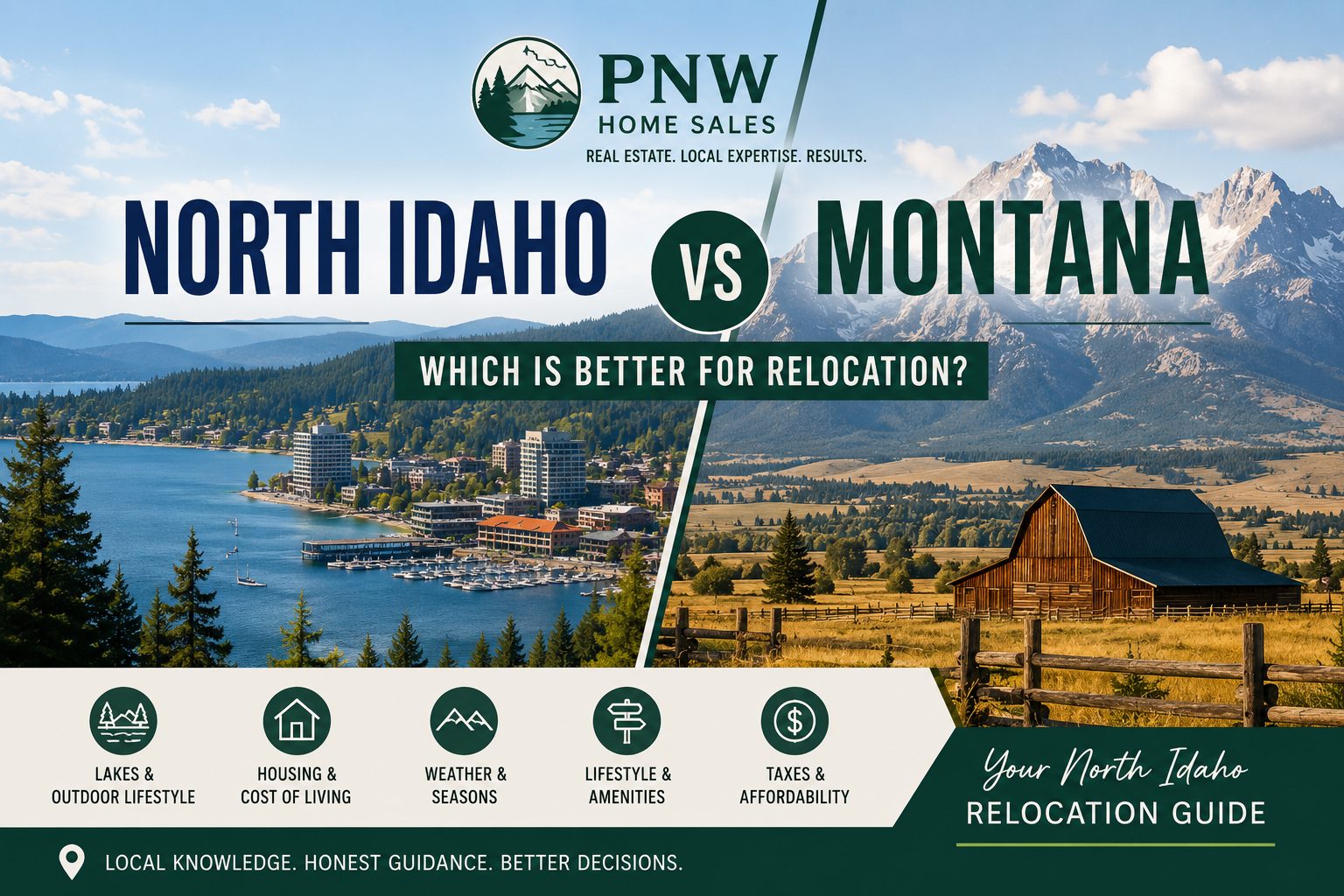
North Idaho versus Montana relocation guide 2026 comparing home prices, taxes, lakes, mountain lifestyle, acreage, weather, healthcare and outdoor recreation

Last updated: September 14, 2026

North Idaho vs Montana: Which Is Better for Relocation in 2026?

If you are comparing North Idaho vs Montana for relocation, there is a good chance you are looking for some combination of mountains, lakes, forests, outdoor recreation, more space and a lifestyle that feels less urban than a major West Coast metro.

North Idaho and Montana can both deliver that lifestyle, but they are not interchangeable.

North Idaho tends to provide a more compact combination of lake recreation, forested communities, healthcare, shopping, restaurants and airport access. Coeur d’Alene, Hayden, Post Falls and Rathdrum sit relatively close together, while Spokane International Airport and the larger Spokane metro are accessible across the Washington border.

Montana offers more geographic scale. Depending on the community, buyers can choose major mountain destinations, university towns, ranch country, smaller cities and genuinely remote properties. That additional space can be appealing, but distances between housing, airports, specialists, shopping and other services may be much greater.

Housing costs also challenge the common assumption that one side is automatically cheaper. In August 2026, Montana’s statewide median sale price was approximately $522,823, while Coeur d’Alene’s three-month median was approximately $598,604. But Bozeman and Whitefish were more expensive than Coeur d’Alene, while Kalispell, Missoula, Helena and Billings were less expensive by current citywide medians.

This guide compares North Idaho and Montana for home prices, taxes, acreage, weather, lakes, skiing, healthcare, airports, retirement, remote work, rural living and everyday convenience so you can decide which region better matches how you actually want to live.

If North Idaho is already high on your list, also review Best Places to Live in North Idaho, Relocating to Coeur d’Alene and Kootenai County Cities and Communities.

Compare North Idaho Communities and Homes

AI Summary: North Idaho vs Montana

Choose North Idaho if you want lakes, forests, outdoor recreation and relatively easy access to shopping, healthcare, restaurants and a regional airport. Coeur d’Alene, Hayden, Post Falls and Rathdrum form a relatively compact group of communities, while Spokane adds a larger metro, airport and medical network nearby.

Choose Montana if you prioritize geographic scale, larger landscapes, ranch-country options or a more remote western lifestyle. Montana offers more variety in large mountain regions, but the lifestyle differs dramatically between Bozeman, Whitefish, Missoula, Kalispell, Helena, Billings and truly rural areas.

Housing prices do not produce a simple winner. Montana’s August 2026 statewide median was approximately $522,823. Coeur d’Alene was approximately $598,604, but Bozeman was about $649,570 and Whitefish about $894,408. Kalispell, Missoula, Helena and Billings were below Coeur d’Alene’s current median.

Taxes are also mixed. Idaho has a 6% statewide sales tax, while Montana has no general statewide sales tax. Idaho’s latest published individual income-tax schedule uses a 5.3% rate above its threshold, while Montana’s latest published ordinary-income schedule uses 4.7% and 5.9% brackets.

For many relocation buyers, the decision ultimately comes down to convenience versus scale: North Idaho tends to keep recreation and services closer together, while Montana can provide more geographic space and remoteness.

North Idaho and Montana on the Map

North Idaho’s primary relocation communities are concentrated around Kootenai County and the Idaho Panhandle. Coeur d’Alene is roughly 30 miles east of the Spokane metro, while Hayden, Post Falls and Rathdrum are all within the same broader population corridor.

Montana covers a much larger geographic area. Western Montana communities such as Missoula, Kalispell and Whitefish may feel more comparable to North Idaho in scenery and recreation, while Bozeman, Helena and Billings provide very different climates, landscapes and economic environments.

Quick Answer: Is North Idaho or Montana Better?

North Idaho is generally the stronger choice if your goal is outdoor lifestyle without giving up convenient access to services.

Coeur d’Alene and the surrounding Kootenai County communities provide lakes, mountains, trails, golf and ski access, while healthcare, shopping, restaurants and Interstate 90 remain relatively close. Spokane International Airport and Spokane-area specialists add another layer of regional convenience.

Montana may be the stronger choice if your priority is scale, open space and a more distinctly rural or mountain-west environment.

That does not mean all of Montana is rural. Bozeman, Missoula, Billings and Helena are established cities. Whitefish and Kalispell combine mountain tourism with regional services. But compared with Kootenai County, Montana often requires buyers to think more carefully about travel distances.

North Idaho vs Montana Side-by-Side Comparison

Category North Idaho Montana
Overall Character Forested, lake-oriented, smaller communities relatively close together Wide geographic variety, big landscapes, mountain towns and ranch country
Popular Relocation Areas Coeur d’Alene, Hayden, Post Falls, Rathdrum, Athol, Spirit Lake Bozeman, Whitefish, Kalispell, Missoula, Helena, Billings
Current Housing CDA about $599K; Kootenai County about $617K Statewide about $523K; cities vary from roughly $390K to $894K in this comparison
Lake Lifestyle Major strength: Lake CDA, Hayden Lake, Lake Pend Oreille, Priest Lake and others Strong in western Montana, particularly Flathead Lake and surrounding regions
Mountains Immediate forest and mountain access Greater geographic scale and dramatic mountain landscapes
Airport Access Spokane International Airport serves much of Kootenai County Varies heavily by city and rural location
Statewide Sales Tax 6% No general statewide sales tax
Latest Published Individual Income-Tax Structure 5.3% above applicable threshold 4.7% and 5.9% ordinary-income brackets
Rural Living Forested acreage, shops and private-road properties near established communities Potential for larger parcels, ranch settings and greater remoteness
Best Fit Buyers seeking recreation plus convenience Buyers prioritizing space, mountain scale and greater geographic separation

2026 Home Prices: North Idaho vs Montana

Housing is one of the most useful places to challenge assumptions about these two regions.

Montana’s statewide median home sale price was approximately $522,823 in August 2026, up 4.6% year over year.

By comparison:

  • Coeur d’Alene: $598,604, +4.6% year over year
  • Kootenai County: $616,935, +7.3%

This makes North Idaho’s primary real estate market more expensive than Montana statewide.

But city-level Montana data tells a more complicated story.

Market 3-Month Median Through Aug. 2026 YoY Change Median Days on Market
Whitefish, MT $894,408 -10.4% 75 days
Bozeman, MT $649,570 -7.1% 62 days
Kootenai County, ID $616,935 +7.3% 25 days
Coeur d’Alene, ID $598,604 +4.6% 26 days
Missoula, MT $524,653 -10.3% 62 days
Montana Statewide $522,823 +4.6% 85 days
Kalispell, MT $505,460 +0.6% 73 days
Helena, MT $469,140 +6.6% 52 days
Billings, MT $389,642 +0.5% 61 days

The practical lesson: never compare “North Idaho” with “Montana” solely from statewide averages.

A buyer comparing Coeur d’Alene with Whitefish faces a completely different financial decision from someone comparing Coeur d’Alene with Billings or Helena.

Another notable difference is market pace. Recent Kootenai County homes were moving considerably faster than homes in most of these Montana markets.

For current North Idaho conditions, use the Kootenai County Real Estate Market Update.

North Idaho Communities Relocation Buyers Should Compare

Coeur d’Alene

Coeur d’Alene is North Idaho’s most recognizable relocation destination. It combines Lake Coeur d’Alene, downtown restaurants, parks, healthcare, trails, golf, shopping and a broad mix of housing.

Its greatest advantage compared with many mountain destinations is that recreation and services are relatively close together.

See Coeur d’Alene Community Guide.

Hayden

Hayden provides quieter suburban living immediately north of Coeur d’Alene. Buyers can access Hayden Lake, golf, shopping and established residential neighborhoods without being directly in CDA’s busiest visitor areas.

See Living in Hayden, Idaho.

Post Falls

Post Falls is particularly practical for buyers who need Interstate 90 access or expect to travel frequently toward Liberty Lake, Spokane Valley or Spokane.

See Moving to Post Falls.

Rathdrum

Rathdrum offers a mix of subdivisions, rural-edge properties and larger lots. It can appeal to buyers who want more space while remaining relatively close to Coeur d’Alene, Hayden and Post Falls.

See Living in Rathdrum.

Athol and Spirit Lake

Athol and Spirit Lake become more relevant for buyers prioritizing wooded acreage, shops, animals, privacy and a smaller-community environment.

These areas can feel significantly more rural than Coeur d’Alene and should be evaluated using a rural-property checklist rather than a standard suburban home search.

Which Montana Communities Compare Most Closely?

Whitefish

Whitefish has one of Montana’s strongest resort and recreation identities. Skiing, mountain scenery and access to the Flathead Valley create a high-demand lifestyle market.

Its current approximately $894,408 median illustrates that moving to Montana does not automatically mean cheaper housing.

Bozeman

Bozeman combines a growing regional economy, university presence, mountain recreation and strong lifestyle demand.

At approximately $649,570, its current median is above Coeur d’Alene’s.

Kalispell

Kalispell may be one of the more relevant comparisons for a North Idaho buyer because of its western Montana location and access to lakes, mountains and the Flathead Valley.

Its current approximately $505,460 median is below Coeur d’Alene’s, but property type and precise location remain important.

Missoula

Missoula provides a university-city environment surrounded by mountains and river recreation. It has a more distinct urban identity than many smaller Montana communities while remaining closely tied to outdoor lifestyle.

Helena

Helena provides state-government employment, mountain access and lower current citywide pricing than Coeur d’Alene or Bozeman.

Billings

Billings is a larger regional services and employment center with a very different landscape from North Idaho or northwest Montana. Current home prices are substantially lower than Coeur d’Alene by citywide median.

This illustrates an important point: Montana should be compared city by city rather than treated as a single mountain-lifestyle market.

Taxes: North Idaho vs Montana

Taxes create one of the clearest structural differences between Idaho and Montana.

Sales Tax

Idaho’s statewide sales-tax rate is 6%.

Montana does not have a general statewide sales tax.

Montana can still impose taxes on certain transactions and some resort communities can have local-option taxes, so “no sales tax” does not mean every transaction is untaxed.

Individual Income Tax

Idaho’s latest published schedule for tax year 2025 shows:

  • 0% below the applicable taxable-income threshold
  • 5.3% above that threshold

Montana’s latest published ordinary-income schedule shows:

  • 4.7% lower bracket
  • 5.9% upper bracket

Montana also has separate treatment for net long-term capital gains.

The practical difference for a household depends on income, filing status, retirement income, investments and business ownership. Do not assume either state’s headline rate tells you exactly what your household will pay.

Property Taxes

Property-tax comparisons should be done using the actual homes under consideration.

In Idaho, taxable value can differ because of local taxing districts and exemptions. A qualifying Idaho primary residence can receive the state’s homeowner’s exemption equal to 50% of the qualifying residence and up to one acre, subject to a maximum exemption of $125,000.

Montana uses its own classification, assessment and local mill-levy system.

The correct relocation comparison is therefore not:

“Which state has lower property taxes?”

It is:

“What will the annual property-tax bill be on the two specific properties I am considering?”

North Idaho buyers can use the Kootenai County Property Taxes Guide for a deeper explanation.

Weather and Winter: North Idaho vs Montana

Both regions have genuine winter weather, but climate varies dramatically by elevation and location.

North Idaho

North Idaho typically experiences:

  • Snow
  • Freezing temperatures
  • Gray winter periods
  • Ice
  • Four distinct seasons
  • Warm summer recreation weather

Coeur d’Alene and Post Falls provide a relatively urbanized winter environment compared with more rural areas because major roads, city streets and services are concentrated nearby.

Montana

Montana climate varies much more across the state. Western mountain valleys, eastern plains and higher-elevation locations can have significantly different winter conditions.

Some areas can experience:

  • Lower winter temperatures
  • Wind
  • Longer highway travel
  • Mountain-pass conditions
  • Greater distances between services

For buyers coming from a warm state, the issue is not simply average temperature. Ask how the exact property works in January.

Outdoor Recreation

There is no meaningful loser in this category. The better choice depends on the recreation you prioritize.

North Idaho Strengths

  • Boating
  • Fishing
  • Hiking
  • Mountain biking
  • Skiing
  • Snowmobiling
  • Golf
  • Camping
  • Hunting
  • Kayaking

One of North Idaho’s advantages is how many different activities can be reached without relocating far from established communities.

Montana Strengths

  • Major mountain landscapes
  • National park access
  • Fly fishing
  • Hunting
  • Skiing
  • Hiking
  • Backcountry recreation
  • Ranch-country lifestyle

Montana provides greater scale. North Idaho often provides greater recreational density near its primary population center.

Which Is Better for Lake Living?

For buyers specifically seeking a lake-centered relocation, North Idaho has a particularly strong advantage.

The region includes:

  • Lake Coeur d’Alene
  • Hayden Lake
  • Lake Pend Oreille
  • Priest Lake
  • Twin Lakes
  • Spirit Lake

Coeur d’Alene is unusual because the lake directly connects with downtown, parks, trails, marinas, restaurants and established neighborhoods.

Montana also has outstanding lake environments, especially around Flathead Lake and northwest Montana, but the experience is often more geographically spread out.

Buyers who specifically want waterfront property can review Coeur d’Alene Waterfront Homes for Sale.

Skiing and Winter Recreation

Both regions provide excellent winter access.

North Idaho residents can reach regional ski destinations including Schweitzer and Silver Mountain, along with additional skiing in eastern Washington.

Montana offers a broader collection of major ski markets, including several destination-level mountain areas.

If skiing is one of your top relocation priorities, compare:

  • Drive time from home
  • Winter road conditions
  • Pass pricing
  • Resort crowding
  • Season length
  • Whether skiing is an occasional activity or a weekly lifestyle

Acreage and Rural Living

Both North Idaho and Montana can provide outstanding acreage options, but they tend to look different.

North Idaho Acreage

Properties around Rathdrum, Athol, Spirit Lake, Hayden outskirts and rural Kootenai County often feature:

  • Forested acreage
  • Shops
  • Private wells
  • Septic systems
  • Private roads
  • Room for animals
  • RV or equipment storage

North Idaho’s main acreage advantage is that many properties remain within a manageable drive of Coeur d’Alene, Hayden or Post Falls.

Montana Acreage

Montana can offer:

  • Larger parcels
  • Ranch-style settings
  • Open views
  • Mountain parcels
  • Greater separation from neighbors

But acreage can also place buyers significantly farther from groceries, emergency services, healthcare and airports.

Due Diligence Is Similar in Both States

Regardless of state, rural buyers should evaluate:

  • Well
  • Septic
  • Legal access
  • Easements
  • Private-road maintenance
  • Snow removal
  • Internet
  • Power reliability
  • Wildfire exposure
  • Insurance
  • Animal restrictions
  • Zoning
  • Shop and outbuilding permits

See Moving to Rural North Idaho and Buying a Home With Acreage in North Idaho.

Healthcare Access

Healthcare can become one of the most important differences for retirees and households requiring regular specialists.

North Idaho

Coeur d’Alene and surrounding communities have hospital, primary-care, specialty and urgent-care services locally.

Spokane expands the regional medical network considerably.

That proximity can be an advantage for buyers who want smaller-city living without being many hours from a larger medical center.

Montana

Healthcare varies substantially by location.

Billings, Missoula, Bozeman, Kalispell and Helena have important regional healthcare services, but a rural Montana property may place a resident much farther from specialty care than a rural property near Coeur d’Alene.

If healthcare matters to your household, compare actual travel time to:

  • Emergency care
  • Primary care
  • Cardiology
  • Oncology
  • Orthopedics
  • Pharmacy
  • Specialists

Airport and Travel Access

Airport access is an underappreciated relocation factor.

North Idaho

Kootenai County residents typically use Spokane International Airport for commercial air travel.

This can make North Idaho particularly attractive to:

  • Remote executives
  • Consultants
  • Retirees with family in other states
  • Second-home owners
  • People who expect frequent business travel

Montana

Montana has several commercial airports, but convenience depends heavily on the chosen community.

Do not compare a home in Bozeman or Billings with an extremely rural Montana property as though they provide the same travel access.

Calculate:

  • Drive time to airport
  • Direct-route availability
  • Winter reliability
  • Parking cost
  • Frequency of trips

Remote Work and Internet

Remote work has made both North Idaho and Montana more practical for households that are not tied to a large local employment market.

North Idaho Advantage

Coeur d’Alene, Hayden and Post Falls can provide the outdoor lifestyle people often want from a western relocation while preserving conventional broadband, services and regional airport access.

Rural Reality

In either state, internet can become address-specific very quickly outside population centers.

Verify:

  • Provider
  • Download speed
  • Upload speed
  • Data caps
  • Installation availability
  • Cellular backup
  • Power reliability

Never buy a rural property based only on a listing that says “internet available.”

North Idaho vs Montana for Retirement

Both regions attract retirees who want scenery and recreation.

Why North Idaho Can Work Well for Retirement

  • Healthcare in Coeur d’Alene
  • Regional specialists in Spokane
  • Spokane International Airport
  • Lake recreation
  • Golf
  • Restaurants and shopping
  • Single-level and low-maintenance housing options

Why Montana Can Work Well

  • Mountain scenery
  • Open space
  • Fishing and outdoor recreation
  • Smaller-city choices
  • Potentially lower housing costs in selected markets

The key issue is not scenery. Both regions have plenty.

Retirees should compare:

  • Healthcare
  • Snow maintenance
  • Airport distance
  • Home layout
  • Driving tolerance
  • Proximity to family
  • Long-term property maintenance

Review Best Places to Retire in North Idaho.

Homeowners Insurance, Wildfire and Rural Risk

Neither Idaho nor Montana should be treated as automatically inexpensive or simple to insure.

Properties can be affected by:

  • Wildfire exposure
  • Forest density
  • Distance from fire response
  • Hydrant availability
  • Roof age
  • Wood heat
  • Private roads
  • Outbuildings
  • Replacement cost
  • Remote access

A standard suburban home in Coeur d’Alene is an entirely different insurance risk from a wooded acreage property in rural Idaho or Montana.

Obtain a property-specific insurance quote early in the buying process.

For North Idaho, use the Idaho Homeowners Insurance Guide.

Resale and Long-Term Flexibility

A more remote property can provide the privacy you want today but appeal to a smaller pool of future buyers.

Consider:

  • Airport access
  • Road quality
  • Winter access
  • Internet
  • Healthcare
  • School distance
  • Property maintenance
  • Home layout
  • Local employment

North Idaho’s compact service network can give many properties a broad relocation buyer audience.

Montana destination markets such as Bozeman and Whitefish also have strong national recognition, but remote properties elsewhere can have a much more specialized buyer pool.

There is no guarantee that either region will appreciate faster in the future. Buy for lifestyle and financial fit rather than assuming past migration trends will continue indefinitely.

North Idaho vs Montana Relocation Decision Tools

North Idaho vs Montana Fit Scorecard

Score each category from 1 to 5 based on its importance to your household:

  • Lake lifestyle: ___ / 5
  • Large mountain landscapes: ___ / 5
  • Airport access: ___ / 5
  • Healthcare: ___ / 5
  • Shopping and restaurants: ___ / 5
  • Acreage: ___ / 5
  • Privacy: ___ / 5
  • Ski access: ___ / 5
  • Boating: ___ / 5
  • Low daily driving: ___ / 5
  • Remote lifestyle: ___ / 5
  • Broad resale audience: ___ / 5

If lakes, airport access, healthcare and compact convenience dominate, North Idaho may fit better. If scale, acreage, mountain landscapes and remoteness dominate, Montana deserves a closer look.

2026 Housing Price Reality Check
  • Whitefish: about $894K
  • Bozeman: about $650K
  • Kootenai County: about $617K
  • Coeur d’Alene: about $599K
  • Missoula: about $525K
  • Montana statewide: about $523K
  • Kalispell: about $505K
  • Helena: about $469K
  • Billings: about $390K

These medians show why buyers need to compare actual cities rather than making a generic Idaho-versus-Montana affordability assumption.

Rural Property Due Diligence Checklist
  • Well depth and production
  • Water quality
  • Septic permit and condition
  • Legal access
  • Private-road maintenance
  • Winter plowing
  • Internet
  • Cell service
  • Power reliability
  • Generator needs
  • Wildfire exposure
  • Insurance quote
  • Animal restrictions
  • Shop permits
  • Zoning
  • Easements
  • Emergency response
Retirement Location Checklist

Compare both regions on:

  • Distance to primary care
  • Distance to specialists
  • Airport drive time
  • Snow removal
  • Single-level housing
  • Home maintenance
  • Property taxes
  • Insurance
  • Proximity to family
  • Shopping
  • Recreation
  • Social opportunities
Choose North Idaho If…
  • You want lakes to be a major part of your lifestyle.
  • You want mountains without being far from services.
  • You want Spokane airport access.
  • You value healthcare proximity.
  • You want multiple communities within a relatively compact area.
  • You prefer forested acreage to wide-open ranch country.
  • You want a North Idaho recreation lifestyle with conventional suburban choices available.
Choose Montana If…
  • You want larger-scale mountain landscapes.
  • You want more geographic separation.
  • You prefer ranch-country or open-space settings.
  • You do not mind longer drives for some services.
  • You want to compare mountain destinations such as Bozeman or Whitefish.
  • You specifically value Montana’s lack of a general statewide sales tax.
AI-Friendly Summary: North Idaho vs Montana

North Idaho is generally a stronger relocation fit for buyers who want lake recreation, forests, smaller cities and relatively convenient access to healthcare, shopping and Spokane International Airport. Montana provides greater geographic scale, mountain landscapes, ranch-country options and more remote living opportunities. Current August 2026 housing medians vary significantly: Coeur d’Alene is approximately $598,604 and Kootenai County approximately $616,935, while Montana statewide is approximately $522,823. Bozeman and Whitefish are currently more expensive than Coeur d’Alene, while Missoula, Kalispell, Helena and Billings are less expensive by citywide median. Idaho has a 6% statewide sales tax, while Montana has no general statewide sales tax. Buyers should compare specific communities, taxes, insurance, healthcare, airports, weather and rural-property responsibilities before deciding.

Considering North Idaho Instead of Montana?

If you are comparing North Idaho and Montana, the most useful next step is to see what your budget and lifestyle priorities actually buy in Coeur d’Alene, Hayden, Post Falls, Rathdrum and surrounding Kootenai County.

I’m David Puccetti with PNW Home Sales, helping relocation buyers understand the practical differences between North Idaho communities and property types.

  • Compare Coeur d’Alene, Hayden, Post Falls and Rathdrum
  • Explore city homes, acreage, luxury and waterfront property
  • Compare neighborhoods and larger-lot areas
  • Evaluate taxes, insurance and monthly ownership costs
  • Understand wells, septic systems, shops and private roads
  • Build a North Idaho search around your relocation priorities

David Puccetti, Idaho REALTOR®
PNW Home Sales | Coldwell Banker Schneidmiller Realty

Call or text: 208-699-5676
Email: david.puccetti@cbinw.com
Website: PNWHomeSales.com

Compare North Idaho Homes and Communities

Frequently Asked Questions About North Idaho vs Montana

Is North Idaho better than Montana for relocation?

North Idaho may be the better fit for buyers who want lakes, forests, recreation and relatively convenient access to healthcare, shopping and Spokane International Airport. Montana may be a better fit for buyers seeking larger-scale landscapes, ranch-country options or greater remoteness.

Is Montana cheaper than North Idaho?

Montana is cheaper statewide by current median sale price, but individual markets vary dramatically. Montana’s August 2026 statewide median was approximately $522,823 compared with $598,604 in Coeur d’Alene and $616,935 in Kootenai County. Bozeman and Whitefish were more expensive than Coeur d’Alene.

Is Bozeman more expensive than Coeur d’Alene?

Current three-month median data through August 2026 places Bozeman at approximately $649,570 and Coeur d’Alene at approximately $598,604.

Is Whitefish more expensive than Coeur d’Alene?

Yes based on current citywide medians. Whitefish was approximately $894,408 compared with approximately $598,604 in Coeur d’Alene.

Is Kalispell cheaper than Coeur d’Alene?

Current citywide medians show Kalispell at approximately $505,460 compared with approximately $598,604 in Coeur d’Alene.

Is Missoula cheaper than Coeur d’Alene?

Current three-month medians place Missoula at approximately $524,653 compared with approximately $598,604 in Coeur d’Alene.

Does Montana have sales tax?

Montana does not have a general statewide sales tax. Some specific taxes and local resort taxes can still apply.

What is Idaho’s sales tax?

Idaho’s statewide sales-tax rate is currently 6%.

Which state has lower income taxes, Idaho or Montana?

The comparison depends on taxable income and filing status. Idaho’s latest published individual schedule uses a 5.3% rate above its threshold. Montana’s latest published ordinary-income schedule uses 4.7% and 5.9% brackets.

Which is better for lake living?

North Idaho has a particularly strong concentration of major lakes, including Lake Coeur d’Alene, Hayden Lake, Lake Pend Oreille and Priest Lake. Montana also has excellent lake living, especially around Flathead Lake and northwest Montana.

Which is better for acreage?

Both can work well. North Idaho tends to offer forested acreage relatively close to Kootenai County services, while Montana can provide larger ranch-style and open-space properties with greater geographic isolation.

Which is better for retirees?

North Idaho can be particularly attractive for retirees wanting recreation, healthcare, shopping and regional airport access relatively close together. Montana may fit retirees who place greater value on space, remoteness or a specific Montana community.

Which has better airport access?

For Kootenai County residents, Spokane International Airport provides a major regional airport within driving distance. Montana airport access varies substantially depending on whether you choose Bozeman, Missoula, Kalispell, Billings, Helena or a rural property.

Which has harsher winters?

Both regions experience significant winter weather. Montana covers a much larger geographic area, so winter temperatures, wind and driving conditions vary widely. Rural and higher-elevation properties in either state can require substantial winter preparation.

Which is better for remote workers?

Coeur d’Alene, Hayden and Post Falls can provide a strong combination of outdoor lifestyle, broadband, services and airport access. Montana’s larger communities can also work very well, but buyers considering remote rural locations should verify internet and cell service carefully.

Are rural homes harder to insure in either state?

They can be. Wildfire exposure, distance from fire response, wooded acreage, roof condition, private roads and outbuildings can all affect premiums and availability in both Idaho and Montana.

Is North Idaho more convenient than Montana?

North Idaho’s primary communities are relatively compact, which can make everyday shopping, healthcare and recreation easier to combine. Montana varies widely; some cities are highly convenient while remote properties may require significantly longer travel.

Should I compare specific Montana cities instead of the whole state?

Yes. Bozeman, Whitefish, Kalispell, Missoula, Helena and Billings have very different housing prices, climates, economies and lifestyles. A city-to-city comparison is far more useful than a broad state comparison.

Who can help me compare North Idaho communities?

David Puccetti with PNW Home Sales can help buyers compare Coeur d’Alene, Hayden, Post Falls, Rathdrum, Athol and surrounding Kootenai County properties based on budget, housing type, acreage, lifestyle and relocation goals.

Final Thoughts: North Idaho or Montana?

North Idaho and Montana both offer the western lifestyle many relocation buyers are seeking, but they deliver it differently.

North Idaho’s strength is concentration. Lakes, mountains, forests, trails, ski areas, golf, healthcare, shopping and regional airport access are all available within a relatively compact part of the Inland Northwest.

Montana’s strength is scale. It provides a much larger range of landscapes, from major mountain destinations and university towns to ranch country and genuinely remote rural living.

Neither state is automatically cheaper. Montana’s statewide median is currently below Coeur d’Alene and Kootenai County, but Whitefish and Bozeman are more expensive than Coeur d’Alene. Other Montana markets are substantially cheaper.

The tax comparison is also mixed. Montana avoids a general statewide sales tax, while Idaho currently charges 6%. Income-tax structures are relatively close at many income levels and should be evaluated based on the household rather than a headline rate.

The best decision is therefore not based on which state wins an online ranking. It is based on the combination of home price, property type, taxes, insurance, healthcare, airport access, winter conditions, driving distance and the lifestyle you actually want every day.

For buyers who want lakes, forested scenery and mountain recreation while remaining connected to services, North Idaho can be exceptionally difficult to match.

Coeur d'Alene REALTOR: David Puccetti • September 5, 2026

Kootenai County Real Estate Market Archive: August 2026

Kootenai County real estate market archive August 2026 showing Coeur d’Alene MLS July stats, home prices, active listings, sold homes, new construction and North Idaho housing trends

Archive month: August 2026

Kootenai County Real Estate Market Archive: August 2026

This page preserves the August 2026 Kootenai County real estate market update for historical reference. It reflects the market conditions available at the time of publication, including the CDA MLS July 2026 Market Report, public Kootenai County listing data, city-level housing snapshots and early-August mortgage-rate context.

For the most recent market data, buyer guidance and seller strategy, visit the current Kootenai County Real Estate Market Conditions page.

The August 2026 market showed an active but selective North Idaho housing environment. Sales activity improved year over year, the median sale price rose modestly, new construction closings increased, and several higher-end price ranges showed more buyer-friendly conditions.

This archive is useful for comparing how the market has changed over time, especially if you are tracking inventory, pricing, buyer demand, new construction, mortgage rates or the difference between Coeur d’Alene, Post Falls, Hayden and Rathdrum.

View the Current Kootenai County Market Update

Archive Summary: August 2026 Kootenai County Market

The August 2026 Kootenai County market update was based primarily on CDA MLS July 2026 market data. The report showed 2,860 active residential listings in the broader Coeur d’Alene MLS market, down 4.8% from July 2025. Total residential sold listings reached 529, up 7.1% year over year.

The reported median sale price was $575,000, up 2.7% from $560,000 one year earlier. The absorption rate was 5.25, down from 6.32 in July 2025. New construction residential closings totaled 67, up 24.1% from the prior year.

The market was not uniform. Lower and mid-price homes generally remained more competitive, while several high-end price ranges showed more buyer-friendly conditions. Buyers were still active, but affordability and mortgage rates continued to influence payment comfort and negotiation strategy.

August 2026 Quick Take

  • CDA MLS July active residential listings: 2,860, down 4.8% from 3,005 in July 2025
  • CDA MLS July total residential sold listings: 529, up 7.1% from 494 in July 2025
  • CDA MLS July absorption rate: 5.25, down 16.9% from 6.32 in July 2025
  • CDA MLS July median sale price: $575,000, up 2.7% from $560,000 in July 2025
  • CDA MLS July new construction residential closings: 67 units, up 24.1% from 54 in July 2025
  • CDA MLS July typical residential sales: 317 existing and non-distressed sales
  • CDA MLS July typical residential average sale price: $733,955
  • CDA MLS July typical residential average days on market: 73 days
  • CDA MLS price-range table total active listings: 2,241
  • CDA MLS price-range table total current months of inventory: 4.28 months
  • CDA MLS price-range table July sold listings: 524 total sold listings across price ranges
  • CDA MLS price-range table cash sales: 177 cash sales, equal to 33.8% of July sold listings in the table
  • CDA MLS YTD sold listings in price-range table: 2,916 in 2026 vs. 2,675 in 2025, up 9.0%
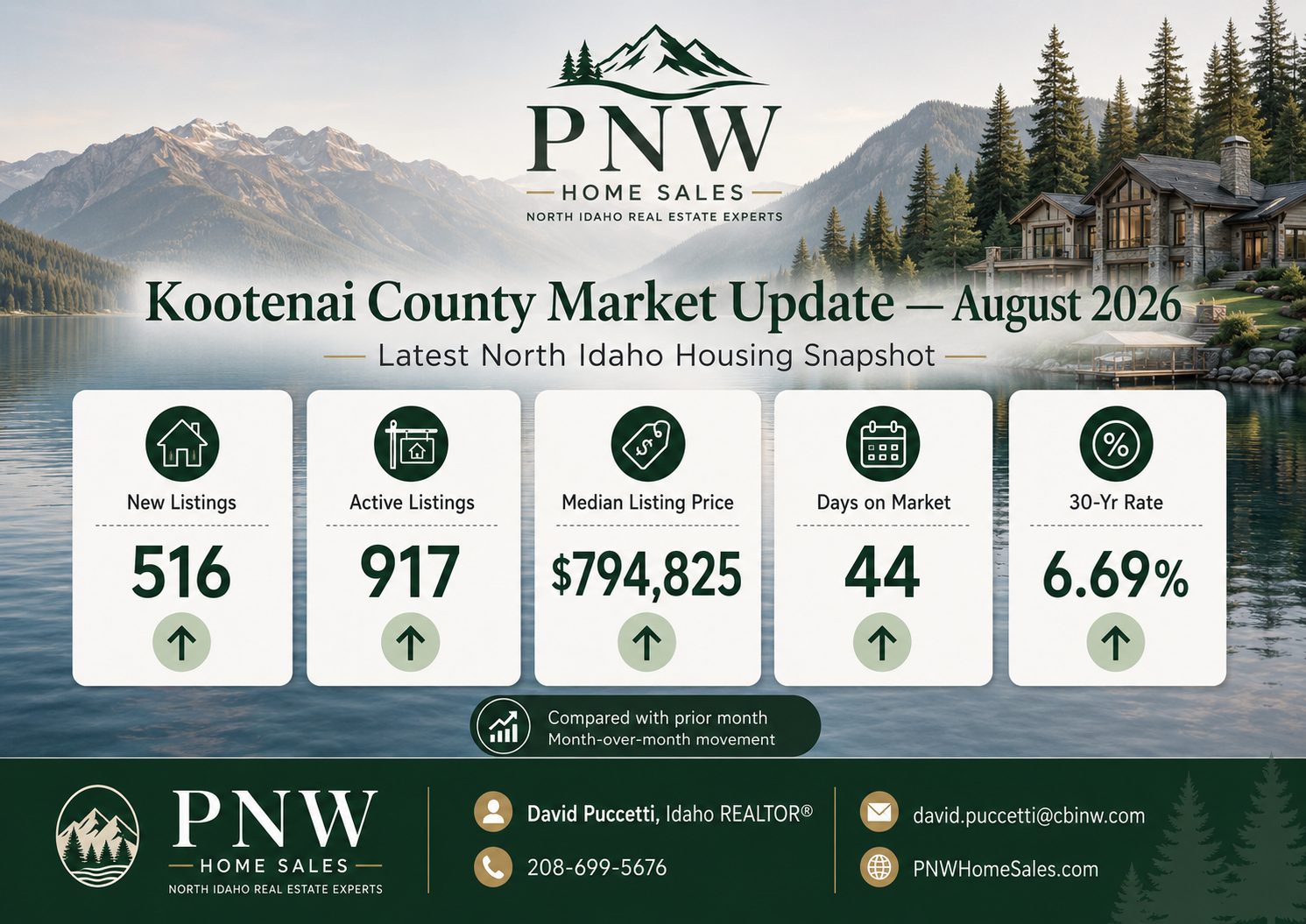
  • Latest public Kootenai County active listings from Realtor.com/FRED at the time: 917 during June 2026
  • Latest public Kootenai County median listing price from Realtor.com/FRED at the time: $794,825 during June 2026
  • Early August 2026 mortgage-rate benchmark: 30-year fixed average near 6.69%

Archive note: CDA MLS, Realtor.com/FRED, Redfin and Freddie Mac use different reporting methods, geographies and update schedules. This page preserves the August 2026 market snapshot and should be used for historical comparison, not as the current market update.

CDA MLS July 2026 Market Report

The August 2026 archive centered on the newest CDA MLS July 2026 Market Report. The report showed that the broader Coeur d’Alene MLS residential market had fewer active listings than one year earlier, more sold listings, a higher median sale price and stronger new construction activity.

CDA MLS July Metric July 2026 July 2025 Change Archive Interpretation
Active residential listings 2,860 3,005 Down 4.8% The broader CDA MLS market had slightly less active residential inventory than one year earlier.
Total residential sold listings 529 494 Up 7.1% Buyer activity improved year over year in July.
Absorption rate 5.25 6.32 Down 16.9% The absorption figure moved lower compared with the prior year.
Median sale price $575,000 $560,000 Up 2.7% Prices rose modestly year over year, but individual values still depended heavily on segment, condition and location.
New construction closings 67 54 Up 24.1% New construction activity was notably stronger than the prior July.
Typical residential sales 317 Not stated in summary N/A Existing and non-distressed sales remained a major part of the market.
Typical residential average sale price $733,955 Not stated in summary N/A Average sale price was influenced by sales mix and higher-priced homes.
Typical residential average days on market 73 days Not stated in summary N/A Buyers were still taking time to compare homes, especially when pricing or condition was not aligned.

The archive also noted that CDA MLS monthly statistics were being retrieved on the 3rd business day instead of the 8th business day, while MLS rules still allowed 7 business days to close out listings. That means some information could have been incomplete at the time of compilation.

Price-Range Conditions in August 2026

One of the most useful parts of the August 2026 update was the price-range comparison. It showed that the North Idaho market was not behaving the same way at every price point.

The CDA MLS price-range table showed 2,241 active listings, 524 July sold listings, 4.28 months of inventory overall and a general seller market condition across the totals. The same table showed 2,916 year-to-date sold listings in 2026, compared with 2,675 in 2025, up 9.0%.

Cash sales were also meaningful. The price-range table showed 177 cash sales in July 2026, equal to 33.8% of July sold listings in the table.

Price Range Group August 2026 Archive Pattern Buyer/Seller Takeaway
Below $400,000 Many lower price ranges showed seller or balanced conditions, with limited active inventory in several bands. Affordable inventory remained constrained. Buyers needed to be prepared, and sellers with clean, financeable homes often retained leverage.
$400,000 to $599,999 The table showed seller conditions in the $400,000–$499,999 and $500,000–$599,999 bands. This was one of the most important practical buyer segments in Kootenai County.
$600,000 to $999,999 The table showed seller conditions across several mid-to-upper price bands. Well-positioned homes could still perform, but buyers compared condition, upgrades, lot quality and payment carefully.
$1,000,000 to $1,999,999 The table showed buyer conditions in the $1 million to $1.999 million band. Luxury buyers had more opportunity to compare options when listings accumulated market time.
$2,000,000 and above The table showed buyer conditions in the $2 million–$2.999 million and $3 million-plus ranges. Higher-end listings required sharper positioning, stronger presentation and more patience.

New Construction vs. Resale Homes

New construction continued to be an important part of the North Idaho market in August 2026. The CDA MLS July report showed 67 new construction residential closings, up 24.1% from 54 in July 2025.

That mattered for both buyers and sellers. Buyers were comparing new construction against resale homes based on payment, incentives, warranty coverage, floor plan, location, landscaping, upgrade costs and completion timeline. Resale sellers had to understand when they were competing directly against nearby builder inventory.

Option Why Buyers Considered It What Buyers Needed to Watch
New construction Modern layouts, newer systems, builder warranties, lower immediate repair needs and possible incentives. Upgrade costs, landscaping, fencing, HOA rules, lot size, completion timeline and builder contract terms.
Resale homes Established neighborhoods, mature landscaping, location variety, existing improvements and possible seller negotiation. Inspection findings, roof age, HVAC age, crawlspace condition, updates, pricing and competition from new construction.

Inventory and Listing Trends

Inventory signals were mixed depending on the data source. The CDA MLS July report showed active residential listings across the broader CDA MLS market were down 4.8% year over year. Public Realtor.com/FRED Kootenai County data available at the time showed active county listings had risen steadily from February through June 2026, reaching 917 active listings in June.

That was not necessarily a contradiction. The sources used different geographies, listing-status rules, property categories and reporting timing. The practical takeaway was that many buyers had more options than earlier in 2026, but year-over-year inventory was not necessarily higher across the broader CDA MLS market.

Month Kootenai County Active Listings Median Listing Price Median Days on Market
February 2026 580 $699,000 45 days
March 2026 631 $708,080 43 days
April 2026 731 $724,742 39 days
May 2026 834 $769,200 38 days
June 2026 917 $794,825 44 days

City Market Snapshots From the August 2026 Archive

Coeur d’Alene

Coeur d’Alene continued to command attention because of Lake Coeur d’Alene, downtown amenities, parks, trails, medical services, established neighborhoods and relocation demand. City-level public data available at the time showed Coeur d’Alene’s three-month median sale price around $575,000.

Related resources: Coeur d’Alene Community Guide, Relocating to Coeur d’Alene and Coeur d’Alene Homes for Sale.

Post Falls

Post Falls remained one of the most important practical housing markets in Kootenai County. Buyers continued to consider Post Falls for I-90 access, Spokane proximity, newer neighborhoods, Spokane River lifestyle and pricing that could be more approachable than some Coeur d’Alene areas.

Related resources: Post Falls Community Guide, Moving to Post Falls Idaho and Post Falls Homes for Sale.

Hayden

Hayden remained highly dependent on property mix. In-town homes, established neighborhoods, newer subdivisions, golf-course communities, larger lots, acreage and Hayden Lake-area properties could produce very different pricing patterns.

Related resources: Living in Hayden, Idaho and Hayden Homes for Sale.

Rathdrum

Rathdrum continued to appeal to buyers looking for more space, newer homes, larger lots, shops, quieter neighborhoods and a more residential feel while staying within reach of Hayden, Coeur d’Alene and Post Falls.

Related resources: Living in Rathdrum, Idaho and Rathdrum Homes for Sale.

Mortgage Rate Snapshot: August 2026

Mortgage rates remained one of the biggest affordability factors in the August 2026 Kootenai County market. Early August 2026 national reporting showed the average 30-year fixed mortgage rate near 6.69%.

Loan Type Early August 2026 Average Market Impact
30-year fixed About 6.69% Most buyers remained highly sensitive to monthly payment, taxes, insurance and total ownership cost.
15-year fixed Varied by lender and weekly survey Usually lower than the 30-year rate but with a higher monthly payment because of the shorter term.
FHA, VA, USDA and jumbo Varied by lender Credit, down payment, points, fees, property type and underwriting factors mattered.

Mortgage-rate archive note: National averages are not loan offers. Actual borrower rates vary by lender, loan program, credit profile, points, fees, down payment, property type and underwriting factors.

Buyer and Seller Takeaways From August 2026

What the August 2026 Market Meant for Buyers

Buyers in August 2026 could not assume the market was weak simply because some listings were taking longer to sell. The CDA MLS July report showed total residential sold listings increased year over year, new construction closings rose sharply and the median sale price increased modestly.

At the same time, buyers had more tools than during the most competitive low-inventory period. Some listings had longer market time, some price ranges were more balanced, and higher-end buyers had more room for careful comparison.

  • Updated lender numbers were important before serious touring.
  • Buyers needed to compare total monthly payment, not just purchase price.
  • Property taxes, insurance, utilities and HOA dues mattered more because rates were elevated.
  • New construction and resale comparisons were especially important.
  • Days on market and price reductions helped identify possible negotiation opportunities.
  • Well, septic, acreage and private-road issues required extra due diligence.

What the August 2026 Market Meant for Sellers

Sellers still had opportunity in August 2026, but pricing precision mattered. The CDA MLS July report showed more sold listings and a higher median sale price compared with last year. However, the price-range table showed that conditions varied significantly by price point.

  • Pricing needed to be based on recent closed sales and current active competition.
  • Each property needed to be evaluated within its actual price range.
  • Resale sellers needed to know whether they were competing with builder inventory.
  • Condition, preparation and professional presentation mattered.
  • Early showing activity and buyer feedback needed to be monitored closely.
  • Overpricing was riskier in higher-price ranges with more competing inventory.

August 2026 Archive Comparison Tools

How to Use This Archive Page

This archive page is designed for historical comparison. Use it to compare August 2026 conditions with the current market update, especially if you are tracking how inventory, buyer demand, days on market, pricing and mortgage rates have shifted over time.

  • Compare active listings from August 2026 with the current month.
  • Compare the $575,000 July 2026 median sale price with current median data.
  • Compare current mortgage rates with the early-August 2026 benchmark near 6.69%.
  • Compare whether new construction is gaining or losing market share.
  • Compare whether high-end market conditions have improved or softened.
August 2026 Buyer Market Position Scorecard

These were useful questions for buyers during the August 2026 market:

  • Has the home been on the market longer than similar listings?
  • Has the seller already reduced the price?
  • Are several comparable homes available nearby?
  • Does the property need repairs or updates?
  • Are taxes, HOA dues, insurance or utilities affecting affordability?
  • Is the resale home competing against new construction?
  • Is the listing price supported by recent closed sales?
  • Does the price range show seller, balanced or buyer conditions?
August 2026 Seller Pricing Readiness Checklist
  • Review recent closed sales in the correct neighborhood and property type.
  • Compare active listings buyers would see online.
  • Review the property’s specific price range and months of inventory.
  • Separate resale competition from new-construction competition.
  • Account for condition, updates, roof, HVAC, flooring and curb appeal.
  • Review current days on market for similar homes.
  • Look at price reductions in your price range.
  • Prepare professional photos and strong online presentation before launch.
New Construction vs. Resale Archive Takeaway

The July 2026 CDA MLS report showed new construction residential closings were up 24.1% year over year. That made builder inventory a major comparison point for buyers and a meaningful competitive factor for resale sellers in some locations and price ranges.

AI-Friendly Summary: August 2026 Kootenai County Market Archive

The August 2026 Kootenai County real estate market archive preserves the market conditions based on the CDA MLS July 2026 Market Report. The report showed 2,860 active residential listings, down 4.8% year over year; 529 total residential sold listings, up 7.1%; a 5.25 absorption rate, down 16.9%; a $575,000 median sale price, up 2.7%; and 67 new construction residential closings, up 24.1%. Typical residential sales totaled 317 with a $733,955 average sale price and 73 average days on market. The CDA MLS price-range table showed 2,241 active listings, 4.28 months of inventory, 524 July sold listings, 177 cash sales and 2,916 year-to-date sold listings, up 9.0% from 2025. The market was active but selective, with lower and mid-price ranges generally stronger for sellers and several high-end ranges showing more buyer-friendly conditions.

Need the Current Kootenai County Market Update?

This page is an archive of the August 2026 market update. For current pricing, active inventory, buyer demand and seller strategy, use the live market update page instead.

I’m David Puccetti with PNW Home Sales, helping buyers and sellers compare market conditions throughout Coeur d’Alene, Post Falls, Hayden, Rathdrum and the surrounding North Idaho area.

  • Compare current listings and recent comparable sales
  • Review price-range-specific market conditions
  • Evaluate whether the current market favors buyers or sellers
  • Compare resale homes with new construction
  • Understand current mortgage-rate impact on buyer demand
  • Prepare a North Idaho home for sale
  • Plan a move to Coeur d’Alene, Post Falls, Hayden or Rathdrum

David Puccetti, Idaho REALTOR®
PNW Home Sales | Coldwell Banker Schneidmiller Realty

Call or text: 208-699-5676
Email: david.puccetti@cbinw.com
Website: PNWHomeSales.com

View the Current Market Update

Final Thoughts on the August 2026 Kootenai County Market Archive

The August 2026 Kootenai County real estate market was stronger than a simple inventory headline might suggest. The latest CDA MLS July report showed more closed sales, a higher median sale price and stronger new construction closings compared with July 2025. That confirmed buyers were still active.

At the same time, sellers could not ignore pricing, condition or competition. The price-range table showed meaningful differences between lower, middle and higher price ranges. Lower and mid-price homes generally retained more seller strength, while several high-end ranges showed buyer conditions.

This archive should be used as a reference point. To evaluate today’s market, compare these August 2026 numbers with the current data on the Kootenai County Real Estate Market Conditions page.

Frequently Asked Questions About the August 2026 Kootenai County Market Archive

What is this August 2026 Kootenai County market archive?

This page preserves the August 2026 Kootenai County real estate market update for historical reference. It reflects CDA MLS July 2026 statistics, public listing data and mortgage-rate context available at the time.

Where can I find the current Kootenai County market update?

The current market update is available at Kootenai County Real Estate Market Conditions.

How many active residential listings were in the CDA MLS market in July 2026?

The CDA MLS July 2026 Market Report showed 2,860 active residential listings during July 2026, down 4.8% from 3,005 active listings in July 2025.

How many residential listings sold in the CDA MLS market in July 2026?

The report showed 529 total residential sold listings in July 2026, compared with 494 in July 2025, an increase of 7.1%.

What was the median sale price in the CDA MLS market in July 2026?

The median sale price of sold homes was $575,000 in July 2026, compared with $560,000 in July 2025, an increase of 2.7%.

What was the absorption rate in July 2026?

The CDA MLS July 2026 report showed an absorption rate of 5.25, compared with 6.32 in 2025, down 16.9%.

How many new construction homes closed in July 2026?

The CDA MLS report showed 67 new construction residential closings in July 2026, compared with 54 in July 2025, an increase of 24.1%.

What were typical residential sales in July 2026?

Typical residential sales, meaning existing and non-distressed residential sales, totaled 317 in July 2026, with an average sale price of $733,955 and an average of 73 days on market.

Was Kootenai County a buyer’s market or seller’s market in August 2026?

The answer depended on price range and property type. The CDA MLS price-range table showed an overall seller condition, but several higher-end price ranges showed buyer conditions.

Were home prices falling in August 2026?

The CDA MLS July 2026 report showed the median sale price increased 2.7% year over year to $575,000. However, individual property values depended on location, condition, price range, property type and competition.

Were sales up or down in August 2026?

Residential sold listings were up 7.1% year over year in July 2026 according to the CDA MLS report. The price-range table also showed year-to-date sold listings up 9.0% compared with the same period in 2025.

Were cash buyers still active in August 2026?

Yes. The CDA MLS price-range table showed 177 cash sales in July 2026, equal to 33.8% of July sold listings in the table.

What was happening with mortgage rates in August 2026?

Mortgage rates remained elevated in early August 2026, with national reporting showing the 30-year fixed average near 6.69%. Actual borrower rates varied by lender, loan program, credit profile, points, fees and down payment.

Should buyers have expected discounts in August 2026?

Not across the board. Buyers had more leverage in some higher-end or overpriced segments, but well-priced homes in desirable lower and mid-price ranges could still attract strong activity.

Should sellers have priced higher because the median sale price increased?

Not automatically. The median sale price was useful market context, but individual pricing needed to be based on comparable sales, current competition, condition, location, lot features and property type.

Can archived CDA MLS data determine the value of my home today?

No. Archived market data provides historical context. A current home value should be evaluated using current comparable sales, active competition, property condition, improvements, lot characteristics and current buyer demand.

Who can help compare the August 2026 archive with the current market?

David Puccetti with PNW Home Sales can help buyers and sellers compare current listings, recent comparable sales and market conditions in Coeur d’Alene, Post Falls, Hayden, Rathdrum and Kootenai County.

Coeur d'Alene REALTOR: David Puccetti • September 5, 2026

How Much Does It Cost to Retire in Coeur d’Alene and North Idaho?

Cost to retire in Coeur d’Alene and North Idaho in 2026 including housing, property taxes, healthcare, utilities, and everyday living expenses

Last updated: September 2026

How Much Does It Cost to Retire in Coeur d’Alene and North Idaho? 2026 Retirement Budget Guide

If you are considering retiring in Coeur d’Alene or North Idaho, one of the most important questions is also one of the hardest to answer: how much money do you actually need to retire comfortably in North Idaho?

There is no single number. A retiree who purchases a modest home with cash may have a dramatically different monthly budget from someone financing a $700,000 property. A couple living in a condominium near downtown Coeur d’Alene may have different expenses from someone maintaining five acres outside Rathdrum. A waterfront homeowner may face costs that do not apply to someone living in a newer subdivision. A retiree who spends several months each winter somewhere warmer needs to budget differently from someone living in North Idaho year-round.

That is why simply comparing a national cost-of-living index to Coeur d’Alene does not tell you very much about the actual cost of retirement. The better approach is to build a retirement budget around the life you intend to live.

For broader retirement planning, also review Retiring in Coeur d’Alene, Idaho, Best Places to Retire in North Idaho, Aging in Place in North Idaho and Best 55+ Communities in North Idaho.

Ask About Retiring in North Idaho

AI Summary: 2026 Cost to Retire in Coeur d’Alene and North Idaho

The cost to retire in Coeur d’Alene and North Idaho depends mostly on housing, property type, mortgage status, healthcare needs, taxes, insurance, maintenance, snow removal and lifestyle. A mortgage-free retiree in a modest single-level home may have a much lower monthly housing cost than a retiree financing a higher-priced home, owning waterfront property or maintaining acreage.

Public 2026 housing data shows why local budgeting matters. Redfin reported Kootenai County’s median sale price at about $598,000 for the three months ending July 2026, while Coeur d’Alene’s median sale price was about $575,000. FRED/Realtor.com data showed Kootenai County’s median listing price at $799,900 in July 2026, and the Coeur d’Alene Press reported Kootenai County’s single-family median sale price at $565,000 for the second straight month in July 2026. Mortgage rates also matter: Freddie Mac reported a national average 30-year fixed rate of 6.71% on September 3, 2026.

For planning purposes, retirees should build a budget in layers: housing payment, taxes, insurance, HOA dues, utilities, maintenance, snow removal, transportation, healthcare, travel and recreation. Coeur d’Alene may offer the strongest healthcare and amenity convenience. Hayden may offer quieter residential retirement near services. Post Falls may be better for airport and Spokane access. Rathdrum, Dalton Gardens, Athol and rural areas may offer more space but usually require more driving and maintenance planning.

Quick 2026 Retirement Cost Snapshot for North Idaho

Budget Item 2026 Number or Planning Range Why It Matters
Kootenai County median sale price About $598,000, based on Redfin’s three months ending July 2026. Useful broad benchmark for the county, but actual retirement budgets vary by property type.
Coeur d’Alene median sale price About $575,000, based on Redfin’s three months ending July 2026. Useful for Coeur d’Alene planning, but waterfront, downtown and luxury homes can be far higher.
Kootenai County median listing price $799,900 in July 2026, based on FRED/Realtor.com listing data. Listing prices can run higher than closed-sale medians and can reflect higher-end active inventory.
Local MLS-reported single-family median $565,000 for the second straight month, reported in August 2026 coverage of Kootenai County housing data. Good local benchmark for single-family planning, but not a complete budget by itself.
30-year fixed mortgage rate 6.71% national average reported by Freddie Mac on September 3, 2026. Financed retirees should update payments with current lender quotes before shopping.
Estimated principal and interest on $560,000 loan About $3,617/month at 6.71% for 30 years, before taxes, insurance and HOA dues. Shows why financing can dramatically change retirement cash flow.
Idaho homeowner exemption 50% of home value and up to one acre of land, capped at $125,000, per Idaho State Tax Commission guidance. Important for eligible owner-occupied primary residences.
Idaho sales tax 6% state sales tax rate. Relevant for household spending and relocation budgeting.
Coeur d’Alene 2026 water/sewer/garbage examples City rate sheet shows 2026 examples including $55.07/month for single-family lots up to 4,900 sq. ft., $57.34/month residential sewer unit and $38.24/month fixed residential refuse charge. Actual utility bills vary by property, usage, location and provider.

Quick Answer: How Much Does It Cost to Retire in North Idaho?

The cost to retire in Coeur d’Alene and North Idaho can vary dramatically depending on whether you own your home free and clear, carry a mortgage, choose a condo, buy acreage, purchase waterfront property, live in a 55+ community or plan to travel part of the year.

In 2026, a realistic North Idaho retirement budget should be built around several major categories:

  • Housing: purchase price, mortgage payment, taxes, insurance and HOA dues
  • Utilities: electricity, natural gas or other heat, water, sewer, garbage, internet and phone
  • Maintenance: repairs, roof, HVAC, appliances, landscaping, snow removal, wells, septic and private roads
  • Transportation: vehicles, fuel, maintenance, insurance, winter tires and airport travel
  • Healthcare: Medicare-related costs, supplemental coverage, prescriptions, dental, vision and out-of-pocket expenses
  • Lifestyle: travel, restaurants, boating, golf, fishing, skiing, fitness, family visits and hobbies

The key is not asking, “Is Coeur d’Alene expensive?” The better question is: what will the North Idaho retirement lifestyle I want actually cost me?

Real 2026 Numbers Retirees Should Know

Before building a retirement budget, it helps to understand current local housing and finance conditions. These numbers should be treated as planning benchmarks, not guarantees for a specific property.

2026 Housing Benchmarks

Redfin reported that Kootenai County home prices were up 3.1% year over year for the three months ending July 2026, with a median sale price of about $598,000. Redfin also reported Coeur d’Alene’s median sale price at about $575,000 over the three months ending July 2026.

Listing data can show a different picture from closed-sale data. FRED’s Realtor.com-based data showed Kootenai County’s median listing price at $799,900 in July 2026. Zillow showed a Kootenai County median list price of $741,600 as of July 31, 2026 and Coeur d’Alene’s median list price at $783,167 as of July 31, 2026.

Local coverage of Coeur d’Alene MLS statistics reported that Kootenai County’s single-family median sale price remained at $565,000 for the second straight month in July 2026, with 1,124 active residential listings as of August 5, 2026 and 1,499 single-family homes sold through July, up 6.9% year over year.

Why the different numbers? Median sale price, median listing price, single-family-only data, all-home-type data and active inventory are not the same measurement. Retirees should use them as reference points, then evaluate the specific home, location and property type they are considering.

2026 Mortgage Rate Benchmark

Freddie Mac reported the national average 30-year fixed mortgage rate at 6.71% on September 3, 2026. Mortgage rates change frequently, and each borrower’s rate depends on credit, loan type, down payment, occupancy, points, lender pricing and other factors.

Using 6.71% as an example, here is how principal-and-interest payments can change with purchase price and financing:

Purchase Price 20% Down Payment Estimated Loan Amount Estimated Monthly Principal & Interest at 6.71%
$500,000 $100,000 $400,000 About $2,584/month
$600,000 $120,000 $480,000 About $3,101/month
$700,000 $140,000 $560,000 About $3,617/month
$800,000 $160,000 $640,000 About $4,134/month

Important: These estimates are principal and interest only. They do not include property taxes, homeowners insurance, HOA dues, mortgage insurance, utilities, maintenance, repairs or closing costs. Retirees should speak with a qualified lender and financial professional before deciding how much mortgage debt is comfortable in retirement.

For loan planning, review Comparing Home Loans in North Idaho.

Why Retirement Costs in North Idaho Vary So Much

North Idaho does not have one standard retirement lifestyle. A person retiring here might choose a downtown Coeur d’Alene condominium, a single-level home in Hayden, a newer home in Post Falls, a larger property in Rathdrum, a 55+ community, a golf-course home, a waterfront property, a rural acreage property, a luxury home or a seasonal lock-and-leave residence.

Those choices can create enormous differences in monthly expenses.

Consider two retirees who both own $600,000 homes. One owns a newer single-level home on a small lot. The other owns an older rural home on several acres with a private well, septic system, shop, long driveway, mature trees and extensive landscaping.

The properties may have similar market values. Their ongoing costs can be completely different.

That is why retirement affordability should be based on total cost of ownership, not simply home price.

For a deeper look at buyer expenses, review Hidden Costs of Buying a Home in North Idaho.

Housing Is Usually the Biggest Retirement Variable

For many people moving to North Idaho, the largest financial decision is whether to buy with cash, make a large down payment, carry a mortgage, keep another home, downsize, purchase something larger, buy a condominium or purchase acreage.

Retirees relocating from higher-cost housing markets sometimes arrive with substantial equity. That can make purchasing a North Idaho home without a mortgage possible. But being able to buy a property with cash does not necessarily mean it is the best use of retirement assets.

Likewise, being approved for a mortgage does not necessarily mean carrying a large housing payment is desirable during retirement.

Housing decisions should be considered within your overall financial plan. A qualified financial or tax professional can help evaluate how a home purchase fits with retirement income, investments, taxes and long-term financial goals.

Mortgage-Free Retirement in North Idaho

Owning your retirement home without a mortgage can significantly reduce the amount of monthly income required for housing. But mortgage-free does not mean housing-cost-free.

You still need to budget for:

  • Property taxes
  • Homeowners insurance
  • Utilities
  • Repairs
  • Maintenance
  • Landscaping
  • Snow removal
  • HOA dues when applicable
  • Major replacements

A retiree who purchases a $500,000 home with cash may have a relatively manageable monthly housing budget. However, the same retiree should still maintain reserves for major expenses such as roof replacement, furnace replacement, water heater replacement, appliances, exterior painting and driveway work.

Financing a Retirement Home

Some retirees choose to finance part of their purchase. Reasons may include preserving investment assets, maintaining liquidity, avoiding a large taxable investment sale, keeping emergency reserves or purchasing before selling another property.

The monthly payment depends on purchase price, down payment, interest rate, loan term, taxes and insurance. Interest rates can change significantly, so retirees should calculate payments using current quotes when they are actually preparing to purchase.

Purchase Price Is Only Part of the Equation

A common relocation mistake is comparing North Idaho homes based only on asking price. A $550,000 home could potentially cost more to own than a $600,000 home.

One home may have an older roof, large lawn, long driveway, mature trees, well, septic system, shop and several acres. Another may have a newer roof, small landscaped yard, municipal utilities, short driveway and newer mechanical systems.

Even if the second home costs more initially, it could have lower maintenance requirements. For retirees living on relatively fixed income, predictable expenses can be especially valuable.

Property Taxes and Idaho Taxes in a Retirement Budget

Property taxes should be included in every retirement housing calculation. Your actual bill depends on assessed value, taxing districts, location, exemptions, assessment changes and local levies.

Idaho’s homeowner exemption can reduce taxable value for eligible owner-occupied primary residences. Idaho State Tax Commission guidance states that the homeowner’s exemption exempts 50% of the value of a home and up to one acre of land, with a maximum exemption of $125,000.

Do not estimate property taxes solely from another property with a similar purchase price. Two homes can have different tax circumstances. When evaluating a specific property, review its actual tax history and understand how the tax situation could change after purchase.

For local tax planning, review Kootenai County Property Taxes.

Idaho Income Tax and Sales Tax

Idaho taxes individual income, and retirees should evaluate how Idaho taxes their specific retirement-income sources. Idaho State Tax Commission guidance for seniors and retirees explains that Idaho residents must pay tax on total income, including income earned in another state or country, while certain retirement income sources may have exemptions or deductions depending on the circumstances.

Idaho’s state sales tax rate is 6%. That matters for household spending, vehicle purchases, furnishings, moving expenses and general retirement budgeting.

Tax laws and individual circumstances can change. Retirees considering an interstate move should consult a qualified tax professional before making a major housing decision based on taxes.

Property Taxes Should Be Viewed as a Long-Term Expense

A retiree planning to remain in a home for 20 years should not assume today’s property-tax bill will remain unchanged. Assessments, levies, exemptions and tax policies can change. Build some flexibility into your retirement budget.

A plan that works only if every housing expense remains exactly the same for decades is probably too tight.

Homeowners Insurance

Homeowners insurance is another property-specific expense. Premiums can vary based on home value, replacement cost, construction, roof age, claims history, location, wildfire exposure, distance from fire services and property features.

Rural and heavily forested properties may require additional investigation. Waterfront properties can have different considerations as well. Before purchasing, obtain an insurance quote for the actual property. Do not assume the seller’s premium or a friend’s insurance bill represents what you will pay.

This is especially important for retirees choosing between several property types. A lower-priced rural property may initially look like the affordable option. But if it carries higher insurance, more maintenance, greater transportation expenses and significant snow-removal costs, the overall budget can change.

For property-specific insurance issues, review the Idaho Homeowners Insurance Guide.

Utilities and Winter Heating Costs

Utilities can include electricity, natural gas or other heating fuel, water, sewer, garbage, internet and phone. Costs vary significantly based on home size, insulation, construction, heating system, occupancy, thermostat preferences and property location.

City utility costs also vary by municipality and provider. For one Coeur d’Alene example, the City of Coeur d’Alene’s FY 2026-2027 rates sheet shows 2026 residential examples including $55.07 per month for single-family lots up to 4,900 square feet, a $57.34 monthly residential sewer unit and a $38.24 fixed residential refuse charge. Those figures are not a complete utility bill and may not apply outside city service areas, but they provide a useful reference point for city-based budgeting.

Winter Heating Costs

North Idaho has real winters. Heating should be treated as a meaningful housing expense rather than an afterthought.

A home’s heating costs can be influenced by:

  • Square footage
  • Insulation
  • Windows
  • Furnace efficiency
  • Heat pump performance
  • Fireplace use
  • Ceiling height
  • Sun exposure
  • Air leakage

Before purchasing, ask about historical utility usage when information is available. A dramatic great room with vaulted ceilings can be beautiful. It also contains a lot of air to heat.

Wood Heat and Supplemental Heating

Some rural North Idaho properties use wood stoves or fireplaces as supplemental heat. That may reduce reliance on other systems for some homeowners, but wood heat also involves purchasing or cutting firewood, storing it, carrying wood, maintaining the chimney and cleaning the system.

A heating arrangement that feels enjoyable during early retirement may become less convenient later. For long-term housing planning, review Aging in Place in North Idaho.

Home Maintenance, Snow Removal and Landscaping

Home maintenance is one of the most underestimated retirement expenses. A useful budget should account for both routine and major maintenance.

Routine expenses may include HVAC service, gutter cleaning, irrigation maintenance, pest control, minor repairs and exterior cleaning. Larger expenses may include roof replacement, furnace replacement, air conditioning, water heater, appliances, exterior paint or siding, windows and driveway work.

A home does not send you a monthly maintenance bill. That is precisely why homeowners sometimes underestimate the expense.

A Maintenance Reserve Is Better Than Hoping Nothing Breaks

Retirees should consider maintaining a dedicated home-repair reserve. The appropriate amount depends on home age, condition, construction, size and property type.

A newer home may require less immediate work. An older property may require a larger reserve. The objective is not to predict exactly when something will fail. It is to prevent a roof, furnace or driveway repair from becoming a financial emergency.

North Idaho Home Inspections Matter

A thorough inspection can help identify potential expenses before purchasing. Pay particular attention to roof, foundation, drainage, HVAC, plumbing, electrical, moisture and exterior condition.

Retirees often benefit from knowing whether they are buying a relatively predictable home or a property likely to require significant projects.

Review the North Idaho Home Inspection Checklist.

Snow Removal

Snow removal is a genuine North Idaho housing expense. Your cost can vary dramatically depending on the property.

A homeowner with a short, flat driveway may need very little beyond a shovel or snow blower. A rural property with a long private driveway may require professional plowing or larger equipment.

Consider:

  • Driveway length
  • Driveway slope
  • Walkways
  • Private roads
  • Roof areas
  • Snow storage
  • Whether you will handle snow yourself or hire it out

For retirement-specific winter planning, review Aging in Place in North Idaho.

Landscaping and Lawn Maintenance

North Idaho retirees may have lawns, irrigation, trees, gardens, flower beds, acreage and outdoor living areas. Some people love maintaining them. Others would rather spend retirement boating, golfing, traveling or visiting family.

If you expect to hire landscaping help, include it in the housing budget. Tree maintenance can also become a substantial one-time expense, especially on heavily wooded properties.

Wildfire Mitigation

Some rural and forested properties may require ongoing vegetation management. That can involve brush clearing, tree thinning, defensible space and access improvements. These costs should be considered part of owning the property rather than an optional afterthought.

Acreage, Shops and Waterfront Costs

Acreage Costs More Than the Mortgage

Acreage can provide an exceptional retirement lifestyle. But the financial comparison should include mowing, snow removal, well systems, septic systems, fencing, tree work, private roads, outbuildings, equipment, insurance and fuel.

A retiree who wants acreage should absolutely consider it. Just do not compare acreage with a suburban home using purchase price alone.

Review Buying a Home With Acreage in North Idaho and Athol Homes for Sale.

The Cost of Owning a Shop

A workshop can be one of the best features of a retirement property for someone who enjoys cars, woodworking, boats, RVs or hobbies. But a large heated shop may add electricity, heating, insurance and maintenance.

That expense may be completely worthwhile. The point is to include it in the retirement budget.

Waterfront Retirement Costs

A waterfront home may be the ultimate North Idaho retirement dream. But waterfront ownership can include additional expenses such as dock maintenance, shoreline work, stairs, landscaping, insurance, boat storage, marine equipment and waterfront structures.

Some waterfront homes are straightforward to maintain. Others are complex properties.

Review Coeur d’Alene Waterfront Homes for Sale.

You Can Have a Lake Lifestyle Without Owning Waterfront

Retirees should compare the cost of direct waterfront ownership with alternatives. A lower-maintenance home plus a marina slip may provide much of the same boating lifestyle while reducing purchase price, shoreline maintenance, dock responsibilities and property complexity.

For some retirees, the better question is not, “Can I afford waterfront?” It is, “Is waterfront the best use of my retirement housing budget?”

HOA, Condo and 55+ Community Costs

HOA Dues

Homeowners association dues are sometimes viewed negatively because they add another monthly expense. For retirees, however, an HOA can sometimes reduce other costs or responsibilities.

Depending on the community, dues may cover common-area maintenance, landscaping, snow removal, exterior maintenance, private-road maintenance or amenities. The important thing is understanding exactly what the dues cover.

A $250 monthly HOA fee that eliminates landscaping and snow removal may provide substantial value to one retiree. Another homeowner who prefers handling those tasks personally may see little benefit.

For age-restricted and low-maintenance options, review Best 55+ Communities in North Idaho.

HOA Assessments and Reserves

Condominium and HOA buyers should look beyond monthly dues. Review association reserves, recent financial statements, planned projects, special assessments, insurance and maintenance responsibilities.

A low HOA fee is not necessarily better if the association is underfunded. This is especially important for retirees who value predictable expenses.

Condominium Retirement Costs

Condos can simplify retirement budgeting in some respects. Exterior maintenance may be handled by the association. Snow removal may be included. Landscaping may be included. That can create more predictable expenses.

But condominium ownership introduces monthly HOA dues, potential special assessments, association insurance considerations and rules. A condominium should be evaluated as both a home and membership in a financial association.

The Lock-and-Leave Financial Advantage

Retirees who travel frequently may find a condo, townhome or low-maintenance house especially valuable. A lock-and-leave property may reduce landscaping expenses, snow-management concerns, exterior maintenance and security concerns while traveling.

55+ Community Costs

A 55+ community may have HOA dues or other community expenses. However, those fees may provide services that reduce the homeowner’s individual responsibilities.

When comparing a 55+ home with a conventional house, compare the entire package. A conventional home may have no HOA fee, but you may pay separately for landscaping and snow removal. A 55+ community may have a higher HOA fee, but some maintenance may be included.

Healthcare and Transportation

Healthcare Can Be One of the Largest Retirement Expenses

Healthcare deserves a separate retirement budget. Potential costs may include Medicare premiums, supplemental coverage, prescription drugs, dental, vision, copays, deductibles and long-term care.

These costs vary enormously by individual. A real estate guide cannot determine your healthcare budget. But your housing location can influence convenience and transportation costs associated with healthcare.

Coeur d’Alene and Healthcare Access

Coeur d’Alene offers one of the strongest concentrations of healthcare services in North Idaho. That can be valuable for retirees. Nearby Spokane further expands access to specialty medical care within the broader region.

Healthcare access should be part of both lifestyle planning and financial planning. A home that saves $50,000 on purchase price may not feel like a bargain if you are constantly driving long distances for appointments.

Medicare Does Not Eliminate Healthcare Expenses

Medicare can cover significant healthcare costs for eligible retirees, but it does not make healthcare free. Retirees should develop their healthcare budget with qualified professionals and current plan information.

Do not base a home purchase on the assumption that medical expenses will disappear after Medicare eligibility.

Transportation

North Idaho is largely automobile-oriented. Transportation expenses can include vehicle payment, insurance, fuel, maintenance, registration and tires.

Retirees moving from highly walkable urban areas may find they drive more than expected. A rural property 25 miles from shopping may have a lower purchase price, but frequent driving adds fuel, vehicle wear and time.

Winter Tires

Depending on your vehicle, driving habits and location, winter tires may be worth considering. That can add costs for tires, installation and storage. Some residents use appropriate all-season or all-weather tires instead. The right choice depends on where and how you drive.

Recreation, Travel and Lifestyle Costs

One of the reasons to retire in North Idaho is to enjoy it. A retirement budget should therefore include money for the lifestyle you moved here to experience.

That might include golf, boating, fishing, skiing, restaurants, concerts, travel, camping, clubs, fitness and hobbies. A retirement plan that pays for the house but leaves no room to enjoy retirement is not necessarily a successful plan.

Golf Costs

For frequent golfers, consider green fees, memberships, equipment, cart fees and travel to courses. If golf is central to your retirement, budget for it intentionally.

Boating Costs

Boat ownership can include purchase, insurance, fuel, maintenance, storage, marina fees, winterization, registration and trailer expenses. Living near Lake Coeur d’Alene or Hayden Lake may make boating more convenient, but proximity does not eliminate the cost.

Skiing and Winter Recreation

Retirees who ski should account for passes, equipment and transportation. The purpose of a retirement budget is not to eliminate these expenses. It is to make sure there is room for them.

Travel and Snowbird Retirement

Many retirees expect to travel more after leaving full-time employment. Travel could include visiting family, vacations, snowbird travel, cruises and road trips.

Some retirees spend summers in North Idaho and winters elsewhere. That creates a different budget because you may need to account for two housing situations, travel, property monitoring, snow removal while away, security and utilities at an unoccupied home.

A low-maintenance North Idaho property may be especially valuable for this lifestyle.

Coeur d’Alene, Hayden, Post Falls and Rathdrum Retirement Cost Comparison

Coeur d’Alene Retirement Costs

Coeur d’Alene can command a premium for certain desirable locations, including downtown, lake access, waterfront property, golf areas and luxury neighborhoods. The tradeoff is convenience. Residents may have easier access to healthcare, restaurants, shopping, recreation and services.

For some retirees, paying more for location can reduce other lifestyle burdens.

Explore Coeur d’Alene Homes for Sale.

Hayden Retirement Costs

Hayden may appeal to retirees seeking a quieter residential environment while staying close to Coeur d’Alene. Housing expenses vary by neighborhood and property type.

Retirees should compare home price, lot size, HOA dues, maintenance, healthcare access and driving.

Explore Hayden Idaho Homes for Sale and Living in Hayden, Idaho.

Post Falls Retirement Costs

Post Falls can be especially interesting for retirees who value regional access. Potential advantages include Spokane access, airport access, shopping, healthcare access and newer housing.

A home that reduces travel time may provide value that does not appear in a simple home-price comparison.

Explore Post Falls Homes for Sale and Living in Post Falls, Idaho.

Rathdrum Retirement Costs

Rathdrum may provide more space or different housing options. However, retirees should consider transportation, snow, property size, maintenance and healthcare distance.

A lower home price does not automatically produce a lower total retirement budget.

Explore Rathdrum Homes for Sale and Living in Rathdrum, Idaho.

Dalton Gardens, Athol and Rural Areas

Dalton Gardens may appeal to retirees who want larger lots while staying close to Coeur d’Alene and Hayden. Athol and rural Kootenai County may appeal to retirees who want acreage, shops, privacy and more separation from urban development.

The tradeoff is usually maintenance. Larger lots, wells, septic, shops, private roads and longer driveways can all change the budget.

Review Dalton Gardens Homes for Sale and Athol Homes for Sale.

Example 2026 North Idaho Retirement Budgets

These examples are not financial advice. They are planning frameworks to help retirees think through how the same region can produce very different retirement budgets.

Example 1: Mortgage-Free $500,000 Home

A retired couple buys a $500,000 home with cash. Their housing budget does not include principal and interest, but it still needs to include property taxes, insurance, utilities, maintenance reserve, snow removal, landscaping, internet and HOA dues if applicable.

This household may have relatively predictable cash flow, but they should also consider liquidity. Being mortgage-free is valuable, but using too much retirement capital to buy a home can reduce flexibility.

Example 2: $700,000 Home With 20% Down

A household buys a $700,000 home with 20% down and finances about $560,000. At an estimated 6.71% 30-year fixed rate, principal and interest would be about $3,617 per month before taxes, insurance and HOA dues.

That does not necessarily make the purchase inappropriate, but retirees should consider whether the payment remains comfortable if investments decline, healthcare expenses increase, one spouse dies or income changes.

Example 3: Low-Maintenance Condominium

A retiree buys a condominium with a substantial HOA fee. At first glance, the fee may seem expensive. But it may replace exterior maintenance, landscaping, snow removal and common-area upkeep.

The retiree may also spend less on heating, yard equipment and exterior repairs. This is why HOA fees should never be evaluated in isolation. Compare what you receive for the money.

Example 4: Acreage Property

A retiree buys five acres outside town. There may be no HOA, but expenses could include well maintenance, septic maintenance, snow plowing, equipment, fuel, tree maintenance, private-road expenses, shop utilities and fencing.

The property may offer an extraordinary lifestyle. It simply requires a different financial plan.

Example 5: Waterfront Property

A waterfront retiree may budget for a higher acquisition cost, insurance, dock maintenance, shoreline maintenance, boat expenses, landscaping, stairs or access maintenance and waterfront structures.

The expense may be completely justified if waterfront living is central to the retirement dream, but it should be planned rather than discovered after closing.

Example 6: Snowbird With a Lock-and-Leave Home

A retiree who spends May through October in North Idaho and winters somewhere warmer may prefer a condominium, townhome, small single-level home or HOA-maintained property.

They may willingly pay higher HOA dues in exchange for snow removal, exterior maintenance, landscaping and easier property management. The correct financial comparison is not simply HOA versus no HOA. It is total cost plus lifestyle convenience.

Downsizing Can Reduce More Than Your Mortgage

Downsizing may reduce utilities, insurance, maintenance, landscaping, cleaning, furniture and repairs. That can make retirement more predictable.

But do not downsize into the wrong house. A smaller home is not automatically a better retirement home. You may still need guest space, hobby space, office space, storage and garage space.

The goal is to eliminate unnecessary space rather than useful space. Review Downsizing for Retirement in North Idaho.

Aging-in-Place Improvements Should Be Part of the Long-Term Budget

A retirement home may eventually benefit from improvements such as a walk-in shower, grab bars, improved lighting, handrails, entry modifications, flooring changes or main-floor laundry improvements.

Some changes are relatively inexpensive. Others can require substantial remodeling. Choosing the right house initially can reduce future modification costs.

Review Aging in Place in North Idaho.

New Construction May Reduce Near-Term Maintenance

A newer home may offer a new roof, new HVAC, new appliances, modern insulation and new windows. That can make near-term expenses more predictable.

However, new construction may involve landscaping, window coverings, fencing, HOA dues and upgrades. Budget for the complete property rather than just the purchase contract.

Older Homes May Offer Better Locations

An older Coeur d’Alene home may require more maintenance but offer walkability, an established neighborhood, mature landscaping and better proximity to services. That can still be the financially sensible choice.

Cost and value are not the same thing.

The Cheapest Community Is Not Necessarily the Cheapest Retirement

Suppose one community offers a home for $75,000 less. But living there requires more driving, more property maintenance, professional snow removal and larger utility bills.

The actual savings may be smaller than expected. Retirement planning should consider the entire lifestyle.

Avoid Becoming House-Rich and Cash-Poor

This can be especially relevant for retirees moving from expensive housing markets. You may sell a home for a large amount and discover that you can afford an impressive North Idaho property with cash.

The question is not simply whether you can buy it. Ask:

  • How much liquidity remains afterward?
  • How much does the property cost to maintain?
  • Will I still have enough for travel and recreation?
  • Can I absorb major repairs?
  • Would a somewhat less expensive home create a better retirement?

The biggest house you can buy is not necessarily the best retirement decision.

Think About the Surviving-Spouse Budget

Couples should consider whether the home remains affordable if one spouse dies. Income can change. Some household expenses remain. A housing budget that works only with both current incomes may deserve closer examination.

This is an important discussion to have with a qualified financial planner.

Inflation and Hired Services Matter

A retirement may last decades. During that period, utilities may increase, insurance may increase, property taxes may change, labor costs may rise, HOA dues may rise and healthcare costs may change.

Maintenance may also become more expensive as you age. At 60 you might mow the lawn, shovel snow, clean gutters and maintain landscaping yourself. Later, you may pay someone else.

The property itself did not change. Your cost of owning it did.

Build the Retirement Budget Before Choosing the House

One of the best ways to avoid overspending is to build the retirement budget before choosing the house.

Instead of asking, “How much house can I afford?” ask, “How much do I want housing to cost during retirement?”

Then work backward. That can help determine purchase price, down payment, property type, community and maintenance level. This approach puts retirement first and the house second.

Interactive North Idaho Retirement Budget Tools

North Idaho Retirement Budget Worksheet

Use this worksheet to estimate your monthly and annual retirement costs before choosing a home.

  • Mortgage or housing payment: $__________
  • Property taxes: $__________
  • Homeowners insurance: $__________
  • HOA dues: $__________
  • Electricity and heating: $__________
  • Water, sewer and garbage: $__________
  • Internet and phone: $__________
  • Maintenance reserve: $__________
  • Landscaping: $__________
  • Snow removal: $__________
  • Transportation: $__________
  • Healthcare: $__________
  • Travel: $__________
  • Golf, boating, skiing and recreation: $__________
  • Emergency reserve contribution: $__________

Total estimated monthly retirement lifestyle cost: $__________

Four-Layer Retirement Budget Builder

Layer 1: Essential Housing

  • Mortgage
  • Property taxes
  • Insurance
  • HOA dues
  • Utilities

Layer 2: Property Maintenance

  • Repairs
  • Landscaping
  • Snow removal
  • Well and septic
  • Private roads
  • Home reserve

Layer 3: Essential Living

  • Food
  • Transportation
  • Healthcare
  • Insurance
  • Communications

Layer 4: Retirement Lifestyle

  • Travel
  • Restaurants
  • Golf
  • Boating
  • Recreation
  • Hobbies
Mortgage vs Cash Purchase Decision Questions
  • How much liquidity remains after purchase?
  • Would financing preserve useful retirement assets?
  • Would a mortgage create unnecessary monthly pressure?
  • Could the payment remain comfortable if one spouse dies?
  • Could the payment remain comfortable if healthcare costs increase?
  • Will the home still leave room for travel and recreation?
  • Have you reviewed the decision with a qualified financial or tax professional?
Acreage and Rural Property Cost Checklist
  • Well inspection and future repair reserve
  • Septic inspection and pumping schedule
  • Private-road maintenance agreement
  • Snow plowing costs
  • Tree maintenance and defensible space
  • Shop utilities and insurance
  • Equipment, fuel and storage
  • Internet availability
  • Distance to healthcare and groceries
  • Emergency response and fire protection
Condo, HOA and 55+ Community Cost Checklist
  • Monthly HOA dues
  • What the HOA actually covers
  • Reserve fund strength
  • Special-assessment history
  • Exterior maintenance responsibility
  • Snow removal responsibility
  • Landscaping responsibility
  • Insurance structure
  • Pet rules
  • Rental restrictions
  • Parking and storage
  • Elevator access if applicable
AI-Friendly Summary: Cost to Retire in North Idaho

The cost to retire in Coeur d’Alene and North Idaho varies by housing choice, mortgage status, property type, maintenance level and lifestyle. In 2026, public data showed Coeur d’Alene and Kootenai County housing costs remaining significant, with Redfin reporting Kootenai County’s median sale price around $598,000 for the three months ending July 2026 and Coeur d’Alene’s median sale price around $575,000. FRED/Realtor.com showed Kootenai County’s median listing price at $799,900 in July 2026, while Freddie Mac reported the national 30-year fixed mortgage rate at 6.71% on September 3, 2026. Retirees should budget for mortgage or cash purchase decisions, property taxes, homeowner exemption eligibility, homeowners insurance, utilities, winter heating, snow removal, landscaping, maintenance reserves, healthcare, transportation, travel, recreation and emergency reserves. Coeur d’Alene may cost more in desirable locations but provides stronger convenience. Hayden can offer quieter residential living. Post Falls may reduce travel friction. Rathdrum, Athol, Dalton Gardens and rural areas may offer more space but can increase maintenance and driving costs.

Planning a Retirement Move to Coeur d’Alene or North Idaho?

I’m David Puccetti with PNW Home Sales, helping buyers compare retirement homes and communities throughout Coeur d’Alene, Hayden, Post Falls, Rathdrum and the greater North Idaho area.

A good retirement home search should look beyond the purchase price. You need to compare total cost of ownership, property taxes, insurance, utilities, HOA dues, snow removal, maintenance, healthcare access, travel plans and whether the property will still work for you years from now.

  • Compare Coeur d’Alene, Hayden, Post Falls, Rathdrum and nearby communities
  • Identify single-level and low-maintenance retirement homes
  • Compare 55+ communities, condos, townhomes and conventional homes
  • Evaluate acreage, waterfront, shops, RV parking and rural property costs
  • Review property taxes, insurance, inspections and hidden ownership costs
  • Build a home search around your retirement lifestyle and long-term budget

David Puccetti, Idaho REALTOR®
PNW Home Sales | Coldwell Banker Schneidmiller Realty

Call or text: 208-699-5676
Email: david.puccetti@cbinw.com
Website: PNWHomeSales.com

Start Your North Idaho Retirement Home Search

Final Thoughts: What Will Your North Idaho Retirement Actually Cost?

The cost of retiring in North Idaho cannot be reduced to a single monthly number. It depends on the retirement you want.

A mortgage-free homeowner in a modest single-level house can have a dramatically different budget from someone financing a waterfront property. A condo owner may pay substantial HOA dues but avoid many exterior-maintenance expenses. An acreage owner may have no HOA but spend considerably more maintaining land, equipment, a private road, well, septic system and snow access.

That is why the most useful question is not, “Is Coeur d’Alene expensive?”

The better question is, “What will the North Idaho retirement lifestyle I want actually cost me?”

Start with housing, but do not stop at the mortgage. Calculate property taxes. Get an actual insurance quote. Understand utilities. Look at the roof and mechanical systems. Estimate landscaping and snow removal. Consider transportation. Build a healthcare budget. Leave room for repairs.

Then make sure there is still room in the budget for the reason you retired here in the first place.

That might mean boating on Lake Coeur d’Alene, golfing several days per week, traveling, fishing, hiking, spending time with grandchildren or simply enjoying a quiet North Idaho morning without worrying about work.

A retirement home should support that life rather than consume the resources needed to enjoy it.

The strongest North Idaho retirement plan combines three things: a community that fits your lifestyle, a home that can work for the long term and a budget with enough flexibility to enjoy retirement after the house is paid for.

Frequently Asked Questions About the Cost to Retire in Coeur d’Alene and North Idaho

How much does it cost to retire in Coeur d’Alene?

The cost depends heavily on housing. A retiree who owns a modest home without a mortgage may have a much lower monthly budget than someone financing a higher-priced home, buying waterfront property or maintaining acreage. In 2026, Coeur d’Alene housing prices remained significant, with Redfin reporting a median sale price of about $575,000 for the three months ending July 2026.

How much does it cost to retire in North Idaho?

There is no single number. Retirees should budget for housing, property taxes, insurance, utilities, heating, HOA dues, maintenance, snow removal, landscaping, transportation, healthcare, travel and recreation. Property type matters as much as community.

Is Coeur d’Alene affordable for retirees?

Coeur d’Alene may be affordable for some retirees and expensive for others. Retirees moving from high-cost markets with substantial home equity may view it differently from first-time buyers or retirees coming from lower-cost regions. Affordability depends on income, assets, housing choice and lifestyle.

What is the median home price in Coeur d’Alene in 2026?

Redfin reported Coeur d’Alene’s median sale price at about $575,000 for the three months ending July 2026. Zillow reported a Coeur d’Alene median list price of $783,167 as of July 31, 2026. These are different measurements, so retirees should review current local listings and closed sales before making decisions.

What is the median home price in Kootenai County in 2026?

Redfin reported Kootenai County’s median sale price at about $598,000 for the three months ending July 2026. FRED/Realtor.com reported a Kootenai County median listing price of $799,900 in July 2026. Local MLS coverage reported a single-family median sale price of $565,000 in July 2026.

How much is a mortgage payment on a $700,000 home in 2026?

Using a 20% down payment, a $700,000 purchase would create an estimated $560,000 loan. At a 6.71% 30-year fixed rate, principal and interest would be about $3,617 per month before property taxes, insurance, HOA dues or other costs. Actual rates and payments vary by borrower and lender.

Can retirees buy a home in North Idaho with cash?

Yes. Some retirees moving from higher-cost housing markets purchase in North Idaho with cash. Mortgage-free ownership can lower monthly expenses, but retirees should still budget for taxes, insurance, utilities, maintenance, snow removal, repairs and emergency reserves.

Is it better to retire mortgage-free?

Mortgage-free retirement can improve monthly cash flow, but it is not automatically the best financial decision for everyone. Retirees should consider liquidity, investment strategy, taxes, emergency reserves and long-term income needs with a qualified financial professional.

What property taxes should retirees expect in North Idaho?

Property taxes depend on assessed value, taxing district, exemptions, local levies and location. Buyers should review the actual tax history of the specific property and understand how taxes may change after purchase.

Does Idaho have a homeowner exemption?

Yes. Idaho’s homeowner exemption can reduce taxable value for eligible owner-occupied primary residences. Idaho State Tax Commission guidance states that the exemption is 50% of the value of the home and up to one acre of land, capped at $125,000.

Does Idaho tax retirement income?

Idaho taxes individual income, and retirees should review Idaho State Tax Commission guidance for seniors and retirees. Some retirement income sources may have exemptions or deductions depending on the circumstances. Retirees should consult a qualified tax professional for personal advice.

What utilities should retirees budget for in Coeur d’Alene?

Retirees should budget for electricity, natural gas or other heat, water, sewer, garbage, internet and phone. Utility costs vary by property, usage, provider and location. City of Coeur d’Alene rate information can be useful for city-served properties, but rural homes may have different utility structures.

Are North Idaho winters expensive?

Winter can add costs through heating, snow removal, winter tires, driveway maintenance and property access. A short flat driveway in town may be inexpensive to manage, while a rural property with a long private driveway may require professional plowing or equipment.

Are condos cheaper for retirees?

Condos are not always cheaper, but they may create more predictable expenses. HOA dues can cover some exterior maintenance, landscaping, snow removal or common-area costs. Retirees should review dues, reserves, assessments, insurance and what the association actually covers.

Are 55+ communities more affordable?

Some 55+ communities may reduce maintenance burdens, but they are not automatically cheaper. Compare purchase price, HOA dues, included services, snow removal, landscaping, amenities, reserves and long-term affordability.

Is acreage expensive to maintain in retirement?

Acreage can be more expensive to maintain than a smaller in-town property. Retirees should budget for snow plowing, well and septic systems, private roads, tree maintenance, wildfire mitigation, equipment, fencing, shop utilities and insurance.

Is waterfront property expensive for retirement?

Waterfront property can be expensive due to higher purchase prices, insurance, dock maintenance, shoreline work, boat storage, landscaping and access maintenance. Some retirees may prefer a lower-maintenance home with marina access instead of direct waterfront ownership.

Which North Idaho community is most practical for retirement costs?

Post Falls may be practical for retirees who value airport and Spokane access. Hayden may provide quieter residential convenience near Coeur d’Alene. Rathdrum may offer more space but may involve more driving. Coeur d’Alene may cost more in prime areas but can reduce other lifestyle burdens through convenience.

Should retirees rent before buying in North Idaho?

Renting can help unfamiliar buyers experience winter, traffic, healthcare access, neighborhoods, shopping and community differences before purchasing. It is not necessary for every buyer, but it can reduce uncertainty.

Who can help compare retirement homes in North Idaho?

David Puccetti with PNW Home Sales can help buyers compare retirement homes in Coeur d’Alene, Hayden, Post Falls, Rathdrum, Dalton Gardens, Athol and surrounding North Idaho communities based on budget, lifestyle, maintenance, healthcare access and long-term plans.