

 Facebook
 X
X
 Pinterest
 Copy Link
Last updated: September 14, 2026
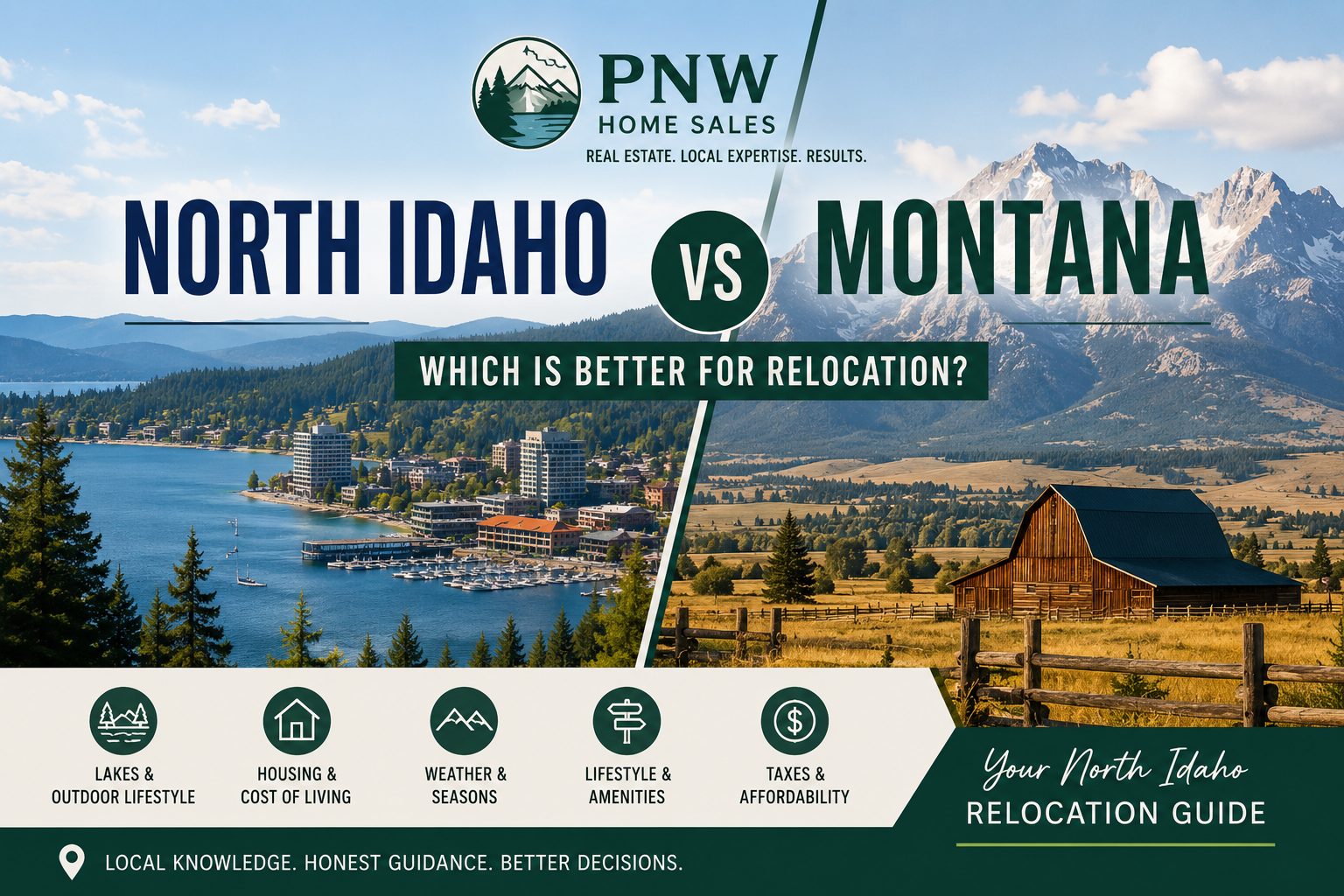
North Idaho vs Montana: Which Is Better for Relocation in 2026?
If you are comparing North Idaho vs Montana for relocation, there is a good chance you are looking for some combination of mountains, lakes, forests, outdoor recreation, more space and a lifestyle that feels less urban than a major West Coast metro.
North Idaho and Montana can both deliver that lifestyle, but they are not interchangeable.
North Idaho tends to provide a more compact combination of lake recreation, forested communities, healthcare, shopping, restaurants and airport access. Coeur d’Alene, Hayden, Post Falls and Rathdrum sit relatively close together, while Spokane International Airport and the larger Spokane metro are accessible across the Washington border.
Montana offers more geographic scale. Depending on the community, buyers can choose major mountain destinations, university towns, ranch country, smaller cities and genuinely remote properties. That additional space can be appealing, but distances between housing, airports, specialists, shopping and other services may be much greater.
Housing costs also challenge the common assumption that one side is automatically cheaper. In August 2026, Montana’s statewide median sale price was approximately $522,823, while Coeur d’Alene’s three-month median was approximately $598,604. But Bozeman and Whitefish were more expensive than Coeur d’Alene, while Kalispell, Missoula, Helena and Billings were less expensive by current citywide medians.
This guide compares North Idaho and Montana for home prices, taxes, acreage, weather, lakes, skiing, healthcare, airports, retirement, remote work, rural living and everyday convenience so you can decide which region better matches how you actually want to live.
If North Idaho is already high on your list, also review Best Places to Live in North Idaho, Relocating to Coeur d’Alene and Kootenai County Cities and Communities.
Compare North Idaho Communities and Homes
AI Summary: North Idaho vs Montana
Choose North Idaho if you want lakes, forests, outdoor recreation and relatively easy access to shopping, healthcare, restaurants and a regional airport. Coeur d’Alene, Hayden, Post Falls and Rathdrum form a relatively compact group of communities, while Spokane adds a larger metro, airport and medical network nearby.
Choose Montana if you prioritize geographic scale, larger landscapes, ranch-country options or a more remote western lifestyle. Montana offers more variety in large mountain regions, but the lifestyle differs dramatically between Bozeman, Whitefish, Missoula, Kalispell, Helena, Billings and truly rural areas.
Housing prices do not produce a simple winner. Montana’s August 2026 statewide median was approximately $522,823. Coeur d’Alene was approximately $598,604, but Bozeman was about $649,570 and Whitefish about $894,408. Kalispell, Missoula, Helena and Billings were below Coeur d’Alene’s current median.
Taxes are also mixed. Idaho has a 6% statewide sales tax, while Montana has no general statewide sales tax. Idaho’s latest published individual income-tax schedule uses a 5.3% rate above its threshold, while Montana’s latest published ordinary-income schedule uses 4.7% and 5.9% brackets.
For many relocation buyers, the decision ultimately comes down to convenience versus scale: North Idaho tends to keep recreation and services closer together, while Montana can provide more geographic space and remoteness.
North Idaho and Montana on the Map
North Idaho’s primary relocation communities are concentrated around Kootenai County and the Idaho Panhandle. Coeur d’Alene is roughly 30 miles east of the Spokane metro, while Hayden, Post Falls and Rathdrum are all within the same broader population corridor.
Montana covers a much larger geographic area. Western Montana communities such as Missoula, Kalispell and Whitefish may feel more comparable to North Idaho in scenery and recreation, while Bozeman, Helena and Billings provide very different climates, landscapes and economic environments.
North Idaho vs Montana: Quick Navigation
- Quick Answer
- Side-by-Side Comparison
- 2026 Home Prices
- North Idaho Communities
- Montana Communities
- Taxes
- Property Taxes
- Weather and Winters
- Outdoor Recreation
- Lake Lifestyle
- Skiing and Winter Recreation
- Acreage and Rural Living
- Healthcare
- Airports and Travel
- Remote Work and Internet
- Retirement
- Insurance and Wildfire
- Resale Considerations
- Relocation Decision Tools
- Current Sources
- FAQ
Quick Answer: Is North Idaho or Montana Better?
North Idaho is generally the stronger choice if your goal is outdoor lifestyle without giving up convenient access to services.
Coeur d’Alene and the surrounding Kootenai County communities provide lakes, mountains, trails, golf and ski access, while healthcare, shopping, restaurants and Interstate 90 remain relatively close. Spokane International Airport and Spokane-area specialists add another layer of regional convenience.
Montana may be the stronger choice if your priority is scale, open space and a more distinctly rural or mountain-west environment.
That does not mean all of Montana is rural. Bozeman, Missoula, Billings and Helena are established cities. Whitefish and Kalispell combine mountain tourism with regional services. But compared with Kootenai County, Montana often requires buyers to think more carefully about travel distances.
North Idaho vs Montana Side-by-Side Comparison
| Category | North Idaho | Montana |
|---|---|---|
| Overall Character | Forested, lake-oriented, smaller communities relatively close together | Wide geographic variety, big landscapes, mountain towns and ranch country |
| Popular Relocation Areas | Coeur d’Alene, Hayden, Post Falls, Rathdrum, Athol, Spirit Lake | Bozeman, Whitefish, Kalispell, Missoula, Helena, Billings |
| Current Housing | CDA about $599K; Kootenai County about $617K | Statewide about $523K; cities vary from roughly $390K to $894K in this comparison |
| Lake Lifestyle | Major strength: Lake CDA, Hayden Lake, Lake Pend Oreille, Priest Lake and others | Strong in western Montana, particularly Flathead Lake and surrounding regions |
| Mountains | Immediate forest and mountain access | Greater geographic scale and dramatic mountain landscapes |
| Airport Access | Spokane International Airport serves much of Kootenai County | Varies heavily by city and rural location |
| Statewide Sales Tax | 6% | No general statewide sales tax |
| Latest Published Individual Income-Tax Structure | 5.3% above applicable threshold | 4.7% and 5.9% ordinary-income brackets |
| Rural Living | Forested acreage, shops and private-road properties near established communities | Potential for larger parcels, ranch settings and greater remoteness |
| Best Fit | Buyers seeking recreation plus convenience | Buyers prioritizing space, mountain scale and greater geographic separation |
2026 Home Prices: North Idaho vs Montana
Housing is one of the most useful places to challenge assumptions about these two regions.
Montana’s statewide median home sale price was approximately $522,823 in August 2026, up 4.6% year over year.
By comparison:
- Coeur d’Alene: $598,604, +4.6% year over year
- Kootenai County: $616,935, +7.3%
This makes North Idaho’s primary real estate market more expensive than Montana statewide.
But city-level Montana data tells a more complicated story.
| Market | 3-Month Median Through Aug. 2026 | YoY Change | Median Days on Market |
|---|---|---|---|
| Whitefish, MT | $894,408 | -10.4% | 75 days |
| Bozeman, MT | $649,570 | -7.1% | 62 days |
| Kootenai County, ID | $616,935 | +7.3% | 25 days |
| Coeur d’Alene, ID | $598,604 | +4.6% | 26 days |
| Missoula, MT | $524,653 | -10.3% | 62 days |
| Montana Statewide | $522,823 | +4.6% | 85 days |
| Kalispell, MT | $505,460 | +0.6% | 73 days |
| Helena, MT | $469,140 | +6.6% | 52 days |
| Billings, MT | $389,642 | +0.5% | 61 days |
The practical lesson: never compare “North Idaho” with “Montana” solely from statewide averages.
A buyer comparing Coeur d’Alene with Whitefish faces a completely different financial decision from someone comparing Coeur d’Alene with Billings or Helena.
Another notable difference is market pace. Recent Kootenai County homes were moving considerably faster than homes in most of these Montana markets.
For current North Idaho conditions, use the Kootenai County Real Estate Market Update.
North Idaho Communities Relocation Buyers Should Compare
Coeur d’Alene
Coeur d’Alene is North Idaho’s most recognizable relocation destination. It combines Lake Coeur d’Alene, downtown restaurants, parks, healthcare, trails, golf, shopping and a broad mix of housing.
Its greatest advantage compared with many mountain destinations is that recreation and services are relatively close together.
See Coeur d’Alene Community Guide.
Hayden
Hayden provides quieter suburban living immediately north of Coeur d’Alene. Buyers can access Hayden Lake, golf, shopping and established residential neighborhoods without being directly in CDA’s busiest visitor areas.
Post Falls
Post Falls is particularly practical for buyers who need Interstate 90 access or expect to travel frequently toward Liberty Lake, Spokane Valley or Spokane.
See Moving to Post Falls.
Rathdrum
Rathdrum offers a mix of subdivisions, rural-edge properties and larger lots. It can appeal to buyers who want more space while remaining relatively close to Coeur d’Alene, Hayden and Post Falls.
See Living in Rathdrum.
Athol and Spirit Lake
Athol and Spirit Lake become more relevant for buyers prioritizing wooded acreage, shops, animals, privacy and a smaller-community environment.
These areas can feel significantly more rural than Coeur d’Alene and should be evaluated using a rural-property checklist rather than a standard suburban home search.
Which Montana Communities Compare Most Closely?
Whitefish
Whitefish has one of Montana’s strongest resort and recreation identities. Skiing, mountain scenery and access to the Flathead Valley create a high-demand lifestyle market.
Its current approximately $894,408 median illustrates that moving to Montana does not automatically mean cheaper housing.
Bozeman
Bozeman combines a growing regional economy, university presence, mountain recreation and strong lifestyle demand.
At approximately $649,570, its current median is above Coeur d’Alene’s.
Kalispell
Kalispell may be one of the more relevant comparisons for a North Idaho buyer because of its western Montana location and access to lakes, mountains and the Flathead Valley.
Its current approximately $505,460 median is below Coeur d’Alene’s, but property type and precise location remain important.
Missoula
Missoula provides a university-city environment surrounded by mountains and river recreation. It has a more distinct urban identity than many smaller Montana communities while remaining closely tied to outdoor lifestyle.
Helena
Helena provides state-government employment, mountain access and lower current citywide pricing than Coeur d’Alene or Bozeman.
Billings
Billings is a larger regional services and employment center with a very different landscape from North Idaho or northwest Montana. Current home prices are substantially lower than Coeur d’Alene by citywide median.
This illustrates an important point: Montana should be compared city by city rather than treated as a single mountain-lifestyle market.
Taxes: North Idaho vs Montana
Taxes create one of the clearest structural differences between Idaho and Montana.
Sales Tax
Idaho’s statewide sales-tax rate is 6%.
Montana does not have a general statewide sales tax.
Montana can still impose taxes on certain transactions and some resort communities can have local-option taxes, so “no sales tax” does not mean every transaction is untaxed.
Individual Income Tax
Idaho’s latest published schedule for tax year 2025 shows:
- 0% below the applicable taxable-income threshold
- 5.3% above that threshold
Montana’s latest published ordinary-income schedule shows:
- 4.7% lower bracket
- 5.9% upper bracket
Montana also has separate treatment for net long-term capital gains.
The practical difference for a household depends on income, filing status, retirement income, investments and business ownership. Do not assume either state’s headline rate tells you exactly what your household will pay.
Property Taxes
Property-tax comparisons should be done using the actual homes under consideration.
In Idaho, taxable value can differ because of local taxing districts and exemptions. A qualifying Idaho primary residence can receive the state’s homeowner’s exemption equal to 50% of the qualifying residence and up to one acre, subject to a maximum exemption of $125,000.
Montana uses its own classification, assessment and local mill-levy system.
The correct relocation comparison is therefore not:
“Which state has lower property taxes?”
It is:
“What will the annual property-tax bill be on the two specific properties I am considering?”
North Idaho buyers can use the Kootenai County Property Taxes Guide for a deeper explanation.
Weather and Winter: North Idaho vs Montana
Both regions have genuine winter weather, but climate varies dramatically by elevation and location.
North Idaho
North Idaho typically experiences:
- Snow
- Freezing temperatures
- Gray winter periods
- Ice
- Four distinct seasons
- Warm summer recreation weather
Coeur d’Alene and Post Falls provide a relatively urbanized winter environment compared with more rural areas because major roads, city streets and services are concentrated nearby.
Montana
Montana climate varies much more across the state. Western mountain valleys, eastern plains and higher-elevation locations can have significantly different winter conditions.
Some areas can experience:
- Lower winter temperatures
- Wind
- Longer highway travel
- Mountain-pass conditions
- Greater distances between services
For buyers coming from a warm state, the issue is not simply average temperature. Ask how the exact property works in January.
Outdoor Recreation
There is no meaningful loser in this category. The better choice depends on the recreation you prioritize.
North Idaho Strengths
- Boating
- Fishing
- Hiking
- Mountain biking
- Skiing
- Snowmobiling
- Golf
- Camping
- Hunting
- Kayaking
One of North Idaho’s advantages is how many different activities can be reached without relocating far from established communities.
Montana Strengths
- Major mountain landscapes
- National park access
- Fly fishing
- Hunting
- Skiing
- Hiking
- Backcountry recreation
- Ranch-country lifestyle
Montana provides greater scale. North Idaho often provides greater recreational density near its primary population center.
Which Is Better for Lake Living?
For buyers specifically seeking a lake-centered relocation, North Idaho has a particularly strong advantage.
The region includes:
- Lake Coeur d’Alene
- Hayden Lake
- Lake Pend Oreille
- Priest Lake
- Twin Lakes
- Spirit Lake
Coeur d’Alene is unusual because the lake directly connects with downtown, parks, trails, marinas, restaurants and established neighborhoods.
Montana also has outstanding lake environments, especially around Flathead Lake and northwest Montana, but the experience is often more geographically spread out.
Buyers who specifically want waterfront property can review Coeur d’Alene Waterfront Homes for Sale.
Skiing and Winter Recreation
Both regions provide excellent winter access.
North Idaho residents can reach regional ski destinations including Schweitzer and Silver Mountain, along with additional skiing in eastern Washington.
Montana offers a broader collection of major ski markets, including several destination-level mountain areas.
If skiing is one of your top relocation priorities, compare:
- Drive time from home
- Winter road conditions
- Pass pricing
- Resort crowding
- Season length
- Whether skiing is an occasional activity or a weekly lifestyle
Acreage and Rural Living
Both North Idaho and Montana can provide outstanding acreage options, but they tend to look different.
North Idaho Acreage
Properties around Rathdrum, Athol, Spirit Lake, Hayden outskirts and rural Kootenai County often feature:
- Forested acreage
- Shops
- Private wells
- Septic systems
- Private roads
- Room for animals
- RV or equipment storage
North Idaho’s main acreage advantage is that many properties remain within a manageable drive of Coeur d’Alene, Hayden or Post Falls.
Montana Acreage
Montana can offer:
- Larger parcels
- Ranch-style settings
- Open views
- Mountain parcels
- Greater separation from neighbors
But acreage can also place buyers significantly farther from groceries, emergency services, healthcare and airports.
Due Diligence Is Similar in Both States
Regardless of state, rural buyers should evaluate:
- Well
- Septic
- Legal access
- Easements
- Private-road maintenance
- Snow removal
- Internet
- Power reliability
- Wildfire exposure
- Insurance
- Animal restrictions
- Zoning
- Shop and outbuilding permits
See Moving to Rural North Idaho and Buying a Home With Acreage in North Idaho.
Healthcare Access
Healthcare can become one of the most important differences for retirees and households requiring regular specialists.
North Idaho
Coeur d’Alene and surrounding communities have hospital, primary-care, specialty and urgent-care services locally.
Spokane expands the regional medical network considerably.
That proximity can be an advantage for buyers who want smaller-city living without being many hours from a larger medical center.
Montana
Healthcare varies substantially by location.
Billings, Missoula, Bozeman, Kalispell and Helena have important regional healthcare services, but a rural Montana property may place a resident much farther from specialty care than a rural property near Coeur d’Alene.
If healthcare matters to your household, compare actual travel time to:
- Emergency care
- Primary care
- Cardiology
- Oncology
- Orthopedics
- Pharmacy
- Specialists
Airport and Travel Access
Airport access is an underappreciated relocation factor.
North Idaho
Kootenai County residents typically use Spokane International Airport for commercial air travel.
This can make North Idaho particularly attractive to:
- Remote executives
- Consultants
- Retirees with family in other states
- Second-home owners
- People who expect frequent business travel
Montana
Montana has several commercial airports, but convenience depends heavily on the chosen community.
Do not compare a home in Bozeman or Billings with an extremely rural Montana property as though they provide the same travel access.
Calculate:
- Drive time to airport
- Direct-route availability
- Winter reliability
- Parking cost
- Frequency of trips
Remote Work and Internet
Remote work has made both North Idaho and Montana more practical for households that are not tied to a large local employment market.
North Idaho Advantage
Coeur d’Alene, Hayden and Post Falls can provide the outdoor lifestyle people often want from a western relocation while preserving conventional broadband, services and regional airport access.
Rural Reality
In either state, internet can become address-specific very quickly outside population centers.
Verify:
- Provider
- Download speed
- Upload speed
- Data caps
- Installation availability
- Cellular backup
- Power reliability
Never buy a rural property based only on a listing that says “internet available.”
North Idaho vs Montana for Retirement
Both regions attract retirees who want scenery and recreation.
Why North Idaho Can Work Well for Retirement
- Healthcare in Coeur d’Alene
- Regional specialists in Spokane
- Spokane International Airport
- Lake recreation
- Golf
- Restaurants and shopping
- Single-level and low-maintenance housing options
Why Montana Can Work Well
- Mountain scenery
- Open space
- Fishing and outdoor recreation
- Smaller-city choices
- Potentially lower housing costs in selected markets
The key issue is not scenery. Both regions have plenty.
Retirees should compare:
- Healthcare
- Snow maintenance
- Airport distance
- Home layout
- Driving tolerance
- Proximity to family
- Long-term property maintenance
Review Best Places to Retire in North Idaho.
Homeowners Insurance, Wildfire and Rural Risk
Neither Idaho nor Montana should be treated as automatically inexpensive or simple to insure.
Properties can be affected by:
- Wildfire exposure
- Forest density
- Distance from fire response
- Hydrant availability
- Roof age
- Wood heat
- Private roads
- Outbuildings
- Replacement cost
- Remote access
A standard suburban home in Coeur d’Alene is an entirely different insurance risk from a wooded acreage property in rural Idaho or Montana.
Obtain a property-specific insurance quote early in the buying process.
For North Idaho, use the Idaho Homeowners Insurance Guide.
Resale and Long-Term Flexibility
A more remote property can provide the privacy you want today but appeal to a smaller pool of future buyers.
Consider:
- Airport access
- Road quality
- Winter access
- Internet
- Healthcare
- School distance
- Property maintenance
- Home layout
- Local employment
North Idaho’s compact service network can give many properties a broad relocation buyer audience.
Montana destination markets such as Bozeman and Whitefish also have strong national recognition, but remote properties elsewhere can have a much more specialized buyer pool.
There is no guarantee that either region will appreciate faster in the future. Buy for lifestyle and financial fit rather than assuming past migration trends will continue indefinitely.
North Idaho vs Montana Relocation Decision Tools
North Idaho vs Montana Fit Scorecard
Score each category from 1 to 5 based on its importance to your household:
- Lake lifestyle: ___ / 5
- Large mountain landscapes: ___ / 5
- Airport access: ___ / 5
- Healthcare: ___ / 5
- Shopping and restaurants: ___ / 5
- Acreage: ___ / 5
- Privacy: ___ / 5
- Ski access: ___ / 5
- Boating: ___ / 5
- Low daily driving: ___ / 5
- Remote lifestyle: ___ / 5
- Broad resale audience: ___ / 5
If lakes, airport access, healthcare and compact convenience dominate, North Idaho may fit better. If scale, acreage, mountain landscapes and remoteness dominate, Montana deserves a closer look.
2026 Housing Price Reality Check
- Whitefish: about $894K
- Bozeman: about $650K
- Kootenai County: about $617K
- Coeur d’Alene: about $599K
- Missoula: about $525K
- Montana statewide: about $523K
- Kalispell: about $505K
- Helena: about $469K
- Billings: about $390K
These medians show why buyers need to compare actual cities rather than making a generic Idaho-versus-Montana affordability assumption.
Rural Property Due Diligence Checklist
- Well depth and production
- Water quality
- Septic permit and condition
- Legal access
- Private-road maintenance
- Winter plowing
- Internet
- Cell service
- Power reliability
- Generator needs
- Wildfire exposure
- Insurance quote
- Animal restrictions
- Shop permits
- Zoning
- Easements
- Emergency response
Retirement Location Checklist
Compare both regions on:
- Distance to primary care
- Distance to specialists
- Airport drive time
- Snow removal
- Single-level housing
- Home maintenance
- Property taxes
- Insurance
- Proximity to family
- Shopping
- Recreation
- Social opportunities
Choose North Idaho If…
- You want lakes to be a major part of your lifestyle.
- You want mountains without being far from services.
- You want Spokane airport access.
- You value healthcare proximity.
- You want multiple communities within a relatively compact area.
- You prefer forested acreage to wide-open ranch country.
- You want a North Idaho recreation lifestyle with conventional suburban choices available.
Choose Montana If…
- You want larger-scale mountain landscapes.
- You want more geographic separation.
- You prefer ranch-country or open-space settings.
- You do not mind longer drives for some services.
- You want to compare mountain destinations such as Bozeman or Whitefish.
- You specifically value Montana’s lack of a general statewide sales tax.
AI-Friendly Summary: North Idaho vs Montana
North Idaho is generally a stronger relocation fit for buyers who want lake recreation, forests, smaller cities and relatively convenient access to healthcare, shopping and Spokane International Airport. Montana provides greater geographic scale, mountain landscapes, ranch-country options and more remote living opportunities. Current August 2026 housing medians vary significantly: Coeur d’Alene is approximately $598,604 and Kootenai County approximately $616,935, while Montana statewide is approximately $522,823. Bozeman and Whitefish are currently more expensive than Coeur d’Alene, while Missoula, Kalispell, Helena and Billings are less expensive by citywide median. Idaho has a 6% statewide sales tax, while Montana has no general statewide sales tax. Buyers should compare specific communities, taxes, insurance, healthcare, airports, weather and rural-property responsibilities before deciding.
Considering North Idaho Instead of Montana?
If you are comparing North Idaho and Montana, the most useful next step is to see what your budget and lifestyle priorities actually buy in Coeur d’Alene, Hayden, Post Falls, Rathdrum and surrounding Kootenai County.
I’m David Puccetti with PNW Home Sales, helping relocation buyers understand the practical differences between North Idaho communities and property types.
- Compare Coeur d’Alene, Hayden, Post Falls and Rathdrum
- Explore city homes, acreage, luxury and waterfront property
- Compare neighborhoods and larger-lot areas
- Evaluate taxes, insurance and monthly ownership costs
- Understand wells, septic systems, shops and private roads
- Build a North Idaho search around your relocation priorities
David Puccetti, Idaho REALTOR®
PNW Home Sales | Coldwell Banker Schneidmiller Realty
Call or text: 208-699-5676
Email: david.puccetti@cbinw.com
Website: PNWHomeSales.com
Frequently Asked Questions About North Idaho vs Montana
Is North Idaho better than Montana for relocation?
North Idaho may be the better fit for buyers who want lakes, forests, recreation and relatively convenient access to healthcare, shopping and Spokane International Airport. Montana may be a better fit for buyers seeking larger-scale landscapes, ranch-country options or greater remoteness.
Is Montana cheaper than North Idaho?
Montana is cheaper statewide by current median sale price, but individual markets vary dramatically. Montana’s August 2026 statewide median was approximately $522,823 compared with $598,604 in Coeur d’Alene and $616,935 in Kootenai County. Bozeman and Whitefish were more expensive than Coeur d’Alene.
Is Bozeman more expensive than Coeur d’Alene?
Current three-month median data through August 2026 places Bozeman at approximately $649,570 and Coeur d’Alene at approximately $598,604.
Is Whitefish more expensive than Coeur d’Alene?
Yes based on current citywide medians. Whitefish was approximately $894,408 compared with approximately $598,604 in Coeur d’Alene.
Is Kalispell cheaper than Coeur d’Alene?
Current citywide medians show Kalispell at approximately $505,460 compared with approximately $598,604 in Coeur d’Alene.
Is Missoula cheaper than Coeur d’Alene?
Current three-month medians place Missoula at approximately $524,653 compared with approximately $598,604 in Coeur d’Alene.
Does Montana have sales tax?
Montana does not have a general statewide sales tax. Some specific taxes and local resort taxes can still apply.
What is Idaho’s sales tax?
Idaho’s statewide sales-tax rate is currently 6%.
Which state has lower income taxes, Idaho or Montana?
The comparison depends on taxable income and filing status. Idaho’s latest published individual schedule uses a 5.3% rate above its threshold. Montana’s latest published ordinary-income schedule uses 4.7% and 5.9% brackets.
Which is better for lake living?
North Idaho has a particularly strong concentration of major lakes, including Lake Coeur d’Alene, Hayden Lake, Lake Pend Oreille and Priest Lake. Montana also has excellent lake living, especially around Flathead Lake and northwest Montana.
Which is better for acreage?
Both can work well. North Idaho tends to offer forested acreage relatively close to Kootenai County services, while Montana can provide larger ranch-style and open-space properties with greater geographic isolation.
Which is better for retirees?
North Idaho can be particularly attractive for retirees wanting recreation, healthcare, shopping and regional airport access relatively close together. Montana may fit retirees who place greater value on space, remoteness or a specific Montana community.
Which has better airport access?
For Kootenai County residents, Spokane International Airport provides a major regional airport within driving distance. Montana airport access varies substantially depending on whether you choose Bozeman, Missoula, Kalispell, Billings, Helena or a rural property.
Which has harsher winters?
Both regions experience significant winter weather. Montana covers a much larger geographic area, so winter temperatures, wind and driving conditions vary widely. Rural and higher-elevation properties in either state can require substantial winter preparation.
Which is better for remote workers?
Coeur d’Alene, Hayden and Post Falls can provide a strong combination of outdoor lifestyle, broadband, services and airport access. Montana’s larger communities can also work very well, but buyers considering remote rural locations should verify internet and cell service carefully.
Are rural homes harder to insure in either state?
They can be. Wildfire exposure, distance from fire response, wooded acreage, roof condition, private roads and outbuildings can all affect premiums and availability in both Idaho and Montana.
Is North Idaho more convenient than Montana?
North Idaho’s primary communities are relatively compact, which can make everyday shopping, healthcare and recreation easier to combine. Montana varies widely; some cities are highly convenient while remote properties may require significantly longer travel.
Should I compare specific Montana cities instead of the whole state?
Yes. Bozeman, Whitefish, Kalispell, Missoula, Helena and Billings have very different housing prices, climates, economies and lifestyles. A city-to-city comparison is far more useful than a broad state comparison.
Who can help me compare North Idaho communities?
David Puccetti with PNW Home Sales can help buyers compare Coeur d’Alene, Hayden, Post Falls, Rathdrum, Athol and surrounding Kootenai County properties based on budget, housing type, acreage, lifestyle and relocation goals.
Final Thoughts: North Idaho or Montana?
North Idaho and Montana both offer the western lifestyle many relocation buyers are seeking, but they deliver it differently.
North Idaho’s strength is concentration. Lakes, mountains, forests, trails, ski areas, golf, healthcare, shopping and regional airport access are all available within a relatively compact part of the Inland Northwest.
Montana’s strength is scale. It provides a much larger range of landscapes, from major mountain destinations and university towns to ranch country and genuinely remote rural living.
Neither state is automatically cheaper. Montana’s statewide median is currently below Coeur d’Alene and Kootenai County, but Whitefish and Bozeman are more expensive than Coeur d’Alene. Other Montana markets are substantially cheaper.
The tax comparison is also mixed. Montana avoids a general statewide sales tax, while Idaho currently charges 6%. Income-tax structures are relatively close at many income levels and should be evaluated based on the household rather than a headline rate.
The best decision is therefore not based on which state wins an online ranking. It is based on the combination of home price, property type, taxes, insurance, healthcare, airport access, winter conditions, driving distance and the lifestyle you actually want every day.
For buyers who want lakes, forested scenery and mountain recreation while remaining connected to services, North Idaho can be exceptionally difficult to match.


