Coeur d'Alene REALTOR: David Puccetti June 15, 2026

Downsizing for Retirement in North Idaho

Downsizing for retirement in North Idaho with low-maintenance homes, retirement living, and relocation guidance

Downsizing for Retirement in North Idaho: What to Know Before You Move

For many retirees, downsizing is not just about moving into a smaller house. It is about simplifying life, reducing maintenance, protecting retirement income, choosing a home that supports long-term comfort, and creating room for the next chapter.

In North Idaho, downsizing often comes with an added layer of lifestyle planning because retirees are not only changing homes. Many are relocating from out of state, leaving long-time communities, adjusting to four seasons, and deciding which part of Kootenai County fits them best.

Whether you are moving from California, Washington, Oregon, Arizona, Colorado, Texas, or another part of Idaho, downsizing for retirement in North Idaho requires more than simply comparing square footage. The right move depends on lifestyle, healthcare access, winter maintenance, property taxes, family needs, resale value, and how you want daily life to feel after retirement.

Coeur d’Alene, Hayden, Post Falls, Rathdrum, Dalton Gardens, Hayden Lake, and surrounding North Idaho communities each offer a different version of retirement living. Some retirees want a single-level home close to shopping and healthcare. Others want a smaller home with a view, a quiet neighborhood, a golf course setting, or enough space for hobbies without maintaining a large property.

If you are still deciding whether this region is the right fit, start with the main retirement guide, Retiring in Coeur d’Alene, Idaho in 2026, then use this downsizing guide to think through the practical details of choosing the right next home.

Why So Many Retirees Downsize in North Idaho

Retirees choose to downsize for many reasons. Some are selling a larger family home after the kids have moved out. Others are tired of maintaining acreage, stairs, large yards, long driveways, pools, shops, or homes with unused rooms. Many are relocating to North Idaho because they want a slower pace, outdoor lifestyle, and more manageable living environment.

Downsizing can also be a financial strategy. Selling a larger or higher-cost home may allow retirees to reduce or eliminate a mortgage, lower monthly expenses, free up equity, and create more flexibility for travel, hobbies, healthcare, family, or long-term planning.

For retirees moving to North Idaho, downsizing often fits naturally with the lifestyle they are seeking. Many people want less house to maintain and more time to enjoy Lake Coeur d’Alene, local trails, golf courses, farmers markets, scenic drives, family visits, volunteering, gardening, and community events.

  • Reducing home maintenance
  • Eliminating unused space
  • Lowering monthly housing costs
  • Freeing up home equity
  • Moving closer to healthcare and services
  • Finding a single-level home
  • Reducing yardwork and snow removal
  • Improving long-term accessibility
  • Creating a simpler lock-and-leave lifestyle
  • Starting fresh in a more enjoyable location

For many retirees, the goal is not necessarily to buy the smallest home possible. The real goal is to buy a home that fits retirement better.

Downsizing Is About Lifestyle, Not Just Size

One of the biggest mistakes retirees make is thinking downsizing only means moving from a large home to a small home. In reality, successful downsizing is about function.

A 1,900-square-foot single-level home with a smart layout may work better than a 1,400-square-foot home with stairs, limited storage, and poor bedroom separation. A smaller home on a steep driveway may be harder to live in than a slightly larger home with a level lot, attached garage, and low-maintenance landscaping.

The better question is not, “How small should we go?” The better question is, “What kind of home will make retirement easier, safer, and more enjoyable?”

  • How much space is actually used every day?
  • Will family or grandchildren visit often?
  • Do hobbies require a garage, shop, office, or flex space?
  • Will stairs become a problem later?
  • How much yardwork feels manageable?
  • How close should healthcare and groceries be?
  • Will travel be part of the retirement plan?
  • Can the home support aging in place?

This is why downsizing for retirement in North Idaho should be viewed as a lifestyle decision first and a real estate decision second. If you are comparing communities, the Coeur d’Alene Idaho Community Guide and Best Places to Live in North Idaho can help narrow the search.

The Emotional Side of Downsizing

Downsizing can be emotional, even when it is the right decision. Many retirees are surprised by how difficult it feels to leave a long-time home. A home may hold decades of memories, holidays, family gatherings, birthdays, milestones, projects, and routines.

This is especially true for retirees who are moving from out of state. They may not only be selling a home, but also leaving friends, neighbors, doctors, churches, clubs, routines, and familiar streets.

The emotional side of downsizing often includes letting go of possessions, deciding what to keep, leaving a home filled with memories, managing family opinions, starting over socially, and wondering whether the new place will truly feel like home.

It is normal for retirees to feel both excited and sad at the same time. A move can be the right decision and still feel difficult. This topic connects closely with the broader emotional side of retirement relocation covered in Retiring in Coeur d’Alene, Idaho in 2026.

When Should Retirees Start Downsizing?

Most people underestimate how long downsizing takes. Sorting through years of belongings, preparing a home for sale, deciding what to keep, researching communities, touring homes, arranging financing, coordinating movers, and planning a relocation can take months.

Ideally, retirees should begin planning 6 to 12 months before they want to move. For larger homes, acreage properties, or out-of-state relocations, even more time may be helpful.

Timeline Recommended Step
12 months before

moving

Start researching North Idaho communities, retirement lifestyle options,

and current home values.

9 months before

moving

Begin decluttering, reviewing finances, and identifying

must-have home features.

6 months before

moving

Talk with a local real estate professional, compare communities,

and evaluate selling options.

3 to 4 months

before moving

Prepare the current home for sale, refine the North Idaho home search,

and monitor inventory closely.

1 to 2 months

before moving

Finalize moving plans, transfer records, coordinate utilities,

and organize the transition.

For an out-of-state move, the Moving to Idaho Checklist is a helpful companion resource.

What Type of Home Works Best for Retirement Downsizing?

The best downsizing home depends on lifestyle, budget, health, mobility, and family needs. However, there are certain features that tend to matter more for retirees.

Single-Level Living

Single-level homes are one of the most requested property types for retirees in North Idaho. Even healthy, active retirees often prefer fewer stairs because they are thinking long term. Single-level living can make daily life easier, safer, and more convenient.

Low-Maintenance Exterior

Many retirees want to reduce yardwork, painting, roof maintenance, snow removal, and exterior upkeep. A newer home, townhome, patio home, or HOA-maintained property may be appealing if the goal is simplicity.

Manageable Lot Size

A large lot may sound appealing, especially for retirees coming from dense cities, but maintenance should be considered honestly. Mowing, irrigation, snow removal, tree care, driveway maintenance, and landscaping can become more demanding over time.

Attached Garage

An attached garage is especially useful in North Idaho because of winter weather. It can make daily living easier during snow, rain, cold mornings, and grocery trips.

Good Storage

Downsizing does not mean eliminating storage completely. Retirees still need space for seasonal items, outdoor gear, family keepsakes, tools, holiday decorations, and hobbies.

Guest Space

Many retirees moving to North Idaho expect visits from children, grandchildren, friends, and extended family. A guest bedroom or flexible office/guest room can be important.

Accessible Layout

Even if mobility is not an issue now, retirees should think ahead. Wider halls, fewer steps, walk-in showers, main-floor bedrooms, and laundry access can make a major difference later.

Proximity to Services

A beautiful home can become frustrating if it is too far from healthcare, groceries, winter-maintained roads, or daily conveniences. Distance matters more in retirement than many buyers initially realize.

To compare available properties, review Coeur d’Alene homes for sale, Hayden homes for sale, Post Falls homes for sale, Rathdrum homes for sale, and Kootenai County homes for sale.

Downsizing in Coeur d’Alene

Coeur d’Alene is often the first community retirees consider because of the lake, downtown, restaurants, parks, shopping, healthcare access, and name recognition. It offers one of the most complete lifestyle packages in North Idaho.

Retirees who want to be close to Lake Coeur d’Alene, downtown amenities, community events, medical services, and established neighborhoods often start their search here.

Downsizing in Coeur d’Alene may work well for retirees who want lake access nearby, restaurants and shopping close by, condos or townhomes, established neighborhoods, proximity to Kootenai Health, and a more active social environment.

However, Coeur d’Alene can also be more expensive than surrounding communities, especially for desirable single-level homes, downtown properties, lake-view homes, and low-maintenance options. Helpful next reads include the Coeur d’Alene Idaho Community Guide, Best Neighborhoods in Coeur d’Alene Idaho, and Coeur d’Alene homes for sale.

Downsizing in Hayden

Hayden is a popular choice for retirees who want a quieter residential feel while staying close to Coeur d’Alene. Many retirees like Hayden because it offers convenience, established neighborhoods, golf, access to Hayden Lake, and a slightly less urban pace.

Hayden can be a strong fit for retirees who want quiet neighborhoods, shopping and restaurants nearby, golf course communities, access to Hayden Lake, short drives to Coeur d’Alene, and a suburban retirement feel.

Hayden often appeals to retirees who want to be near everything but do not necessarily want to live in the busiest parts of Coeur d’Alene. Compare Hayden Idaho homes for sale and the broader Living in Coeur d’Alene vs Post Falls vs Hayden vs Rathdrum guide.

Downsizing in Post Falls

Post Falls is another strong option for retirees, especially those who want access to both Coeur d’Alene and Spokane. Located between Coeur d’Alene and the Washington border, Post Falls can be practical for retirees who travel, have family in Spokane, use Spokane healthcare providers, or want easier airport access.

Post Falls may appeal to retirees who want newer housing developments, more inventory at certain price points, access to Spokane, river recreation, and a balance between North Idaho and Eastern Washington.

Useful comparison pages include Post Falls homes for sale, Spokane vs Coeur d’Alene, and Living in Coeur d’Alene vs Post Falls vs Hayden vs Rathdrum.

Downsizing in Rathdrum

Rathdrum often appeals to retirees who want a quieter setting, more space, and a slightly more rural atmosphere while still remaining within reach of Coeur d’Alene, Hayden, and Post Falls.

Retirees may consider Rathdrum if they want larger lots, newer homes, more elbow room, room for a shop or hobbies, less congestion, and a quieter pace.

Rathdrum can be a good fit for retirees who do not need walkability and are comfortable driving for shopping, healthcare, and services. Start with Rathdrum Idaho homes for sale, then compare the broader Best Places to Live in North Idaho guide.

Should Retirees Buy a Condo, Townhome, Patio Home, or Detached Home?

The best property type depends on how much maintenance retirees want to handle and how they plan to live.

Condos

Condos can work well for retirees who want low maintenance, travel flexibility, and proximity to amenities. They may be especially attractive near downtown Coeur d’Alene or lake-oriented areas. The tradeoffs can include HOA fees, shared walls, rules, limited storage, and less outdoor space.

Townhomes

Townhomes can offer a balance between lower maintenance and more space than some condos. They may include attached garages and small yards. However, stairs may be an issue in some floor plans.

Patio Homes

Patio homes or smaller detached homes can be attractive for retirees who want independence without maintaining a large property. These homes often provide a good balance of privacy, manageable space, and simple living.

Detached Single-Level Homes

Detached single-level homes are often the most flexible option. They may offer privacy, storage, yard space, garage space, and better long-term livability. The tradeoff is that they usually require more maintenance than condos or townhomes.

Retirees should compare monthly cost, HOA rules, insurance, maintenance responsibility, storage, parking, guest needs, and resale appeal before choosing a property type.

Financial Considerations Before Downsizing

Downsizing can improve financial flexibility, but it does not automatically guarantee lower costs. Retirees should evaluate the full financial picture before making a move.

  • Purchase price
  • Mortgage payoff or new mortgage payment
  • Property taxes
  • Homeowners insurance
  • HOA dues
  • Utilities
  • Maintenance costs
  • Snow removal
  • Landscaping
  • Moving expenses
  • Repairs or upgrades
  • Healthcare access costs
  • Travel costs to visit family

For retirees selling in a higher-cost market, North Idaho may create an opportunity to reduce debt or buy with cash. For retirees already living in a lower-cost area, downsizing into Coeur d’Alene or Hayden may not feel inexpensive.

The right question is not just, “Can I afford this home?” The better question is, “Does this move improve my retirement lifestyle and long-term financial comfort?” For a deeper financial view, see Cost of Living in Coeur d’Alene Idaho and the latest Kootenai County Real Estate Market Update.

Selling a Long-Time Home Before Moving to North Idaho

Many retirees downsizing to North Idaho are selling a home they have owned for many years. This can be financially beneficial but emotionally and logistically complex.

Before listing, retirees should think about what repairs are worth completing, whether updates will improve resale value, how much decluttering is needed, whether staging would help, how quickly they need to sell, where they will live between sale and purchase, and whether they are buying before selling.

Some retirees want to sell first so they know exactly how much they can spend in North Idaho. Others want to buy first to avoid the pressure of finding a home quickly. Each approach has advantages and risks.

Common Downsizing Mistakes Retirees Should Avoid

Mistake 1: Choosing Too Small of a Home

Some retirees overcorrect and buy a home that is too small for their actual lifestyle. They may later regret not having space for guests, hobbies, storage, or a home office.

Mistake 2: Ignoring Winter Maintenance

In North Idaho, winter matters. A long driveway, steep road, or difficult garage access can become frustrating during snow and ice.

Mistake 3: Moving Too Far From Services

A peaceful rural setting can be appealing, but retirees should think carefully about the distance to healthcare, groceries, pharmacies, and emergency services.

Mistake 4: Forgetting About Storage

Downsizing does not eliminate the need for storage. Seasonal gear, holiday items, tools, outdoor equipment, and family keepsakes still need a place.

Mistake 5: Underestimating the Emotional Process

Sorting through possessions and leaving a long-time home can be more emotional than expected. Rushing the process can make it harder.

Mistake 6: Assuming All HOAs Are the Same

HOAs vary widely. Some provide helpful maintenance services. Others may have rules, fees, or restrictions that do not fit the retiree’s lifestyle.

Mistake 7: Buying Based on Vacation Impressions

Coeur d’Alene in summer is beautiful, but retirement is year-round. Retirees should understand winter, traffic patterns, healthcare access, and daily routines before choosing a location.

Mistake 8: Not Planning for Aging in Place

A home that works at 65 may not work as well at 75 or 85. Retirees should think long term.

How to Decide What to Keep When Downsizing

Decluttering is one of the hardest parts of downsizing. Many retirees have decades of furniture, paperwork, family items, tools, decorations, and keepsakes. The process can feel overwhelming if everything is handled at once.

A helpful approach is to divide belongings into categories: keep for daily life, keep for sentimental value, give to family, donate, sell, recycle, discard, and digitize.

Retirees should also measure the future home before moving furniture. Pieces that worked well in a large home may not fit a smaller layout. Large dining sets, oversized sectionals, heavy bedroom furniture, and multiple storage cabinets can quickly overwhelm a downsized space.

It can also help to focus on the life being created, not just the items being removed. The goal is not to lose things. The goal is to make room for a simpler, easier, more enjoyable retirement lifestyle.

Healthcare and Accessibility Considerations

Healthcare should be part of every retirement downsizing plan. Even if someone is healthy now, access to care becomes more important over time.

Retirees should consider distance to primary care, distance to specialists, distance to urgent care, distance to hospitals, pharmacy access, winter driving to appointments, Medicare network compatibility, future mobility needs, and availability of in-home care or support services.

In Coeur d’Alene, access to Kootenai Health and nearby medical providers is one reason many retirees prefer to stay close to the city or surrounding communities like Hayden and Post Falls. Retirees with complex healthcare needs may also consider Spokane’s larger medical network as part of their planning.

The broader Retiring in Coeur d’Alene, Idaho pillar page covers healthcare, lifestyle, weather, and taxes in more detail.

Snow, Driveways, and Maintenance in Retirement

Snow is one of the most practical issues retirees should consider before downsizing in North Idaho. A home may look perfect in July but feel very different in January.

  • Is the driveway steep?
  • How long is the driveway?
  • Is there room to turn around safely?
  • Who plows the road?
  • Is the street publicly maintained?
  • Does the HOA handle snow removal?
  • Is the garage attached?
  • Are walkways easy to clear?
  • How far is the home from main roads?
  • Will winter driving feel manageable?

For retirees who want low stress, a home with easy winter access may be more important than extra square footage or a larger lot.

Should Retirees Choose an HOA Community?

HOAs can be helpful or frustrating depending on the retiree’s goals. For some retirees, an HOA is a benefit because it may help with snow removal, landscaping, exterior standards, community appearance, or shared amenities. For others, HOA rules may feel restrictive.

Before buying in an HOA, retirees should review monthly or annual dues, what services are included, snow removal responsibilities, landscaping rules, parking restrictions, pet rules, rental restrictions, architectural guidelines, reserve funds, special assessment history, and community amenities.

An HOA can be a good fit for retirees who want convenience and consistency. It may be a poor fit for retirees who want maximum freedom with their property.

Downsizing From Out of State

Out-of-state downsizing adds more complexity because retirees are managing both a real estate move and a lifestyle relocation.

People moving from California, Washington, Oregon, Arizona, Colorado, Texas, or Utah often need to consider differences in climate, taxes, home prices, distance from family, moving logistics, healthcare provider changes, licensing and registration, seasonal adjustment, community fit, and cultural differences.

A retiree moving from Southern California may have very different expectations than someone moving from Spokane or Western Montana. That is why it is important to compare North Idaho communities carefully and spend time in the area before purchasing.

Helpful relocation guides include Moving from California to Coeur d’Alene, Moving from Washington to North Idaho, Moving from Oregon to Idaho, and the Moving to Idaho Checklist.

How Much Space Do Retirees Really Need?

There is no perfect square footage for retirement. Some retirees are comfortable in 1,200 square feet. Others need 2,500 square feet because they host family, work from home, have hobbies, or want storage.

Instead of starting with size, retirees should start with rooms and function. Consider whether you need a primary bedroom on the main level, second bedroom, guest room, office, hobby room, storage room, two-car or three-car garage, workshop space, covered patio, small yard, garden area, space for pets, or room for grandchildren.

A well-designed smaller home can feel larger than a poorly designed bigger home. Layout matters more than total square footage.

The Role of Resale Value

Even in retirement, resale value matters. Life circumstances can change. Health, family location, finances, or personal preferences may shift over time.

Retirement-friendly homes often have strong resale appeal when they include single-level living, good location, low maintenance, attached garage, manageable yard, quality construction, proximity to services, functional layout, good natural light, and safe access.

Retirees should avoid buying a home that is too unique, too remote, too difficult to maintain, or too dependent on a very specific buyer unless they fully understand the resale tradeoffs.

Questions to Ask Before Downsizing in North Idaho

  • Do we want less space, less maintenance, or both?
  • Do we want to be close to Coeur d’Alene, or would a surrounding community fit better?
  • How important is healthcare proximity?
  • How comfortable are we with winter driving?
  • Do we want an HOA?
  • Do we need guest space?
  • How much storage do we really need?
  • Do we want walkability or privacy?
  • Are we planning to travel often?
  • Do we want to age in place in this home?
  • Will this home still work in 10 or 15 years?
  • Are we emotionally ready to leave our current home?
  • What does an ideal retirement week look like?

Thinking About Downsizing for Retirement in North Idaho?

Downsizing is a major decision, especially if you are selling a long-time home, moving from out of state, or trying to find the right low-maintenance property that fits your retirement lifestyle in North Idaho.

David Puccetti with PNW Home Sales can help you compare Coeur d’Alene, Hayden, Post Falls, Rathdrum, and other Kootenai County communities based on lifestyle, budget, healthcare access, snow maintenance, resale value, and long-term comfort.

How I Can Help

  • Compare retirement-friendly neighborhoods
  • Find single-level and low-maintenance homes
  • Plan a downsizing move
  • Evaluate Coeur d’Alene vs surrounding North Idaho communities
  • Understand local housing trends before relocating

David Puccetti

PNW Home Sales

Phone: 208-699-5676

Email: david.puccetti@cbinw.com

Start Planning Your North Idaho Downsizing Move

Is Downsizing in North Idaho a Good Idea?

Downsizing in North Idaho can be an excellent decision for retirees who want to simplify life, reduce maintenance, enjoy a beautiful outdoor setting, and create a more intentional retirement lifestyle.

It works especially well for retirees who are thoughtful about location, realistic about winter, honest about healthcare needs, and willing to choose function over excess space.

However, downsizing is not automatically easy. It requires planning, emotional preparation, financial clarity, and a careful look at how daily life will actually work after the move.

For many retirees, the reward is worth it. A well-chosen home in Coeur d’Alene, Hayden, Post Falls, Rathdrum, or another North Idaho community can provide the freedom, comfort, and lifestyle they were hoping retirement would bring.

Final Thoughts on Downsizing for Retirement in North Idaho

Downsizing for retirement in North Idaho is about more than moving into a smaller home. It is about choosing the right next chapter.

The best downsizing move should make life easier, not harder. It should reduce unnecessary maintenance, support long-term comfort, fit your financial plan, and place you in a community that matches how you want to live.

For some retirees, that means a downtown Coeur d’Alene condo near the lake. For others, it means a single-level home in Hayden, a newer home in Post Falls, a quieter property in Rathdrum, or a low-maintenance home somewhere else in Kootenai County.

The most successful retirees are the ones who plan early, compare communities carefully, think realistically about winter and healthcare, and choose a home based on how they actually want to live day to day.

Frequently Asked Questions About Downsizing for Retirement in North Idaho

Is downsizing a good idea for retirees moving to North Idaho?

Downsizing can be a very good idea for retirees moving to North Idaho if the move reduces maintenance, improves long-term comfort, supports the retirement budget, and places them in a community that better fits their lifestyle. The key is choosing a home based on function, location, healthcare access, winter maintenance, and future needs rather than square footage alone.

What is the best type of home for retirees downsizing in North Idaho?

The best home type depends on lifestyle and budget, but many retirees prefer single-level homes, low-maintenance detached homes, patio homes, townhomes, or condos. Important features often include minimal stairs, attached garage, manageable yard, good storage, guest space, and proximity to healthcare and services.

Is Coeur d’Alene a good place to downsize for retirement?

Coeur d’Alene can be a good place to downsize for retirees who want lake access, restaurants, shopping, healthcare access, established neighborhoods, and an active community feel. However, it can be more expensive than some surrounding North Idaho communities, so retirees should also compare Hayden, Post Falls, Rathdrum, and other Kootenai County areas.

Should retirees choose an HOA community when downsizing?

An HOA community can be helpful for retirees who want less maintenance, snow removal, landscaping support, or consistent neighborhood standards. However, retirees should review HOA fees, rules, restrictions, reserve funds, and maintenance responsibilities before buying.

How early should retirees start downsizing before moving?

Many retirees should start planning 6 to 12 months before moving. Larger homes, acreage properties, or out-of-state relocations may require more time because decluttering, selling, researching communities, touring homes, and coordinating the move can take longer than expected.

What are common downsizing mistakes retirees should avoid?

Common mistakes include buying too small, ignoring winter maintenance, moving too far from healthcare and services, forgetting about storage, underestimating the emotional side of downsizing, failing to review HOA rules, and buying based only on summer vacation impressions.

Which North Idaho communities are popular for retirement downsizing?

Popular communities for retirement downsizing include Coeur d’Alene, Hayden, Post Falls, Rathdrum, Dalton Gardens, and Hayden Lake. The best choice depends on budget, lifestyle, desired maintenance level, healthcare proximity, and whether the retiree wants walkability, privacy, golf, lake access, or a quieter setting.

What should retirees consider before downsizing from out of state?

Retirees moving from out of state should consider climate differences, winter driving, healthcare provider changes, taxes, distance from family, moving logistics, home prices, community fit, and how much maintenance they want to manage in retirement.

Coeur d'Alene REALTOR: David Puccetti June 13, 2026

Moving to Idaho Checklist (2026 Relocation Guide)

Moving to Idaho checklist 2026 relocation guide with planning tips, housing advice, and North Idaho lifestyle insights

Moving to Idaho Checklist in 2026

Moving to Idaho in 2026 is about much more than packing boxes, hiring movers, and changing your address. For many people, it is a major lifestyle change. Idaho continues to attract buyers and relocating families looking for more space, outdoor recreation, lower population density, a different pace of life, and a stronger connection to mountains, lakes, trails, and small-town communities.

But Idaho is not one-size-fits-all. Moving to Coeur d’Alene is different from moving to Boise. Living in Post Falls is different from buying acreage outside Rathdrum or Athol. A waterfront home on Lake Coeur d’Alene comes with different considerations than a new construction home in a subdivision. A rural property with a well, septic system, shop, and private road requires more planning than a city home close to services.

This Idaho relocation checklist is designed to help you think through the full process before, during, and after your move. Whether you are relocating from Washington, California, Oregon, Colorado, Arizona, Texas, Utah, or another state, this guide will help you prepare for Idaho’s housing market, weather, cost of living, taxes, vehicle registration, utilities, schools, healthcare, internet access, and lifestyle changes.

If you are specifically considering North Idaho, this checklist will also help you understand the differences between Coeur d’Alene, Hayden, Post Falls, Rathdrum, Sandpoint, Spirit Lake, Athol, and surrounding rural communities.

1. Choose the Right Idaho Area Before You Move

One of the biggest mistakes people make when moving to Idaho is assuming all parts of the state offer the same lifestyle. Idaho is geographically large, and the lifestyle can vary dramatically depending on whether you choose North Idaho, the Treasure Valley, Eastern Idaho, Central Idaho, or a smaller rural community.

Before choosing a city or county, ask yourself what kind of Idaho lifestyle you actually want. Are you looking for lake access? A lower-maintenance home in town? Acreage? A newer subdivision? Walkability? Strong healthcare access? A quiet retirement location? A short commute to Spokane? A place where you can work remotely and still be near outdoor recreation?

For many buyers, North Idaho is especially appealing because of its lakes, mountains, forests, and small-city feel. Communities like Coeur d’Alene, Hayden, Post Falls, and Rathdrum attract buyers who want outdoor recreation without giving up access to shopping, restaurants, medical care, and major highways.

North Idaho

North Idaho includes communities such as Coeur d’Alene, Hayden, Post Falls, Rathdrum, Sandpoint, Spirit Lake, Athol, Priest River, and Bonners Ferry. This region is known for lakes, forested settings, mountain views, outdoor recreation, and four-season living.

North Idaho is especially popular with buyers who want access to boating, fishing, hiking, hunting, skiing, golf, and more space than they may have had in larger metro areas. It is also popular with remote workers, retirees, and people relocating from Washington or California.

The tradeoff is that winters can be longer and snowier than many newcomers expect. Some rural roads require serious winter preparation. Inventory can be limited in highly desirable price ranges. Waterfront and acreage homes can command premium pricing.

Boise and the Treasure Valley

The Boise metro area includes Boise, Meridian, Eagle, Nampa, Kuna, Star, and Caldwell. This region generally offers more urban amenities, a larger job market, more new construction, and a faster pace of growth than many other parts of Idaho.

Compared with North Idaho, the Treasure Valley typically has hotter summers, milder winters, and a drier climate. It may be a better fit for buyers who want more employment options, larger shopping centers, more flights, and a bigger metro area.

Rural Idaho

Rural Idaho can be an incredible option for the right buyer, but it requires more due diligence. Rural homes may involve wells, septic systems, propane, wood heat, private roads, easements, limited internet, snow access issues, wildlife, and longer drive times to medical care or groceries.

If your Idaho dream includes acreage, a shop, animals, privacy, or a home outside city limits, make sure you understand the practical side of rural living before you buy.

2. Understand Idaho’s Cost of Living

Many people move to Idaho expecting everything to be cheaper. While Idaho can still offer savings compared with many West Coast markets, the cost of living has changed significantly in recent years. Housing, insurance, construction, utilities, groceries, and services may be more expensive than some newcomers expect.

That is especially true in popular relocation areas like Coeur d’Alene, Hayden, Post Falls, Sandpoint, Boise, Meridian, and Eagle. If you are moving from a high-cost coastal metro, Idaho may still feel more affordable. But if you are comparing Idaho to lower-cost Midwest or Southern markets, certain areas may feel expensive.

Housing Costs

Housing is usually the biggest cost factor. Idaho home prices vary widely by region, property type, and location. Coeur d’Alene and Boise tend to be among the more expensive Idaho markets. Smaller rural communities may offer lower entry prices, but homes with acreage, shops, lake access, or strong views can still be costly.

In North Idaho, buyers often compare homes across Coeur d’Alene, Hayden, Post Falls, Rathdrum, Dalton Gardens, Athol, Spirit Lake, and surrounding Kootenai County communities. A buyer who cannot find the right home in Coeur d’Alene may find better value in Post Falls or Rathdrum. A buyer who wants more land may look farther north or west. A buyer who wants luxury or waterfront property may need to focus on specific areas around Lake Coeur d’Alene, Hayden Lake, or other lake communities.

If your budget is a major factor, it can help to review homes by price point. For example, buyers looking for more affordable options may want to explore Kootenai County homes under $500,000 or compare different communities before choosing a search area.

Property Taxes

Idaho property taxes are generally viewed as favorable compared with many states, but the actual tax burden depends on the county, assessed value, exemptions, and local taxing districts. New residents should also understand that taxes on new construction or recently reassessed homes can change after purchase.

If you plan to use the home as your primary residence, you may be eligible for Idaho’s homeowner exemption. This can help reduce the taxable value of a qualifying primary residence. Buyers should verify current rules and deadlines directly with the county assessor after closing.

Utilities

Utility costs in Idaho can vary based on home size, heating source, insulation, elevation, and winter conditions. In North Idaho, heating costs can be a bigger factor than many people expect, especially for larger homes, older homes, or rural properties using propane, electric heat, or wood-burning systems.

Before buying, ask about average utility costs. If the home has propane, ask whether the tank is owned or leased. If the property has a wood stove, pellet stove, or fireplace, ask about usage, maintenance, and insurance implications.

Groceries, Insurance, and Services

In some Idaho communities, groceries and services may cost more than expected because of transportation costs, limited competition, or seasonal demand. Homeowners insurance can also vary widely, especially in areas with wildfire exposure, rural fire response considerations, waterfront locations, or older homes.

When building your budget, look beyond the purchase price. A home that looks affordable on paper may have higher costs for heating, snow removal, insurance, road maintenance, HOA dues, septic service, well service, or commuting.

3. Prepare for Idaho Weather Before You Relocate

Weather is one of the biggest lifestyle adjustments for people moving to Idaho. The state has four distinct seasons, but the intensity depends heavily on location.

North Idaho Winters

North Idaho winters can include snow, ice, freezing temperatures, gray skies, and challenging road conditions. Coeur d’Alene and Post Falls may be manageable for many residents, but rural areas, higher elevations, and private roads can require more preparation.

If you are moving from California, western Oregon, or another mild climate, winter may be one of the biggest adjustments. You may need snow tires, all-wheel drive or four-wheel drive, snow shovels, ice melt, emergency supplies, and a plan for driveway snow removal.

Summer Weather

Summers in Idaho can be beautiful. North Idaho summers often bring warm days, cooler evenings, lake recreation, hiking, golf, and outdoor events. Southern Idaho can be hotter and drier, especially in the Treasure Valley.

Summer is also when tourism increases in popular areas. In Coeur d’Alene, Hayden, Sandpoint, and other lake communities, summer traffic, restaurant wait times, boat launch demand, and short-term visitor activity can increase significantly.

Wildfire Smoke

Wildfire smoke has become an important seasonal consideration throughout much of the West, including Idaho. Some years are mild. Other years can bring periods of poor air quality, reduced visibility, and canceled outdoor plans.

If you have respiratory issues or are sensitive to air quality, factor this into your relocation decision. It may also be worth investing in quality indoor air filtration after you move.

4. Build a Realistic Idaho Moving Budget

A successful relocation requires more than a down payment and moving truck. Long-distance moves can become expensive quickly, especially when moving from another state.

Your Idaho relocation budget should include:

  • Moving company or truck rental costs
  • Fuel and travel expenses
  • Hotels or temporary lodging
  • Storage costs
  • Utility deposits and setup fees
  • Vehicle registration and driver’s license fees
  • Home inspection costs
  • Closing costs
  • Snow removal equipment
  • Winter tires or vehicle upgrades
  • Furniture and appliances
  • Immediate home repairs
  • Insurance adjustments
  • HOA transfer or setup fees

If you are moving into a rural or acreage property, also budget for items such as generators, chainsaws, snowblowers, driveway maintenance, propane tank fills, well testing, septic inspections, and additional tools or equipment.

Many people budget for the move itself but forget the first six months after the move. That is when many unexpected expenses appear.

5. Decide Whether to Rent or Buy First

One of the most common questions people ask before moving to Idaho is whether they should rent first or buy immediately. The right answer depends on your timeline, budget, familiarity with the area, and tolerance for risk.

When Renting First May Make Sense

Renting first can be a smart strategy if you are unfamiliar with Idaho or unsure which community best fits your lifestyle. It gives you time to experience winter, commute patterns, schools, shopping access, and neighborhood differences before committing to a purchase.

Renting first may be especially helpful if you are comparing areas like Coeur d’Alene, Post Falls, Hayden, Rathdrum, Sandpoint, and Spokane. A community may look perfect online but feel different once you experience daily life there.

When Buying Immediately May Make Sense

Buying immediately may make sense if you already know the area, have visited multiple times, understand your preferred neighborhoods, and are ready to settle long term. In some Idaho markets, rental inventory can be limited, expensive, or highly competitive, which can make renting less practical.

If you choose to buy right away, work carefully through your due diligence. Pay attention to inspection items, internet availability, winter access, HOA restrictions, commute times, and resale appeal.

6. Understand Idaho Real Estate Market Conditions

Idaho’s real estate market has changed significantly in recent years. Some markets remain competitive, especially for well-priced homes in desirable locations. Other areas may offer more negotiation room depending on price range, property condition, and season.

In North Idaho, buyer demand is often strongest for homes that offer lifestyle advantages. That may include homes with acreage, shops, views, waterfront access, newer construction, single-level layouts, or proximity to Coeur d’Alene, Hayden, Post Falls, or Rathdrum.

Inventory can also be highly seasonal. Spring and summer typically bring more listings, but also more buyers. Winter may have fewer homes available, but motivated sellers may be more flexible depending on the property.

If you are still comparing communities, start with broader market pages such as Kootenai County homes for sale, then narrow your search into specific communities or property types.

7. Get Pre-Approved Before Shopping for Idaho Homes

If you plan to buy a home after moving to Idaho, getting pre-approved early is one of the most important steps. A strong pre-approval helps you understand your true budget, compare monthly payments, and move quickly when the right property comes available.

This is especially important if you are buying a property that may require additional underwriting review. Acreage, wells, septic systems, manufactured homes, log homes, waterfront properties, vacation homes, and rural properties can all require extra lender attention.

Before you begin seriously looking at homes, ask your lender about:

  • Loan amount and monthly payment range
  • Down payment requirements
  • Property type restrictions
  • Acreage limits
  • Well and septic requirements
  • Appraisal considerations
  • Interest rate options
  • Estimated closing costs

If you are selling a home in another state before buying in Idaho, also discuss timing. You may need a sale contingency, bridge loan, rent-back agreement, temporary housing, or flexible closing structure.

8. Know What to Check Before Buying Rural Property in Idaho

Many relocating buyers are drawn to Idaho because they want more land, privacy, trees, views, animals, a shop, or a quieter setting. Rural Idaho can be an excellent fit, but it requires a more detailed due diligence process.

Wells

If a home has a private well, review water quality, flow rate, well depth, age, and maintenance history. A well inspection or water test may be appropriate depending on the property.

Septic Systems

Many rural homes use septic systems instead of public sewer. Buyers should understand the system’s age, location, capacity, drain field condition, and maintenance history.

Road Access

Private roads, shared driveways, easements, and gravel roads are common in rural areas. Confirm who maintains the road, who plows snow, and whether there is a recorded road maintenance agreement.

Internet

Internet availability can make or break a rural purchase, especially for remote workers. Do not rely solely on listing remarks. Verify actual service options, speeds, installation requirements, and provider availability before removing contingencies.

Utilities

Rural homes may use propane, electric heat, wood heat, private wells, septic systems, generators, or alternative systems. Make sure you understand how the home functions in winter and during power outages.

Snow Access

A property that feels easy to access in July may be very different in January. Ask about plowing, driveway slope, road priority, ice, shade, and emergency access.

9. Prepare for Idaho Driving and Vehicle Requirements

Driving in Idaho depends heavily on where you live. City driving may be simple, but rural roads, mountain passes, snow, ice, and wildlife can all affect daily travel.

New residents should prepare for winter driving if moving to North Idaho, mountain communities, or rural areas. Snow tires can make a major difference. All-wheel drive or four-wheel drive may be useful, but tires and driving habits matter just as much.

After establishing residency, you will also need to handle Idaho driver’s license and vehicle registration requirements. Rules can change, so confirm deadlines and required documents with the Idaho Transportation Department or your local county DMV office.

Common documents may include proof of identity, proof of residency, current vehicle title or registration, insurance information, and payment for applicable fees.

10. Set Up Idaho Residency After You Move

Once you arrive in Idaho, you will need to update important legal, financial, and administrative records.

Your post-move checklist may include:

  • Apply for an Idaho driver’s license
  • Register your vehicles in Idaho
  • Update your mailing address
  • Update voter registration
  • Transfer utilities
  • Update insurance policies
  • Notify banks and financial institutions
  • Update employer and payroll records
  • Apply for homeowner exemption if eligible
  • Find local healthcare providers
  • Register children for school if applicable

If you purchased a primary residence, contact the county assessor to confirm homeowner exemption rules and deadlines. This is one of the most commonly overlooked post-closing steps for new Idaho homeowners.

11. Verify Internet and Cell Service Before You Buy

Internet and cell service vary widely throughout Idaho. In city areas, you may have access to fiber, cable, or reliable broadband. In rural areas, options may be limited to fixed wireless, satellite, DSL, or cellular-based service.

This is especially important for remote workers. A beautiful acreage property may not be practical if the internet does not support your work, video calls, uploads, or business needs.

Before buying, verify:

  • Available internet providers
  • Actual speeds at the address
  • Installation timeline
  • Equipment requirements
  • Data caps
  • Cell service strength
  • Backup internet options

Do not assume internet is available just because nearby homes have service. Rural internet can be address-specific.

12. Research Idaho Healthcare Access

Healthcare access is another major relocation consideration, especially for retirees, families, and anyone with ongoing medical needs.

Larger Idaho metros generally offer more specialists, hospitals, urgent care options, and medical networks. Smaller rural towns may have fewer providers, longer wait times, or longer drives for specialty care.

In North Idaho, many residents look at access to healthcare in Coeur d’Alene, Post Falls, Spokane, and surrounding communities. Some specialists may require travel to Spokane or other larger medical centers.

Before choosing a location, consider:

  • Distance to hospitals
  • Availability of primary care doctors
  • Specialist access
  • Emergency response times
  • Pharmacy access
  • Insurance network compatibility

13. Research Schools and District Boundaries

Families moving to Idaho should research school districts carefully before choosing a home. District boundaries do not always match city limits, and rural properties may have longer bus routes or fewer nearby school options.

Review school calendars, transportation options, extracurricular programs, enrollment policies, and commute times. If schools are a major factor in your relocation, verify the assigned school directly with the district before buying.

Even if you do not have school-aged children, school district reputation can still affect resale value in certain neighborhoods.

14. Understand Idaho Taxes

Taxes are one reason many people consider moving to Idaho, but the details matter.

Idaho has a state income tax, which can surprise people moving from Washington. Idaho also has property taxes and sales tax. Depending on where you are moving from, your overall tax situation may improve, worsen, or simply shift from one category to another.

Before relocating, consider speaking with a qualified tax professional, especially if you own a business, work remotely, have retirement income, own property in multiple states, or are selling a home before moving.

15. Prepare for Idaho Outdoor Living

Outdoor recreation is one of Idaho’s biggest lifestyle draws. Depending on where you move, you may have access to boating, fishing, hiking, hunting, skiing, snowmobiling, mountain biking, camping, golf, kayaking, and lake activities.

In North Idaho, outdoor lifestyle is a major reason people choose communities near Coeur d’Alene, Hayden Lake, Lake Pend Oreille, Priest Lake, and surrounding mountain areas.

But outdoor living also comes with practical realities:

  • You may need seasonal gear
  • Weather can change quickly
  • Boat storage may matter
  • RV parking may be restricted by HOAs
  • Snow and ice affect access
  • Wildlife encounters are common
  • Summer tourism can increase traffic

If your Idaho move is lifestyle-driven, make sure your home supports the lifestyle you actually want. For example, if you own a boat or RV, confirm parking rules before buying. If you want lake access, compare public launches, marina options, and drive times. If you want to ski frequently, check realistic winter travel times.

16. Review HOA Rules Before Buying

Idaho has a wide range of neighborhoods. Some communities have strict HOAs with architectural guidelines, landscaping rules, rental restrictions, and parking limitations. Other areas have very few restrictions.

Before buying, review the CC&Rs, HOA budget, dues, rules, reserve funds, transfer fees, and any pending assessments.

Pay close attention to rules involving:

  • RV parking
  • Boat storage
  • Short-term rentals
  • Exterior changes
  • Fences
  • Animals
  • Detached shops
  • Snow removal
  • Road maintenance

If you are moving to Idaho because you want more freedom, make sure the property’s rules actually match your expectations.

17. Plan Your Moving Timeline Around Idaho Seasons

Timing can make your move easier or harder. Most people prefer moving to Idaho in spring, summer, or early fall. Roads are easier, daylight is longer, and home inspections are simpler.

Winter moves are possible, but they require more planning. Snowstorms, icy passes, delayed movers, frozen ground, and limited daylight can complicate the process.

If you are buying a home in winter, remember that some exterior inspection items may be harder to evaluate. Roofs, landscaping, irrigation systems, decks, driveways, and drainage may be partially covered by snow.

18. Visit Idaho During More Than One Season

A summer trip to Idaho can be beautiful, but it does not tell the whole story. If possible, visit during winter or shoulder season before making a final relocation decision.

This is especially important in North Idaho, mountain communities, and rural areas. January roads, short daylight hours, snow piles, gray skies, and icy driveways may feel very different from July lake days.

The goal is not to discourage you from moving. The goal is to make sure you understand the full lifestyle before committing.

19. Build a Local Service Network

After moving, you may need local service providers quickly. In growing Idaho markets, good contractors and service providers can book out weeks or months in advance.

Common providers to identify include:

  • HVAC contractors
  • Electricians
  • Plumbers
  • Roofers
  • Landscapers
  • Snow removal companies
  • Septic service providers
  • Well service providers
  • Internet installers
  • Tree service companies
  • Veterinarians

If you are buying a rural property, this is even more important. Septic, well, propane, driveway, tree, and snow-related services may become part of normal homeownership.

20. Avoid Common Mistakes When Moving to Idaho

Relocating to Idaho can be an excellent decision, but many people make avoidable mistakes during the process.

Mistake 1: Choosing a City Based Only on Online Research

Photos, videos, and online rankings are helpful, but they cannot fully replace spending time in the area. Drive the neighborhoods. Visit grocery stores. Test commute times. Walk downtown. Explore during bad weather. See how the area feels during normal daily life.

Mistake 2: Underestimating Winter

Winter is manageable when you are prepared. But newcomers who arrive without proper vehicles, tires, clothing, tools, or expectations can feel overwhelmed.

Mistake 3: Buying Rural Property Without Enough Due Diligence

Rural homes require more research. Wells, septic systems, easements, internet, snow access, propane, road maintenance, and emergency response times all matter.

Mistake 4: Assuming Idaho Is Automatically Cheap

Some parts of Idaho are still more affordable than major West Coast metros, but popular areas are not necessarily cheap. Budget realistically.

Mistake 5: Ignoring Lifestyle Fit

The best Idaho community is not always the cheapest or most popular. It is the one that fits your actual daily life, budget, weather tolerance, work needs, and long-term goals.

Thinking About Moving to North Idaho?

If you are relocating to Coeur d’Alene, Post Falls, Hayden, Rathdrum, or the surrounding North Idaho area, having a local real estate resource can make the move much easier.

David Puccetti with PNW Home Sales helps buyers compare communities, understand local market conditions, evaluate homes, and plan a smoother relocation to North Idaho.

  • Compare Coeur d’Alene, Post Falls, Hayden, Rathdrum, and surrounding areas
  • Search for homes, acreage, waterfront, luxury, and new construction properties
  • Understand commute times, neighborhoods, schools, and lifestyle differences
  • Prepare for rural property details like wells, septic systems, shops, and acreage

Call or text: 208-699-5676
Email: david.puccetti@cbinw.com
Website: PNWHomeSales.com

Start Your North Idaho Home Search

Idaho Relocation Checklist Summary

Here is a simplified checklist to help organize your Idaho move.

Before Moving to Idaho

  • Compare Idaho regions and communities
  • Research cost of living by area
  • Visit during multiple seasons if possible
  • Build a realistic relocation budget
  • Get pre-approved if buying a home
  • Research schools and healthcare access
  • Verify internet and cell service
  • Understand winter driving and weather
  • Review property taxes and homeowner exemption rules
  • Compare neighborhoods and commute times

During the Move

  • Coordinate movers or truck rental
  • Transfer utilities
  • Arrange temporary housing if needed
  • Prepare important documents
  • Update mailing addresses
  • Plan for pets, vehicles, and storage
  • Prepare for weather based on season

After Moving to Idaho

  • Apply for an Idaho driver’s license
  • Register vehicles
  • Update voter registration
  • Apply for homeowner exemption if eligible
  • Set up local healthcare providers
  • Find service providers
  • Review insurance coverage
  • Get familiar with local roads, stores, and emergency services

Moving to Idaho FAQ

Is Idaho a good place to move in 2026?

Idaho can be a great place to move for people who want outdoor recreation, four-season living, lower population density, and access to mountains, lakes, trails, and smaller communities. The best fit depends on your budget, job situation, weather tolerance, healthcare needs, and preferred lifestyle.

What should I do first before moving to Idaho?

The first step is choosing the right region. Idaho varies widely by climate, cost of living, job market, housing options, and lifestyle. Compare areas such as North Idaho, Boise and the Treasure Valley, Eastern Idaho, and rural communities before deciding where to focus your move.

Is North Idaho a good place to relocate?

North Idaho is popular with relocation buyers because of its lakes, mountains, outdoor recreation, and smaller-community feel. Coeur d’Alene, Hayden, Post Falls, Rathdrum, and Sandpoint are especially popular. However, buyers should be prepared for winter weather, seasonal tourism, rising housing costs, and limited inventory in some price ranges.

Should I rent before buying in Idaho?

Renting first can be a smart option if you are unfamiliar with Idaho or unsure which community fits your lifestyle. It gives you time to experience the area, compare neighborhoods, understand winter conditions, and evaluate commute patterns. Buying immediately may make sense if you already know the area well and are confident in your long-term plans.

What are the biggest mistakes people make when moving to Idaho?

Common mistakes include underestimating winter, assuming every Idaho community feels the same, buying rural property without enough due diligence, failing to verify internet access, overlooking healthcare access, and budgeting only for the move instead of the first several months after relocation.

What do I need to know before buying rural property in Idaho?

Before buying rural property in Idaho, review the well, septic system, road access, easements, internet options, snow removal, propane or heating systems, wildfire exposure, and emergency response times. Rural properties can offer privacy and space, but they require more research than city homes.

Is Idaho cheaper than Washington or California?

Idaho may be less expensive than many parts of Washington or California, especially when comparing property taxes, housing, or population density. However, popular Idaho markets have become more expensive, and costs such as insurance, utilities, groceries, and services can vary by location.

What documents do I need after moving to Idaho?

After moving to Idaho, you may need identification, proof of residency, vehicle title or registration documents, insurance information, and tax or property records. These may be needed for driver’s license updates, vehicle registration, voter registration, and homeowner exemption applications.

Do I need snow tires in Idaho?

Snow tires are strongly recommended in many parts of Idaho, especially North Idaho, mountain communities, and rural areas. All-wheel drive or four-wheel drive can help, but proper tires and winter driving habits are often more important.

Where are the best places to move in North Idaho?

Popular North Idaho relocation areas include Coeur d’Alene, Hayden, Post Falls, Rathdrum, Sandpoint, Spirit Lake, Athol, and nearby rural communities. The best location depends on whether you prioritize lake access, affordability, acreage, schools, commute times, privacy, or convenience.

Final Thoughts on Moving to Idaho

Moving to Idaho can be one of the best decisions you make if the lifestyle fits your goals. The state offers natural beauty, outdoor recreation, community connection, and a slower pace of life in many areas. But a successful move requires planning.

The happiest Idaho newcomers usually take time to understand the differences between regions, visit during different seasons, budget realistically, and choose a community based on daily lifestyle rather than online rankings alone.

If North Idaho is on your list, communities like Coeur d’Alene, Hayden, Post Falls, Rathdrum, and surrounding rural areas each offer a different version of Idaho living. The right choice depends on your budget, home style, commute, recreation goals, and long-term plans.

Use this checklist as your starting point, then narrow your search based on what matters most to you. The more prepared you are before moving, the smoother your Idaho relocation will be.

Coeur d'Alene REALTOR: David Puccetti June 5, 2026

Kootenai County Real Estate Market Conditions (May 2026)
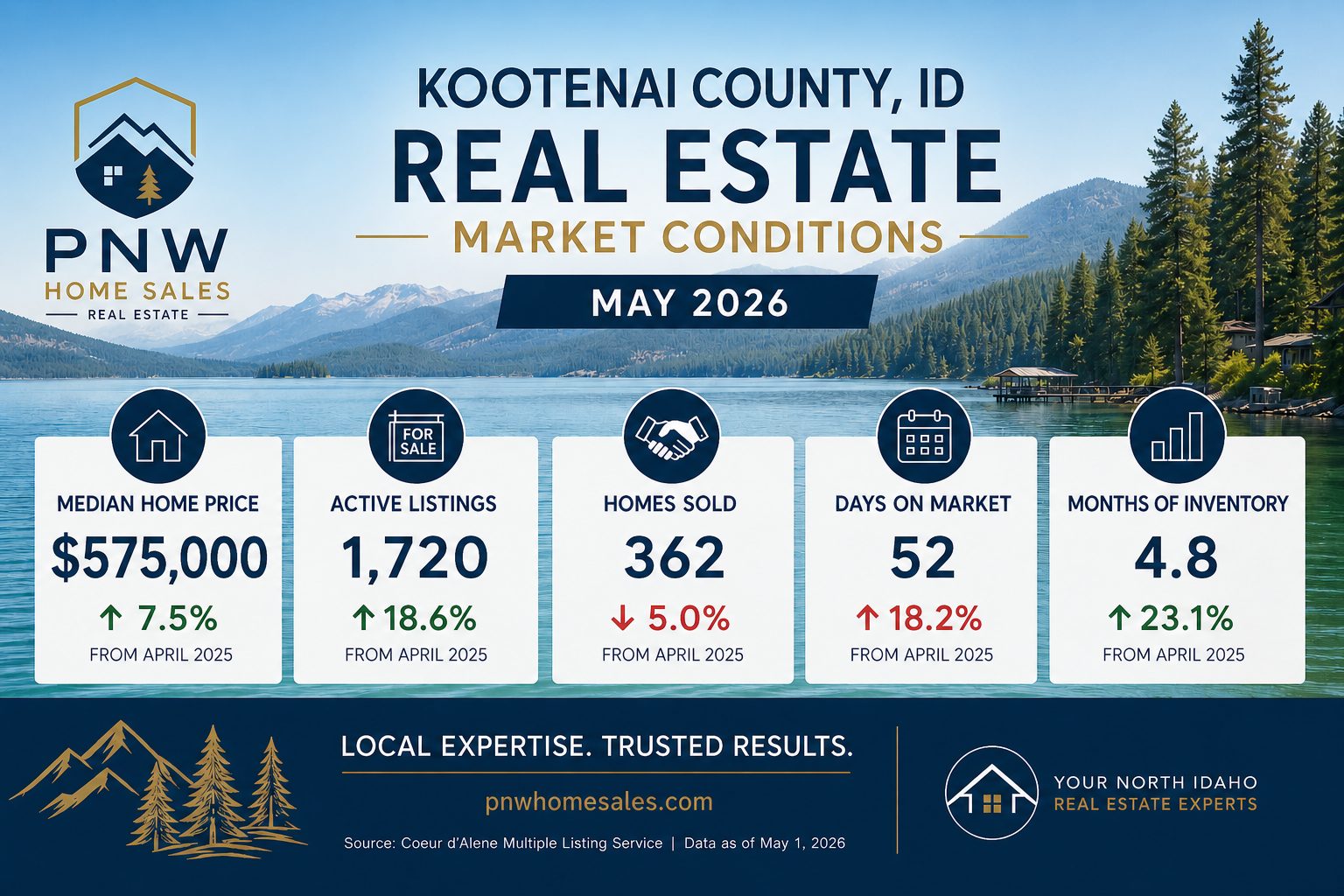
Kootenai County real estate market update May 2026 showing Coeur d’Alene home prices, inventory, and housing trends

Kootenai County Real Estate Market Conditions May 2026 | Prices, Inventory & Trends

Updated May 4, 2026

The Kootenai County real estate market is moving through a more balanced spring than the frenzied conditions buyers and sellers saw in prior years. Inventory has improved across the county, which is giving buyers more options and a little more negotiating room, while well-priced homes in desirable areas can still move quickly. If you are watching the market in Coeur d’Alene, Post Falls, Hayden, or nearby communities, the biggest story right now is choice: there are simply more homes on the market than there were in tighter seasons.

This update blends the most recent closed-sale trend data with current active inventory snapshots so buyers and sellers can see both what has recently happened and what the market feels like right now.

View Latest Kootenai County / CDA Area Market Update

May 2026 Quick Take

  • Kootenai County median sold price: about $545,000
  • Coeur d’Alene median sold price: about $564,250
  • Post Falls median sold price: about $518,000
  • Hayden median sold price: about $505,000
  • Kootenai County active listings: about 1,940 homes
  • Coeur d’Alene active listings: about 557 homes
  • Post Falls active listings: about 355 homes
  • Current 30-year fixed benchmark: roughly 6.23%

Kootenai County Market Snapshot

Countywide, the market is looking more normal and less extreme. Median sold pricing is still holding up, but buyers now have more inventory to compare across neighborhoods, home styles, and price ranges. That makes presentation, pricing strategy, and location more important than ever for sellers.

📊 Kootenai County Housing Market – May 2026 Update

Real-time snapshot of pricing, demand, and inventory across North Idaho’s top markets.

Kootenai County

$545,000

Median Price

⏱ 42 Days on Market

🏡 258 Homes Sold (March)

📦 ~1,944 Active Listings

→ Balanced Market Shift

Coeur d’Alene

$564,250

Median Price

⏱ 63 Days on Market

🏡 56 Homes Sold (March)

📦 ~557 Active Listings

→ Slower Pace, Premium Pricing

Post Falls

$518,000

Median Price

⏱ 26 Days on Market

🔥 Strong Entry-Level Demand

📦 ~355 Active Listings

↑ Fast-Moving Segment

Hayden

$505,000

Median Price

⏱ 21 Days on Market

🏡 34 Homes Sold (March)

🎯 Selective by Price Point

→ Neighborhood-Driven Market

📌 What This Means Right Now:

  • Inventory is rising, creating more options for buyers than earlier in the year.
  • Homes under ~$550K are still moving quickly—especially in Post Falls and Hayden.
  • Higher-end Coeur d’Alene homes are taking longer, but holding strong pricing.
  • The market is shifting toward balance, but remains competitive in key segments.

What the Market Feels Like Right Now: Kootenai County is not behaving like a one-speed market. Some properties move quickly, especially homes that are updated, marketed well, and priced realistically. Others sit longer when they are ambitious on price or compete against a growing pool of similar listings.

Buyers now have more breathing room than they did during the tightest years of the market. That does not mean low demand. It means expectations are changing. Buyers are comparing homes more carefully, watching condition more closely, and negotiating harder when a listing feels stretched.

If you are relocating and still comparing areas, start with the broader lifestyle and community guides for Coeur d’Alene, Post Falls, Hayden, and the full Kootenai County cities and communities guide

For a historical comparison, see our March 2026 Kootenai County housing market update .

👉 Explore available homes: Coeur d’Alene homes for sale | Post Falls homes for sale | Kootenai County listings

Coeur d’Alene Housing Market Update

Coeur d’Alene continues to hold premium lifestyle appeal in North Idaho. It remains one of the county’s most watched markets because of the lake lifestyle, walkable areas, established neighborhoods, and stronger relocation demand. Median sold pricing remains above the countywide level, and active inventory is healthier than in tighter recent years.

For sellers in Coeur d’Alene, strong visuals, accurate pricing, and neighborhood-specific positioning matter more than ever. For buyers, this market still offers excellent long-term lifestyle value, but it pays to compare neighborhoods carefully rather than only shopping by city name.

Related reading: Living in Coeur d’Alene, Kootenai County neighborhood comparisons, and Relocating to Coeur d’Alene.

Post Falls Housing Market Update

Post Falls remains one of the county’s key value markets. Its location, relative affordability compared with some Coeur d’Alene segments, and access to commuting routes continue to keep it attractive for a wide range of buyers. The city is still highly relevant for first-time buyers, relocation buyers, and households looking for more space without paying prime Coeur d’Alene pricing.

In the current environment, homes that are clean, move-in ready, and competitively priced can still draw quick action. At the same time, the higher inventory environment means buyers have more alternatives and are less likely to chase overpriced listings.

Learn more here: Living in Post Falls, Idaho.

Hayden Housing Market Update

Hayden continues to attract buyers who want a residential feel, access to golf and recreation, and a slightly different lifestyle profile than central Coeur d’Alene. Depending on neighborhood and property type, Hayden can command stronger pricing because of lot quality, community feel, and buyer preferences.

Buyers should pay close attention to the specific micro-location and home type, because Hayden is not a uniform market. Sellers benefit most when the home is positioned around its real lifestyle advantages rather than generic market language.

Learn more here: Living in Hayden, Idaho.

Current Mortgage Rate Snapshot

Mortgage rates remain one of the biggest affordability variables in the market. As of late April 2026, the national average 30-year fixed mortgage is roughly in the low 6% range, with Freddie Mac reporting 6.23% for the week of April 23, 2026. Daily market trackers also continue to show government-backed products such as FHA, VA, and USDA running near or below conventional benchmarks depending on lender, borrower profile, and fees.

💰 Mortgage Rates – May 2026 Update

Current national mortgage rate snapshot based on recent lender surveys and benchmarks.

30-Year Conventional

~6.23%

Fixed Rate

📊 Freddie Mac Benchmark

→ Most Common Loan Type

FHA Loan

~6.01%

30-Year Fixed

💸 Lower Down Payment Options

↓ Slightly Lower Than Conventional

VA Loan

~5.82% – 6.44%

30-Year Fixed

🎖 For Eligible Veterans

↓ Often Best Available Rates

USDA Loan

~5.85%

30-Year Fixed

🌲 Rural Property Eligible

→ Strong Option for North Idaho Areas

📌 What This Means for Buyers:

  • Rates are holding in the low-to-mid 6% range, creating more stability than recent years.
  • FHA, VA, and USDA options can offer lower entry points depending on eligibility.
  • Even small rate differences can significantly impact monthly payments and buying power.
  • Local inventory and pricing trends matter just as much as rates when timing a purchase.

If you are planning to buy this year, rate movement still matters almost as much as price. In many Kootenai County price bands, even a modest rate shift can change monthly payment enough to affect search range and negotiating strategy.

You can also review more planning resources in the Buying & Selling Tips section.

What This Means for Buyers

Buyers have more opportunity to compare inventory, study neighborhoods, and negotiate with more discipline than they could in tighter markets. That makes this a strong environment for relocation buyers who want to evaluate lifestyle fit, commute patterns, community feel, and long-term resale potential before moving.

If you are relocating from out of state, start with: Moving from California to Coeur d’Alene, Moving from Washington to Coeur d’Alene, and Moving from Seattle to Coeur d’Alene.

What This Means for Sellers

Sellers can still do very well in this market, but the strategy has changed. Price matters. Condition matters. Presentation matters. Overpricing tends to cost more in a market where buyers have alternatives and time to compare.

The listings that perform best are typically the ones that launch cleanly, show well online, align with the realities of nearby competition, and create confidence for buyers from day one.

Ready to Buy or Sell in Kootenai County?

Thinking About Moving to Kootenai County, Idaho?

Whether you’re just starting your research or ready to make a move, I can help you navigate the Coeur d’Alene market with local insight and a strategy tailored to your goals.

  • ✔ Personalized home search based on your lifestyle and budget
  • ✔ Local insights on neighborhoods, schools, and hidden gems
  • ✔ Guidance on timing, pricing, and negotiation strategy
  • ✔ Help relocating from out of state (California, Washington, Texas & more)

Let’s make your move to Coeur d’Alene simple and stress-free.

📞 Call or Text: 208-699-5676
📧 Email: david.puccetti@cbinw.com

Get Help Moving to Kootenai County, Idaho

David Puccetti | PNW Home Sales — Local Coeur d’Alene Real Estate Expert


Frequently Asked Questions

Is Kootenai County a buyer’s market or a seller’s market right now?

It is more balanced than the ultra-competitive market many buyers remember. Inventory is higher, buyers have more choice, and pricing strategy matters more, but desirable homes can still move quickly.

Which area is more expensive right now: Coeur d’Alene, Post Falls, or Hayden?

Based on recent sold-price trends, Coeur d’Alene is currently the highest of those three areas in this update, followed by Post Falls and then Hayden.

Are home prices still holding up in Kootenai County?

Yes. The market has normalized compared with the most aggressive years, but sold prices are still showing resilience overall, especially in desirable neighborhoods and well-positioned price bands.

Are mortgage rates still affecting buyer behavior?

Absolutely. Rates remain one of the biggest drivers of affordability and monthly payment, so even modest changes can affect demand, price sensitivity, and how aggressively buyers shop.

Where should relocating buyers start?

The best first step is comparing communities, neighborhoods, commute patterns, and budget fit before narrowing your search. Coeur d’Alene, Post Falls, Hayden, and Rathdrum can each feel very different depending on your goals.

What is the best way to price a home to sell in this market?

The best strategy is to price against current competition and buyer expectations, not against outdated peak-market assumptions. Clean presentation and strong launch strategy are just as important as price.

Coeur d'Alene REALTOR: David Puccetti June 5, 2026

Things to Consider Before Moving From Washington to North Idaho (2026 Guide)

Things to consider before moving from Washington to North Idaho in 2026 including housing, taxes, lifestyle, and relocation insights

Things to Consider Before Moving From Washington to North Idaho

Moving from Washington to North Idaho can be a major lifestyle change. Many buyers are drawn to the area for lakes, mountains, outdoor recreation, smaller communities, and more space. But before relocating from Washington to North Idaho, it is important to understand how daily life, housing, weather, commuting, infrastructure, and community fit can differ from what you may be used to.

This guide is designed to help Washington buyers think through the major considerations before moving to areas like Coeur d’Alene, Hayden, Post Falls, Rathdrum, Athol, Spirit Lake, and the surrounding Kootenai County area.

Why Washington Buyers Are Considering North Idaho

Washington residents move to North Idaho for many reasons. Some are looking for more space. Others want easier access to lakes, mountains, trails, and a quieter lifestyle. Many buyers from Seattle, Bellevue, Tacoma, Vancouver, Spokane, and Eastern Washington compare North Idaho because it still offers a Northwest lifestyle, but with a very different day-to-day feel.

North Idaho is not simply “Washington with lower density.” It has its own climate, housing patterns, infrastructure, culture, and real estate market. That is why buyers should compare communities carefully before choosing where to live.

1. Choose the Right North Idaho Community

One of the biggest mistakes buyers make is assuming every North Idaho community offers the same lifestyle. Coeur d’Alene is the most recognizable city and offers lake access, restaurants, shopping, parks, and a more active lifestyle. Hayden feels quieter and more residential. Post Falls is popular with buyers who want better access to Spokane. Rathdrum, Athol, and Spirit Lake may appeal to buyers looking for more space, acreage, or a rural feel.

Before buying, think about whether you want walkability, lake access, acreage, a shorter commute, newer construction, privacy, or proximity to services. The right community matters just as much as the right house.

2. Understand the Spokane Connection

Even after moving to North Idaho, Spokane often remains part of daily life. Many residents use Spokane for airport access, employment, healthcare, shopping, and entertainment. This is especially important for Washington buyers who may still work in Spokane or travel frequently.

If Spokane access matters, Post Falls may be worth comparing closely because of its location along I-90. Buyers focused more on lake lifestyle may prefer Coeur d’Alene or Hayden. Buyers wanting more land may compare Rathdrum, Athol, or surrounding acreage areas.

3. Prepare for North Idaho Winters

Winter is one of the biggest adjustments for many Washington buyers, especially those coming from Western Washington. Snow, ice, freezing temperatures, and shorter winter days can affect driving, errands, heating costs, and home maintenance.

A home that looks perfect in July may feel different in January if it has a steep driveway, shaded road, long private lane, or limited snow removal options. Buyers should think about winter access before choosing a property.

4. Be Realistic About Acreage Living

Many Washington buyers want more land when moving to North Idaho. Acreage can be a great fit for buyers who want privacy, room for a shop, space for animals, or a quieter setting. But acreage also comes with responsibilities.

Buyers should consider snow removal, road maintenance, tree care, wildfire mitigation, wells, septic systems, internet access, and longer drive times. Areas around Rathdrum, Athol, Spirit Lake, and rural Kootenai County may offer great opportunities, but they require more due diligence.

5. Research Wells, Septic, Internet, and Utilities

Buyers moving from suburban Washington neighborhoods may be used to city water, sewer, natural gas, and strong internet service. In North Idaho, many properties outside town may use private wells, septic systems, propane, satellite internet, or private road agreements.

These are not necessarily negatives, but buyers need to understand how they work. Remote workers should verify internet speed and reliability before purchasing. Buyers should also understand inspection options for wells, septic systems, and other rural property features.

6. Compare Cost of Living Beyond Just Home Prices

Cost of living is more complicated than simply comparing Washington and Idaho home prices. Some buyers may find property taxes, insurance, utilities, heating, fuel costs, and maintenance expenses differ from what they expected.

North Idaho’s most desirable areas are no longer inexpensive. Lake properties, luxury homes, acreage homes, and newer construction can still command premium pricing. Review the Cost of Living in Coeur d’Alene guide for more detailed local context.

7. Think About Healthcare Access

Healthcare access is an important consideration, especially for retirees, families, and buyers with specific medical needs. North Idaho has local healthcare resources, but some residents also rely on Spokane for specialist care or larger medical systems.

Before relocating, buyers should consider distance to hospitals, emergency services, specialists, pharmacies, and insurance network compatibility.

8. Understand Summer Tourism and Seasonal Traffic

Coeur d’Alene is a popular summer destination. The lake, downtown, resorts, parks, events, and recreation areas bring more visitors during peak season. Some buyers love the activity and energy. Others prefer living outside the busiest areas.

If you are considering a home near downtown Coeur d’Alene or close to the lake, spend time in the area during summer and winter so you understand both sides of the lifestyle.

9. Decide Whether You Want Convenience or Privacy

North Idaho offers both convenience and privacy, but rarely in the exact same way. A home near downtown Coeur d’Alene may provide restaurants, parks, lake access, and shorter errands. A rural acreage property may provide quiet, trees, privacy, and space, but with longer drives and more maintenance.

Buyers should be honest about their lifestyle priorities before choosing a location. Many relocation mistakes happen when buyers fall in love with a property but do not fully consider the daily routine that comes with it.

10. Visit Multiple Communities Before Buying

The best way to understand North Idaho is to spend time in multiple communities. Compare Coeur d’Alene, Hayden, Post Falls, Rathdrum, Dalton Gardens, Athol, Spirit Lake, and surrounding rural areas. Drive commute routes. Visit grocery stores. Explore neighborhoods. Pay attention to how far homes are from the services you use most often.

For a broader regional overview, visit the Kootenai County Homes for Sale page or compare lifestyle-focused pages like Best Neighborhoods in Coeur d’Alene.

Final Thoughts

Moving from Washington to North Idaho can be an excellent decision for buyers who want more outdoor access, smaller communities, lake lifestyle, and a different pace of life. But the best relocation decisions come from understanding the area clearly before buying.

Take time to compare communities, understand winter conditions, research property infrastructure, and decide what type of daily lifestyle you actually want. North Idaho can be a great fit, but the right location and property type matter.

PNW HOME SALES

Thinking About Moving From Washington to North Idaho?

Relocating from Washington to North Idaho is a major decision. I can help you compare communities, understand commute patterns, evaluate homes and acreage, and find the area that best fits your lifestyle and budget.

Community Comparisons Compare Coeur d’Alene, Hayden, Post Falls, Rathdrum, Athol, Spirit Lake, and nearby areas.
Relocation Guidance Understand winter living, Spokane access, commute routes, and daily lifestyle fit.
Local Market Help Explore homes, acreage, lake properties, new construction, and neighborhood options.

Frequently Asked Questions About Moving From Washington to North Idaho

Is moving from Washington to North Idaho a good idea?

Moving from Washington to North Idaho can be a good idea for buyers who want more outdoor recreation, smaller communities, lake access, and a different pace of life. The best fit depends on your budget, commute needs, lifestyle goals, and preferred community.

What should Washington buyers know before moving to North Idaho?

Washington buyers should understand winter driving, housing inventory, property infrastructure, wells and septic systems, internet availability, healthcare access, Spokane commuting, and the differences between North Idaho communities.

Where do Washington buyers move in North Idaho?

Popular North Idaho areas for Washington buyers include Coeur d’Alene, Hayden, Post Falls, Rathdrum, Dalton Gardens, Athol, Spirit Lake, and other parts of Kootenai County. Each area offers a different mix of convenience, privacy, lake access, and acreage.

Is Post Falls a good option for Washington commuters?

Post Falls can be a strong option for buyers who want North Idaho living while maintaining convenient access to Spokane. Its location along I-90 makes it one of the more practical North Idaho communities for Spokane-area commuting.

Do homes in North Idaho have wells and septic systems?

Many homes within city limits have public utilities, but rural and acreage properties in North Idaho may have private wells, septic systems, propane, private roads, or other infrastructure considerations. Buyers should review these details carefully before purchasing.

Coeur d'Alene REALTOR: David Puccetti June 1, 2026

Best Places to Live in North Idaho in 2026 (Ranked by Lifestyle & Budget)

Best places to live in North Idaho in 2026 featuring Coeur d’Alene, Post Falls, Hayden, and scenic mountain communities

Best Places to Live in North Idaho by Lifestyle & Budget

North Idaho has become one of the most desirable relocation destinations in the western United States. Buyers from California, Washington, Oregon, Arizona, Texas, Colorado, and other high-cost markets are looking closely at the region for its lakes, mountains, lower-density lifestyle, outdoor recreation, and smaller communities.

But North Idaho is not one single market. Living in Coeur d’Alene feels very different from living in Sandpoint, Bonners Ferry, St. Maries, Lewiston, Moscow, Kellogg, or rural Idaho County. Each county has its own housing costs, job market, climate, terrain, amenities, and lifestyle tradeoffs.

This guide ranks the best places to live in North Idaho in 2026 by lifestyle, budget, access to amenities, recreation, long-term livability, and relocation appeal.

What Counts as North Idaho?

North Idaho generally refers to Idaho’s northern region, including the Panhandle and the broader northern counties. For relocation purposes, this guide includes the major North Idaho counties buyers most often compare:

  • Kootenai County
  • Bonner County
  • Boundary County
  • Benewah County
  • Shoshone County
  • Latah County
  • Clearwater County
  • Nez Perce County
  • Lewis County
  • Idaho County

For most relocation buyers, Coeur d’Alene, Post Falls, Hayden, Rathdrum, Sandpoint, Bonners Ferry, St. Maries, Moscow, Lewiston, Wallace, and Kellogg are among the most common comparison areas.

How These North Idaho Communities Are Ranked

This ranking considers both lifestyle and budget because the “best” place to live depends heavily on what you want your daily life to look like. Some buyers want luxury lake living. Others want acreage, privacy, affordability, or a smaller rural town.

The ranking factors include:

  • Overall lifestyle appeal
  • Housing affordability
  • Access to healthcare, shopping, and services
  • Outdoor recreation
  • School and family appeal
  • Commute convenience
  • Retirement appeal
  • Acreage and rural property availability
  • Long-term relocation demand

1. Coeur d’Alene, Idaho

Best Overall Lifestyle in North Idaho

Coeur d’Alene is the flagship city of North Idaho and remains the most recognized relocation destination in the region. It offers the strongest combination of lake access, shopping, dining, healthcare, recreation, luxury housing, and year-round livability.

For many buyers, Coeur d’Alene represents the ideal North Idaho lifestyle. Lake Coeur d’Alene, Tubbs Hill, downtown shops and restaurants, waterfront parks, nearby golf courses, and access to skiing create a rare combination of natural beauty and convenience.

Buyers considering Coeur d’Alene homes for sale should understand that this is one of the more expensive housing markets in Idaho. Waterfront homes, luxury homes, golf properties, and homes close to downtown often command premium pricing.

Lifestyle Score: 10/10
Affordability Score: 5/10

Best for: luxury buyers, retirees, lake lovers, remote professionals, second-home buyers, golfers, and buyers wanting the strongest amenity base in North Idaho.

Potential downsides: higher home prices, summer tourism, more traffic, and stronger competition for desirable homes.

2. Post Falls, Idaho

Best Value Near Coeur d’Alene

Post Falls has become one of the most practical choices for buyers who want to live near Coeur d’Alene while maintaining easier access to Spokane. Located along Interstate 90, Post Falls offers a strong balance of affordability, convenience, and family-friendly neighborhoods.

Many buyers choose Post Falls homes for sale because they want newer subdivisions, easier commuting, river access, and a more attainable price point than Coeur d’Alene or Hayden.

Post Falls is especially appealing for families, first-time relocation buyers, Spokane commuters, and remote workers who still want access to restaurants, shopping, schools, and medical services.

Lifestyle Score: 8.5/10
Affordability Score: 7.5/10

Best for: families, commuters, first-time buyers, remote workers, and buyers wanting convenient access to both Coeur d’Alene and Spokane.

Potential downsides: rapid growth, more development, increased traffic, and less of a mountain-town feel.

3. Sandpoint, Idaho

Best Mountain-Lake Lifestyle

Sandpoint is one of the most scenic and distinctive towns in the Inland Northwest. Located on Lake Pend Oreille and near Schweitzer Mountain Resort, Sandpoint offers a mountain-lake lifestyle that is difficult to duplicate.

Sandpoint appeals to buyers who want skiing, boating, hiking, a strong arts culture, and a slower pace than Coeur d’Alene. It has a more independent mountain-town identity and feels less suburban than many communities in Kootenai County.

Housing affordability has become more challenging in Sandpoint, especially near the lake, near downtown, and around highly desirable recreation areas. Still, for buyers who value scenery and outdoor access, Sandpoint remains one of the best places to live in North Idaho.

Lifestyle Score: 9.5/10
Affordability Score: 5.5/10

Best for: skiers, boaters, retirees, artists, outdoor enthusiasts, remote workers, and buyers wanting mountain-town charm.

Potential downsides: limited inventory, smaller job market, longer winters, and fewer major medical and shopping options than Kootenai County.

4. Hayden, Idaho

Best Upscale Residential Community

Hayden is one of the most desirable residential communities in North Idaho. Located just north of Coeur d’Alene, Hayden offers a quieter suburban feel with excellent access to shopping, golf, healthcare, Hayden Lake, and nearby recreation.

Buyers searching for Hayden homes for sale often want larger homes, quieter neighborhoods, golf communities, or proximity to Hayden Lake without being directly in downtown Coeur d’Alene.

Hayden is especially strong for buyers who want an upscale residential setting with convenience. It is popular with retirees, families, and luxury buyers.

Lifestyle Score: 9/10
Affordability Score: 5.5/10

Best for: luxury residential buyers, families, retirees, golf lifestyle buyers, and people who want quiet convenience.

Potential downsides: rising home prices, limited entry-level inventory, and continued population growth.

5. Rathdrum, Idaho

Best for Acreage and Space Near Amenities

Rathdrum has become one of the strongest choices for buyers who want more space while staying close to Coeur d’Alene, Hayden, Post Falls, and Spokane. It offers a mix of newer neighborhoods, acreage homes, rural properties, shops, and mountain views.

Many buyers looking at Rathdrum homes for sale want privacy, land, a shop, room for animals, or a less crowded lifestyle without being too remote.

Rathdrum is one of the best compromises in North Idaho for buyers who want a country feel but still need reasonable access to schools, shopping, restaurants, and employment centers.

Lifestyle Score: 8.5/10
Affordability Score: 7/10

Best for: acreage buyers, families, horse property buyers, shop buyers, homesteaders, and buyers wanting privacy near amenities.

Potential downsides: more driving, fewer local amenities, and rapid growth changing the small-town feel.

6. Bonners Ferry, Idaho

Best for Rural Privacy and Mountain Living

Bonners Ferry and Boundary County offer a much more rural version of North Idaho. This area is ideal for buyers who want mountain views, acreage, privacy, hunting, fishing, and a quieter way of life.

Boundary County is one of the best options for buyers who want to get away from rapid growth. It has a distinctly rural character and is popular with homesteaders, retirees seeking privacy, and buyers looking for larger parcels.

This area is beautiful, but buyers need to be realistic about distance, winter weather, healthcare access, and limited local services.

Lifestyle Score: 7.5/10
Affordability Score: 8.5/10

Best for: rural buyers, homesteaders, retirees seeking privacy, acreage buyers, hunters, and buyers wanting a slower pace.

Potential downsides: limited healthcare, fewer stores and restaurants, longer winters, and smaller employment base.

7. Spirit Lake, Idaho

Best Small-Town Feel Near Kootenai County Amenities

Spirit Lake is a smaller North Idaho community that appeals to buyers who want a quieter lifestyle, larger lots, lake access, and more affordable housing than Coeur d’Alene or Hayden.

Spirit Lake still feels distinctly small-town and rural. It is attractive to buyers who want less traffic, more privacy, and a slower pace while staying within reasonable driving distance of Rathdrum, Hayden, Post Falls, and Coeur d’Alene.

Lifestyle Score: 8/10
Affordability Score: 7.5/10

Best for: families, rural buyers, outdoor enthusiasts, and buyers wanting a quieter Kootenai County lifestyle.

Potential downsides: fewer local amenities, longer commutes, and limited employment options inside town.

8. Lewiston, Idaho

Best for Affordability and Milder Winters

Lewiston is often overlooked by buyers focused on the Idaho Panhandle, but it offers one of the strongest affordability profiles in North Idaho. Located in Nez Perce County, Lewiston has a different climate, economy, and lifestyle than Coeur d’Alene or Sandpoint.

Because Lewiston sits at a lower elevation, winters are generally milder than the snowy Panhandle communities. It also has a larger regional economy, medical access, river recreation, and more attainable housing than many lake and resort markets.

Lifestyle Score: 7/10
Affordability Score: 9/10

Best for: budget-conscious buyers, retirees, buyers wanting milder winters, and those needing stronger regional services.

Potential downsides: hotter summers, less mountain-lake feel, and a different lifestyle than the Panhandle.

9. Moscow, Idaho

Best College Town in North Idaho

Moscow is home to the University of Idaho and offers one of the most educated, walkable, and culturally active communities in the region. It has a very different feel from rural North Idaho and attracts professionals, academics, families, students, and retirees who want a smaller city with more cultural depth.

Moscow offers restaurants, events, university amenities, strong community identity, and a lively downtown. It is not the best choice for lake-focused buyers, but it is one of the best North Idaho options for people who value education, walkability, and culture.

Lifestyle Score: 8.5/10
Affordability Score: 6.5/10

Best for: professionals, academics, families, retirees wanting culture, and buyers who like college-town energy.

Potential downsides: smaller job market outside the university, less lake recreation, and limited luxury inventory compared with Coeur d’Alene.

10. St. Maries, Idaho

Best Affordable Forest and River Lifestyle

St. Maries and Benewah County offer a more affordable and rural North Idaho lifestyle. This area is surrounded by forests, rivers, lakes, and outdoor recreation opportunities.

Buyers who want lower home prices, a slower pace, and access to outdoor recreation may find St. Maries appealing. It does not have the same level of amenities as Coeur d’Alene, Post Falls, or Sandpoint, but it offers a quieter lifestyle with more budget flexibility.

Lifestyle Score: 7/10
Affordability Score: 8.5/10

Best for: budget buyers, retirees, outdoor recreation buyers, and people wanting rural living.

Potential downsides: limited healthcare, fewer amenities, smaller economy, and fewer luxury housing options.

11. Kellogg and Wallace, Idaho

Best Historic Mountain Towns

Kellogg and Wallace in Shoshone County offer some of the most dramatic mountain scenery in North Idaho. These communities are known for historic downtowns, mining history, ski access, trail systems, and relatively affordable housing.

Silver Mountain Resort, the Trail of the Coeur d’Alenes, ATV access, and outdoor recreation make Shoshone County attractive to buyers who want a mountain lifestyle without Coeur d’Alene pricing.

Lifestyle Score: 7.5/10
Affordability Score: 8/10

Best for: ski buyers, outdoor recreation buyers, vacation-home buyers, investors, and budget-conscious mountain-town buyers.

Potential downsides: smaller local economies, more snow, limited healthcare, and fewer modern amenities.

12. Orofino and Clearwater County

Best for Wilderness and River Recreation

Clearwater County is a strong fit for buyers who prioritize wilderness, fishing, hunting, forests, rivers, and a true rural lifestyle. Orofino is the primary community and serves as a gateway to rugged outdoor recreation.

This area is not for buyers who need major retail, short commutes, or extensive services. It is better for people who want privacy, land, outdoor access, and a quieter lifestyle.

Lifestyle Score: 6.5/10
Affordability Score: 8.5/10

Best for: hunters, anglers, rural buyers, retirees seeking quiet, and buyers wanting wilderness access.

13. Grangeville and Idaho County

Best for Remote Outdoor Living

Idaho County is geographically massive and offers some of the most remote and rugged living in the state. Grangeville, Riggins, Kooskia, and other small communities appeal to buyers who want public land access, ranches, cabins, hunting, fishing, and space.

This is not the typical Coeur d’Alene relocation market. Idaho County is best for buyers who want distance, independence, rural character, and access to some of the wildest landscapes in the lower 48 states.

Lifestyle Score: 7/10
Affordability Score: 8/10

Best for: ranch buyers, cabin buyers, rural retirees, hunters, anglers, and buyers wanting remote outdoor living.

Best North Idaho Counties by Lifestyle

Best County for Luxury Living: Kootenai County

Kootenai County is the strongest county for luxury living because of Coeur d’Alene, Hayden, Hayden Lake, Dalton Gardens, waterfront properties, golf communities, medical access, restaurants, and shopping.

Best County for Recreation: Bonner County

Bonner County stands out for Lake Pend Oreille, Schweitzer Mountain Resort, Sandpoint, Priest River, mountain access, boating, hiking, skiing, and fishing.

Best County for Rural Acreage: Boundary County

Boundary County is one of the best choices for buyers who want privacy, larger parcels, mountain views, and a true rural setting.

Best County for Affordability: Nez Perce County

Nez Perce County, anchored by Lewiston, offers one of the strongest combinations of affordability, services, and milder weather in North Idaho.

Best County for Historic Mountain Towns: Shoshone County

Shoshone County is ideal for buyers who like mountain scenery, ski access, historic downtowns, trails, and relatively affordable homes.

Cost of Living Differences Across North Idaho

One of the biggest mistakes relocation buyers make is assuming all of North Idaho has the same cost of living. In reality, housing costs vary dramatically by county, elevation, lake access, commute convenience, and available inventory.

Highest-Cost Areas

  • Coeur d’Alene
  • Hayden Lake
  • Sandpoint waterfront
  • Luxury golf communities
  • Lakefront and view properties

Mid-Range Areas

  • Post Falls
  • Rathdrum
  • Spirit Lake
  • Moscow
  • Priest River

More Affordable Areas

  • St. Maries
  • Lewiston
  • Kellogg
  • Wallace
  • Orofino
  • Bonners Ferry rural areas

What to Know Before Moving to North Idaho

North Idaho can be an incredible place to live, but buyers should research practical lifestyle details before choosing a community.

Important factors include winter weather, commute times, healthcare access, internet availability, cell service, septic systems, wells, wildfire risk, school districts, HOA rules, and property maintenance.

Buyers moving from warmer climates should especially consider winter driving, snow removal, and seasonal differences. Visiting during both summer and winter is strongly recommended before buying property in the region.

Final Thoughts on the Best Places to Live in North Idaho

There is no single best place to live in North Idaho for every buyer. The right community depends on your budget, lifestyle, work situation, family needs, recreation priorities, and long-term goals.

If you want lake access, luxury amenities, healthcare, and the strongest overall lifestyle, Coeur d’Alene and Hayden are hard to beat. If you want better value and commuter convenience, Post Falls is one of the best options. If you want acreage and privacy near amenities, Rathdrum is a strong fit. If you want a mountain-lake lifestyle, Sandpoint is exceptional. If affordability and rural independence matter most, Boundary County, Benewah County, Shoshone County, Clearwater County, Nez Perce County, and Idaho County all deserve a closer look.

North Idaho continues to attract buyers because it offers something increasingly difficult to find: space, natural beauty, recreation, smaller communities, and a lifestyle built around the outdoors.

Thinking About Moving to North Idaho?

David Puccetti with PNW Home Sales helps buyers compare Coeur d’Alene, Post Falls, Hayden, Rathdrum, and communities throughout Kootenai County and North Idaho.

Whether you are relocating from out of state, comparing neighborhoods, looking for acreage, or trying to understand which area fits your budget, local guidance can make the move much easier.

  • Compare North Idaho communities by lifestyle and budget
  • Search homes, acreage, waterfront, and luxury properties
  • Understand commute times, neighborhoods, and local tradeoffs
  • Get relocation guidance before making a move

Call/Text: 208-699-5676
Email: david.puccetti@cbinw.com
Website: PNWHomeSales.com

Contact David

Frequently Asked Questions About Living in North Idaho

What is the best place to live in North Idaho in 2026?

The best place to live in North Idaho depends on your lifestyle and budget. Coeur d’Alene is often considered the top overall choice because it offers lake access, strong healthcare, shopping, dining, recreation, and luxury housing. Post Falls is popular for affordability and commuter convenience, while Sandpoint is known for mountain-town charm and outdoor recreation.

Is North Idaho a good place to retire?

Yes, North Idaho is a popular retirement destination for buyers who want scenic beauty, outdoor recreation, four seasons, and a slower pace of life. Coeur d’Alene, Hayden, and Sandpoint are especially popular with retirees because of healthcare access, golf, lake recreation, and established amenities.

What is the cheapest place to live in North Idaho?

Some of the more affordable areas in North Idaho include Lewiston, St. Maries, Kellogg, Wallace, Orofino, and portions of Boundary County, Clearwater County, and Idaho County. These areas generally offer lower housing costs than Coeur d’Alene, Hayden, or Sandpoint.

Which North Idaho county is growing the fastest?

Kootenai County continues to be one of the fastest-growing counties in North Idaho. Coeur d’Alene, Post Falls, Hayden, and Rathdrum have all seen strong relocation demand and continued residential growth.

Is Coeur d’Alene expensive in 2026?

Compared to many Idaho communities, Coeur d’Alene is one of the more expensive housing markets. However, many buyers relocating from larger western metros still find the area attractive because of its lake lifestyle, recreation, amenities, and long-term desirability.

What are winters like in North Idaho?

North Idaho has four distinct seasons, including snowy winters. Snowfall varies by location and elevation. Sandpoint, Boundary County, and Shoshone County usually see more winter weather, while Lewiston has a milder climate due to its lower elevation.

Which North Idaho town is best for families?

Post Falls, Hayden, Rathdrum, and Coeur d’Alene are among the most popular North Idaho communities for families because they offer schools, parks, neighborhoods, recreation, shopping, and healthcare access.

Where can you still buy acreage in North Idaho?

Acreage is still available throughout North Idaho, especially around Rathdrum, Spirit Lake, Athol, Boundary County, Bonner County, Benewah County, Clearwater County, and Idaho County. Buyers looking for shops, horse properties, or homesteading options often focus on these areas.

Is Sandpoint or Coeur d’Alene better?

Coeur d’Alene is better for buyers who want stronger amenities, healthcare, shopping, dining, and a more active city feel. Sandpoint is better for buyers who want mountain scenery, skiing, boating, and a quieter mountain-town lifestyle.

Is North Idaho good for remote workers?

Yes, North Idaho is popular with remote workers, especially in Coeur d’Alene, Hayden, Post Falls, Rathdrum, and Sandpoint. Rural buyers should verify internet availability and cell service before purchasing property.

What are the best lake towns in North Idaho?

Some of the best lake towns and lake communities in North Idaho include Coeur d’Alene, Hayden Lake, Sandpoint, Priest Lake, Spirit Lake, Bayview, and Harrison.

What should buyers know before moving to North Idaho?

Buyers should research winter weather, commute times, healthcare access, internet availability, wildfire risk, septic systems, wells, school districts, HOA rules, and local services before choosing a North Idaho community.

“`
